Free preview · full pattern in the Heirloom Doilies & Tablecloths
Pine Couvrette for a Music Stool (Victorian): vintage crochet pattern
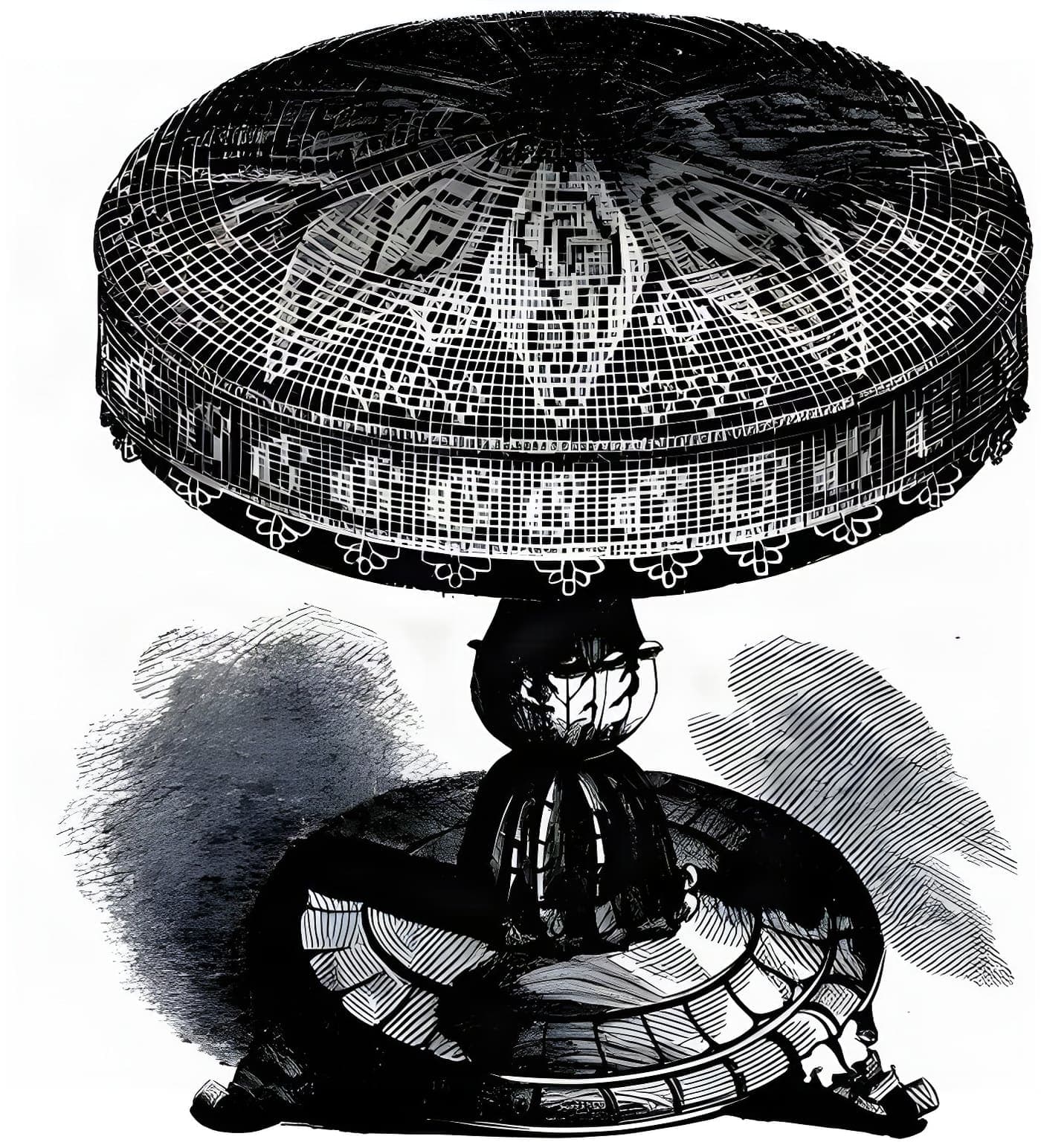
A Victorian round cover for the top of a music stool in Brooks' Goat's-head crochet cotton No. 8: an octagonal centre of solid dc sections, open squares and diminished points forming a pine pattern, with a separate 26-repeat square-crochet band and a scalloped edging.
By the crochetpatterns.io editorial team · Updated · Editorial policy · pattern testing in progress
| Detail | Value |
|---|---|
| Skill level | Advanced |
| Yarn weight | Lace (#0) |
| Yardage | As printed: eight reels (reel length not printed). |
| Hook | 1.25 mm |
| Gauge | Not printed. Work to the size of the article. |
| Finished size | Not printed. The centre is worked to fit the top of the stool; the band is a ring of 624 chain (208 squares, 26 pattern repeats). |
| Time | about 21 hours |
Materials
- White cotton crochet thread about size 8–10 (period: Brooks' Goat's-head Crochet Cotton No. 8), eight reels as printed
- Tapestry needle for weaving in ends
- Hook: Start with a 1.25 mm (US steel 8) hook and adjust to suit your thread; the book names only “crochet hook, No. 18”, and no gauge is printed.
Yarn Kit & Substitution Options
This pattern calls for 350 yards of weight #0 yarn. Select a suggested yarn to see required skeins and estimated cost:
Caron Simply Soft · 100% Acrylic
315 yds per skein · High-yield yardage, silky no-scratch texture
2 skeins required
approx. $$10.98 total
Abbreviations (US terms)
- chain
- slip stitch
- single crochet
- double crochet
- treble crochet
- double crochet two together
- stitch
- stitches
- round
- repeat
- skip
- loop
- beginning
Notes before you start
- Source: "The Pine Couvrette, for a Music Stool, in Crochet", The Ladies' Work-Book, John Cassell, La Belle Sauvage Yard, Ludgate Hill, London (no year printed). Public domain in the USA.
- As printed — materials: Eight reels of Brooks' Goat's-head Crochet Cotton, No. 8; crochet hook, No. 18.. Gauge: Not given.
- Modernisation note: Stitch names converted to modern US terms strictly by the book's own crochet lesson: “chain” / “ch.” = ch; “slip” / “slip-stitch” = sl st; “single crochet” / “s.c.” = sc; “double crochet” / “double” / “d.c.” = dc; “treble crochet” / “treble” / “t.c.” = tr; “long treble” / “long t.c.” = dtr; “long” / “l.” = dc (one wrap, from the book's “double long … twisting the cotton twice”); “open square” = dc, ch 2, sk 2; “close square” = 3 dc; “diminished” / “contracted” stitch = dc2tog; “miss” = sk; “loop” (of a chain or row) = st. In this book “double crochet” means the same stitch as the modern US dc, and “single crochet” the modern sc.
- Modernisation note: Period wording modernised: “needle” written as “hook”; “commence” as “begin”; “unite” / “close into a round” as “join into a ring”; “round loop” as “ring”; “receipt” as “directions”; “scollop” as “scallop”. Round and row numbers are kept as printed.
- Modernisation note: Printed paragraphs split into one step per round, row or instruction; no stitches, counts or rows added, removed or reordered. Words in square brackets or marked “Check:” are ours, and the printed wording is quoted wherever a reading was needed.
- Modernisation note: Brooks' Great Exhibition Prize Goat's-head Crochet Cotton (and its Knitting Cord) was a period English cotton sold by number; the lower the number, the thicker the cotton. Its numbers do not match modern crochet-thread sizes exactly; the modern size given is an approximate equivalent only.
- Modernisation note: The book's hook “No. 18” is not a Penelope number; no conversion is printed. The modern hook is an approximate suggestion only.
- Modernisation note: No yardage is printed and none is estimated.
- Modernisation note: Check: Rnd 5 is printed “X ch., miss 3 ch.” with the number of chain missing; ch 3 is read from Rnd 4 and the Rnd 6 description (“divided by a chain of three”).
- Modernisation note: Check: Rnd 7 says 10 dc over the 7, but working “2 d.c. on the first and last” as in Rnd 6 gives 9; increase evenly to 10.
- Modernisation note: Check: Rnd 17 is printed “4 ch. on 4”; read as 4 dc on 4.
- Modernisation note: Check: Rnd 38 is printed “** 1 close, 3 open, * twice”, with unmatched repeat marks; read as (1 closed, 3 open) twice.
- Modernisation note: Check: from Rnd 24 the octagon is worked in sections with dc2tog at the points; the counts per section are not printed, so compare each round with the engraving.
- Modernisation note: Check: the edging's last line, “Fasten to the round with a row of s.c., taking a stitch of each”, is kept as printed; it seems to mean a row of sc joining the edging to the band edge.
- Modernisation note: The engraving is referred to where the book says so; the directions themselves are complete enough to work from, but placement and joining of separate pieces follow the illustration.
Row progress: 0 of 7 done (0%)
Stitches
0 of 7 done- Single crochet, “s.c.” (book's definition): “Having a loop on the needle, insert the hook in a stitch, and draw the thread through in a loop. You then have two on the hook; draw the thread through both at once.” = sc.Mark row complete
- Double crochet, “d.c.” (book's definition): “Twist the thread round the hook before inserting it in the stitch, through which you draw the thread in a loop. Three loops being then on the needle, draw the thread through two, and then through the one just formed and the remaining one.” = dc.Mark row complete
- Treble crochet, “t.c.”, and long treble, “long t.c.” (book's definition): “worked in the same manner; in the former the thread is put twice, in the latter three times, round the hook, before inserting it into the stitch.” = tr and dtr.Mark row complete
- To pass from one round to another without breaking the thread (book): “see whether a s.c., d.c., or t.c. stitch begins the next; for s.c. make one chain, for d.c. three, for t.c. four; slip the needle out, and twist the chain, then continue working. This twisted chain will have all the appearance of a d.c. or t.c. stitch.” = a beginning ch 1 / ch 3 / ch 4 that counts as the first st.Mark row complete
- Square crochet (book's definition): “An open square consists of one d.c., two ch.—missing two on the line beneath, before making the next stitch. A close square has three successive d.c.” = open square: dc, ch 2, sk 2; closed square: 3 dc in consecutive sts (a filet block). “A number of chains divisible by three, leaving one over” is needed for the foundation.Mark row complete
- To contract an edge / diminished stitch (book's definition): “Having twisted the thread round the needle as often as the stitch may require, insert it in the work, and half-do a stitch. Instead of completing it, again twist the thread round, until the same number of loops are on, and work a stitch completely. Thus, for two stitches taken in the work, there is only one head.” = for d.c., a dc2tog.Mark row complete
- Repeat marks (book): asterisks, crosses and daggers mark repeats — “in every row or round, if one of any kind is used, a second, similar one, is sure to be found; and that the repetition occurs between the two”. Written here with *…* and (…).Mark row complete
Working on:
Single crochet, “s.c.” (book's definition): “Having a loop on the needle, insert the hook in a stitch, and draw the thread through in a loop. You then have two on the hook; draw the thread through both at once.” = sc.
Continue this pattern
The rest of the Pine Couvrette for a Music Stool (Victorian) pattern is in the Heirloom Doilies & Tablecloths
Still to come in the full pattern:
- How every round begins and ends (book's note)
- Centre
- Band
- Edging
- Finishing
Included with 236 patterns for $19 — $0.08 per pattern.
Errata
No corrections have been published for this pattern. Found a mistake? Tell us and we will log the fix here with a date.
Your notes on this pattern
Keep track of the yarn, hook and changes you used. Saved in this browser only — nobody else can see it.
Frequently asked questions
Where is the The Pine Couvrette, for a Music Stool, in Crochet pattern from?
It was published as "The Pine Couvrette, for a Music Stool, in Crochet" in The Ladies' Work-Book by John Cassell, La Belle Sauvage Yard, Ludgate Hill, London (no year printed). The publication is in the public domain in the United States; this version is transcribed and modernised by crochetpatterns.io.
What yarn or thread do I need for the The Pine Couvrette, for a Music Stool, in Crochet?
Cotton crochet thread about size 8–10 (period: Brooks' No. 8). As printed: eight reels (reel length not printed).
What hook should I use?
Start with a 1.25 mm (US steel 8) hook and adjust to suit your thread; the book names only “crochet hook, No. 18”, and no gauge is printed. Gauge: Not printed. Work to the size of the article.