Free preview · full pattern in the Heirloom Doilies & Tablecloths
Serviette for Cruet-Stand with Forget-me-nots (1850): vintage crochet pattern
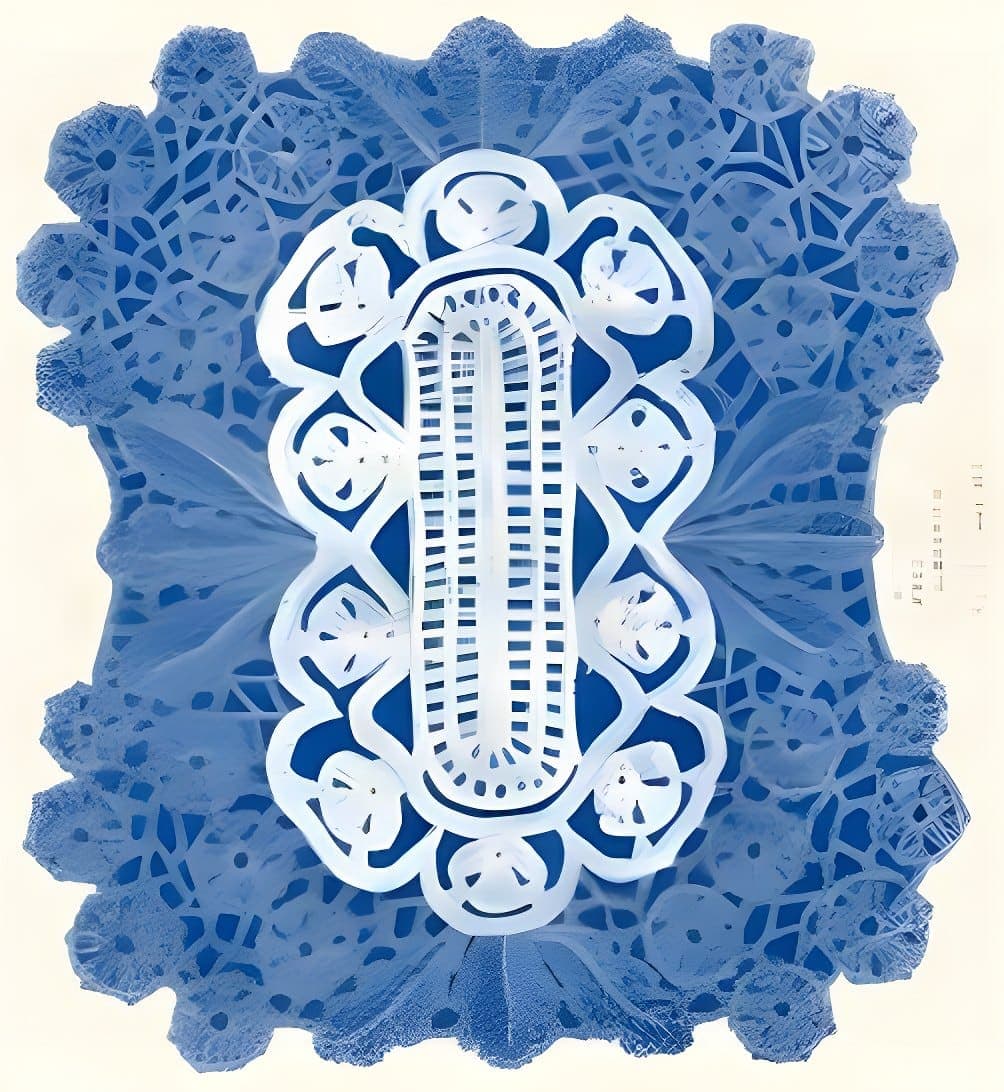
An oval mat for a cruet stand in shaded rose crochet-thread (or white Raworth's No. 30), with a scalloped border and an appliquéd centre of 27 crocheted forget-me-nots and 12 leaves in drab. Originally published as "Serviette for Cruet-Stand" in The Lady's Album of Fancy Work for 1850 by Not printed (the Address names only “the Publishers of.
By the crochetpatterns.io editorial team · Updated · Editorial policy · pattern testing in progress
| Detail | Value |
|---|---|
| Skill level | Advanced |
| Yarn weight | Lace (#0) |
| Yardage | Not printed. (as printed; yardage not given) |
| Hook | 1.3 mm |
| Gauge | Not printed. Work to the size of the article. |
| Finished size | Not printed (worked on a 30-ch foundation). |
| Time | about 7 hours |
Materials
- Cotton crochet thread about size 30 (period: Raworth's No. 30): either all white, or three shades of rose pink and one of drab
- Paper for a pattern; sewing needle and matching thread for the buttonhole stitch and making up
- Tapestry needle for weaving in ends
- Hook: Start with a 1.3 mm (US steel 9) hook and adjust to suit your thread; no gauge is printed.
Yarn Kit & Substitution Options
This pattern calls for 350 yards of weight #0 yarn. Select a suggested yarn to see required skeins and estimated cost:
Caron Simply Soft · 100% Acrylic
315 yds per skein · High-yield yardage, silky no-scratch texture
2 skeins required
approx. $$10.98 total
Abbreviations (US terms)
- chain
- slip stitch
- single crochet
- double crochet
- treble crochet
- double treble crochet
- stitch
- stitches
- round
- repeat
- skip
- loop
Notes before you start
- Source: "Serviette for Cruet-Stand", The Lady's Album of Fancy Work for 1850, Not printed (the Address names only “the Publishers of the Lady's Album of Fancy-Work”), 1850. Public domain in the USA.
- As printed — materials: Raworth's crochet-thread No. 30, or three shades of rose and one of drab crochet-thread. Gauge: Not given.
- Modernisation note: Stitch names converted to modern US terms strictly by the book's own “Explanation of the Various Terms used in Crochet”, not by modern UK usage: “double crochet” / “close double crochet” / “d c” = sc; “single crochet” / “single” / “s c” = sl st; “long stitch” / “long” / “l s” = dc; “double long stitch” / “d l s” = tr; “treble long stitch” / “t l s” = dtr; “chain” / “c s” = ch; “single open crochet” = dc, ch 1, sk 1; “chain-stitch open crochet” = ch loops (5 or another odd number) joined into every 3rd st, then into the centre of each loop below; “three chain crochet” = the same with ch-3 loops; “miss” = sk; “unite” = join (the joining stitch is not named). Note that the book's “double crochet” is a modern sc and its “single crochet” a modern sl st.
- Modernisation note: Period wording modernised: “needle” / “tambour-needle” written as “hook”; “commence” as “begin”; “cotton” / “thread” as “thread”; “receipt” as “directions”. Round and row numbers are kept as printed.
- Modernisation note: Printed paragraphs split into one step per row, round or instruction; no stitches, counts or rows added, removed or reordered. Words in square brackets or marked “Check:” are ours.
- Modernisation note: Raworth's crochet-thread (and Manlove's) was a period English cotton sold by number; the numbers do not match modern crochet-thread sizes exactly. The modern size given is an approximate equivalent only.
- Modernisation note: No hook size and no gauge is printed. The modern starting hook is an approximate suggestion only.
- Modernisation note: No yardage is printed and none is estimated.
- Modernisation note: Colour swatches are approximate modern readings of the period colour names; they are not in the book. “Drab” is a dull greyish brown; “puce” a dark purplish brown; “cerise” a deep cherry pink; “geranium” a bright scarlet-pink.
- Modernisation note: The engraving (illustration) is referred to as a guide; the directions are complete enough to work from, but stitch counts per repeat are not always printed.
- Modernisation note: Check: Rnd 4 “5 single” is converted strictly by the book's definition (single crochet = sl st); a sl st adds no height, so compare with the engraving — sc may have been meant.
- Modernisation note: Check: Rnd 5 is very compressed. It is not stated exactly which sl st the ch-5 is joined to, nor whether the group (sl st … sl st) is worked into the ring formed; the engraving shows a scallop over each ch-11.
- Modernisation note: Check: in the leaf, “1 single long” is read as one long stitch (dc); it may instead mean 1 sl st followed by 1 dc.
- Modernisation note: Check: “repeat four times more” for the forget-me-not is read as 5 petals in all.
- Modernisation note: Check: the book does not say whether Rnds 6 and 7 use the darkest rose throughout, nor which shade is the “second”; with the white-only option all parts are white except the drab flowers.
Row progress: 0 of 5 done (0%)
Stitches
0 of 5 done- Double crochet (book's definition): “having made a chain, pass the needle through the first loop on the chain, draw the cotton through the loop, there will now be two loops on the needle, through these draw the cotton.” = single crochet (sc). “Close double crochet” = sc worked in every st with no chain between.Mark row complete
- Single crochet (book's definition): “Insert the needle in the loops, and draw the cotton through this loop and that on the needle.” = slip stitch (sl st). The book's “single” on its own means this stitch.Mark row complete
- Long stitch (book's definition): “Twist the cotton round the needle, pass it through the loop, draw the cotton through the first two loops on the needle, then catch the cotton again and draw it through the next two loops; there will be one loop left on the needle.” = double crochet (dc).Mark row complete
- Double long stitch (book's definition): “This resembles long stitch, excepting that the cotton is twisted twice round the needle.” = treble crochet (tr).Mark row complete
- Treble long stitch (book's definition): “Twist the cotton three times round the needle.” = double treble crochet (dtr).Mark row complete
Working on:
Double crochet (book's definition): “having made a chain, pass the needle through the first loop on the chain, draw the cotton through the loop, there will now be two loops on the needle, through these draw the cotton.” = single crochet (sc). “Close double crochet” = sc worked in every st with no chain between.
Continue this pattern
The rest of the Serviette for Cruet-Stand with Forget-me-nots (1850) pattern is in the Heirloom Doilies & Tablecloths
Still to come in the full pattern:
- Serviette
- Forget-me-nots (make 27)
- Leaves (make 12)
- Finishing
Included with 236 patterns for $19 — $0.08 per pattern.
Errata
No corrections have been published for this pattern. Found a mistake? Tell us and we will log the fix here with a date.
Your notes on this pattern
Keep track of the yarn, hook and changes you used. Saved in this browser only — nobody else can see it.
Frequently asked questions
Where is the Serviette for Cruet-Stand pattern from?
It was published as "Serviette for Cruet-Stand" in The Lady's Album of Fancy Work for 1850 by Not printed (the Address names only “the Publishers of the Lady's Album of Fancy-Work”) in 1850. The publication is in the public domain in the United States; this version is transcribed and modernised by crochetpatterns.io.
What yarn or thread do I need for the Serviette for Cruet-Stand?
Cotton crochet thread about size 30 (period: Raworth's No. 30). Not printed.
What hook should I use?
Start with a 1.3 mm (US steel 9) hook and adjust to suit your thread; no gauge is printed. Gauge: Not printed. Work to the size of the article.