Free preview · full pattern in the Heirloom Doilies & Tablecloths
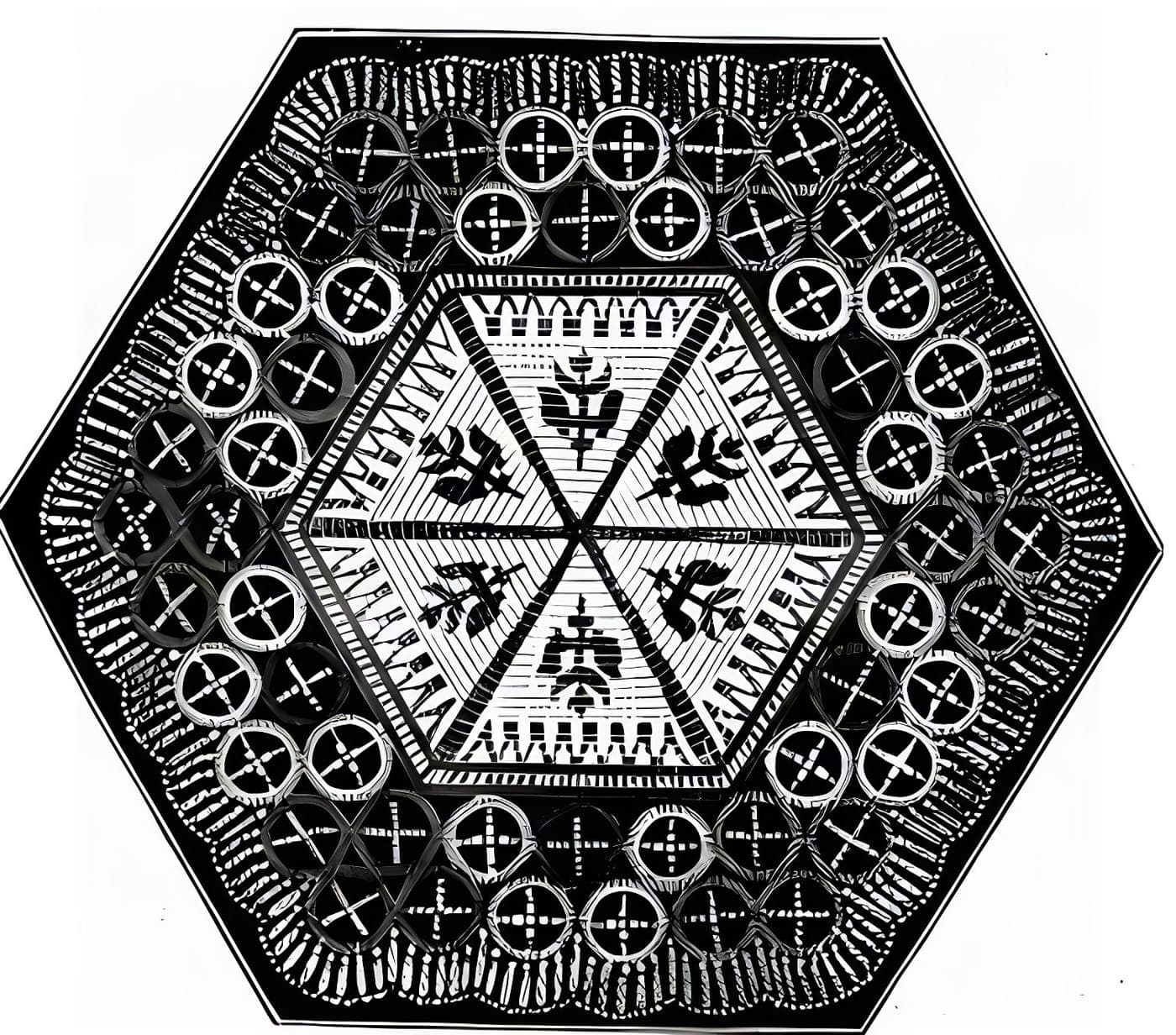
Hexagonal Lamp Mat in Cerise and White Silk (Victorian): vintage crochet pattern
A Victorian hexagonal lamp mat of white and four shades of cerise netting silk, worked in single crochet over fine cotton cord, bordered with 54 silk-covered rings crossed with steel beads and bugles, and a fringe of long steel bugles.
By the crochetpatterns.io editorial team · Updated · Editorial policy · pattern testing in progress
| Detail | Value |
|---|---|
| Skill level | Advanced |
| Yarn weight | Lace (#0) |
| Yardage | As printed: 6 skeins white and 3 skeins of each of four cerise shades (skein length not printed). |
| Hook | 0.75 mm |
| Gauge | Not printed. Work to the size of the article. |
| Finished size | Not printed. The centre is a hexagon of 26 rounds; the ring border and bugle fringe are added round it. |
| Time | about 10 hours |
Materials
- Silk thread about the thickness of size 20–30 crochet cotton (period: netting silk): 6 skeins white and 3 skeins each of four shades of cerise, from almost brown to bright cerise, as printed
- Rather large silver-grey or steel seed beads (one hank), short square bugle beads (one string), and ½ in (13 mm) fluted bugle beads (1 oz / 28 g)
- One skein of fine white cotton cord to work over
- 54 small rings to cover (size not printed)
- Beading needle and strong thread for the fringe; tapestry needle
- Hook: Start with a 0.75 mm (US steel 14) hook and adjust to suit your silk and cord; the book names a “tapered, indented crochet-hook, No. 22”, and no gauge is printed.
Yarn Kit & Substitution Options
This pattern calls for 350 yards of weight #0 yarn. Select a suggested yarn to see required skeins and estimated cost:
Caron Simply Soft · 100% Acrylic
315 yds per skein · High-yield yardage, silky no-scratch texture
2 skeins required
approx. $$10.98 total
Abbreviations (US terms)
- single crochet
- stitch
- stitches
- round
- repeat
Notes before you start
- Source: "Lamp Mat, in Crochet", The Ladies' Work-Book, John Cassell, La Belle Sauvage Yard, Ludgate Hill, London (no year printed). Public domain in the USA.
- As printed — materials: 6 skeins of white netting silk, and 3 skeins each of four shades of cerise ditto, the darkest being almost brown, and the lightest a rich and brilliant cerise.; A hank of rather large steel beads, a string of short square steel bugles, and 1 oz. of fluted ditto, 1/2 inch long.; A skein of rather fine white cotton cord, and 54 rings.; Tapered, indented crochet-hook, No. 22.. Gauge: Not given.
- Modernisation note: Stitch names converted to modern US terms strictly by the book's own crochet lesson: “chain” / “ch.” = ch; “slip” / “slip-stitch” = sl st; “single crochet” / “s.c.” = sc; “double crochet” / “double” / “d.c.” = dc; “treble crochet” / “treble” / “t.c.” = tr; “long treble” / “long t.c.” = dtr; “long” / “l.” = dc (one wrap, from the book's “double long … twisting the cotton twice”); “open square” = dc, ch 2, sk 2; “close square” = 3 dc; “diminished” / “contracted” stitch = dc2tog; “miss” = sk; “loop” (of a chain or row) = st. In this book “double crochet” means the same stitch as the modern US dc, and “single crochet” the modern sc.
- Modernisation note: Period wording modernised: “needle” written as “hook”; “commence” as “begin”; “unite” / “close into a round” as “join into a ring”; “round loop” as “ring”; “receipt” as “directions”; “scollop” as “scallop”. Round and row numbers are kept as printed.
- Modernisation note: Printed paragraphs split into one step per round, row or instruction; no stitches, counts or rows added, removed or reordered. Words in square brackets or marked “Check:” are ours, and the printed wording is quoted wherever a reading was needed.
- Modernisation note: Period purse silk, netting silk and crochet silk have no exact modern equivalent; a silk (or fine mercerised) thread about the thickness of size 20–30 crochet cotton is suggested. “Ombré” silk is shaded from light to dark along the strand; “gold thread” was a metallic gold thread.
- Modernisation note: Period bead descriptions (“steel”, “rather larger than seed beads”, “No. 5”, “No. 6”) have no exact modern equivalent. Choose small seed beads (about size 11/0–8/0) whose hole will take the thread doubled through the needle; steel beads can be replaced with silver-grey or gunmetal seed beads. Check: approximate.
- Modernisation note: The book's “tapered, indented crochet-hook, No. 22” was a fine steel hook sold by number; no conversion is printed. The modern hook is an approximate suggestion only.
- Modernisation note: No yardage is printed and none is estimated.
- Modernisation note: Colour swatches are approximate modern readings of the period colour names; they are not in the book. “Cerise” is a deep cherry pink; “maize” a soft yellow; “stone-colour” and “drab” pale greyish browns; “slate” a blue-grey.
- Modernisation note: Check: Rnd 1 is kept as printed (“8 s.c. on the end of the cord, and form into a round, after which 6 s.c. to secure it”); the book does not say whether the 6 sc are worked into the ring or over the cord end.
- Modernisation note: Check: Rnd 7 is printed “3 on the centre one of 5” without a colour; cerise is read from Rnd 9 (“3 cerise on centre of 5”).
- Modernisation note: Check: “Change to the next shade of cerise” is printed after Rnds 8 and 12, and the lightest shade is named at Rnd 16; the shade for Rnds 24–26 is not named.
- Modernisation note: Check: no ring size is printed; choose rings that sit neatly along a side of the finished hexagon, as in the engraving.
Row progress: 0 of 3 done (0%)
Stitches
0 of 3 done- Single crochet, “s.c.” (book's definition): “Having a loop on the needle, insert the hook in a stitch, and draw the thread through in a loop. You then have two on the hook; draw the thread through both at once.” = sc.Mark row complete
- To work over cord (book): “Hold it in the left hand, with the work, and work round it, as you would if it were merely an end of thread. The stitches must, however, be sufficiently close to cover it entirely.”Mark row complete
- To work with several colours (book): “Hold the threads not in use along the edge of the work, and work them in. When the colour is to be changed, begin the stitch with the old colour, and complete it with the new, which continue to work with, holding the other in.” = carry the unused strands inside the stitches and change colour on the last yo of the stitch before (tapestry crochet).Mark row complete
Working on:
Single crochet, “s.c.” (book's definition): “Having a loop on the needle, insert the hook in a stitch, and draw the thread through in a loop. You then have two on the hook; draw the thread through both at once.” = sc.
Continue this pattern
The rest of the Hexagonal Lamp Mat in Cerise and White Silk (Victorian) pattern is in the Heirloom Doilies & Tablecloths
Still to come in the full pattern:
- Centre
- Rings
- Finishing
Included with 236 patterns for $19 — $0.08 per pattern.
Errata
No corrections have been published for this pattern. Found a mistake? Tell us and we will log the fix here with a date.
Your notes on this pattern
Keep track of the yarn, hook and changes you used. Saved in this browser only — nobody else can see it.
Frequently asked questions
Where is the Lamp Mat, in Crochet pattern from?
It was published as "Lamp Mat, in Crochet" in The Ladies' Work-Book by John Cassell, La Belle Sauvage Yard, Ludgate Hill, London (no year printed). The publication is in the public domain in the United States; this version is transcribed and modernised by crochetpatterns.io.
What yarn or thread do I need for the Lamp Mat, in Crochet?
Silk thread about size 20–30 (period: netting silk). As printed: 6 skeins white and 3 skeins of each of four cerise shades (skein length not printed).
What hook should I use?
Start with a 0.75 mm (US steel 14) hook and adjust to suit your silk and cord; the book names a “tapered, indented crochet-hook, No. 22”, and no gauge is printed. Gauge: Not printed. Work to the size of the article.