Free preview · full pattern in the Heirloom Doilies & Tablecloths
Simple Little Doily in Carpet Warp (1914): vintage crochet pattern
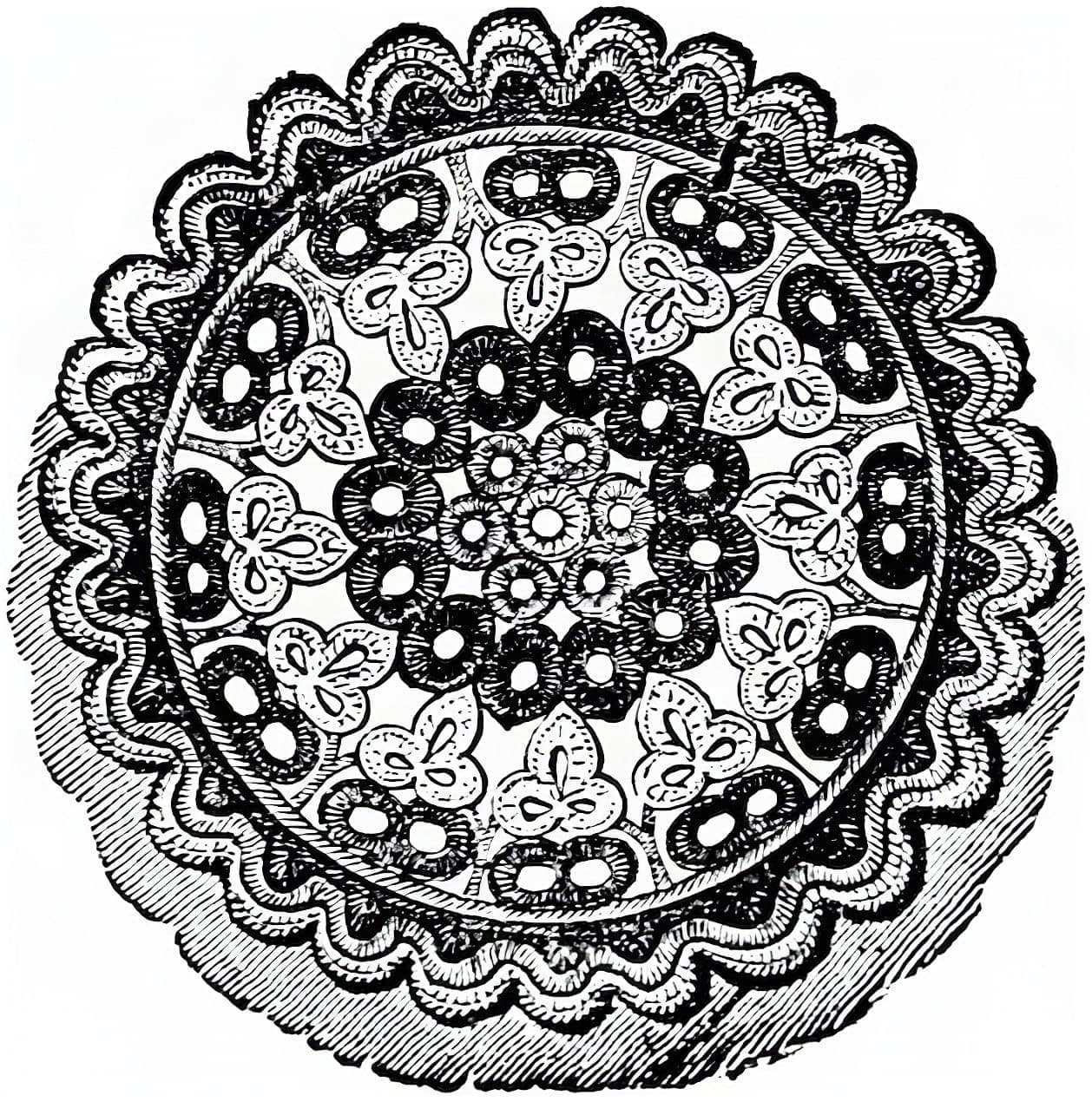
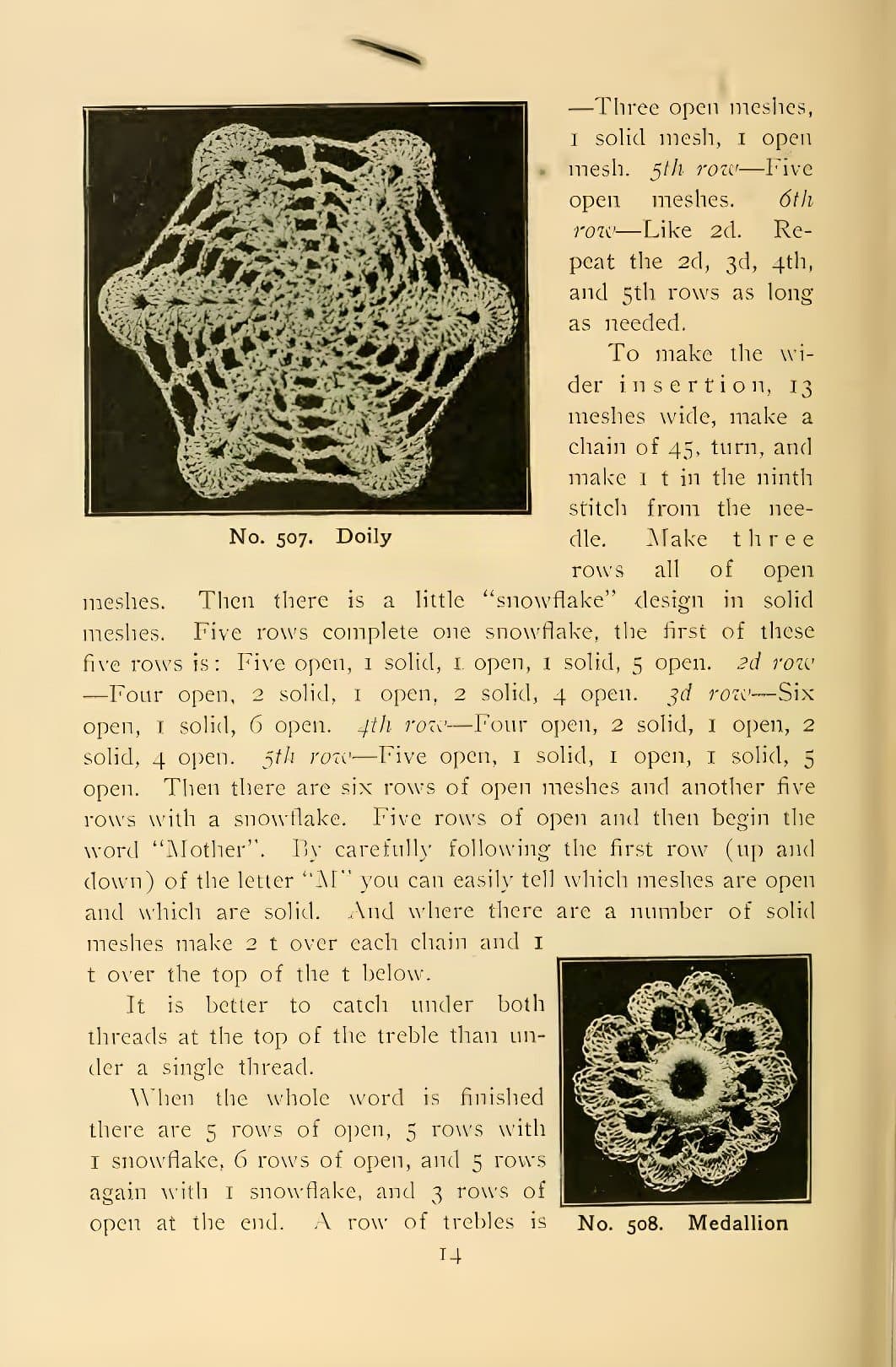
A small six-pointed doily of carpet warp worked from a ring in rounds of trebles, with shells that grow every round into six fan-shaped points. Originally published as "Doily" in Priscilla Juniors' Crochet Book (Belle Robinson) by The Priscilla Publishing Co., Boston in 1914, it is now in the public domain.
By the crochetpatterns.io editorial team · Updated · Editorial policy · pattern testing in progress
| Detail | Value |
|---|---|
| Skill level | Easy |
| Yarn weight | Super fine (#1) |
| Yardage | Not printed. (as printed; yardage not given) |
| Hook | 2 mm |
| Gauge | No stitch gauge printed. Printed check: nearly 5 in (12.5 cm) across when finished. |
| Finished size | Nearly 5 in (12.5 cm) across, as printed. |
| Time | about 4 hours |
Materials
- Cotton rug (carpet) warp — colour not stated
- Tapestry needle
- Hook: Start with 2 mm (US steel 2) — approximate; the doily should measure nearly 5 in (12.5 cm) across
Yarn Kit & Substitution Options
This pattern calls for 350 yards of weight #1 yarn. Select a suggested yarn to see required skeins and estimated cost:
Knit Picks Stroll Sock · 75% Superwash Merino, 25% Nylon
231 yds per skein · Durable stitch definition, machine washable
2 skeins required
approx. $$13.98 total
Abbreviations (US terms)
- chain
- slip stitch
- double crochet
- stitch
- round
- repeat
- shell
- chain space
Notes before you start
- Source: "Doily" (No. 507), Priscilla Juniors' Crochet Book (Belle Robinson), The Priscilla Publishing Co., Boston, 1914. Public domain in the USA.
- As printed — materials: carpet warp; crochet-needle No. 5. Gauge: Not given.
- Modernisation note: Stitches converted by the book's own definitions (pages 3–6), not by name: chain stitch (“ch”) = ch; slip stitch (“sl” — “made with the needle in the loop, a loop pulled through the work and through the loop on the needle”) = sl st; double crochet (“d” — “made with the needle in the loop, a loop drawn through the work and another loop drawn through both”) = modern US single crochet (sc); treble crochet (“t” — “another loop over the needle, a loop drawn through the work (making three loops on the needle), then a loop is drawn through two on the needle, leaving two loops on the needle; another loop drawn through these two finishes the treble”) = modern US double crochet (dc); double treble crochet (“d t” — “two loops over the needle, one loop drawn through the work, when there will be four loops on the needle”, then worked off two at a time three times) = modern US treble crochet (tr). The 1914 names are one step taller than modern US names (they match modern UK usage), so every printed “d” is written sc, every “t” dc and every “d t” tr.
- Modernisation note: The book's words and letters are written as modern US abbreviations: ch = ch, sl = sl st, d = sc, t = dc, d t = tr; “needle”, “crochet-needle” or “hook” = hook; “thread over needle (hook)” = yo; “draw thread through (the work)” = draw up a lp; “miss” = sk; “over ch” or “over each chain” = in the ch-sp; “fasten the thread” = fasten off; ordinal names (“1st row”, “2d round”) = Row 1, Rnd 2. Repeats between stars are written “*… ; rep from *” as printed; the book's own rule: “When you see the little stars before and after any directions, whether long or short, the work directed is to be repeated once, or more times.”
- Modernisation note: The book's running paragraphs are split into one row, round or step per line; stitch order and counts unchanged. Section headings added for navigation. Cross-references to other pages of the book are replaced by the stitch lesson itself, copied at the start of the design.
- Modernisation note: Hooks are printed as 1914 steel crochet-needle numbers (the book: “from No. 1 (a very large hook, almost as large as a medium-size bone hook) to No. 14, which is very fine”) or as bone, rubber and amber hooks of “small” or “medium” size, with no diameters. The modern hook given is an approximate starting point only, chosen for the thread or yarn and tied to any printed measurement.
- Modernisation note: No stitch gauge is printed anywhere in the book; work a swatch and match any printed finished measurement.
- Modernisation note: Period threads are 1914 trade descriptions with no exact modern equivalent; modern choices are approximate. Pearl cotton Nos. 3, 5 and 8 are the same numbering as modern perle cotton; Cordonnet Nos. 2, 30 and 50 are given as the nearest modern crochet-thread sizes; carpet warp is modern cotton rug warp; soft knitting cotton has no printed thickness and is suggested by the hook the book pairs with it.
- Modernisation note: Yardage is never printed; the book gives balls, skeins, spools or hanks only (or nothing), so no yardage is estimated.
- Modernisation note: Check: the beginning ch-5 of Rnds 2–4 and ch-8 of Rnd 8 probably count as the first dc plus chains; the book does not say.
- Modernisation note: Check: Rnd 4 is printed “* 4 t between 2 t, ch 2, 1 t over t, 2 ch, 4 t between 2 t, 2 ch *”, which names two shells per repeat, although Rnd 3 makes one pair of dc per repeat (six in all, giving six points). Work one shell of 4 dc between each pair of dc from Rnd 3 and 1 dc over each single dc, with ch 2 between, following the photograph.
- Modernisation note: Check: Rnds 5–7 shells are worked into the shell below; the placement of the extra dc is not stated.
- Modernisation note: Joining at the end of Rnds 5–8 and fastening off are not printed; the finishing step is ours.
- Modernisation note: Metric conversions added.
Row progress: 0 of 3 done (0%)
Stitches (the book's lessons)
0 of 3 done- Chain (ch), the book's lesson: the hook, first through a loop, is caught under the thread over your left forefinger, and catching a loop there it is pulled back through the loop on the hook. Repeat as long as the chain is to be made.Mark row complete
- Slip stitch (sl st; the book's “sl”): with the hook in the loop, pull a loop through the work and through the loop on the hook. A single sl st is often made to fasten tightly.Mark row complete
- Double crochet (dc; the book's “treble crochet”, “t”): yo, insert the hook, draw a loop through the work (3 lps on hook); draw a loop through 2 lps (2 lps on hook); draw another loop through these 2. When starting a row of dc, ch 3 to bring the hook to the top of the row.Mark row complete
Working on:
Chain (ch), the book's lesson: the hook, first through a loop, is caught under the thread over your left forefinger, and catching a loop there it is pulled back through the loop on the hook. Repeat as long as the chain is to be made.
Continue this pattern
The rest of the Simple Little Doily in Carpet Warp (1914) pattern is in the Heirloom Doilies & Tablecloths
Still to come in the full pattern:
- Doily
- Finishing
Included with 236 patterns for $19 — $0.08 per pattern.
Errata
No corrections have been published for this pattern. Found a mistake? Tell us and we will log the fix here with a date.
Your notes on this pattern
Keep track of the yarn, hook and changes you used. Saved in this browser only — nobody else can see it.
Frequently asked questions
Where is the Doily pattern from?
It was published as "Doily" in Priscilla Juniors' Crochet Book (Belle Robinson) by The Priscilla Publishing Co., Boston in 1914. The publication is in the public domain in the United States; this version is transcribed and modernised by crochetpatterns.io.
What yarn or thread do I need for the Doily?
super fine (#1) yarn. Not printed.
What hook should I use?
Start with 2 mm (US steel 2) — approximate; the doily should measure nearly 5 in (12.5 cm) across Gauge: No stitch gauge printed. Printed check: nearly 5 in (12.5 cm) across when finished.