Free preview · full pattern in the Heirloom Doilies & Tablecloths
Violet Doily (1950): vintage crochet pattern
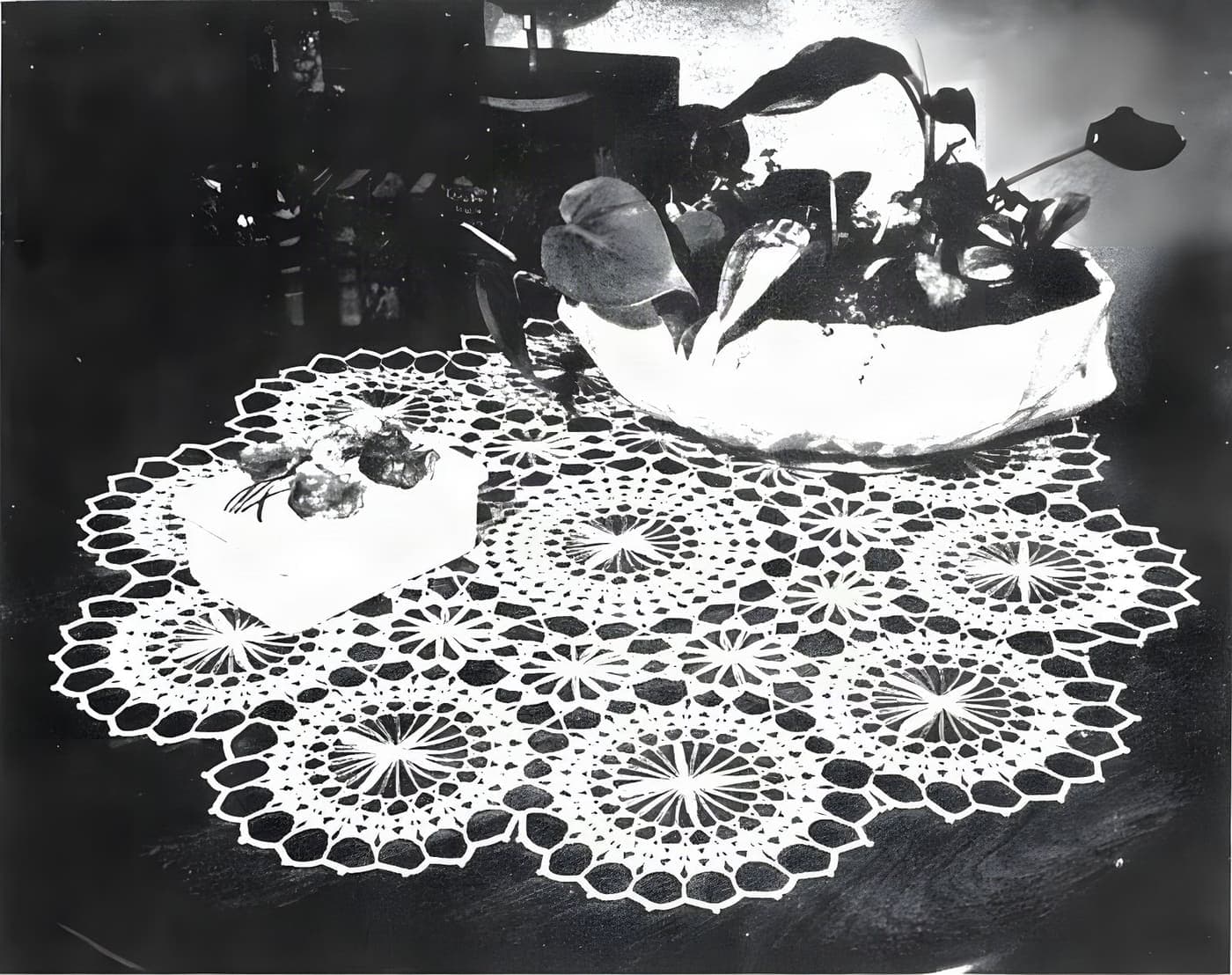
Eighteen five-petalled violets with yellow centres, worked petal by petal in shaded lavender and joined tip to tip in a ring round either of the book's two lace centres. Originally published as "Violet Doilies" in Doily Bouquet (Star Book No. 71) by American Thread Company in 1950, it is now in the public domain.
By the crochetpatterns.io editorial team · Updated · Editorial policy · pattern testing in progress
| Detail | Value |
|---|---|
| Skill level | Advanced |
| Yarn weight | Lace (#0) |
| Yardage | 1 or 2 balls of each colour as printed; ball yardage is not printed. |
| Hook | 1.65 mm |
| Gauge | Not given in the original — work to the finished size printed for your thread. |
| Finished size | 7–11 inches (18–28 cm) across: 11 in (28 cm) in "Puritan", "De Luxe" or "Star" Pearl Cotton size 5; 10 in (25 cm) in "Sillateen Sansil"; 9 in (23 cm) in "Gem" or "Star" Crochet Cotton size 30; 7 in (18 cm) in "Star" Tatting Cotton. |
| Time | about 15 hours |
Materials
- Cotton crochet thread in a shaded lavender, Yellow, Green and White — size 30 where the original names a size (size 20 is the nearest widely stocked weight); size 5 pearl cotton for that line
- Ball counts as printed above for the thread you choose
- Tapestry needle; rustproof pins and starch for blocking
- Hook: The book prints a steel hook number beside each thread: No. 7 (about 1.65 mm), No. 10 (about 1.3 mm), No. 12 (about 1.0 mm), No. 13 (about 0.85 mm). Start with the modern US steel hook of the number printed for the thread you buy and change size until the piece reaches the size printed for that thread.
Yarn Kit & Substitution Options
This pattern calls for 350 yards of weight #0 yarn. Select a suggested yarn to see required skeins and estimated cost:
Caron Simply Soft · 100% Acrylic
315 yds per skein · High-yield yardage, silky no-scratch texture
2 skeins required
approx. $$10.98 total
Abbreviations (US terms)
- chain
- slip stitch
- single crochet
- double crochet
- treble crochet
- stitch
- stitches
- space
- skip
- loop
- round
- row
- increase
- decrease
- cluster
Notes before you start
- Source: "Violet Doilies", Doily Bouquet (Star Book No. 71), American Thread Company, 1950. Public domain in the USA.
- As printed — materials: "GEM" Crochet Cotton Article 35, Size 30 — 1 Ball Shaded Lavenders, 1 Ball Yellow, 1 Ball Green, 1 Ball White — approx. 9 inches — Steel 12; "PURITAN" Crochet Cotton Article 40 — same colours — approx. 11 inches — Steel 7; "DE LUXE" Crochet Cotton Article 346 — same colours — approx. 11 inches — Steel 7; "STAR" Crochet Cotton Article 20, Size 30 — same colours — approx. 9 inches — Steel 12; "STAR" Crochet Cotton Article 30, Size 30 — same colours — approx. 9 inches — Steel 12; "SILLATEEN SANSIL" Article 102 — same colours — approx. 10 inches — Steel 10; "STAR" Tatting Cotton Article 25 — 2 Balls Shaded Lavenders, 2 Balls White, 1 Ball Green, 1 Ball Yellow — approx. 7 inches — Steel 13; "STAR" Pearl Cotton Article 90, Size 5 — same colours — approx. 11 inches — Steel 7. Gauge: Not given.
- Modernisation note: The book prints no abbreviation list. It defines each stitch inline instead, in brackets where it is first used, and by those definitions its terms are already modern US terms: s c = sc, d c = dc, s d c = half double crochet (hdc), tr c = tr, d tr c (3 times over needle) = dtr, tr tr c (4 times over needle) = a triple treble worked with 4 yarn-overs. No stitch has been converted; only the spacing of the letters changes, and "thread over" is written "yo".
- Modernisation note: The original calls every round a "Row" ("2nd Row—"). Pieces worked round and round are labelled "Rnd" here and pieces worked back and forth keep "Row". Run-on paragraphs were split so there is one round, row or step per line. No stitch was added, removed or reordered.
- Modernisation note: The two "Basic Centers" are printed once at the front of the book and shared by four of its doilies, with a note that all four borders fit either one. Both are reprinted in full here so this pattern can be worked from one page.
- Modernisation note: Pick one centre: 18 violets joined singly round Basic Center No. 1, or five groups of three violets round Basic Center No. 2. The two joinings are alternatives, not a sequence.
- Modernisation note: The violet is worked as one round for the yellow centre and then petal by petal in rows; the row numbering runs on through all five petals, which is why the 8th row ends by repeating from the asterisk in row 2.
- Modernisation note: The "rice st" is defined in full inside the second joining and left as printed.
- Modernisation note: Several joinings are given as "as illustrated" — the original relies on its photograph for the exact placement rather than counting it out. Those phrases are kept as printed; work from the photograph included with this pattern.
- Modernisation note: No gauge is printed anywhere in the book. The printed finished size for the thread you choose is the only check on tension.
- Modernisation note: Thread is printed in balls only — no yardage is given for any article number, so none has been supplied. Buy the printed number of balls of a comparable modern thread and check your ball band.
- Modernisation note: "Gem" (Article 35), "Puritan" (Article 40), "De Luxe" (Article 346), "Star" (Articles 20 and 30), "Star" Tatting Cotton (Article 25), "Star" Pearl Cotton (Article 90) and "Sillateen Sansil" (Article 102) are all discontinued. Where a thread size is printed it is repeated above; where it is not, match the printed finished size instead of guessing a size.
- Modernisation note: Metric conversions and the modern thread and hook suggestions were added; they are not in the original.
Row progress: 0 of 7 done (0%)
Violets (make 18)
0 of 7 done- Rnd 1: VIOLET: With Yellow ch 6, join to form a ring, ch 1 and work 10 sc in ring, join, break thread.Mark row complete
- Row 2: Attach Shaded Lavenders, * 2 sc in each of the next 2 sc of 1st row, ch 1 to turn all rows.Mark row complete
- Row 3: 1 sc in each sc.Mark row complete
- Rows 4 and 5: Increase 1 sc at beginning and end of row (6 sc). Work 1 row even.Mark row complete
- Rows 6 and 7: Decrease 1 sc at beginning of each row, ch 2, turn.Mark row complete
- Row 8: 1 dc in each of the next 3 sc leaving last loop of each dc on hook, yo and pull through all loops at one time, ch 3, sl st in base of same row, sl st in each row down side of petal, repeat from * until there are 5 petals, join in base of 1st petal, break thread.Mark row complete
- Work 2nd violet in same manner joining tip of 1 petal to tip of any petal of 1st violet. To join: ch 2, sl st in tip of previous violet, ch 2, sl st in same space on violet being made. Work 16 more violets joining to petal of previous violet leaving 1 petal free at lower edge and 2 petals free at top between joinings.Mark row complete
Working on:
Rnd 1: VIOLET: With Yellow ch 6, join to form a ring, ch 1 and work 10 sc in ring, join, break thread.
Continue this pattern
The rest of the Violet Doily (1950) pattern is in the Heirloom Doilies & Tablecloths
Still to come in the full pattern:
- Basic Center No. 1
- Joining to Basic Center No. 1
- Basic Center No. 2
- Joining to Basic Center No. 2
- Finishing
Included with 236 patterns for $19 — $0.08 per pattern.
Errata
No corrections have been published for this pattern. Found a mistake? Tell us and we will log the fix here with a date.
Your notes on this pattern
Keep track of the yarn, hook and changes you used. Saved in this browser only — nobody else can see it.
Frequently asked questions
Where is the Violet Doilies pattern from?
It was published as "Violet Doilies" in Doily Bouquet (Star Book No. 71) by American Thread Company in 1950. The publication is in the public domain in the United States; this version is transcribed and modernised by crochetpatterns.io.
What yarn or thread do I need for the Violet Doilies?
Size 30 cotton crochet thread where a size is printed (size 20 is the nearest common substitute); size 5 pearl cotton for that line. 1 or 2 balls of each colour as printed; ball yardage is not printed.
What hook should I use?
The book prints a steel hook number beside each thread: No. 7 (about 1.65 mm), No. 10 (about 1.3 mm), No. 12 (about 1.0 mm), No. 13 (about 0.85 mm). Start with the modern US steel hook of the number printed for the thread you buy and change size until the piece reaches the size printed for that thread. Gauge: Not given in the original — work to the finished size printed for your thread.