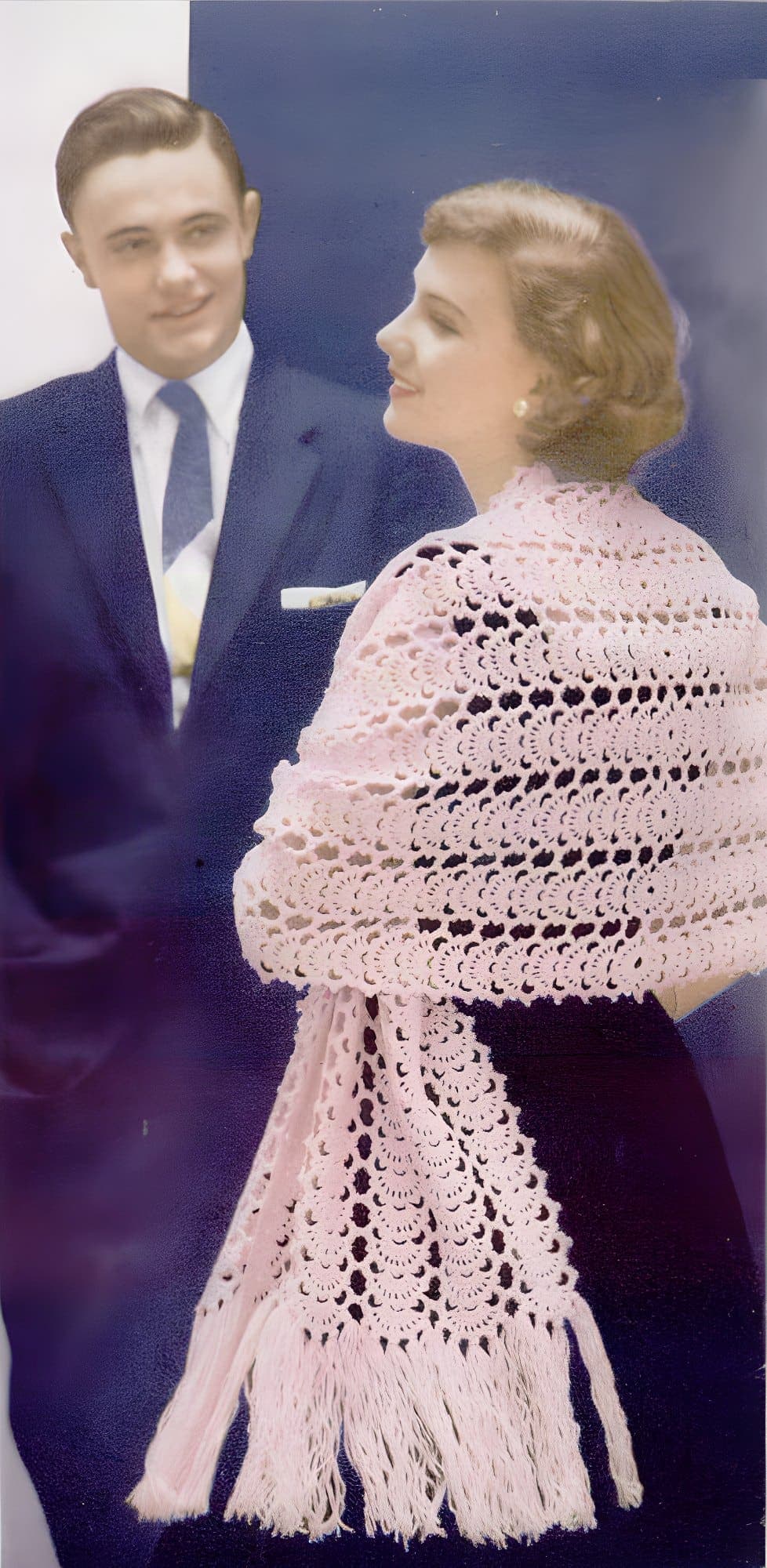
Free preview · full pattern in the Vintage Crochet Stoles & Shawls
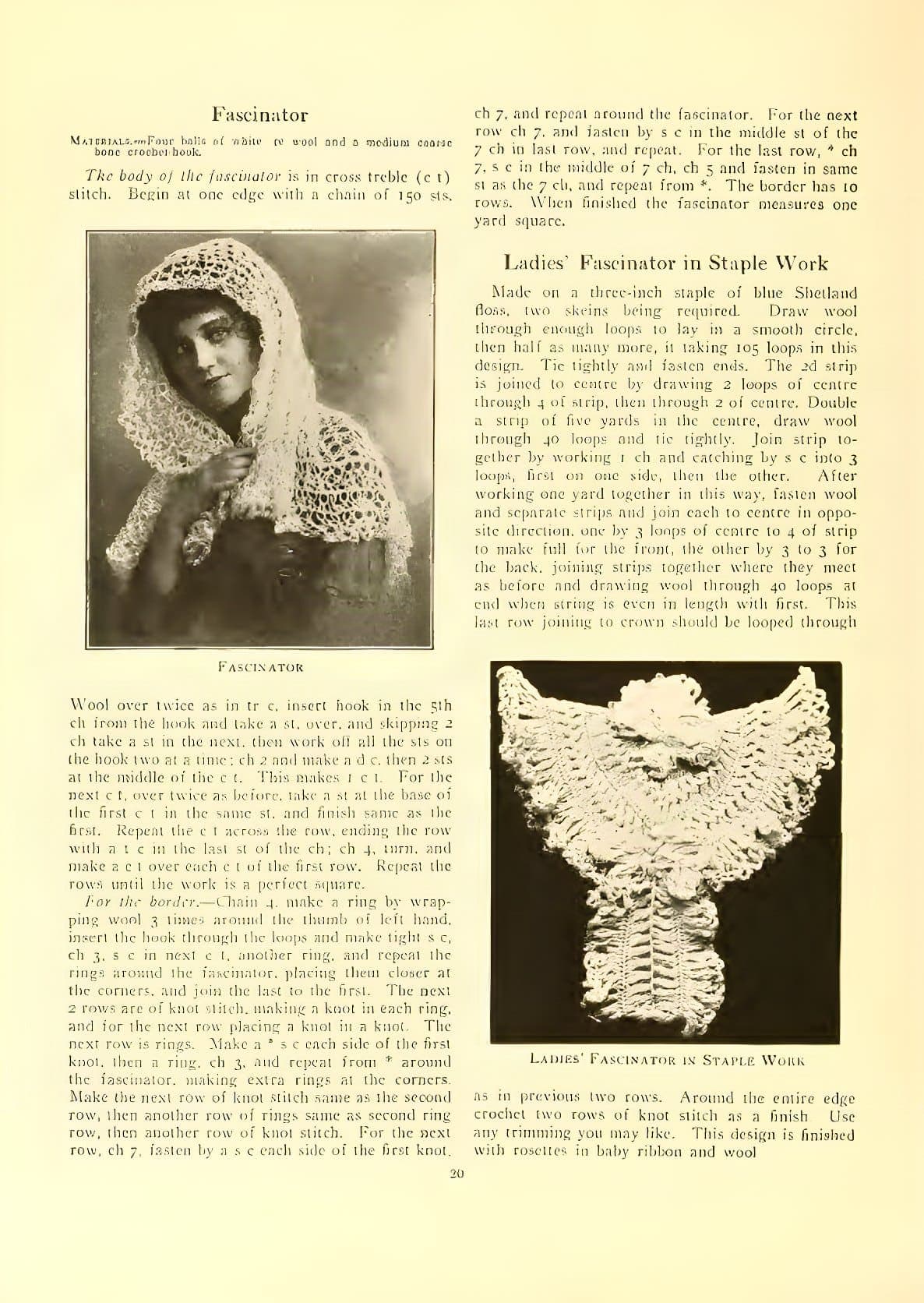
Fascinator in Cross Treble with Ring and Knot-Stitch Border (1912): vintage crochet pattern
A square white ice-wool fascinator (head scarf) worked in rows of cross treble stitch, with a deep ten-row border of wound rings, knot stitch and chain loops. Originally published as "Fascinator" in Priscilla Wool Crochet Book (ed. Lola Burks Hettich) by The Priscilla Publishing Company, Boston in 1912, it is now in the public domain.
By the crochetpatterns.io editorial team · Updated · Editorial policy · pattern testing in progress
| Detail | Value |
|---|---|
| Skill level | Advanced |
| Yarn weight | Super fine (#1) |
| Yardage | the book gives 4 balls of ice wool; ball weight and yardage are not stated. (as printed; yardage not given) |
| Hook | 4 mm |
| Gauge | No stitch gauge printed. Printed check: finished size 1 yd (0.9 m) square. |
| Finished size | As printed: 1 yd (0.9 m) square when finished, including the border. |
| Time | about 6 hours |
Materials
- Super fine (CYC #1) fine lustrous wool or wool-blend yarn — approximate; the original was 4 balls of white ice wool (ball weight and length not printed)
- Crochet hook (original: medium coarse bone hook)
- Tapestry needle
- Hook: Start with 4 mm (US G-6) — approximate; a coarse hook is printed for an open fabric. Check that the finished fascinator will reach the printed 1 yd (0.9 m) square
Yarn Kit & Substitution Options
This pattern calls for 350 yards of weight #1 yarn. Select a suggested yarn to see required skeins and estimated cost:
Knit Picks Stroll Sock · 75% Superwash Merino, 25% Nylon
231 yds per skein · Durable stitch definition, machine washable
2 skeins required
approx. $$13.98 total
Abbreviations (US terms)
- chain
- single crochet
- double crochet
- treble crochet
- stitch
- stitches
- skip
- yarn over
- loop
- repeat
- row
Notes before you start
- Source: "Fascinator", Priscilla Wool Crochet Book (ed. Lola Burks Hettich), The Priscilla Publishing Company, Boston, 1912. Public domain in the USA.
- As printed — materials: Four balls of white ice wool and a medium coarse bone crochet-hook. Gauge: Not given.
- Modernisation note: Stitches converted by the book's own “Explanation of Stitches”, not by name: chain stitch (ch st, “make a series of loops, drawing each loop through the preceding one”) = ch; slip stitch (sl st, “insert the hook into the stitch, draw the wool through that stitch and through the wool on hook at the same time”) = sl st; single crochet (s c, “insert the hook, draw wool through, pass wool around hook (wool over), and draw it through both loops on the hook”) = sc; double crochet (d c, wool around the hook, insert, draw through, then through 2 loops twice) = dc; half double crochet (h d c, wool around the hook, insert, draw through, then “through all 3 loops at once”) = hdc; treble crochet (t c or tr c, wool around the hook twice, insert, draw through, then through 2 loops three times) = tr. For these stitches the 1912 American names already match modern US usage, so no stitch changes height. The book's long crochet (l c: wool around the hook, insert, draw through, then through 1 loop, then through 2 loops twice) is the modern extended double crochet; where used it is written “long crochet” with that definition.
- Modernisation note: The book's abbreviations are written in modern US form: ch st = ch, s c = sc, d c = dc, h d c = hdc, t c / tr c = tr, st(s) = st(s), “wool over” / “thread over” / “pass the wool around the hook” = yo; “miss” = sk; loop = lp; “repeat” = rep; “beginning” = beg. “Widen” is written as increase and “narrow” as decrease, as defined in each design. Ordinal row names (“1st row”, “2d row”) are written Row 1, Row 2; where the book calls a circuit of a round piece a “row” the book's word is kept. “Plain” (a row or round with no increases or decreases) is kept as printed.
- Modernisation note: Knot stitch is the book's own name for the long-loop single crochet mesh known today as Solomon's knot or love knot; its definition is quoted as the first step of each design that uses it. As the book says, “some crocheters refer to it as knot stitch, and others to knot stitch as just half the group”; the book's word “group” (2 knots) is kept.
- Modernisation note: Long printed paragraphs are split into one row, round or step per line; stitch order and counts unchanged. Section headings added for navigation.
- Modernisation note: Hooks are printed as bone hooks described only as fine, medium-sized or coarse, or by an unstated numbering system, with no diameters, so no exact metric size can be read from the book. The suggested modern hook is an approximate starting point chosen for the yarn weight and tied to any printed measurement.
- Modernisation note: No stitch gauge is printed for this design; work a swatch and match any printed measurement (given in the modern gauge line) before starting.
- Modernisation note: The yarns are 1912 trade descriptions with no exact modern equivalent, and the book prints no yardage or skein/ball weights except where quoted in the materials. The CYC weights given are approximations only: Saxony (a fine, firm yarn) and 2-ply (single) zephyr as super fine (CYC #1); ice wool (a very fine, lustrous yarn) as super fine (CYC #1); Shetland floss (a soft, lofty yarn) and eiderdown wool as fine (CYC #2) — lofty yarns and to be matched by gauge or measurement rather than by weight; 4-ply (split) zephyr, 4-fold Germantown and Spanish yarn as light (CYC #3); 8-fold Germantown and knitting worsted as medium (CYC #4).
- Modernisation note: The book's cross treble (c t) is defined inside the directions; its definition is placed first. “Take a st” is written “draw up a lp”. It is close to the modern crossed treble (an X-shaped stitch whose second leg is made with ch 2 and a dc into the crossing).
- Modernisation note: Check: “ch 2 and make a d c, then 2 sts at the middle of the c t” is read as working the dc into 2 threads at the middle (crossing) of the stitch just made; the book gives no more detail. Test on a swatch.
- Modernisation note: Check: “Border Rows 2 and 3” follow the book (“The next 2 rows are of knot stitch, making a knot in each ring, and for the next row placing a knot in a knot”); the book counts 10 border rows in all, so the row labels here are ours.
- Modernisation note: Finishing line (weaving in ends) added. Metric conversions added.
Row progress: 0 of 6 done (0%)
Body (cross treble)
0 of 6 done- Cross treble (the book's definition): Yo twice as in tr, insert the hook in the 5th ch from the hook and draw up a lp, yo, and skipping 2 ch draw up a lp in the next, then work off all the lps on the hook 2 at a time; ch 2 and make a dc, then 2 sts at the middle of the cross treble. This makes 1 cross treble.Mark row complete
- Next cross treble: Yo twice as before, draw up a lp at the base of the first cross treble in the same st, and finish the same as the first.Mark row complete
- Begin at one edge with a ch of 150 sts.Mark row complete
- Row 1: Rep the cross treble across the row, ending the row with a tr in the last st of the ch.Mark row complete
- Row 2: Ch 4, turn, and make a cross treble over each cross treble of the first row.Mark row complete
- Rep Row 2 until the work is a perfect square.Mark row complete
Working on:
Cross treble (the book's definition): Yo twice as in tr, insert the hook in the 5th ch from the hook and draw up a lp, yo, and skipping 2 ch draw up a lp in the next, then work off all the lps on the hook 2 at a time; ch 2 and make a dc, then 2 sts at the middle of the cross treble. This makes 1 cross treble.
Continue this pattern
The rest of the Fascinator in Cross Treble with Ring and Knot-Stitch Border (1912) pattern is in the Vintage Crochet Stoles & Shawls
Still to come in the full pattern:
- Border (10 rows)
- Finishing
Included with 31 patterns for $12 — $0.39 per pattern.
Errata
No corrections have been published for this pattern. Found a mistake? Tell us and we will log the fix here with a date.
Your notes on this pattern
Keep track of the yarn, hook and changes you used. Saved in this browser only — nobody else can see it.
Frequently asked questions
Where is the Fascinator pattern from?
It was published as "Fascinator" in Priscilla Wool Crochet Book (ed. Lola Burks Hettich) by The Priscilla Publishing Company, Boston in 1912. The publication is in the public domain in the United States; this version is transcribed and modernised by crochetpatterns.io.
What yarn or thread do I need for the Fascinator?
super fine (#1) yarn. Not printed — the book gives 4 balls of ice wool; ball weight and yardage are not stated.
What hook should I use?
Start with 4 mm (US G-6) — approximate; a coarse hook is printed for an open fabric. Check that the finished fascinator will reach the printed 1 yd (0.9 m) square Gauge: No stitch gauge printed. Printed check: finished size 1 yd (0.9 m) square.