
Free preview · full pattern in the Vintage Crochet Edgings & Trims
Pineapple Pillowcase Edging #8118 (1951): vintage crochet pattern
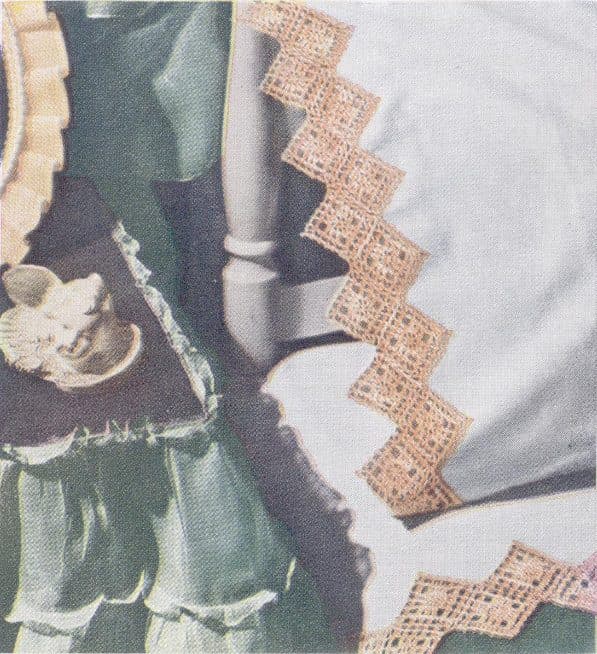
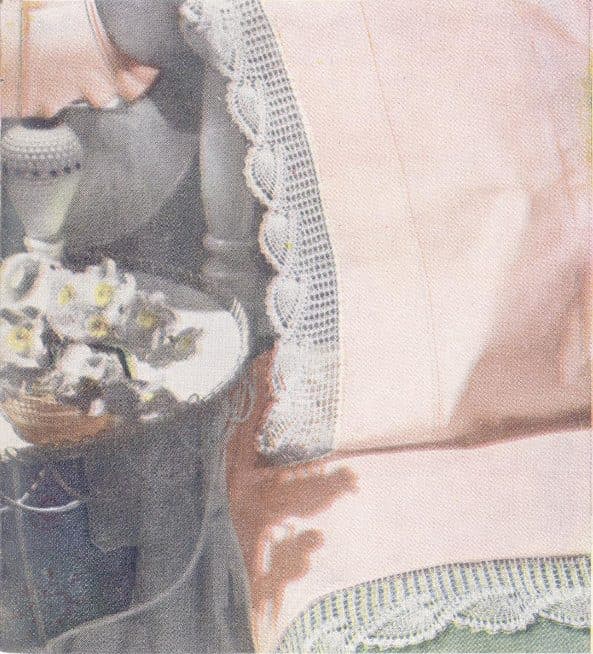
A straight lace edging worked in rows across its depth, with a mesh heading and a repeating pineapple between two shell columns, sewn to the hem of a pillowcase. Originally published as "Pineapple Pillow Case Edging" in Edgings: crocheted, tatted, hair pin lace (Star Book No. 81) by American Thread Company in 1951, it is now in the public domain.
By the crochetpatterns.io editorial team · Reviewed · Editorial policy
By the crochetpatterns.io editorial team · Reviewed September 14, 2026 under our editorial policy · pattern testing in progress
| Detail | Value |
|---|---|
| Skill level | Intermediate |
| Yarn weight | Lace (#0) |
| Yardage | 3 balls (Gem size 30) for a pair (as printed; yardage not given) |
| Hook | 1 mm |
| Gauge | Not given in the original. Suggestion: work one full 14-row repeat and measure its length; divide the pillowcase hem circumference by that length to find how many repeats you need. |
| Finished size | Not given in the original; worked lengthwise on a 37-chain foundation and repeated for the length of the pillowcase hem. |
| Time | about 6 hours |
Materials
- Size 30 crochet cotton, white — check the ball band for yardage
- 1.0 mm steel crochet hook
- A pair of pillowcases
- Sewing needle and thread
- Hook: Start with a 1.0 mm steel hook (the original No. 12) and change size to match the gauge
Abbreviations (US terms)
Notes before you start
- Source: "Pineapple Pillow Case Edging" (#8118), Edgings: crocheted, tatted, hair pin lace (Star Book No. 81), American Thread Company, 1951. Public domain in the USA.
- As printed — materials: “GEM” CROCHET COTTON Article 35, size 30 — 3 balls White or any color desired — steel 12; or “STAR” CROCHET COTTON Article 20, size 30 — 3 balls White or any color desired — steel 12; or “STAR” CROCHET COTTON Article 30, size 30 — 8 balls White or any color desired — steel 12; 1 pair Pillow Cases. Gauge: Not given.
- Modernisation note: Abbreviations respelled to modern US style using the leaflet's own abbreviation table: s c → sc, s d c (short double crochet) → hdc, d c → dc, tr c → tr, d tr c → dtr; “thread over” → “yarn over”. Stitches, order and counts are unchanged.
- Modernisation note: Instructions split into one row, round or step per line; the original prints them as running paragraphs.
- Modernisation note: Hook conversion: the leaflet uses the mid-century US steel hook numbering; the metric size given is the usual modern equivalent (No. 7 ≈ 1.65 mm, No. 11 ≈ 1.1 mm, No. 12 ≈ 1.0 mm, No. 13 ≈ 0.85 mm). Old hooks varied — match the gauge suggestion rather than the number.
- Modernisation note: Thread: the original Gem/Star crochet cottons are size 30; modern size 30 crochet cotton is still made. Ball yardage differs from the 1951 balls — check your ball band.
- Modernisation note: Shell is defined in the foundation row as “3 d c in next st, ch 2, 3 d c in next st”; later rows work “shell in shell” as printed.
- Modernisation note: Check: the 14th row ends “s c in center of next shell, ch 2, turn” — this is how the original prints the turn at the top of the pineapple; work it as written.
- Modernisation note: Finishing steps are our addition.
Rows
- Ch 37, 2 dc in 4th st from hook, ch 2, 3 dc in next st of ch, * ch 3, skip 3 sts of ch, 3 dc in next st, ch 2, 3 dc in next st (shell), repeat from * once, ch 1, skip 1 st of ch, dc in next st, * ch 3, skip 1 st of ch, sc in next st, ch 3, skip 1 st of ch, dc in next st, repeat from * 3 times, ch 2, dc in end st, ch 5, turn.
- 2nd Row—D c in next dc, * ch 3, dc in next dc, repeat from * 3 times, ch 1, dc in same space, ch 1, shell in shell, ch 3, 11 tr in next shell, ch 3, shell in shell, ch 4, turn.
- 3rd Row—Shell in shell, ch 3, sc between 1st 2 tr, * ch 4, sc between next 2 tr, repeat from * 8 times, ch 3, shell in shell, ch 1, dc in next single dc, ch 1, dc in next dc, * ch 3, sc in next mesh, ch 3, dc in next dc, repeat from * 3 times, ch 2, dc in 3rd st of ch, ch 5, turn.
- 4th Row—D c in next dc, * ch 3, dc in next dc, repeat from * 4 times, shell in shell, ch 3, sc in 1st loop of pineapple, * ch 4, sc in next loop, repeat from * 7 times, ch 3, shell in shell, ch 4, turn.
- 5th Row—Shell in shell, ch 3, sc in 1st loop of pineapple, * ch 4, sc in next loop, repeat from * 6 times, ch 3, shell in shell, ch 1, dc in next single dc, * ch 3, sc in next mesh, ch 3, dc in next dc, repeat from * 4 times, ch 2, dc in 3rd st of ch, ch 5, turn.
- 6th Row—D c in next dc, * ch 3, dc in next dc, repeat from * 4 times, ch 1, dc in same space, ch 1, shell in shell, ch 3, sc in 1st loop of pineapple, * ch 4, sc in next loop, repeat from * 5 times, ch 3, shell in shell, ch 4, turn.
- 7th Row—Shell in shell, ch 3, sc in 1st loop of pineapple, * ch 4, sc in next loop, repeat from * 4 times, ch 3, shell in shell, ch 1, dc in next dc, ch 1, dc in next dc, * ch 3, 1 sc in next mesh, ch 3, dc in next dc, repeat from * 4 times, ch 2, dc in 3rd st of ch, ch 5, turn.
- 8th Row—D c in next dc, * ch 3, dc in next dc, repeat from * 5 times, shell in shell, ch 3, sc in 1st loop of pineapple, * ch 4, sc in next loop, repeat from * 3 times, ch 3, shell in shell, ch 4, turn.
- 9th Row—Shell in shell, ch 3, sc in 1st loop of pineapple, * ch 4, 1 sc in next loop, repeat from * twice, ch 3, shell in shell, ch 1, dc in next dc, * ch 3, sc in next mesh, ch 3, dc in next dc, repeat from * 5 times, ch 2, dc in 3rd st of ch, ch 5, turn.
- 10th Row—D c in next dc, * ch 3, dc in next dc, repeat from * 5 times, ch 1, dc in same space, ch 1, shell in shell, ch 3, sc in 1st loop of pineapple, * ch 4, sc in next loop, repeat from * once, ch 3, shell in shell, ch 4, turn.
- 11th Row—Shell in shell, ch 3, sc in 1st loop of pineapple, ch 4, sc in next loop, ch 3, shell in shell, ch 1, dc in next single dc, ch 1, dc in next dc, * ch 3, sc in next mesh, ch 3, dc in next dc, repeat from * 5 times, ch 2, dc in 3rd st of ch, ch 5, turn.
- 12th Row—D c in next dc, * ch 3, dc in next dc, repeat from * 6 times, shell in shell, ch 3, sc in remaining loop of pineapple, ch 3, shell in shell, ch 4, turn.
- 13th Row—Shell in shell, ch 1, shell in next shell, ch 1, dc in next single dc, * ch 3, sc in next mesh, ch 3, dc in next dc, repeat from * 6 times, ch 2, dc in 3rd st of ch, ch 5, turn.
- 14th Row—D c in next dc, * ch 3, dc in next dc, repeat from * 6 times, ch 1, dc in same space, ch 1, shell in shell, ch 2, sc in center of next shell, ch 2, turn.
- 15th Row—Shell in shell, ch 3, skip 1 single dc, shell in next dc, ch 3, skip 1 dc, shell in next dc, ch 1, dc in next dc, * ch 3, sc in next mesh, ch 3, dc in next dc, repeat from * 3 times, ch 2, dc in 3rd st of ch, ch 5, turn.
- Repeat from 2nd row for length desired.
- Work a row of sc across top of edging. Sew to edge of pillow case. Work other pillow case in same manner.
Continue this pattern
The rest of the Pineapple Pillowcase Edging #8118 (1951) pattern is in the Vintage Crochet Edgings & Trims
Still to come in the full pattern:
- Finishing
Included with 18 patterns for $9 — $0.50 per pattern.
Errata
No corrections have been published for this pattern. Found a mistake? Tell us and we will log the fix here with a date.
Frequently asked questions
Where is the Pineapple Pillow Case Edging pattern from?
It was published as "Pineapple Pillow Case Edging" in Edgings: crocheted, tatted, hair pin lace (Star Book No. 81) by American Thread Company in 1951. The publication is in the public domain in the United States; this version is transcribed and modernised by crochetpatterns.io.
What yarn or thread do I need for the Pineapple Pillow Case Edging?
Size 30 crochet cotton. The original uses 3 balls (Gem size 30) for a pair; check your ball band.
What hook should I use?
Start with a 1.0 mm steel hook (the original No. 12) and change size to match the gauge Gauge: Not given in the original. Suggestion: work one full 14-row repeat and measure its length; divide the pillowcase hem circumference by that length to find how many repeats you need.