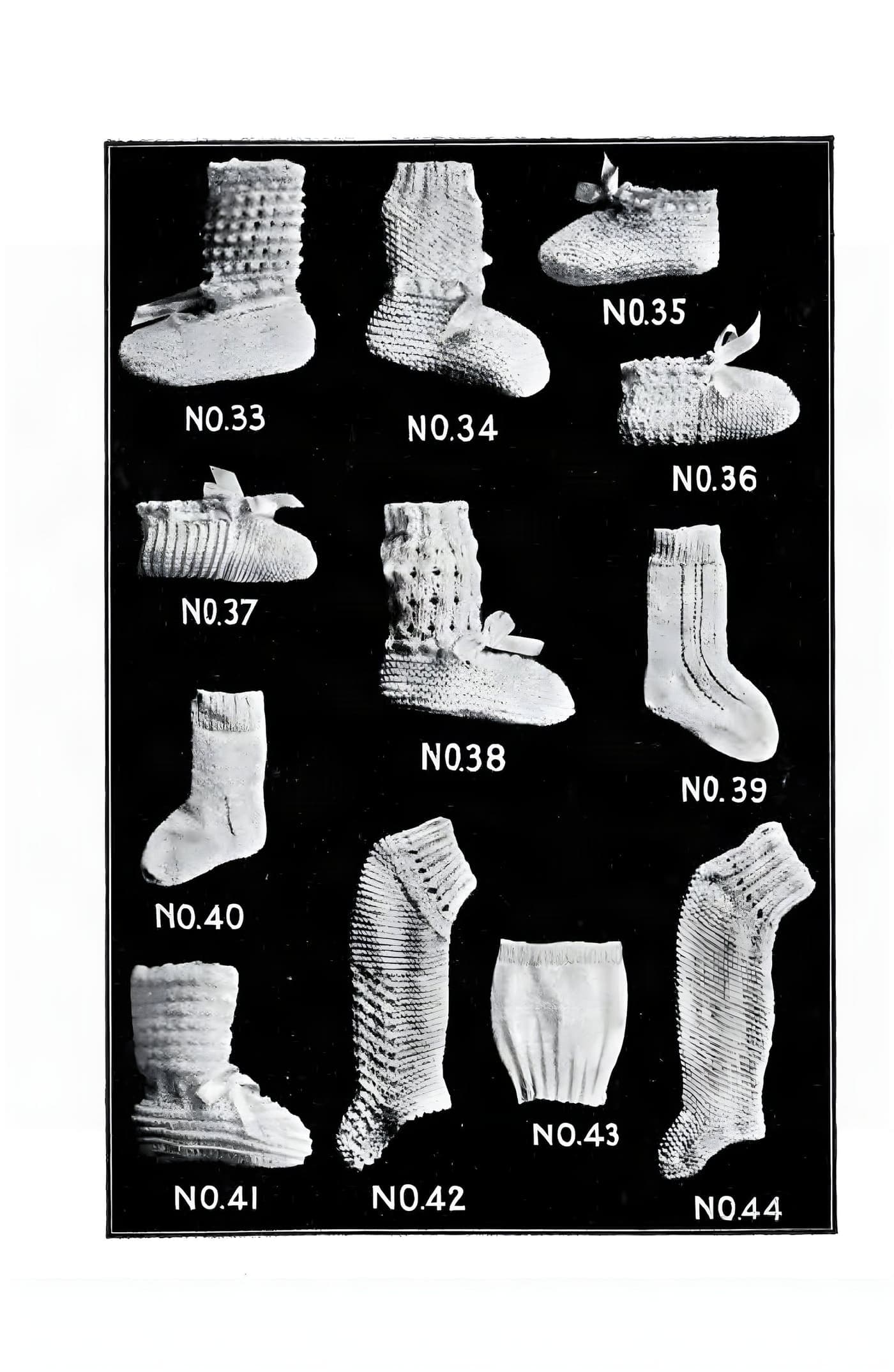
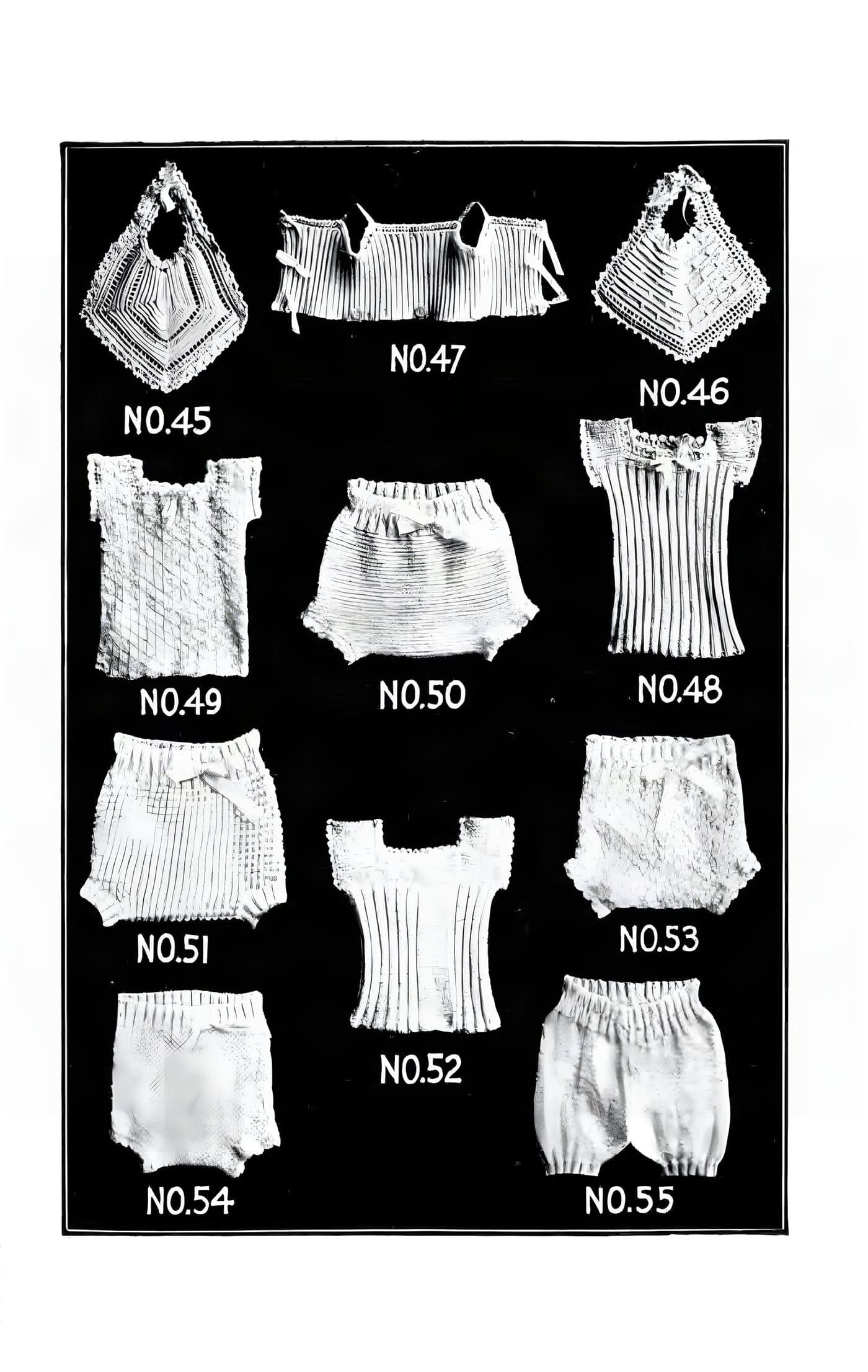
Free preview · full pattern in the Vintage Crochet Baby & Kids' Patterns
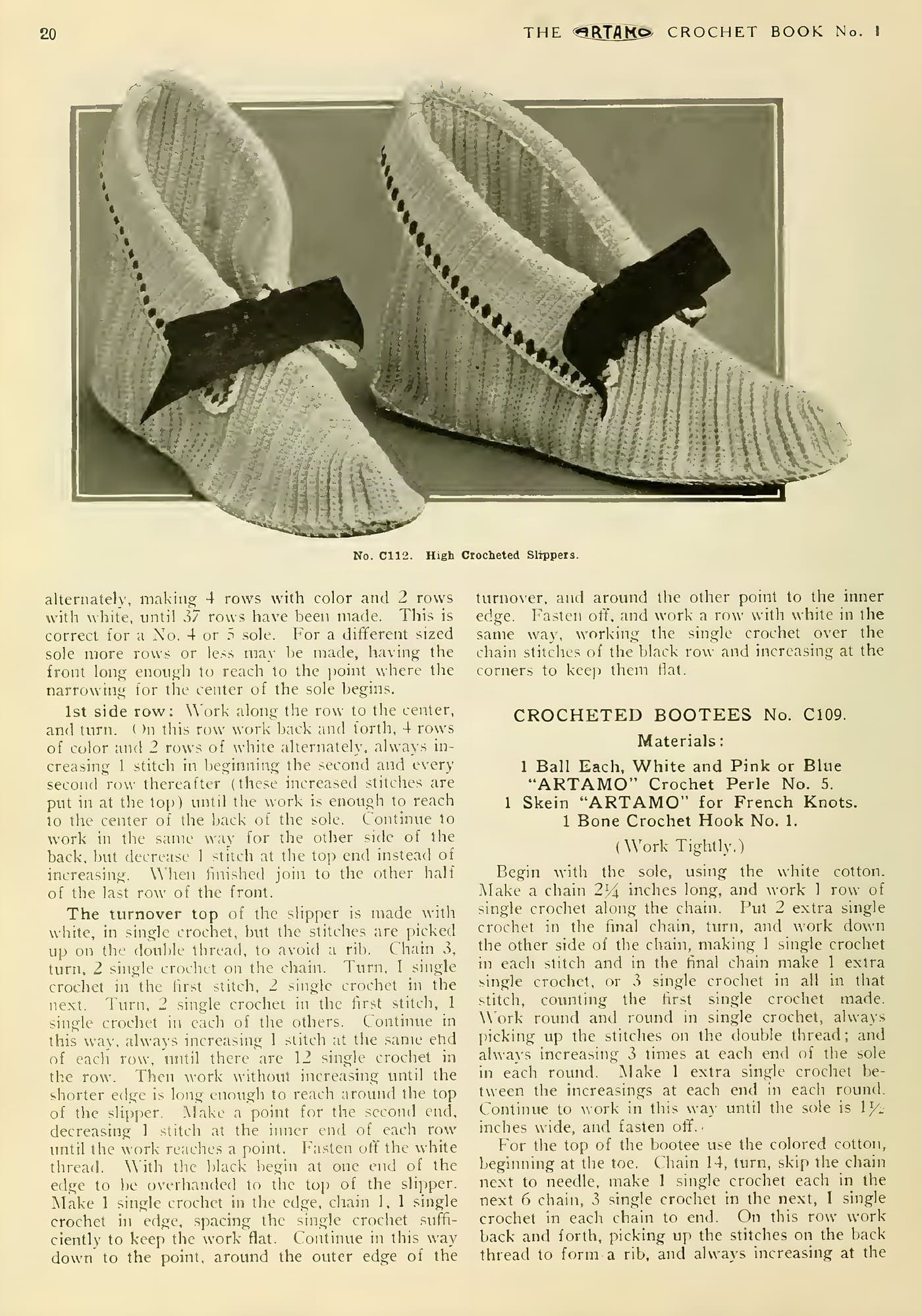
No. C109 Crocheted Bootees with French Knots (1916): vintage crochet pattern
Baby bootees worked tightly in single crochet: an oval sole worked round and round in white, a ribbed coloured front begun at the toe with a centre increase, a side strip carried round the back, and white bands finished with two rows of French knots.
By the crochetpatterns.io editorial team · Updated · Editorial policy · pattern testing in progress
| Detail | Value |
|---|---|
| Skill level | Intermediate |
| Yarn weight | Lace (#0) |
| Yardage | Not printed. The book prints a yardage for only one design in the whole volume, and not for this one. (as printed; yardage not given) |
| Hook | 5 mm |
| Gauge | No gauge printed; the book's only instruction on tension is “Work Tightly.” |
| Finished size | Not printed; the sole is worked from a chain 2 1/4 inches (6 cm) long until it is 1 1/2 inches (4 cm) wide. |
| Time | about 5 hours |
Materials
- Size 5 pearl (perle) cotton, white, 1 ball — approximate; the original was Artamo Crochet Perle No. 5
- Size 5 pearl (perle) cotton, pink or blue, 1 ball
- Six-strand cotton embroidery floss in a contrasting colour for the French knots — the original was 1 skein of Artamo
- Crochet hook (original: No. 1 bone hook)
- Tapestry needle
- Hook: Start with 5 mm (US H-8) — approximate and ours, since the old bone-hook numbers match no modern scale; the book says to work tightly, so go down a size if the fabric is open
Yarn Kit & Substitution Options
This pattern calls for 350 yards of weight #0 yarn. Select a suggested yarn to see required skeins and estimated cost:
Caron Simply Soft · 100% Acrylic
315 yds per skein · High-yield yardage, silky no-scratch texture
2 skeins required
approx. $$10.98 total
Abbreviations (US terms)
- chain
- single crochet
- stitch
- stitches
- round
- row
- repeat
- skip
- back loop only
- increase
Notes before you start
- Source: "Crocheted Bootees No. C109" (C109), The Artamo Crochet Book No. 1, Bentley-Franklin Company, New York, 1916. Public domain in the USA.
- As printed — materials: 1 Ball Each, White and Pink or Blue “ARTAMO” Crochet Perle No. 5.; 1 Skein “ARTAMO” for French Knots.; 1 Bone Crochet Hook No. 1.; (Work Tightly.). Gauge: Not given.
- Modernisation note: Stitches are converted by this book's own key (“The Rudimentary Stitches of Crochet”, book pages 2-3), not by name. The key defines: chain (ch); “single crochet (s. c.)”, sometimes called tight stitch or half stitch — draw up a loop and draw another loop through both loops on the needle, which is the modern US single crochet; “double crochet (d. c.)”, frequently called a plain — thread over, draw up a loop (3 loops on the needle), draw through 2, then draw through the 2 remaining, which is the modern US double crochet; “short double crochet” — thread over, draw up a loop, draw the thread through all 3 loops at once, which is the modern US half double crochet; “treble crochet (t or tr)” — thread over twice, draw up a loop (4 loops), then cast off 2 at a time three times, which is the modern US treble; “long treble crochet”, also called double treble in the directions — thread over three times and cast off 2 at a time until all loops are worked off, which is the modern US double treble; slip stitch, “sometimes called the quarter-stitch”. So throughout this transcription the book's s.c. = sc, d.c. = dc, short d.c. = hdc, t/tr = tr and long treble/double treble = dtr. This book's heights already match modern US usage, so no shift of names was needed.
- Modernisation note: The book's wording is written in modern US form: “needle” = hook; “thread over (the needle)” = yo; “skip” = sk; “pick up a loop” = draw up a loop; “narrow” = decrease; “widen” = increase; “picked up on the double thread” = worked under both loops; “picked up on the back thread” = worked in the back loop only; “join in a ring” = sl st to join into a ring. Ordinal row and round names (“1st row”, “2nd round”) are written Row 1, Rnd 2 and so on.
- Modernisation note: Long printed paragraphs are split into one row, round or step per line; stitch order and counts are unchanged. Section headings added for navigation.
- Modernisation note: “Artamo” was a brand of cotton sold by the publisher and described on the book's back cover: Cordonnet, a six-cord crochet cable cord for crochet and lace making, in sizes 3, 5, 10, 15, 20, 30, 40, 50, 60, 70, 80 and 100; Crochet Perle, in white and fast colours, in sizes 3 and 5; and Four-Ply, four fine strands loosely twisted together, for embroidery. The modern equivalents given here are approximations only: Artamo Cordonnet reads as modern six-cord mercerized cotton crochet thread of the same number, Artamo Crochet Perle as modern pearl (perle) cotton of the same number, and Artamo Four-Ply as modern six-strand cotton embroidery floss. Sizes 15 and 25 are no longer commonly made; the nearest modern sizes are noted where they occur.
- Modernisation note: Hooks are printed only as “Steel Crochet Hook No. …” or “Bone Crochet Hook No. …” with no diameters, so no exact metric size can be read from the book. The metric sizes given are approximate starting points read across to the modern US steel-hook scale, in which a higher number is finer. Check: the old bone-hook numbers were never standardised and do not line up with any modern scale, so the millimetre size suggested for a bone hook is ours; work a swatch and change size to match the photograph.
- Modernisation note: The book's only tension instruction is the bracketed line “(Work Tightly.)” under the materials; it is kept and repeated in the modern gauge field.
- Modernisation note: Check: the book prints no shoe size and no finished length, only the two sole measurements, so the size has to be judged from the sole.
- Modernisation note: Check: no colour is printed beyond the thread named in the materials.
- Modernisation note: Metric conversions added where a measurement is printed; the printed inches are unchanged.
Row progress: 0 of 4 done (0%)
Sole (in white)
0 of 4 done- Make a chain 2 1/4 inches (6 cm) long, and work 1 row of sc along the chain.Mark row complete
- Put 2 extra sc in the final chain, turn, and work down the other side of the chain, making 1 sc in each st, and in the final chain make 1 extra sc, or 3 sc in all in that st, counting the first sc made.Mark row complete
- Work round and round in sc, always working under both loops, and always increasing 3 times at each end of the sole in each rnd. Make 1 extra sc between the increasings at each end in each rnd.Mark row complete
- Continue to work in this way until the sole is 1 1/2 inches (4 cm) wide, and fasten off.Mark row complete
Working on:
Make a chain 2 1/4 inches (6 cm) long, and work 1 row of sc along the chain.
Continue this pattern
The rest of the No. C109 Crocheted Bootees with French Knots (1916) pattern is in the Vintage Crochet Baby & Kids' Patterns
Still to come in the full pattern:
- Front (in the coloured cotton, beginning at the toe)
- Sides and back
- Top band
- Second bootee
- Finishing
Included with 133 patterns for $12 — $0.09 per pattern.
Errata
No corrections have been published for this pattern. Found a mistake? Tell us and we will log the fix here with a date.
Your notes on this pattern
Keep track of the yarn, hook and changes you used. Saved in this browser only — nobody else can see it.
Frequently asked questions
Where is the Crocheted Bootees No. C109 pattern from?
It was published as "Crocheted Bootees No. C109" in The Artamo Crochet Book No. 1 by Bentley-Franklin Company, New York in 1916. The publication is in the public domain in the United States; this version is transcribed and modernised by crochetpatterns.io.
What yarn or thread do I need for the Crocheted Bootees No. C109?
Size 5 pearl cotton. Not printed. The book prints a yardage for only one design in the whole volume, and not for this one.
What hook should I use?
Start with 5 mm (US H-8) — approximate and ours, since the old bone-hook numbers match no modern scale; the book says to work tightly, so go down a size if the fabric is open Gauge: No gauge printed; the book's only instruction on tension is “Work Tightly.”