Free preview · full pattern in the Vintage Crochet Baby & Kids' Patterns
Pansy Baby Cap in Irish Crochet (1915): vintage crochet pattern
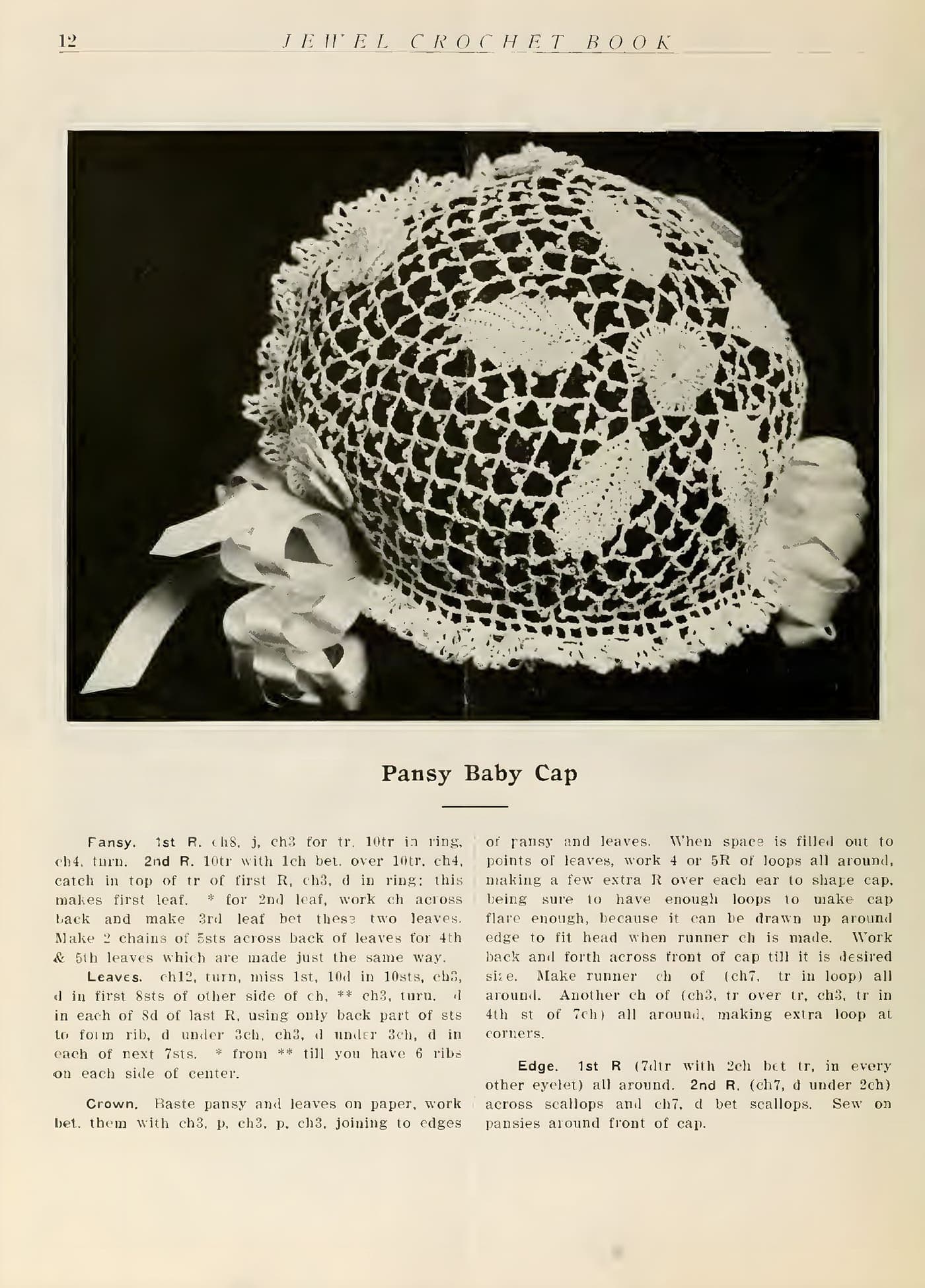
A baby's cap in the Irish manner: five-petalled pansies and ribbed leaves are made separately, basted on paper and filled between with picot chain bars, then loops are worked all around and back and forth across the front until the cap is the size wanted. A runner chain draws the edge to fit, and a scalloped treble edge finishes it.
By the crochetpatterns.io editorial team · Updated · Editorial policy · pattern testing in progress
| Detail | Value |
|---|---|
| Skill level | Advanced |
| Yarn weight | Lace (#0) |
| Yardage | the book gives no yardage for any design. (as printed; yardage not given) |
| Hook | 1.25 mm |
| Gauge | No gauge printed and no measurement printed. Make one pansy and one leaf and measure them against the head before filling the ground. |
| Finished size | Not printed. The book says to work back and forth across the front of the cap till it is the desired size, and to draw the edge up with a runner chain to fit the head. |
| Time | about 5 hours |
Materials
- Size 40 to 60 mercerized cotton crochet thread — a suggestion only; no thread is printed for this design
- Steel crochet hook to suit the thread
- Paper and basting thread, for setting out the pansies and leaves
- Narrow ribbon, for the ties (the photograph shows a ribbon bow)
- Tapestry needle
- Hook: Start with 1.25 mm (US steel 10) — a suggestion only, as no hook is printed; change size to match the fineness of the ground in the photograph
Yarn Kit & Substitution Options
This pattern calls for 350 yards of weight #0 yarn. Select a suggested yarn to see required skeins and estimated cost:
Caron Simply Soft · 100% Acrylic
315 yds per skein · High-yield yardage, silky no-scratch texture
2 skeins required
approx. $$10.98 total
Abbreviations (US terms)
- chain
- single crochet
- double crochet
- treble crochet
- back loop only
- stitch
- stitches
- round
- row
- repeat
- skip
- loop
Notes before you start
- Source: "Pansy Baby Cap", Jewel Crochet Book: A Collection of Unique and Useful Designs with Full Working Instructions, Miller-Clark Designing Company, St. Joseph, Missouri, 1915. Public domain in the USA.
- As printed — materials: Not given. Gauge: Not given.
- Modernisation note: Stitches converted by the book's own printed stitch key (“Key to Terms Used in this Book”), not by name — this book uses the older British-style naming, so its names do not mean what the same names mean today. Chain (ch) = ch. Slip stitch (slst), hook through a stitch, draw a stitch through that and the loop on the hook without throwing thread over = sl st. “Double” (d), hook through the work, draw a stitch through making two on the hook, thread over and draw through both = modern single crochet (sc). “Half treble” (htr), thread over, hook through, draw a stitch through, thread over and draw through all three = modern half double crochet (hdc). “Treble” (tr), thread over, hook through, draw a stitch through making three on the hook, then work off two and two = modern double crochet (dc). “Double treble” (dtr), thread over twice and cast off three times, two and two and two = modern treble (tr). “Triple treble” (ttr), thread over three times and cast off four times = modern double treble (dtr). So every printed tr becomes dc here, every printed dtr becomes tr, and every printed ttr becomes dtr.
- Modernisation note: Picot (p) is the book's own: chain 3, 4 or 5 as you like, then insert the hook in the first of those chains, thread over and draw through the chain stitch and the stitch on the hook at once (a slip stitch). It is written “picot” in full throughout, with the book's chain count wherever one is printed, because there is no picot abbreviation in this site's abbreviation list. Triple picot (tp) is the book's “three picots in succession”.
- Modernisation note: The book's shorthand is written out in modern US form: ch = ch, sl-st = sl st, d = sc, htr = hdc, tr = dc, dtr = tr, ttr = dtr, st(s) = st(s), R = Row or Round, j = join (with a slip stitch), bet = between, m (mesh) = the chain-1 space of the mesh ground, “miss” = sk, “thread over hook” = yo, “* all around” / “* from **” = rep from *. Ordinal row names (“1st R.”, “2nd R.”) are written Row 1, Row 2, or Round 1, Round 2 where the piece is worked in the round; where the book calls a circuit of a circular piece a “row”, the round reading is given in the heading and the change is noted.
- Modernisation note: The book prints each design as one unbroken paragraph; it is split here into one row, round or step per line, with stitch order and counts unchanged. Section headings in bold in the book (Rose, Seed Pods, Crown, Edge, and so on) are kept; any other heading is added for navigation and named as added.
- Modernisation note: Check: no thread size and no hook size are printed for this design. The thread and hook in the modern materials are a starting suggestion read from the scale of the photograph and from the sizes the book prints for its other designs; they are not from the book.
- Modernisation note: Thread is printed only as a number (“No. 60 thread”, “No. 20 thread”) with no brand and no yardage anywhere in the book. The modern equivalents given are approximations only: a size 60 or size 20 mercerized cotton crochet thread of the same size number. No yardage is printed for any design in this book, so none is given here.
- Modernisation note: Hooks are printed only as steel hook numbers (No. 9, No. 10, No. 11) with no diameters, so no exact metric size can be read from the book. The metric sizes given are approximate starting points read across to the modern US steel-hook scale, on which a higher number is finer; work a swatch and change hook size to match any printed measurement.
- Modernisation note: No stitch gauge is printed for any design in this book; work a swatch and match any printed measurement before starting.
- Modernisation note: The printed page is the authority for this transcription; every row was read from the page image, because the scanned text of this book is unusually broken. Where a digit could genuinely be read two ways it is flagged in a Check note below rather than guessed at.
- Modernisation note: The leaf rib is the book's “using only back part of sts”, which is working in the back loop only (blo).
- Modernisation note: This design is written in the Irish-crochet way, with the motifs made first and the ground filled in freehand between them. The directions are complete as printed but leave the number of pansies, the number of filling rows and the finished size to the maker; that is the book's own instruction, not an omission filled in here.
- Modernisation note: Check: the pansy directions call the five petals “leaves” and the ribbed foliage pieces are also called “Leaves”. The two are different pieces; the petals are the five worked from the ring, and the ribbed Leaves are the separate section.
- Modernisation note: Check: the pansy reads “Make 2 chains of 5sts across back of leaves”. The scan of the digit is not certain — it may be another small number — so check the length against the two petals it has to span before working the 4th and 5th petals.
- Modernisation note: Check: Edge Row 1 works “in every other eyelet”; the eyelets are the chain-3 spaces of the second runner chain.
- Modernisation note: Check: the colour is not printed; the cap photographs as white with a pale ribbon.
- Modernisation note: Finishing lines (taking out the basting, fastening off, weaving in ends, the ribbon ties) added; “Sew on pansies around front of cap” is the book's own.
- Modernisation note: Metric conversions added.
Row progress: 0 of 4 done (0%)
Pansy
0 of 4 done- Row 1: Ch 8, join, ch 3 for a dc, 10 dc in the ring, ch 4, turn.Mark row complete
- Row 2: 10 dc with ch 1 between, over the 10 dc, ch 4, catch in the top of the dc of the first row, ch 3, sc in the ring — this makes the first leaf.Mark row complete
- Rep from * for the 2nd leaf, work a chain across the back and make the 3rd leaf between these two leaves.Mark row complete
- Make 2 chains of 5 sts across the back of the leaves for the 4th and 5th leaves, which are made just the same way.Mark row complete
Working on:
Row 1: Ch 8, join, ch 3 for a dc, 10 dc in the ring, ch 4, turn.
Continue this pattern
The rest of the Pansy Baby Cap in Irish Crochet (1915) pattern is in the Vintage Crochet Baby & Kids' Patterns
Still to come in the full pattern:
- Leaves
- Crown
- Edge
- Finishing
Included with 133 patterns for $12 — $0.09 per pattern.
Errata
No corrections have been published for this pattern. Found a mistake? Tell us and we will log the fix here with a date.
Your notes on this pattern
Keep track of the yarn, hook and changes you used. Saved in this browser only — nobody else can see it.
Frequently asked questions
Where is the Pansy Baby Cap pattern from?
It was published as "Pansy Baby Cap" in Jewel Crochet Book: A Collection of Unique and Useful Designs with Full Working Instructions by Miller-Clark Designing Company, St. Joseph, Missouri in 1915. The publication is in the public domain in the United States; this version is transcribed and modernised by crochetpatterns.io.
What yarn or thread do I need for the Pansy Baby Cap?
Size 40–60 crochet cotton (suggested; none printed). Not printed — the book gives no yardage for any design.
What hook should I use?
Start with 1.25 mm (US steel 10) — a suggestion only, as no hook is printed; change size to match the fineness of the ground in the photograph Gauge: No gauge printed and no measurement printed. Make one pansy and one leaf and measure them against the head before filling the ground.