Free preview · full pattern in the Heirloom Doilies & Tablecloths
Judy’s Anti-Macassar in Square Crochet (1854): vintage crochet pattern
The companion to Punch’s Anti-Macassar: a square-crochet (filet) figure of Judy on an open-square ground, written out row by row, with the same shell-and-loop border. Worked in No. 10 crochet cotton. Originally published as "Judy’s Anti-Macassar" in The Ladies' Complete Guide to Crochet, Fancy Knitting, and Needlework (Mrs. Ann S. Stephens) by Dick & Fitzgerald in 1854, it.
By the crochetpatterns.io editorial team · Updated · Editorial policy · pattern testing in progress
| Detail | Value |
|---|---|
| Skill level | Advanced |
| Yarn weight | Lace (#0) |
| Yardage | Not printed. (as printed; yardage not given) |
| Hook | 1.6 mm |
| Gauge | Not printed. |
| Finished size | Not printed. The foundation is 133 ch (44 squares wide) and the design is 57 rows long, plus the border. |
| Time | about 19 hours |
Materials
- Cotton crochet thread about size 10 (period: crochet cotton No. 10; approximate), white
- Fine sewing needle for running in the ends
- Hook: Start with a 1.6 mm (US steel 7) hook and adjust to suit your thread (original: crochet hook No. 16, eagle card-board gauge; approximate conversion). No gauge is printed.
Yarn Kit & Substitution Options
This pattern calls for 350 yards of weight #0 yarn. Select a suggested yarn to see required skeins and estimated cost:
Caron Simply Soft · 100% Acrylic
315 yds per skein · High-yield yardage, silky no-scratch texture
2 skeins required
approx. $$10.98 total
Abbreviations (US terms)
- chain
- single crochet
- double crochet
- stitch
- stitches
- row
- round
- skip
- repeat
Notes before you start
- Source: "Judy’s Anti-Macassar", The Ladies' Complete Guide to Crochet, Fancy Knitting, and Needlework (Mrs. Ann S. Stephens), Dick & Fitzgerald, 1854. Public domain in the USA.
- As printed — materials: Crochet cotton, No. 10; crochet hook, No. 16. 133 ch.. Gauge: Not given.
- Modernisation note: Stitch names checked against the book's own definitions (pp. 22–23), which describe the same stitches as modern US terms, so they are kept: “ch.” = ch; “sl.” / “slip” = sl st; “sc.” = sc; “dc.” = dc (US, not UK); “tc.” (treble crochet) = tr; “l tc.” / “long tc.” (long treble crochet) = dtr; “miss” = sk. Note that the book's “tc.” is a modern US tr, not a UK treble (US dc).
- Modernisation note: Square crochet abbreviations: “o.” / “os.” = open square(s) (1 dc, ch 2, sk 2); “c.” = close square(s) (3 dc). Rows are transcribed as printed, e.g. “19 o, 1 c, 25 o, 1 dc”.
- Modernisation note: Period wording modernised: “needle” (meaning the hook) → hook; “commence” → begin; “close for a loop”, “close in a round” and “form it into a round” → join into a ring (the book does not name the joining stitch unless it says “slip”); “under” a chain → in the ch-sp; “fasten off” → FO; “alternative” → alternate. Repeat marks (✕, +, *, †, ¶, (a)) are written as parentheses with the book's total count.
- Modernisation note: Printed paragraphs split into one step per row, round or instruction; no stitches, counts, rows or rounds added, removed or reordered.
- Modernisation note: Crochet hook numbers belong to the book's “eagle card-board gauge”, a period bell-type gauge in which higher numbers are finer. The metric and US sizes given are approximate conversions only, and no gauge is printed.
- Modernisation note: Period cotton numbers (Evans's crochet cotton and “boar's-head” cotton) do not match modern thread sizes exactly; the modern thread size is a starting approximation. Choose the thread that suits the hook and gives lace of the right fineness.
- Modernisation note: No yardage or weight of thread is printed for this design, and none is estimated.
- Modernisation note: The book says the border is “the same as that given for Punch's Anti-Macassar”; those border directions are copied here.
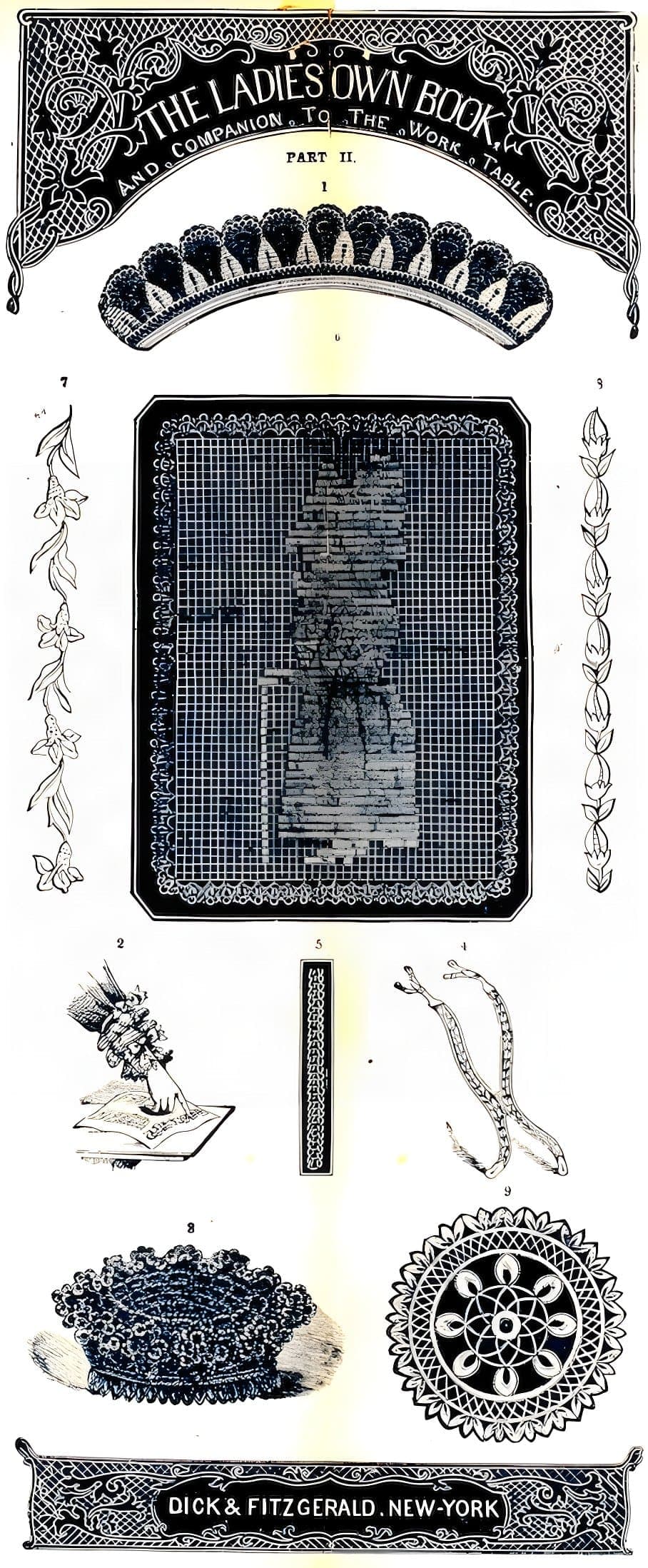
- Modernisation note: Check (stitch totals): counting o as 3 sts and each dc and ch as 1 st, the rows total 133 sts except row 21 (which ends “16 os., 3, 1, dc.” — printed that way, meaning unclear), row 42 (132) and row 53 (132). Compare with the engraving (Fig. 6 of the Part II plate).
- Modernisation note: Check: the book does not say whether the first dc of row 1 goes into the 4th ch from the hook, or how to turn; start each row as for ordinary filet crochet.
- Modernisation note: “Run in the ends” added as finishing.
Row progress: 0 of 5 done (0%)
Stitches
0 of 5 done- Chain (book's definition, “ch.”): “A loop of thread made on the hook, and through this the thread is drawn, forming the first chain stitch; draw the thread through this one, and a second is formed.” = ch.Mark row complete
- Single crochet (book's definition, “sc.”): “Insert the hook in the chain, and draw the thread through it; this forms a second loop on the hook. Draw the thread through these two by a single movement and the stitch will be completed.” = modern US sc.Mark row complete
- Double crochet (book's definition, “dc.”): “Raise the thread over the hook, so as to pass it round, before inserting the latter in the chain; draw the thread through, and you will find three loops on the hook; bring the cotton through two … finish the stitch by drawing the thread through these.” = modern US dc (not the UK dc).Mark row complete
- Square crochet (book's definition): “Open squares are formed thus: 1 dc. 2 ch., miss 2, repeated. Close squares contain three dc. stitches, thus: 1 c. 1 o., would have 4 dc. 2 ch.” The foundation chain must be “divided by three and leave one over”, the extra stitch being the dc that closes the last square. Here o = open square (1 dc, ch 2, sk 2) and c = close square (3 dc); each square takes 3 sts, and the “1 dc” at the end of a row closes the last square. This is modern filet crochet.Mark row complete
- Repeat marks (book's definition): stitches between two similar marks (✕, +, *, †) “are to be done as many times as directed; thus, ✕ 3 dc. 2 ch. ✕ three times, means 3 dc. 2 ch., 3 dc. 2 ch., 3 dc. 2 ch.” So “twice” or “3 times” is the total number of times the group is worked. Written here as (…) twice, (…) 3 times.Mark row complete
Working on:
Chain (book's definition, “ch.”): “A loop of thread made on the hook, and through this the thread is drawn, forming the first chain stitch; draw the thread through this one, and a second is formed.” = ch.
Continue this pattern
The rest of the Judy’s Anti-Macassar in Square Crochet (1854) pattern is in the Heirloom Doilies & Tablecloths
Still to come in the full pattern:
- Anti-macassar
- Border (the same as for Punch’s Anti-Macassar)
- Finishing
Included with 236 patterns for $19 — $0.08 per pattern.
Errata
No corrections have been published for this pattern. Found a mistake? Tell us and we will log the fix here with a date.
Your notes on this pattern
Keep track of the yarn, hook and changes you used. Saved in this browser only — nobody else can see it.
Frequently asked questions
Where is the Judy’s Anti-Macassar pattern from?
It was published as "Judy’s Anti-Macassar" in The Ladies' Complete Guide to Crochet, Fancy Knitting, and Needlework (Mrs. Ann S. Stephens) by Dick & Fitzgerald in 1854. The publication is in the public domain in the United States; this version is transcribed and modernised by crochetpatterns.io.
What yarn or thread do I need for the Judy’s Anti-Macassar?
Size 10 crochet cotton (approximate). Not printed.
What hook should I use?
Start with a 1.6 mm (US steel 7) hook and adjust to suit your thread (original: crochet hook No. 16, eagle card-board gauge; approximate conversion). No gauge is printed. Gauge: Not printed.