Free preview · full pattern in the Heirloom Doilies & Tablecloths
Round Crochet D’Oyley in Seven Shades of Berlin Wool (1854): vintage crochet pattern
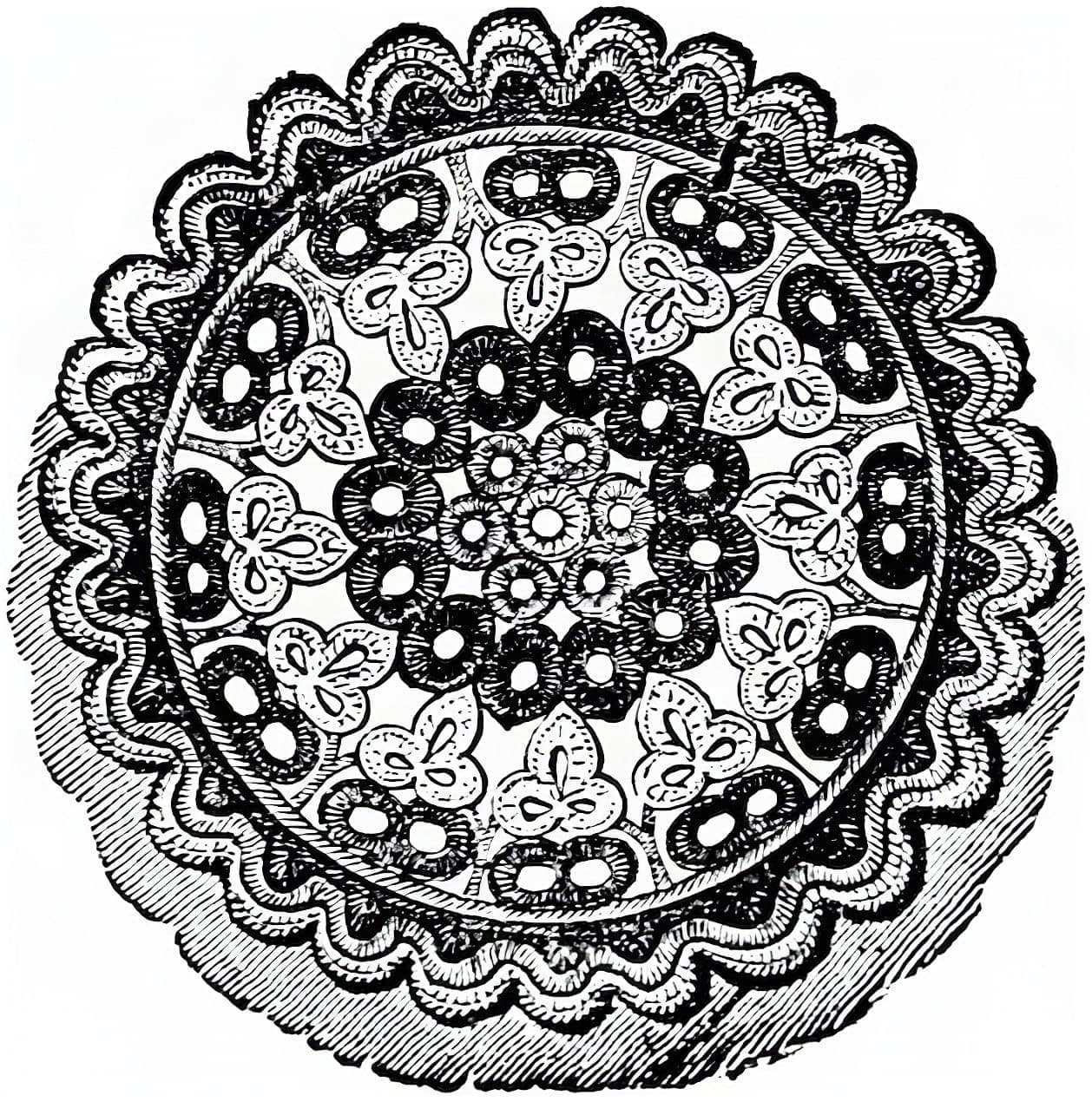
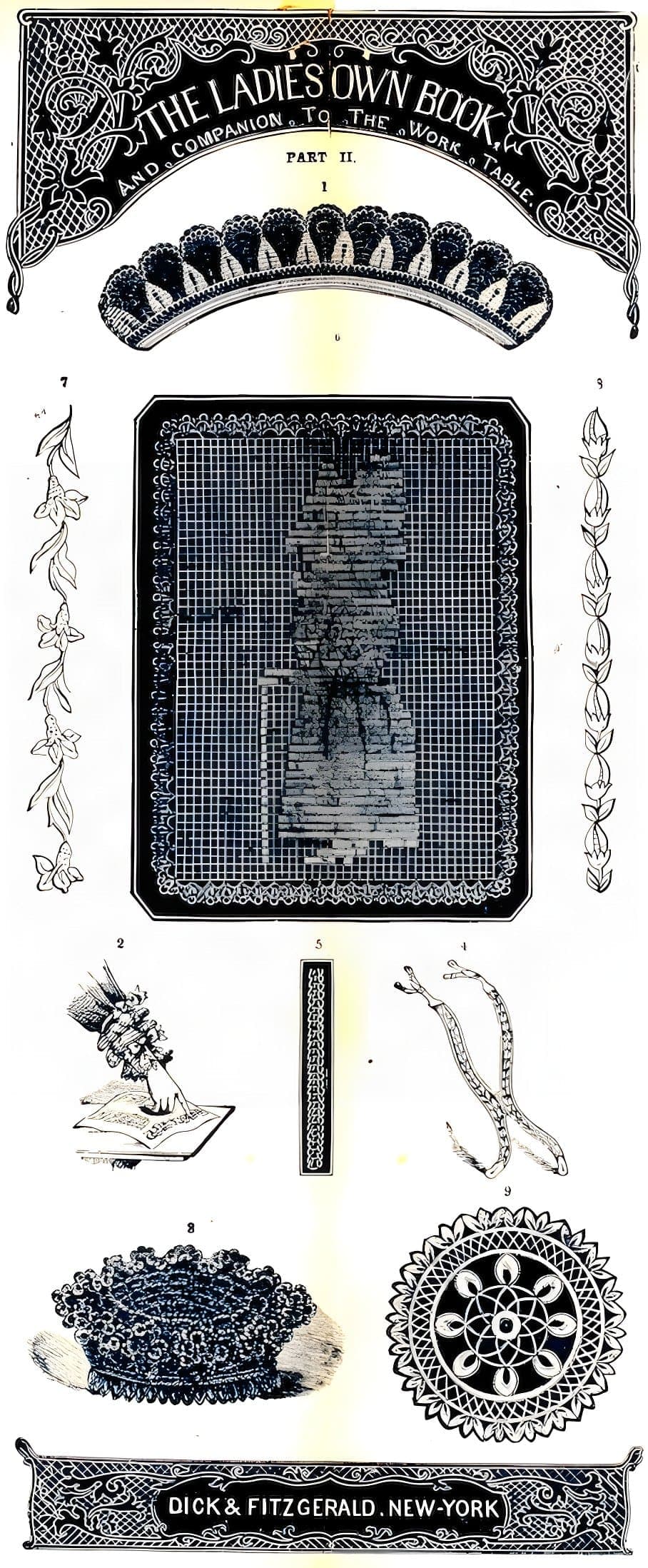
A round d'oyley (doily) worked from the centre with a ring of leaf-shaped loops, chain-loop rounds and a looped edge, in seven shades of Berlin wool. Originally published as "Crochet D’Oyley" in The Ladies' Complete Guide to Crochet, Fancy Knitting, and Needlework (Mrs. Ann S. Stephens) by Dick & Fitzgerald in 1854, it is now in the public domain.
By the crochetpatterns.io editorial team · Updated · Editorial policy · pattern testing in progress
| Detail | Value |
|---|---|
| Skill level | Intermediate |
| Yarn weight | Super fine (#1) |
| Yardage | Not printed. (as printed; yardage not given) |
| Hook | 3 mm |
| Gauge | Not printed. |
| Finished size | Not printed. |
| Time | about 7 hours |
Materials
- Fingering-weight (CYC #1) wool in 7 shades, approximating Berlin wool
- Tapestry needle
- Hook: Start with a 2.75–3 mm (US C-2/D-3) hook and adjust to suit your wool; the book names only a “bone crochet hook” and prints no gauge.
Yarn Kit & Substitution Options
This pattern calls for 350 yards of weight #1 yarn. Select a suggested yarn to see required skeins and estimated cost:
Knit Picks Stroll Sock · 75% Superwash Merino, 25% Nylon
231 yds per skein · Durable stitch definition, machine washable
2 skeins required
approx. $$13.98 total
Abbreviations (US terms)
- chain
- single crochet
- double crochet
- treble crochet
- stitch
- stitches
- round
- skip
- repeat
- fasten off
Notes before you start
- Source: "Crochet D’Oyley", The Ladies' Complete Guide to Crochet, Fancy Knitting, and Needlework (Mrs. Ann S. Stephens), Dick & Fitzgerald, 1854. Public domain in the USA.
- As printed — materials: 7 shades of Berlin wool; bone hook.. Gauge: Not given.
- Modernisation note: Stitch names checked against the book's own definitions (pp. 22–23), which describe the same stitches as modern US terms, so they are kept: “ch.” = ch; “sl.” / “slip” = sl st; “sc.” = sc; “dc.” = dc (US, not UK); “tc.” (treble crochet) = tr; “l tc.” / “long tc.” (long treble crochet) = dtr; “miss” = sk. Note that the book's “tc.” is a modern US tr, not a UK treble (US dc).
- Modernisation note: Period wording modernised: “needle” (meaning the hook) → hook; “commence” → begin; “close for a loop”, “close in a round” and “form it into a round” → join into a ring (the book does not name the joining stitch unless it says “slip”); “under” a chain → in the ch-sp; “fasten off” → FO; “alternative” → alternate. Repeat marks (✕, +, *, †, ¶, (a)) are written as parentheses with the book's total count.
- Modernisation note: Printed paragraphs split into one step per row, round or instruction; no stitches, counts, rows or rounds added, removed or reordered.
- Modernisation note: “Berlin wool” was a fine, soft worsted-spun wool. Ordinary Berlin wool is approximated as fingering weight (CYC #1) and “8 thread” (double) Berlin wool as sport to DK weight (CYC #2–3). The “bone crochet hook” has no printed size; the modern hook is a suggestion only.
- Modernisation note: No yardage or weight of thread is printed for this design, and none is estimated.
- Modernisation note: Check: the book lists 7 shades of Berlin wool but does not say which rounds are worked in which shade.
- Modernisation note: Check: rnd 1 does not give the number of dc worked into the ring (“Dc., increasing 3 in the round”), and rnds 7, 8, 13 and 16 (“Dc all round”) give no counts.
- Modernisation note: Check: rnd 15 works into “spaces” although rnds 13 and 14 are solid dc; compare with Fig. 9 of the Part II plate.
- Modernisation note: “Weave in ends” added.
Row progress: 0 of 5 done (0%)
Stitches
0 of 5 done- Chain (book's definition, “ch.”): “A loop of thread made on the hook, and through this the thread is drawn, forming the first chain stitch; draw the thread through this one, and a second is formed.” = ch.Mark row complete
- Single crochet (book's definition, “sc.”): “Insert the hook in the chain, and draw the thread through it; this forms a second loop on the hook. Draw the thread through these two by a single movement and the stitch will be completed.” = modern US sc.Mark row complete
- Double crochet (book's definition, “dc.”): “Raise the thread over the hook, so as to pass it round, before inserting the latter in the chain; draw the thread through, and you will find three loops on the hook; bring the cotton through two … finish the stitch by drawing the thread through these.” = modern US dc (not the UK dc).Mark row complete
- Treble crochet (book's definition, “tc.”): as dc, “but as the thread is passed twice round the hook before the insertion of the latter in the chain, there will be four loops on … Bring the thread three times through two loops to finish the stitch.” = modern US tr.Mark row complete
- Repeat marks (book's definition): stitches between two similar marks (✕, +, *, †) “are to be done as many times as directed; thus, ✕ 3 dc. 2 ch. ✕ three times, means 3 dc. 2 ch., 3 dc. 2 ch., 3 dc. 2 ch.” So “twice” or “3 times” is the total number of times the group is worked. Written here as (…) twice, (…) 3 times.Mark row complete
Working on:
Chain (book's definition, “ch.”): “A loop of thread made on the hook, and through this the thread is drawn, forming the first chain stitch; draw the thread through this one, and a second is formed.” = ch.
Continue this pattern
The rest of the Round Crochet D’Oyley in Seven Shades of Berlin Wool (1854) pattern is in the Heirloom Doilies & Tablecloths
Still to come in the full pattern:
- D’oyley
- Finishing
Included with 236 patterns for $19 — $0.08 per pattern.
Errata
No corrections have been published for this pattern. Found a mistake? Tell us and we will log the fix here with a date.
Your notes on this pattern
Keep track of the yarn, hook and changes you used. Saved in this browser only — nobody else can see it.
Frequently asked questions
Where is the Crochet D’Oyley pattern from?
It was published as "Crochet D’Oyley" in The Ladies' Complete Guide to Crochet, Fancy Knitting, and Needlework (Mrs. Ann S. Stephens) by Dick & Fitzgerald in 1854. The publication is in the public domain in the United States; this version is transcribed and modernised by crochetpatterns.io.
What yarn or thread do I need for the Crochet D’Oyley?
super fine (#1) yarn. Not printed.
What hook should I use?
Start with a 2.75–3 mm (US C-2/D-3) hook and adjust to suit your wool; the book names only a “bone crochet hook” and prints no gauge. Gauge: Not printed.