Free preview · full pattern in the Vintage Crochet Edgings & Trims
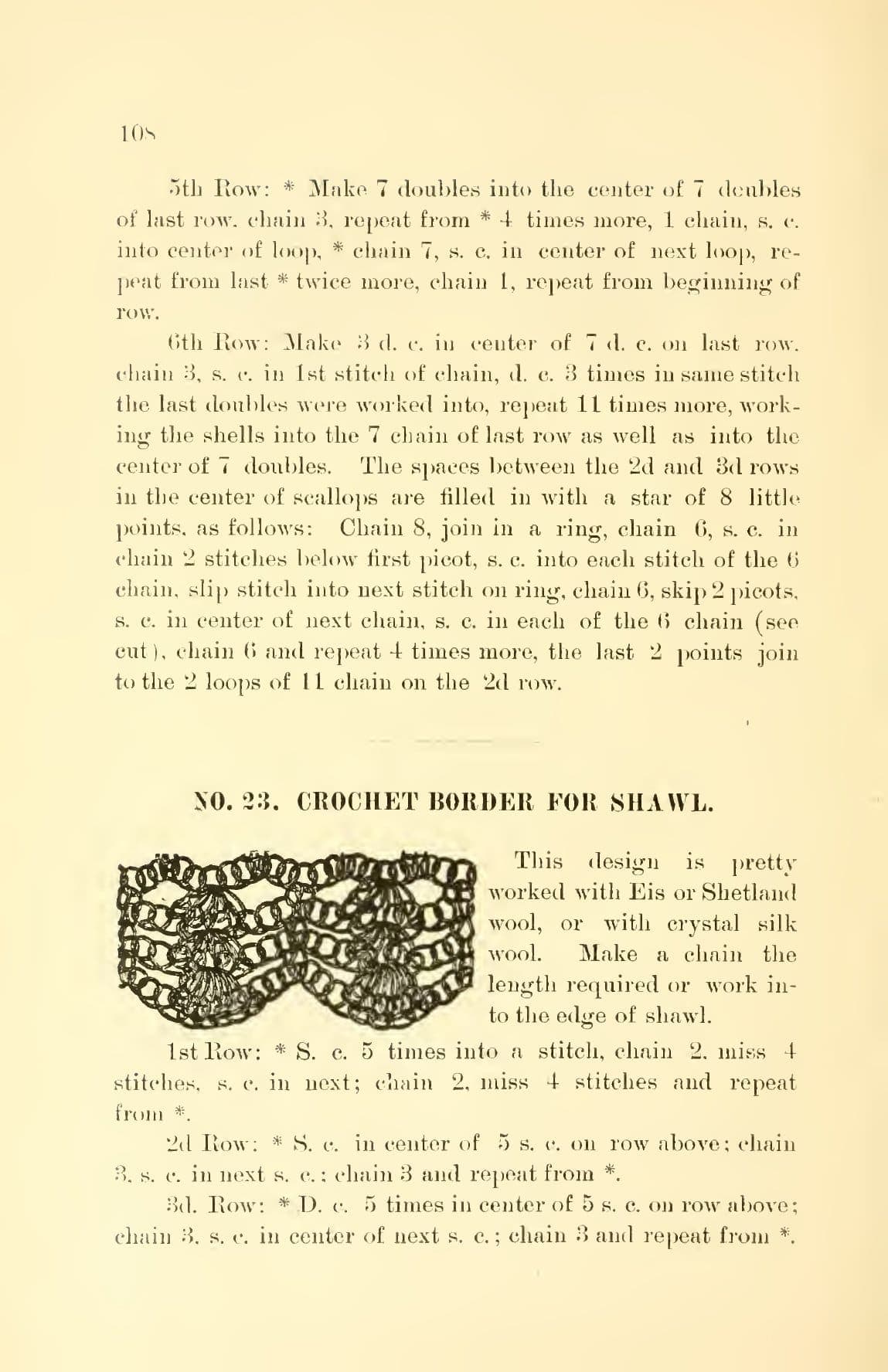
Crochet Border for Shawl, No. 23 (1888): vintage crochet pattern
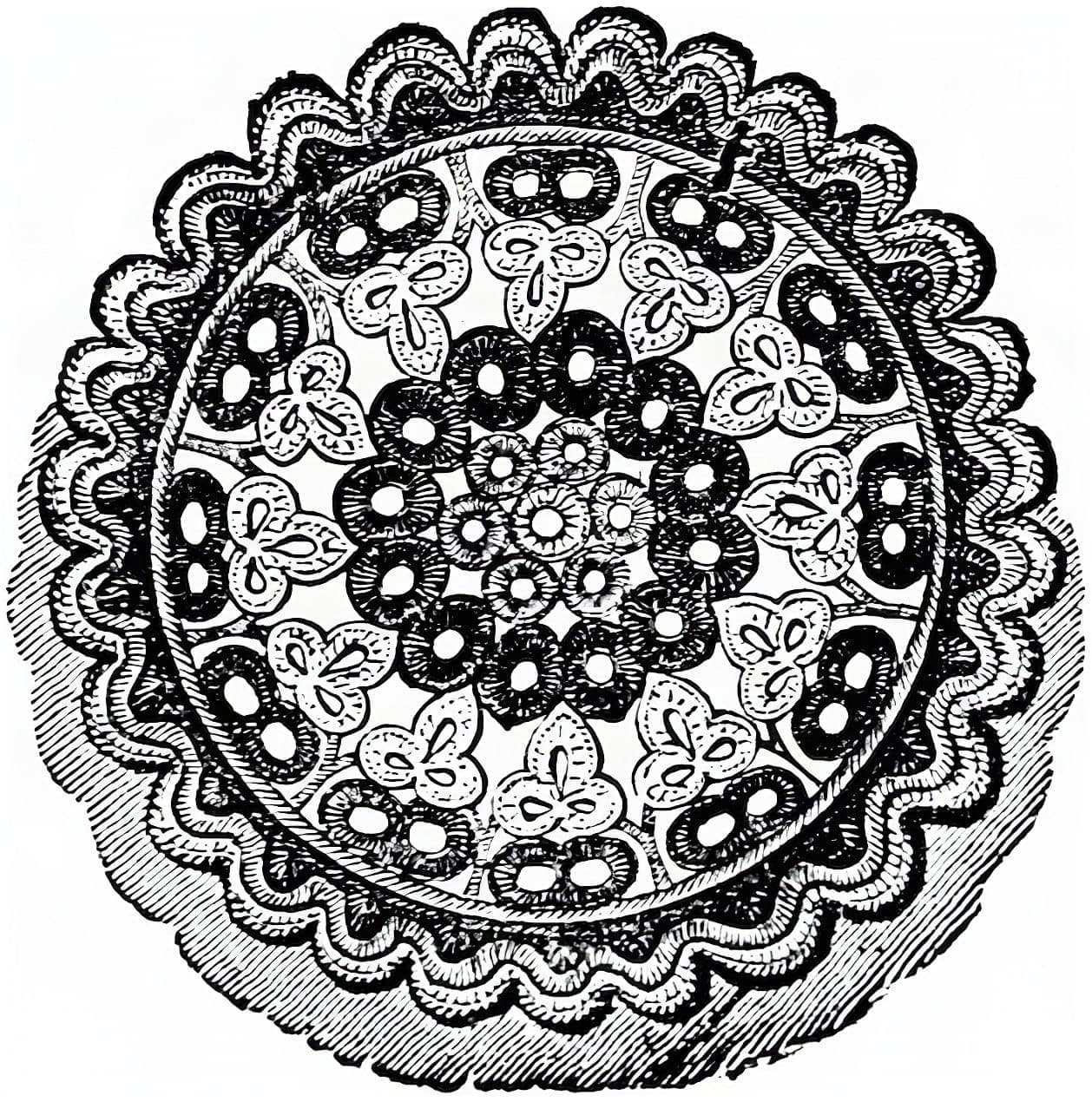
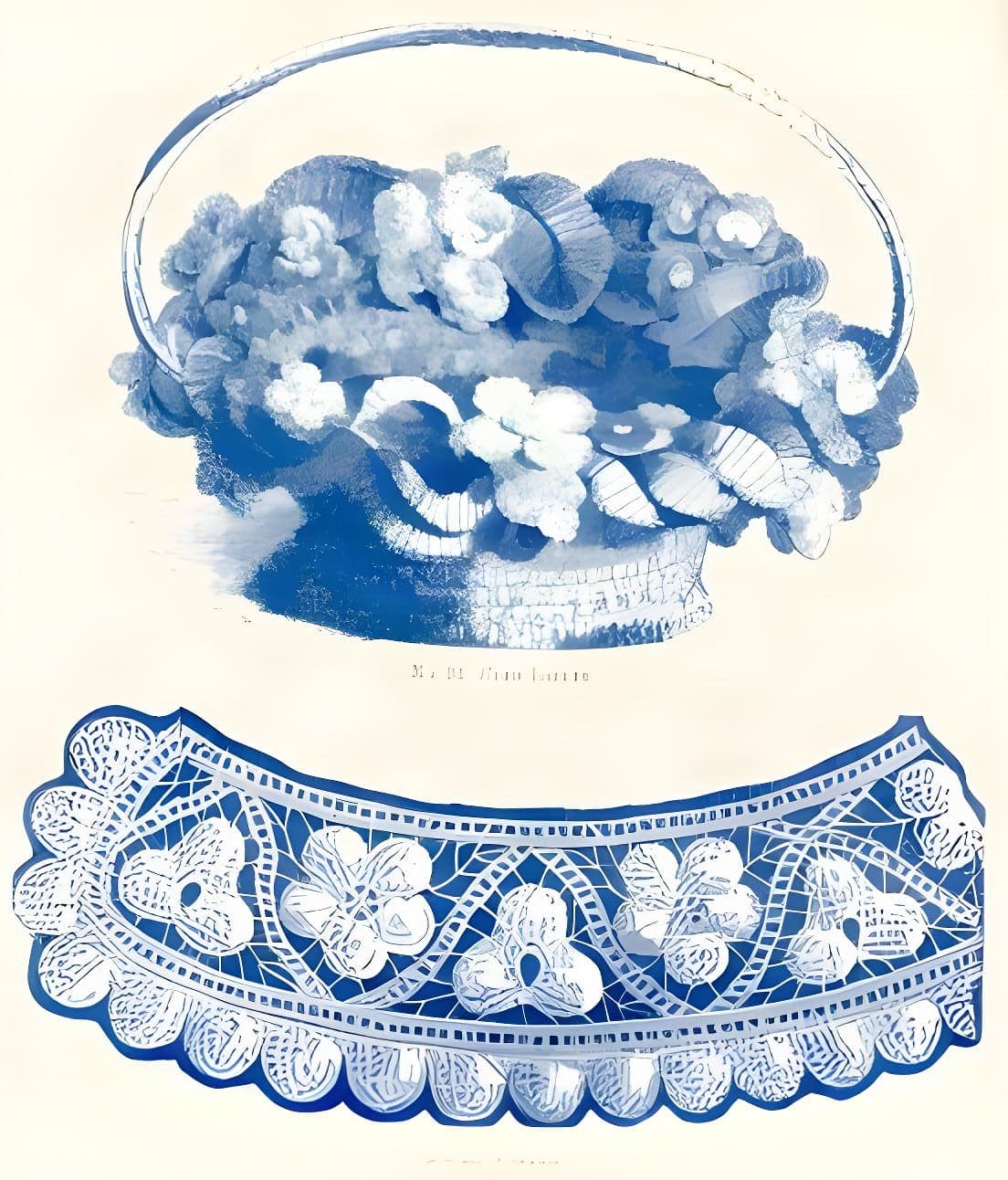
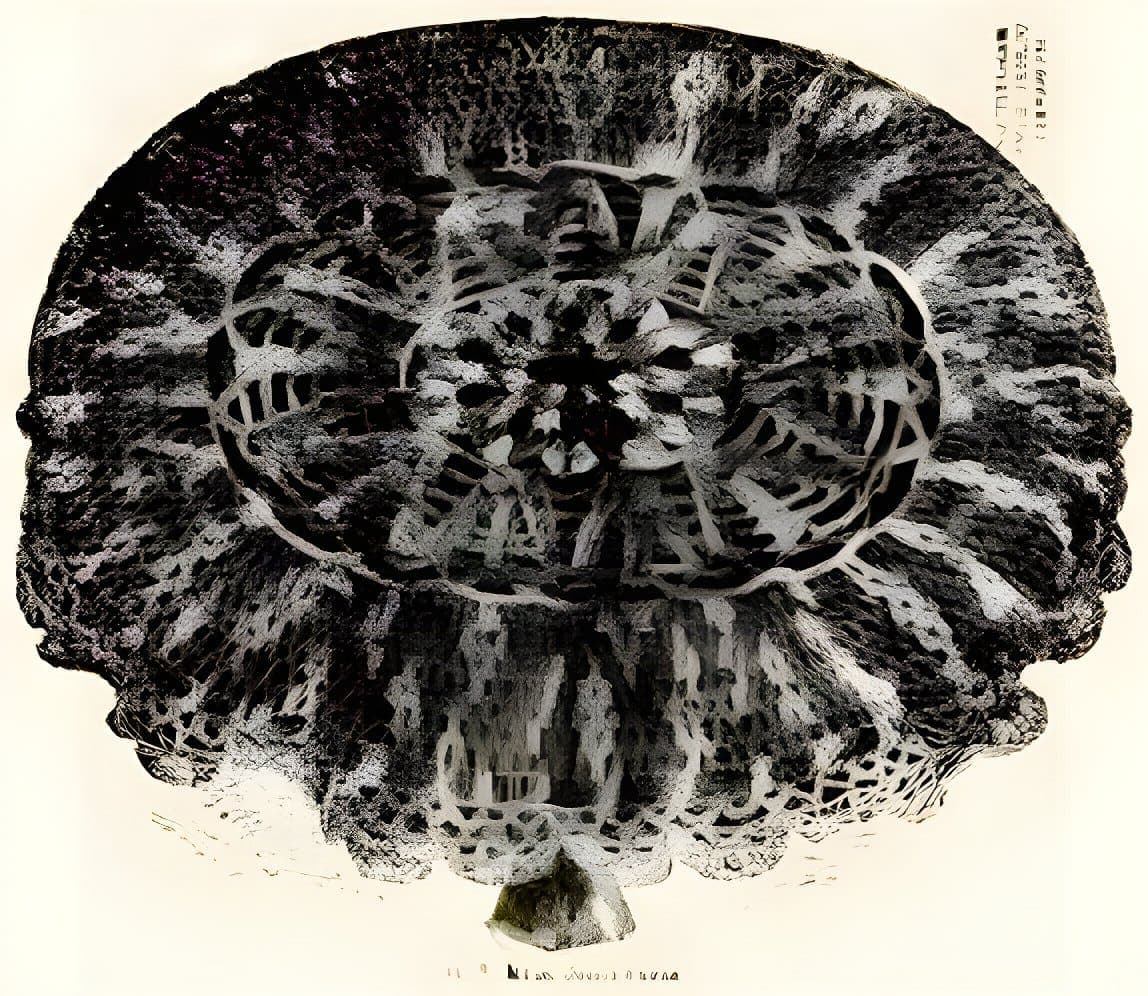
A three-row wool border worked either on its own chain or straight into the edge of a shawl: five single crochets in one stitch with chain-2 between, then the same clusters set on chain-3, and finally five doubles in the centre of each cluster with chain-3 and chain-5 alternating.
By the crochetpatterns.io editorial team · Updated · Editorial policy · pattern testing in progress
| Detail | Value |
|---|---|
| Skill level | Beginner |
| Yarn weight | Super fine (#1) |
| Yardage | Not printed. (as printed; yardage not given) |
| Hook | 5 mm |
| Gauge | No gauge printed. |
| Finished size | No finished measurement is printed for this edging. It is worked to the length of the piece it trims, so its length is set by that piece. |
| Time | about 2 hours |
Materials
- A fine wool — the book names Eis wool, Shetland wool or crystal silk wool and prints no quantity
- Crochet hook to suit the wool
- Tapestry needle for the ends
- Hook: Check: the book prints no hook number for this design. It names a hook size only twice in its whole 114 pages — “a long bone hook No. 6” for the Crochet Dress for Child on page 60 and “a crochet hook No. 12” for the Teapot-Cosy on page 98, both of which are in this file. Neither is an 1888 maker's size that reads across to a modern number for anything else. Match the hook to whatever thread or yarn you choose, and change size until the work lies flat.
Yarn Kit & Substitution Options
This pattern calls for 350 yards of weight #1 yarn. Select a suggested yarn to see required skeins and estimated cost:
Knit Picks Stroll Sock · 75% Superwash Merino, 25% Nylon
231 yds per skein · Durable stitch definition, machine washable
2 skeins required
approx. $$13.98 total
Abbreviations (US terms)
- chain
- single crochet
- double crochet
- stitch
- stitches
- repeat
- skip
- row
Notes before you start
- Source: "No. 23. Crochet Border for Shawl" (No. 23), Instructions for Crochet Work, Western Lace Manufacturing Company, 218 State Street, Chicago, Ill., 1888. Public domain in the USA.
- As printed — materials: “This design is pretty worked with Eis or Shetland wool, or with crystal silk wool.” (printed with the design, book page 108); No quantity, hook number or gauge is printed.. Gauge: Not given.
- Modernisation note: Stitches are converted by this book's own printed key, “DESCRIPTION OF TERMS USED IN CROCHET”, book page 5 (image p-011.jpg) — not by the look of the abbreviation and not from the date. The key settles the question outright: this 1888 Chicago book uses MODERN US stitch names, the same ladder our 1891 Butterick uses and the opposite of the British-style ladder in the 1913 to 1916 Priscilla books. Its “Single Crochet” is: “Pass the hook through a loop of the last row, bring cotton through, throw cotton around the needle and pass it through the two loops on the needle.” One pull-up and two loops worked off together — the modern US single crochet, not a British double. Its “Double Crochet” is: “Throw cotton once around the needle, pass the hook through a loop of the preceding row, bring cotton through, then take cotton up and bring it through two loops twice.” One wrap before insertion, three loops worked off two at a time twice — the modern US double crochet, not a US single. Its “Half Double Crochet” is: “Like double crochet, only pass the cotton through the three loops on the needle, instead of passing it through two loops twice.” — the modern US half double. Its “Treble” is: “Throw the cotton twice around the needle, and work as double crochet, but bring cotton through two loops three times.” — the modern US treble. Its “Double Double Crochet” is: “Throw the cotton over the needle three times, work as double crochet, but draw the cotton through two loops four times.” — the modern US double treble, written dtr below. The WRAP COUNTS are the decisive evidence and they are printed rather than inferred: none for single, one for double, two for treble, three for double double, with the loops worked off two at a time in every case. So this book's s. c., d. c., h. d. c., t. and d. d. c. are written sc, dc, hdc, tr and dtr below with no shift of height.
- Modernisation note: Two of the book's terms do NOT map straight across, and both are handled explicitly rather than quietly. Its “Close Chain Stitch” (page 5) is: “Insert the hook in the loop of preceding row, and draw cotton through it and the loop on the needle at the same time.” That is what we call a slip stitch worked into the fabric, and it is written sl st below. Its own “Slip Stitch” (page 6) is a different move — a joining, not a stitch: “This stitch is used in joining. Take the hook from the last loop worked, pass it through the loop where the work has to be joined; then take the first loop spoken of and draw it through.” Where a design uses sl. st. in that joining sense the row below says join with a sl st and keeps the book's own wording; where it plainly means travelling along a chain or a row, the row says sl st. Its “Ribbed Crochet” (page 6) is: “Make a single crochet in the back loop of each stitch of the row last worked. At the end of every row make a chain stitch and turn the work; then begin the next row.” — written sc in blo below.
- Modernisation note: The book prints its own short table, “ABBREVIATIONS USED IN DIRECTIONS”, book page 6 (image p-012.jpg): “l. — Loop. ch. st. — Chain Stitch. cl. ch. st. — Close Chain Stitch. s. c. — Single Crochet. d. c. — Double Crochet. h. d. c. — Half Double Crochet. t. — Treble. d. d. c. — Double Double Crochet. p. — Picot. r. c. — Ribbed Crochet. sl. st. — Slip Stitch.” Note that its letter for treble is a bare “t.”, not “tr.”; several designs also write “T” or “t. c.” for the same stitch, and all three are written tr below. Most designs spell the stitches out in words anyway, and both forms are written in modern shorthand here.
- Modernisation note: The book's wording is written in modern US form: “needle” always means the crochet hook and is written hook; “set the needle into” = insert the hook in; “fill the ring with” = work the stitches into the ring; “miss” = sk; “catch down” and “fasten” = join with a sl st or a sc, according to what the row is doing; “throw the cotton over the needle” = yo; “d. c. 3 times in the same place” is written 3 dc in the same place; “repeat from *” = rep from *. Ordinal row names (“Ist Row”, “2d Row”, “3d Row”) are written Row 1, Row 2, Row 3, and Round where the design works in the round. The book's own spellings are kept in the design names as printed.
- Modernisation note: Several of these designs print as one solid paragraph with no row numbering at all, the new row marked only by the word “turn”. Those are split here into one row or step per line at the book's own “turn”, and the book's own sub-headings (BORDER, SCALLOP FOR TOP OF BOOTEE, For the Heading and so on) are kept as section headings. Stitch order and counts are unchanged and nothing is added.
- Modernisation note: The scanned text of this book carries the usual optical-reading slips, and every figure below was read back against the 220 dpi page image rather than trusted from the scan: the scan's “Ist” is 1st, its “Sth” is 8th, its “LO” and “lO” are 10, its “+” and “-L” standing in place of a number are the figure 4, its “§” is 5, its “Y” and “)” are 9, its “S” inside a number is 8, and its “e”, “¢”, “«” and “@” are all the letter c, so that “d. ec.”, “d. «.”, “cd. c.” and “a. c.” are all d. c. Where the scan and the printed page disagree, the printed page is followed and the disagreement is recorded as a Check note.
- Modernisation note: No gauge is printed for this design. The book prints a gauge exactly once in its whole 114 pages — for the Crochet Dress for Child on page 60, which is in this file — and gives none for any other design. Work a sample and change hook size until the piece lies flat.
- Modernisation note: No yardage is printed for this design, and none is estimated here.
- Modernisation note: No finished measurement is printed for this edging. It is worked to the length of the piece it trims, so its length is set by that piece.
- Modernisation note: Check: the scan heads this design “NO. 25. CROCHET BORDER FOR SHAWL”; the printed page (book page 108, image p-114.jpg) reads “NO. 23. CROCHET BORDER FOR SHAWL”. The scan has taken the book's 3 for a 5. The design is entered here under its printed number, 23.
- Modernisation note: Check: the scan reads Row 1 as “chain 2. iiss 4+ stitches”; the page reads “chain 2, miss 4 stitches”.
- Modernisation note: Check: the scan reads Row 3 as “chain 3. s. ¢. in center of next s. c.; chain 3”; the page reads “chain 3, s. c. in center of next s. c.; chain 3 and repeat from *” with the ch. 5 printed in Row 3's own opening — the two chain counts are as shown above.
- Modernisation note: This design prints its own wool in its opening paragraph, which is why the original materials quote the design rather than the back-page list. “Eis wool” is the book's own spelling and is kept.
- Modernisation note: Check: no colour is printed. Wool shades are the worker's choice; the ones recorded here are period-plausible and are not the book's.
Row progress: 0 of 4 done (0%)
The border
0 of 4 done- Make a chain the length required, or work into the edge of the shawl.Mark row complete
- Row 1: *5 sc into a st, ch 2, sk 4 sts, sc in the next; ch 2, sk 4 sts and rep from *.Mark row complete
- Row 2: *sc in the centre of the 5 sc on the row above; ch 3, sc in the next sc; ch 3 and rep from *.Mark row complete
- Row 3: *5 dc in the centre of the 5 sc on the row above; ch 3, sc in the centre of the next sc; ch 5 and rep from *.Mark row complete
Working on:
Make a chain the length required, or work into the edge of the shawl.
Continue this pattern
The rest of the Crochet Border for Shawl, No. 23 (1888) pattern is in the Vintage Crochet Edgings & Trims
Still to come in the full pattern:
- Finishing
Included with 618 patterns for $9 — $0.01 per pattern.
Errata
No corrections have been published for this pattern. Found a mistake? Tell us and we will log the fix here with a date.
Your notes on this pattern
Keep track of the yarn, hook and changes you used. Saved in this browser only — nobody else can see it.
Frequently asked questions
Where is the No. 23. Crochet Border for Shawl pattern from?
It was published as "No. 23. Crochet Border for Shawl" in Instructions for Crochet Work by Western Lace Manufacturing Company, 218 State Street, Chicago, Ill. in 1888. The publication is in the public domain in the United States; this version is transcribed and modernised by crochetpatterns.io.
What yarn or thread do I need for the No. 23. Crochet Border for Shawl?
super fine (#1) yarn. Not printed.
What hook should I use?
Check: the book prints no hook number for this design. It names a hook size only twice in its whole 114 pages — “a long bone hook No. 6” for the Crochet Dress for Child on page 60 and “a crochet hook No. 12” for the Teapot-Cosy on page 98, both of which are in this file. Neither is an 1888 maker's size that reads across to a modern number for anything else. Match the hook to whatever thread or yarn you choose, and change size until the work lies flat. Gauge: No gauge printed.