
Free preview · full pattern in the Heirloom Doilies & Tablecloths
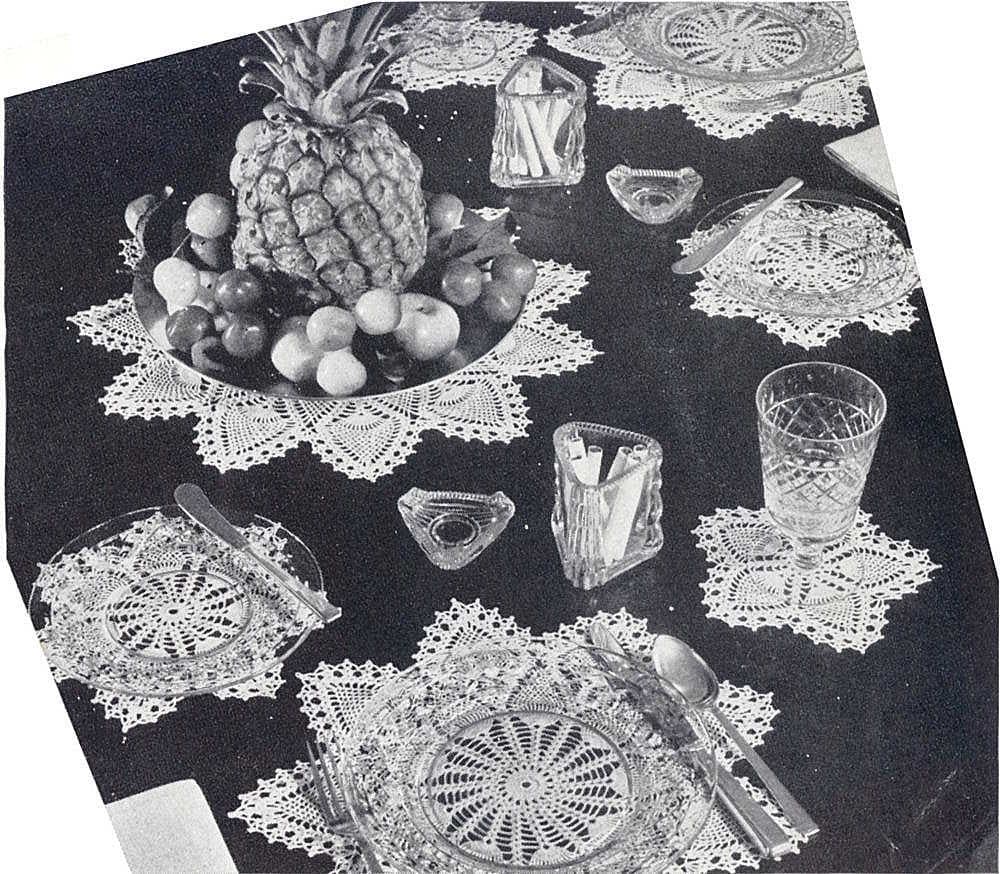
Pineapple Luncheon Set (1941): vintage crochet pattern
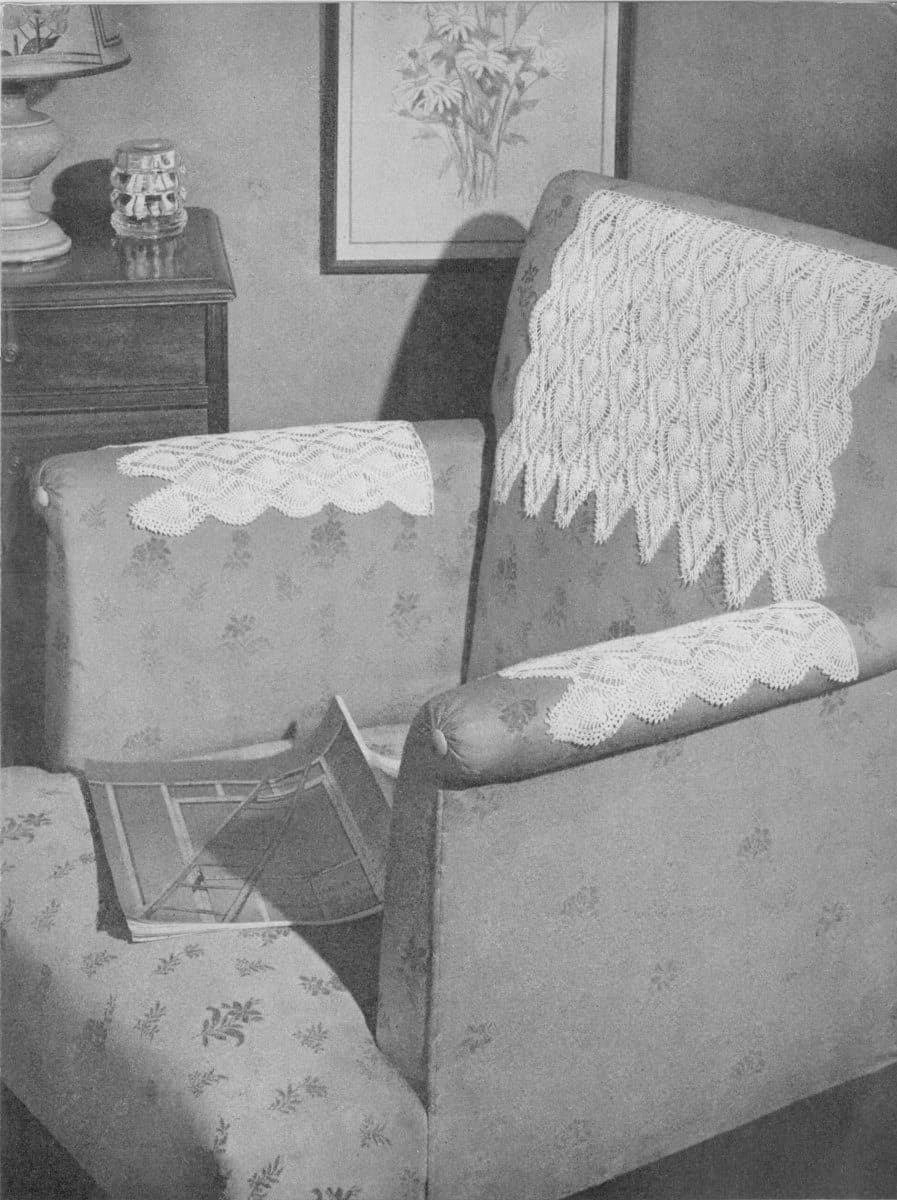
A pineapple-lace luncheon set in fine size 50 thread. The materials list gives ball counts for both Clark's O.N.T. and J. & P. Coats threads. Originally published as "Pineapple Luncheon Set" in Old and New Favorites (Book No. 172) by The Spool Cotton Company in 1941, it is now in the public domain.
By the crochetpatterns.io editorial team · Reviewed · Editorial policy
By the crochetpatterns.io editorial team · Reviewed September 14, 2026 under our editorial policy · pattern testing in progress
| Detail | Value |
|---|---|
| Skill level | Advanced |
| Yarn weight | Lace (#0) |
| Yardage | As printed in the materials below (ball counts by brand) — check the ball band for yardage |
| Hook | 1 mm |
| Gauge | Not given in the original — work to the printed finished size (see pattern). |
| Finished size | Not printed |
| Time | about 21 hours |
Materials
- Size 50 six-cord mercerized crochet thread (printed: Clark's O.N.T. or J. & P. Coats Best Six Cord, size 50)
- Yardage: As printed in the materials below (ball counts by brand) — check the ball band for yardage
- Tapestry needle, rustproof pins and starch for blocking
- Hook: Start with a 1.0 mm (US 12) steel hook for size 50 thread and change size to reach the printed measurements.
Abbreviations (US terms)
Notes before you start
- Source: "Pineapple Luncheon Set" (7335), Old and New Favorites (Book No. 172), The Spool Cotton Company, 1941. Public domain in the USA.
- As printed — materials: SET No. 7335; CLARK’S O.N.T. or J. & P. COATS BEST SIX CORD MERCERIZED CROCHET, size 50:; Small Ball:; Clark’s O.N.T.—11 balls of White or; Ecru or 13 balls of; any color.; J. & P. Coats—8 balls of White or Ecru; or 11 balls of any color.; Big Ball:; Clark’s O.N.T. or J. & P. Coats—5 balls of White or Ecru.; Milward’s Steel Crochet Hook No. 12.; These materials are sufficient for a set consisting of centerpiece, 14″ in diameter; 4 place doilies, 12″ in diameter; 4 bread and butter plate doilies, 7″ in diameter; and 4 glass doilies, 5½″ in diameter.. Gauge: Not given.
- Modernisation note: Transcribed from the original publication; stitches, repeats and their order are unchanged.
- Modernisation note: Run-on paragraphs split into one round, row or step per line.
- Modernisation note: The source leaflets already use US crochet terms; only abbreviations and wording were modernised.
- Modernisation note: Round/row labels rewritten in modern form (e.g. “2nd Round.” → “Rnd 2:”, “7th to 10th rnds incl:” → “Rnds 7–10:”)
- Modernisation note: “attach” → “join”
- Modernisation note: “thread over” → “yo” (yarn over)
- Modernisation note: Page numbers, page-continuation notes and illustration references removed.
- Modernisation note: No gauge is printed. Suggested check: work to the printed finished size (see the pattern) and change hook size if your piece is noticeably larger or smaller.
- Modernisation note: Hook numbers in the original are Milward's steel hook sizes; a starting size is suggested from the thread weight instead of converting the old numbering.
- Modernisation note: Stitch counts have not been added; where the original prints a count it is kept as printed.
Centerpiece
- Starting at center, ch 16, join with sl st.
- Rnd 1: Ch 3, 32 dc in ring, sl st in 3rd st of ch-3.
- Rnd 2: Ch 3, dc in each dc around; join to 3rd st of ch-3.
- Rnd 3: Ch 3, dc in same place as sl st, 2 dc in each dc around, sl st in 3rd st of ch-3.
- Rnd 4: Repeat
- Rnd 2:
- Rnd 5: Ch 3, dc in same place as sl st, * ch 3, skip 2 dc, 2 dc in next dc. Repeat from * around, ending with ch 3, join to 3rd st of ch-3 (22 dc-groups).
- Rnd 6: Sl st in next dc and in next sp, ch 3; in same sp make dc, ch 2 and 2 dc; in each ch-3 sp around make 2 dc, ch 2 and 2 dc; join.
- Rnd 7: Sl st in next dc and in next ch-2 sp, ch 3, in same sp make dc, ch 2 and 2 dc; * ch 1, in next ch-2 sp make 2 dc, ch 2 and 2 dc (shell over shell). Repeat from * around, ending with ch-1; join.
- 8th to
- 12th rnds incl: Repeat 7th rnd, having an extra ch between each shell in each rnd.
- Rnd 13: Sl st in next dc and in next sp, ch 3; in same sp make dc, ch 5 and 2 dc. * Ch 6, in next ch-2 sp make 2 dc, ch 2 and 2 dc, ch 6; in next ch-2 sp make 2 dc, ch 5 and 2 dc. Repeat from * around; join.
- Rnd 14: Sl st in next dc and in next sp, ch 4, 12 tr in ch-5 of shell, * ch 5, in next ch-2 make 2 dc, ch 2 and 2 dc; ch 5, 13 tr in ch-5 of next shell. Repeat from * around, ending with ch 5, join.
- Rnd 15: Ch 5 (to count as tr and ch-1), tr in next tr; (ch 1, tr in next tr) 11 times; * ch 3, shell over next shell, ch 3, tr in next tr; (ch 1, tr in next tr) 12 times. Repeat from * around; join to 4th st of ch-5 first made.
- Rnd 16: Sl st in 1st ch-1 sp, sc in same sp; * (ch 3, sc in next ch-1 sp) 11 times, ch 3, shell over next shell, ch 3, sc in next ch-1 sp. Repeat from * around, ending with ch 3, sc in 1st ch-3 loop,
- Rnd 17: (Ch 3, sc in next loop) 10 times, * ch 3, shell over next shell; (ch 3, sc in next loop) 11 times. Repeat from * around, ending as in
- Rnd 16:
- Rnd 18: (Ch 3, sc in next loop) 9 times, * ch 3, in ch-2 of next shell make 2 dc, ch 2, 2 dc, ch 2 and 2 dc. (Ch 3, sc in next loop) 10 times. Repeat from * around, ending as before.
- Rnd 19: (Ch 3, sc in next loop) 8 times, * ch 3, in next ch-2 make a shell, ch 2, shell in next ch-2. (Ch 3, sc in next loop) 9 times. Repeat from * around, ending as before.
- Rnd 20: (Ch 3, sc in next loop) 7 times, * ch 3, shell over next shell, ch 1, shell in next ch-2 sp, ch 1, shell over next shell; (ch 3, sc in next loop) 8 times. Repeat from * around, ending as before.
- Rnd 21: (Ch 3, sc in next loop) 6 times; * (ch 3, shell over next shell) 3 times; (ch 3, sc in next loop) 7 times. Repeat from * around, ending as before.
- Rnd 22: (Ch 3, sc in next loop) 5 times, * ch 3, shell over next shell; (ch 4, shell over next shell) twice; (ch 3, sc in next loop) 6 times. Repeat from * around.
- Rnd 23: (Ch 3, sc in next loop) 4 times; * ch 3, shell over next shell, ch 5; in next shell make 2 dc, ch 5 and 2 dc; ch 5, shell over next shell; (ch 3, sc in next loop) 5 times. Repeat from * around.
- Rnd 24: (Ch 3, sc in next loop) 3 times; * ch 3, shell over next shell, ch 3, 14 tr in next shell, ch 3, shell over next shell; (ch 3, sc in next loop) 4 times. Repeat from * around.
- Rnd 25: (Ch 3, sc in next loop) twice; * ch 3, shell over next shell, ch 3, tr in next tr; (ch 1, tr in next tr) 13 times; ch 3, shell over next shell; (ch 3, sc in next loop) 3 times. Repeat from * around.
- Rnd 26: Ch 3, sc in next loop, * ch 3, shell over next shell; (ch 3, sc in next ch-1 sp) 13 times; ch 3, shell over next shell; (ch 3, sc in next loop) twice. Repeat from * around.
- Rnd 27: * Ch 4, shell over next shell; (ch 3, sc in next loop) 12 times; ch 3, shell over next shell; ch 4, sc in next loop. Repeat from * around, ending with ch 4, sl st in 1st sc. Fasten off.
- Row 28: Join thread to ch-2 of next shell of previous rnd, ch 3; make dc, ch 2 and 2 dc in same shell; (ch 3, sc in next loop) 11 times; ch 3, shell over next shell. Ch 3, turn.
- Row 29: Shell over shell; (ch 3, sc in next loop) 10 times; ch 3, shell over next shell; ch 3, turn. Continue in this manner, having 1 ch-3 loop less on each row until 36th row is completed.
- Row 37: Shell over shell; (ch 3, sc in next loop) twice; ch 3, shell over shell—1 loop remaining at point. Ch 3, turn. Make shell over shell, ch 4, sc in next loop, ch 4, 2 dc in next shell, ch 1, sl st back in ch-2 of last shell; ch 1, 2 dc where last 2 dc were made. Fasten off. Join thread to ch-2 of next shell of 27th rnd and complete the next point in same manner. Continue until all 11 points have been worked; then work as follows:
- Rnd 1: Join thread to tip of one point where shells were joined, ch 3, in same place where ch-3 was joined make dc, ch 2 and 2 dc. * (Ch 3, shell in next turning ch, between 2 rows) 5 times; ch 2, dc in ch-2 of shell preceding ch-4 (on 27th rnd), holding back the last loop of this dc and next dc on hook; dc in ch-2 of next shell (where thread was attached, to work point); yo and draw through all loops on hook; (ch 3, shell in turning ch between 2 rows) 5 times; ch 3, shell at tip of next point, where shells were joined. Repeat from * around. Join last ch-3 to 3rd st of ch-3.
- Rnd 2: Sl st in next dc and in next sp, ch 8, sc in 5th ch from hook (a p made). Dc in same place as sl st, * ch 3, sc under next ch-3, ch 3; in next shell make dc, p and dc. Repeat from * 4 more times, ch 3, sc in next dc, ch 3; in next shell make dc, p and dc. Ch 3, sc under next ch-3. Continue thus around. Fasten off.
Continue this pattern
The rest of the Pineapple Luncheon Set (1941) pattern is in the Heirloom Doilies & Tablecloths
Still to come in the full pattern:
- Place Doilies
- Glass Doilies
Included with 48 patterns for $19 — $0.40 per pattern.
Errata
No corrections have been published for this pattern. Found a mistake? Tell us and we will log the fix here with a date.
Frequently asked questions
Where is the Pineapple Luncheon Set pattern from?
It was published as "Pineapple Luncheon Set" in Old and New Favorites (Book No. 172) by The Spool Cotton Company in 1941. The publication is in the public domain in the United States; this version is transcribed and modernised by crochetpatterns.io.
What yarn or thread do I need for the Pineapple Luncheon Set?
Size 50 six-cord mercerized crochet thread. As printed in the materials below (ball counts by brand) — check the ball band for yardage
What hook should I use?
Start with a 1.0 mm (US 12) steel hook for size 50 thread and change size to reach the printed measurements. Gauge: Not given in the original — work to the printed finished size (see pattern).