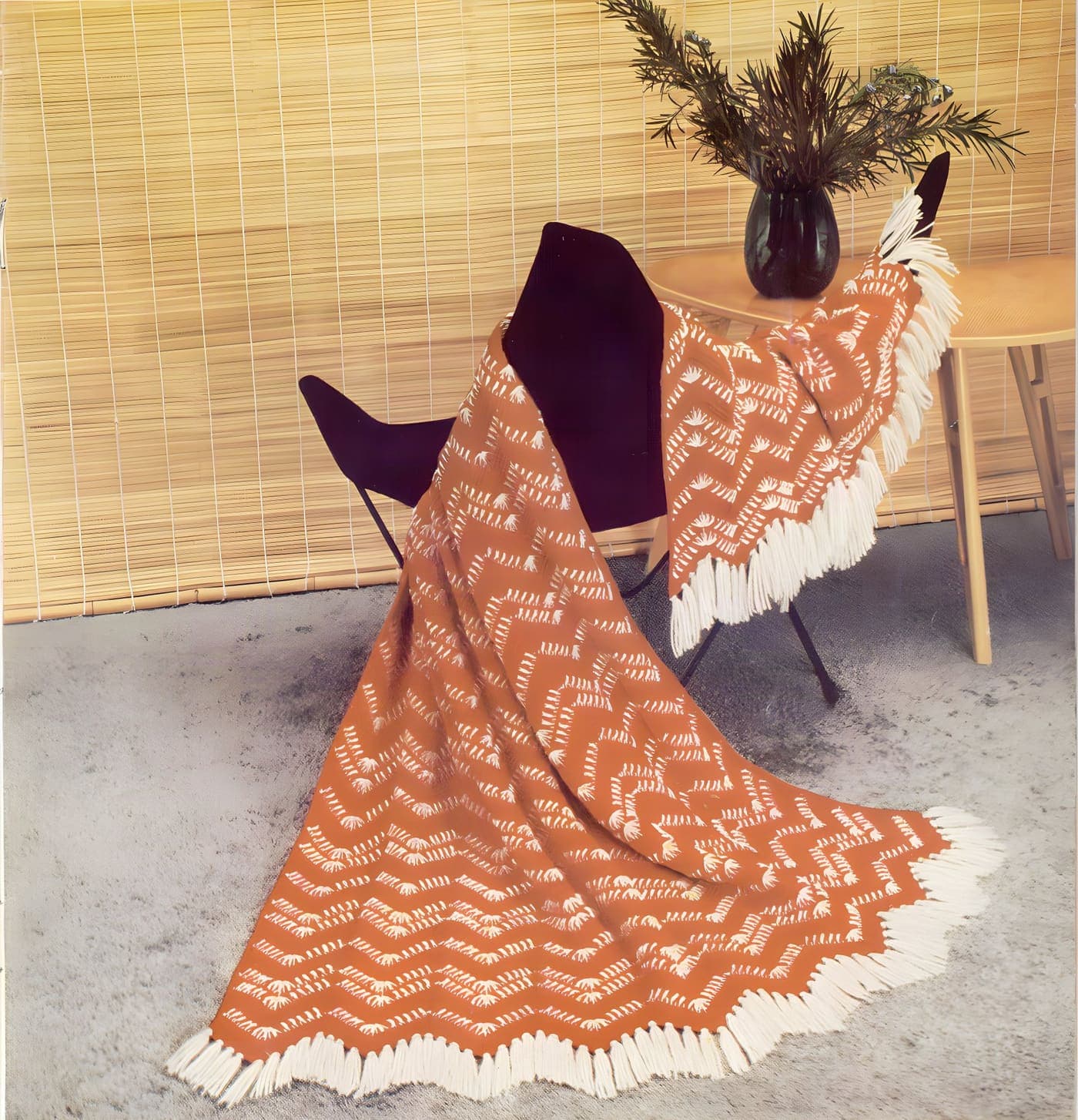
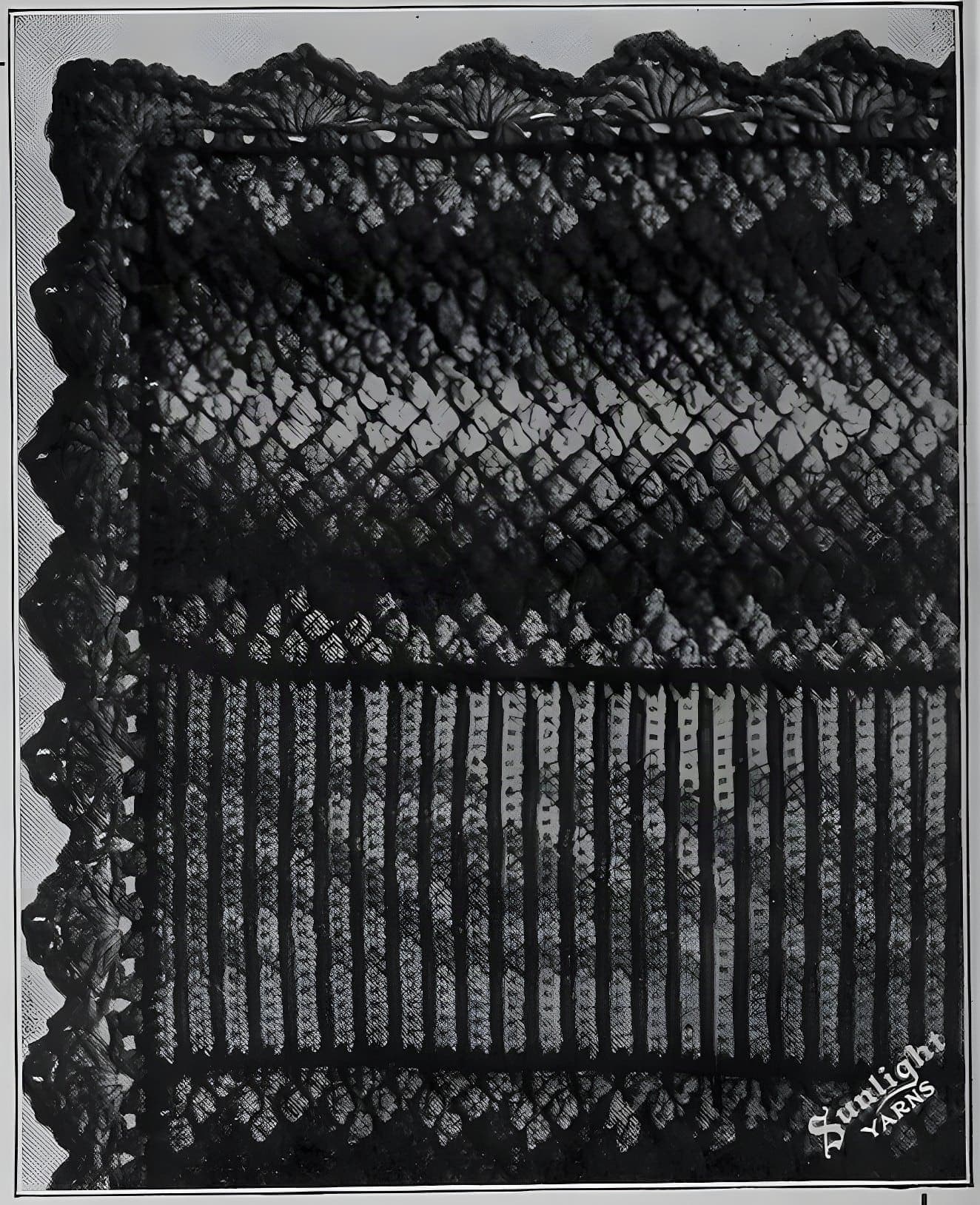
Free preview · full pattern in the Vintage Afghans & Bedspreads
Pine Tree Afghan (No. 2272): vintage crochet pattern
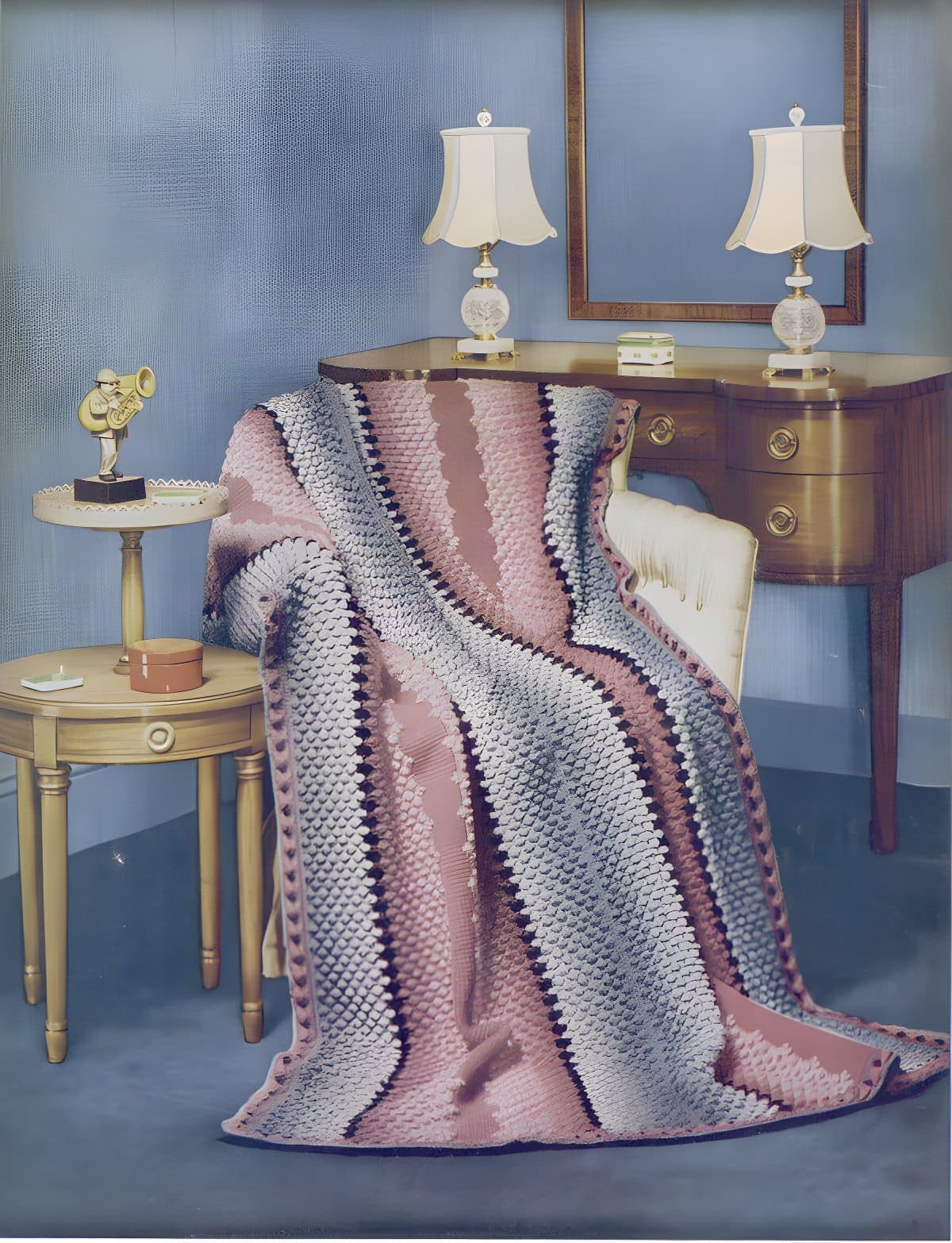
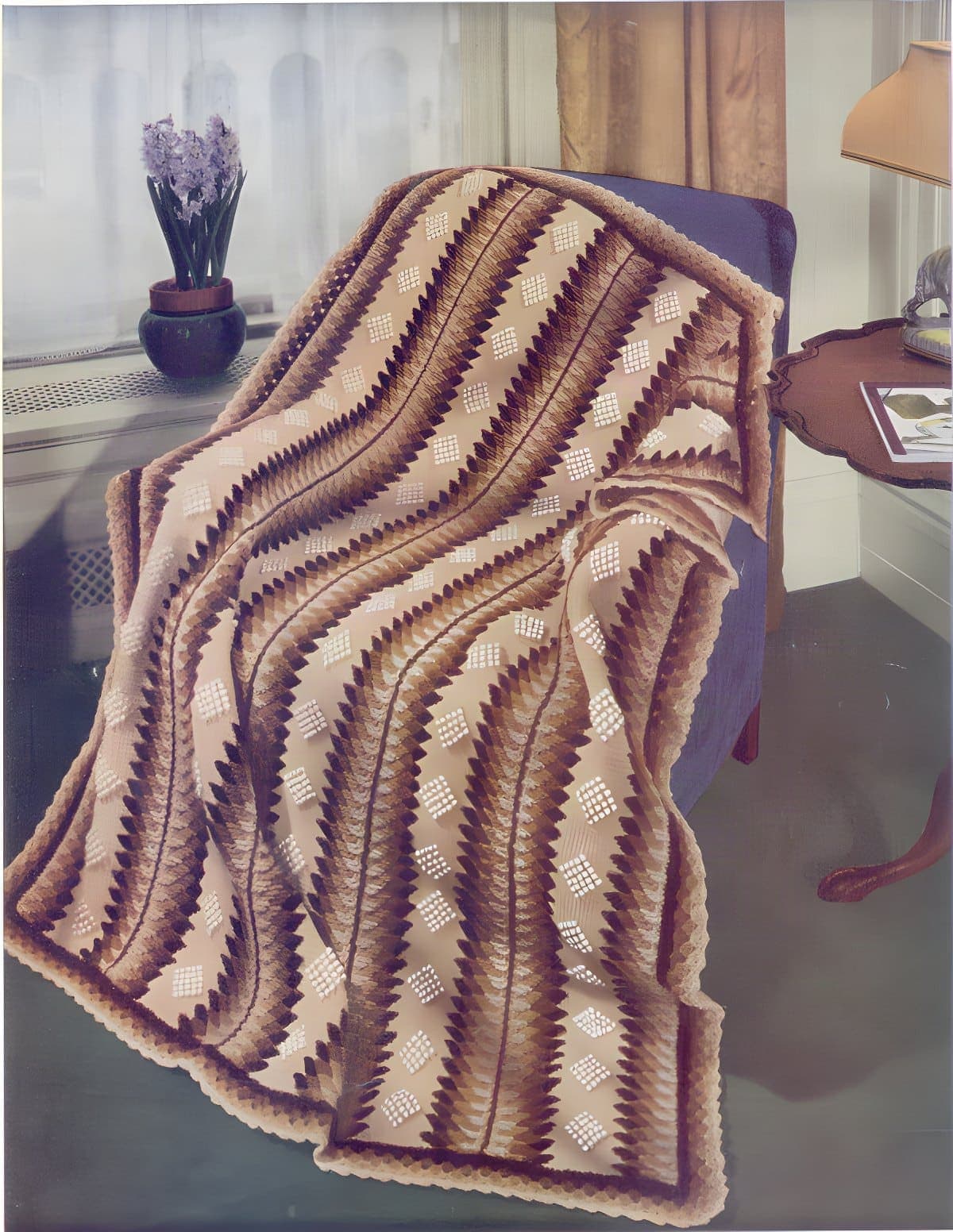
Five russet-brown afghan-stitch panels with a raised diamond pattern of chain Bead stitches, each edged on both long sides with shaded rows of sc and treble stitches in four browns. The panels are sewn together and framed with a six-round shell border.
By the crochetpatterns.io editorial team · Updated · Editorial policy · pattern testing in progress
| Detail | Value |
|---|---|
| Skill level | Advanced |
| Yarn weight | Medium (#4) |
| Yardage | 3416–3796 yd (3124–3471 m) |
| Hook | 3.75 mm |
| Gauge | Afghan stitch: 9 sts = 2 in (18 sts = 4 in / 10 cm) and 4 rows = 1 in (16 rows = 4 in / 10 cm). Shaded pattern: 4 sts and 4 rows = 1 in (16 sts and 16 rows = 4 in / 10 cm). |
| Finished size | Approximately 50 × 72 in (127 × 183 cm) |
| Time | about 12 hours |
Materials
- Worsted (#4) yarn. Bear Brand DeLuxe Knitting Worsted and Fleisher’s Superior Knitting Worsted were worsted-weight knitting yarns; substitute any worsted yarn that matches the gauge.
- Colours: 27 oz Russet Brown 380 (A), 9 oz Russet Brown 381 (B), 12 oz Russet Brown 383 (C), 12 oz Russet Brown 384 (D), 13 oz Russet Brown 40 (E).
- Original hooks: “Boye” 9-inch crochet hook Size F (afghan stitch) and “Boye” 5½-inch crochet hook Size 3 (F).
- Tapestry needle for sewing and weaving in ends.
- Hook: Start with a 3.75 mm (US F-5) afghan (Tunisian) hook for the afghan stitch panels and a 3.75 mm (US F-5) crochet hook for all other rows; change size to match the gauge.
Yarn Kit & Substitution Options
This pattern calls for 3796 yards of weight #4 yarn. Select a suggested yarn to see required skeins and estimated cost:
Caron Simply Soft · 100% Acrylic
315 yds per skein · High-yield yardage, silky no-scratch texture
13 skeins required
approx. $$71.37 total
Abbreviations (US terms)
- chain
- single crochet
- double crochet
- treble crochet
- slip stitch
- stitch
- stitches
- skip
- repeat
- round
- row
- yarn over
- space
- chain space
- back loop only
Notes before you start
- Source: "Pine Tree Afghan" (No. 2272), Your All-time Favorite Afghans to Knit or Crochet in Bear Brand and Fleisher Yarns (Vol. 44, Revised Edition), Bear Brand and Fleisher Yarns (the yarn brands named on the cover; no separate publisher is printed). Public domain in the USA.
- As printed — materials: Color Key | Ounces Needed | Bear Brand Deluxe Knitting Worsted | Fleisher’s Superior Knitting Worsted; A | 27 | Russet Brown 380 | Russet Brown 480; B | 9 | Russet Brown 381 | Russet Brown 481; C | 12 | Russet Brown 383 | Russet Brown 483; D | 12 | Russet Brown 384 | Russet Brown 484; E | 13 | Russet Brown 40 | Russet Brown 140; “Boye” 9-inch Crochet Hook, Size F.; “Boye” 5½-inch Crochet Hook, Size 3 (F).. Gauge: GAUGE: Afghan-St— 9 sts = 2 inches; 4 rows = 1 inch. Shaded Pattern— 4 sts = 1 inch; 4 rows = 1 inch.
- Modernisation note: Abbreviations updated to modern US style: "rpt" → rep, "skip" → sk, "thru" → through, "chs" → ch, "d c" → dc, "back loop of sts" → back loop only (blo). Row labels such as "Row 2—" are written as "Row 2:".
- Modernisation note: The book's rule is that "rpt from * (†) 3 times" means the pattern is made 4 times in all; such repeats are written as "rep from * 3 more times" ("once" → "once more", "twice" → "twice more") so the stitch count is unchanged. Repeats "across", "around" or "to next corner" are unchanged.
- Modernisation note: Square brackets are kept as printed: [ ] means all sts inside are worked in the same st or place, except where the bracket is followed by a number of times, when the bracketed steps are repeated.
- Modernisation note: "Afghan Stitch"/"Afghan-St" is written as "afghan stitch" (called Tunisian simple stitch today). The book's general afghan stitch directions are included as the first section.
- Modernisation note: The book lists a 9-inch and a 5½-inch crochet hook; the directions use the 9-inch (long afghan) hook for the afghan stitch pieces and the 5½-inch hook for the other rows, and are written that way here.
- Modernisation note: The printed colour and materials tables are given one table row per line, with | between columns.
- Modernisation note: "Rpt from † for pattern 15 times … (16 Diamond Patterns)" is written as "15 more times", which matches the printed 16 diamonds; row 7's "rpt between *'s once" is written as "once more" (2 Bead sts in all).
- Modernisation note: Check: rows 8, 9 and 10 say "rpt between *'s of row 7 three times", "four times" and "five times". The diamond shape (1 and 2 Bead sts on rows 6 and 7, with the starting point moving 1 loop each row) reads as 3, 4 and 5 Bead sts in all, but the book's general repeat rule would give 4, 5 and 6. The wording is left as printed — work a test diamond and compare with the photograph.
- Modernisation note: Shaded pattern row 1 is not labelled in the original; it is written as "Row 1". "SC" is written as "sc".
- Modernisation note: Check: shaded pattern rows 7 and 11 place the tr "in free loop of 2nd st of row 3/row 7" while rows 5, 6, 8, 9 and 10 place it "above next tr"; kept as printed.
- Modernisation note: Check: border rnd 2 repeats over 4 sts but rnd 1 gives no stitch count ("about 1 sc in each row along short sides"); the book does not say how to fit the repeat between corners.
- Modernisation note: The book's "FINISHING" heading (joining the strips) is written as "Joining".
- Modernisation note: The printed gauge is given on separate lines in the original; the lines are joined with semicolons.
- Modernisation note: "See page …" references were removed or pointed to the matching section or image on this page.
- Modernisation note: The blocking step is the book's general "To Block Crocheted or Knitted Afghans" directions. Modern advice (ours, not in the original): hot steam can permanently flatten acrylic yarn, so if you substitute acrylic, steam very lightly or wet-block instead.
- Modernisation note: Long printed paragraphs were split into one step per row, round or sentence; no stitches were added, removed or reordered.
- Modernisation note: Metric conversions, the CYC yarn weight, the modern hook suggestion and the yardage estimate were added; they are not in the original.
- Modernisation note: “Boye” hook sizes from this period (e.g. Size 3 (F), Size 5 (G)) were not tied to millimetres; the starting size given is a modern equivalent, and the gauge is what matters.
Row progress: 0 of 4 done (0%)
Afghan stitch (from the book's general directions)
0 of 4 done- Make a chain the desired length.Mark row complete
- Row 1: Draw up a loop in 2nd ch from hook and in each remaining ch (there will be the same number of loops on hook as the number of ch made). Complete row as follows: yo, draw through 1 loop on hook; working back, *yo, draw through 2 loops on hook; rep from * across.Mark row complete
- Row 2: Draw up a loop in 2nd bar from edge, draw up a loop in each remaining bar (there will be the same number of loops on hook as for first row), complete row as before.Mark row complete
- Rep row 2 for pattern for the required number of rows.Mark row complete
Working on:
Make a chain the desired length.
Continue this pattern
The rest of the Pine Tree Afghan (No. 2272) pattern is in the Vintage Afghans & Bedspreads
Still to come in the full pattern:
- Afghan stitch panel (make 5)
- Shaded pattern (both long sides of each panel)
- Joining
- Border
- Finishing
Included with 73 patterns for $19 — $0.26 per pattern.
Errata
No corrections have been published for this pattern. Found a mistake? Tell us and we will log the fix here with a date.
Your notes on this pattern
Keep track of the yarn, hook and changes you used. Saved in this browser only — nobody else can see it.
Frequently asked questions
Where is the Pine Tree Afghan pattern from?
It was published as "Pine Tree Afghan" in Your All-time Favorite Afghans to Knit or Crochet in Bear Brand and Fleisher Yarns (Vol. 44, Revised Edition) by Bear Brand and Fleisher Yarns (the yarn brands named on the cover; no separate publisher is printed). The publication is in the public domain in the United States; this version is transcribed and modernised by crochetpatterns.io.
What yarn or thread do I need for the Pine Tree Afghan?
medium (worsted) (#4) yarn. about 3,796 yd / 3,471 m (the book gives ounces only: 73 oz in all; assumption: ~52 yd/oz, typical of worsted-weight yarn — check your label)
What hook should I use?
Start with a 3.75 mm (US F-5) afghan (Tunisian) hook for the afghan stitch panels and a 3.75 mm (US F-5) crochet hook for all other rows; change size to match the gauge. Gauge: Afghan stitch: 9 sts = 2 in (18 sts = 4 in / 10 cm) and 4 rows = 1 in (16 rows = 4 in / 10 cm). Shaded pattern: 4 sts and 4 rows = 1 in (16 sts and 16 rows = 4 in / 10 cm).