Free preview · full pattern in the Vintage Crochet Edgings & Trims
Deep Scallop Edging for Tablecloths: vintage crochet pattern
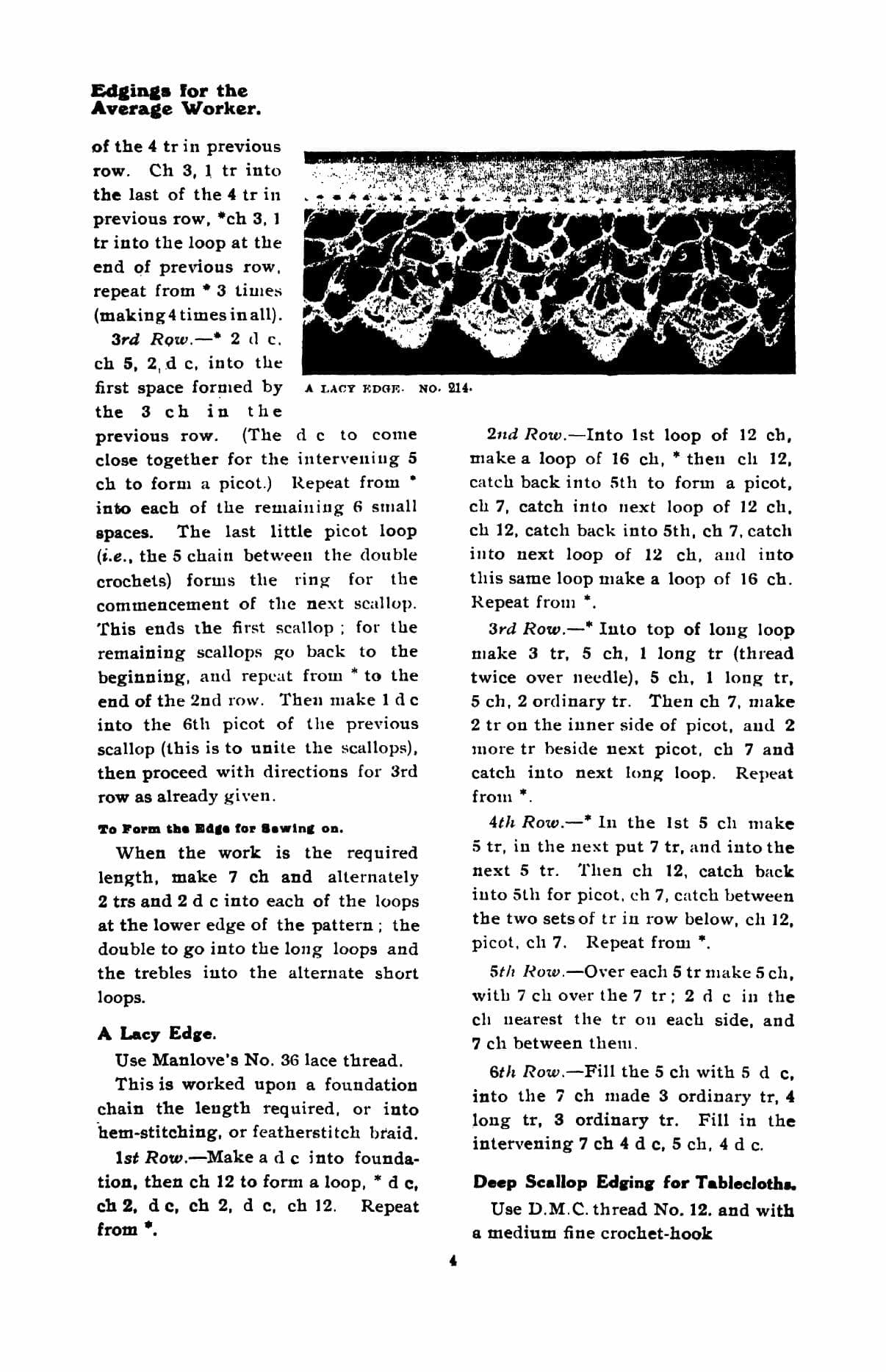
A deep, firm filet-style edging worked lengthways in rows of double crochet and chain-2 spaces, widening into a solid scallop and finished with grouped trebles and a row of six-chain picots. The book calls for a run of seven meshes at the upper edge between repeats.
By the crochetpatterns.io editorial team · Updated · Editorial policy · pattern testing in progress
| Detail | Value |
|---|---|
| Skill level | Advanced |
| Yarn weight | Lace (#0) |
| Yardage | Not printed; see modernisation notes. (as printed; yardage not given) |
| Hook | 1.65 mm |
| Gauge | Not printed; work a sample and change hook size to suit. |
| Finished size | Not printed; worked to the length required. |
| Time | about 5 hours |
Materials
- Size 10 to 20 white cotton crochet thread in place of the book's No. 12 D.M.C. thread — ours, read across by thread number
- A steel hook to suit the thread
- Hook: Start with about 1.65 mm (US steel 6) — ours, approximate. The book prints only “a medium fine crochet-hook”. Change size until the fabric is firm and even.
Yarn Kit & Substitution Options
This pattern calls for 350 yards of weight #0 yarn. Select a suggested yarn to see required skeins and estimated cost:
Caron Simply Soft · 100% Acrylic
315 yds per skein · High-yield yardage, silky no-scratch texture
2 skeins required
approx. $$10.98 total
Abbreviations (US terms)
- chain
- single crochet
- double crochet
- treble crochet
- space
- repeat
- stitch
- skip
Notes before you start
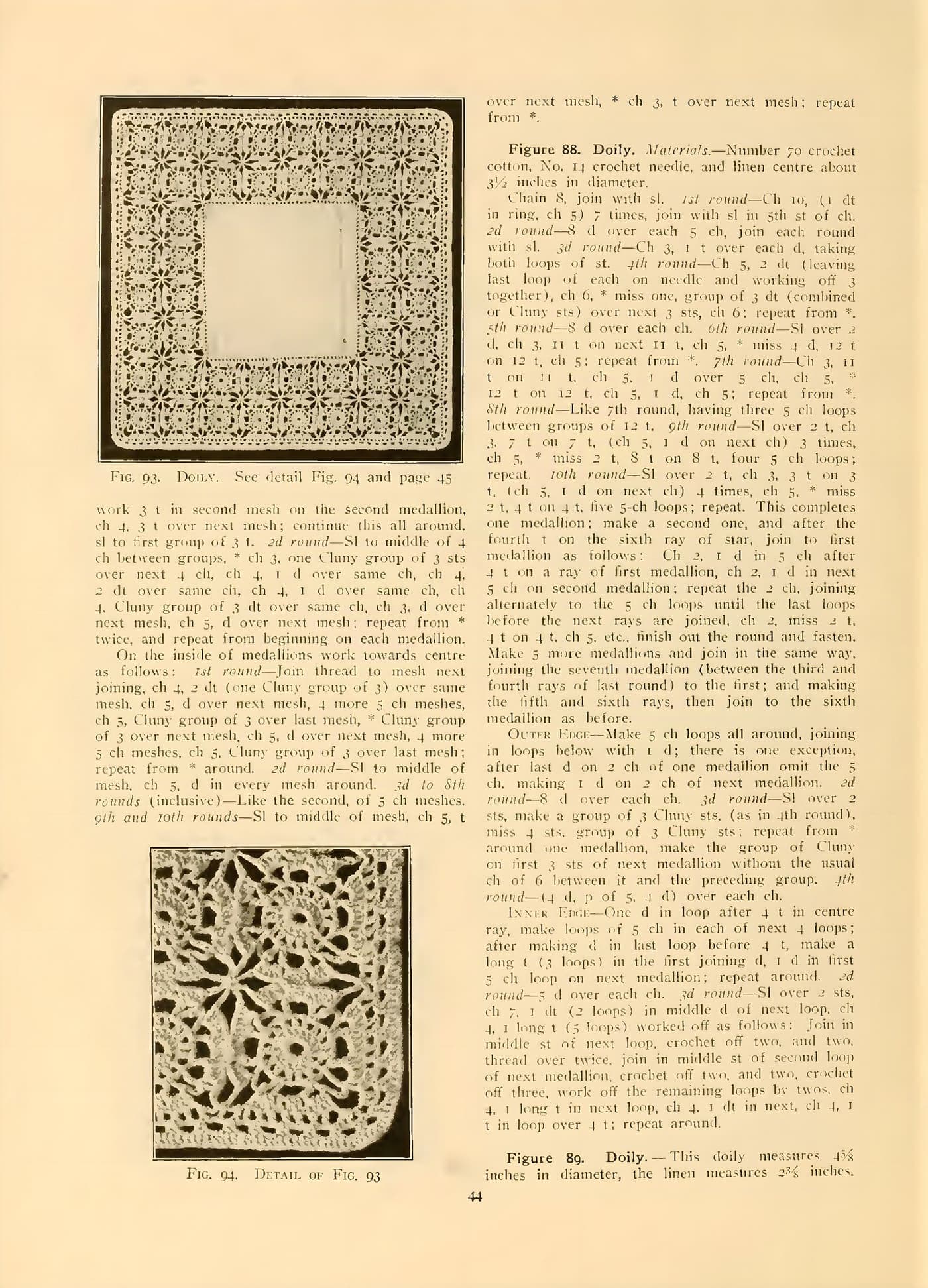
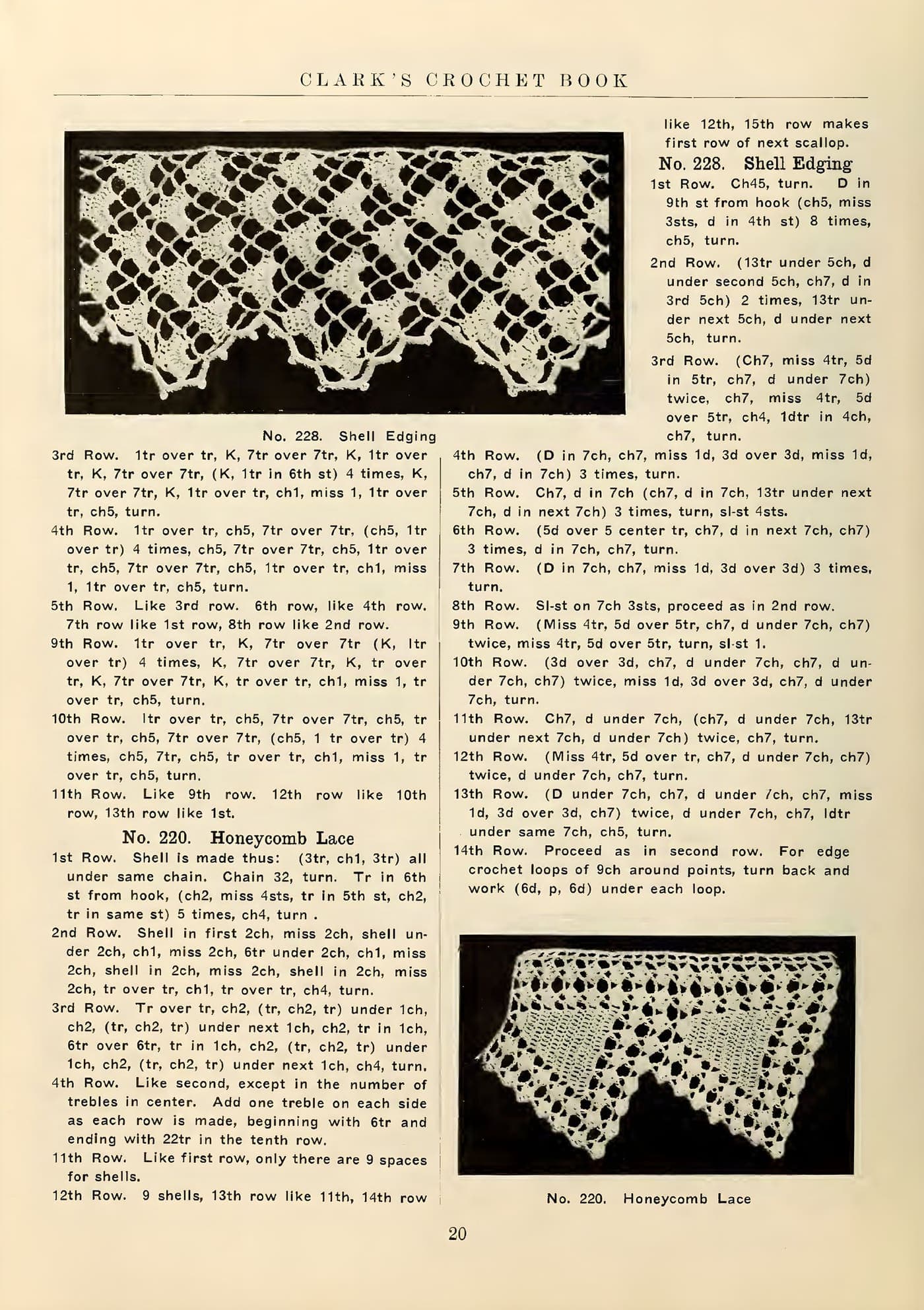
- Source: "Deep Scallop Edging for Tablecloths", The Home Art Crochet Book (edited by Flora Klickmann), The Office of “The Girl's Own Paper & Woman's Magazine”, 4 Bouverie Street E.C., & 65 St. Paul's Churchyard, London; printed by Curtis & Beamish, Ltd., Coventry, England. Public domain in the USA.
- As printed — materials: Use D.M.C. thread No. 12, and a medium fine crochet-hook.. Gauge: Not given.
- Modernisation note: Stitches are converted by this book's own printed key and its own printed wrap counts, not by stitch name. This is a BRITISH book. The key stands at the head of book page 1 (image p-008.jpg) under the heading “Abbreviations used.” and reads: “ch = chain ; s c = single crochet ; d c = double crochet ; tr = treble ; d tr = double treble ; l tr = long treble ; sp = space ; st = stitch.” The book then glosses its tall stitches with wrap counts in the directions themselves, which fixes the ladder beyond argument: “turn the thread twice around the needle for a long tr” (book page 2) and “3 long tr (thread twice over hook)” (book page 9) make the long treble a 2-wrap, 4-loop stitch — the modern US treble; “3 triple tr into the ring (thread three times over the needle)” (book page 6) makes the triple treble a 3-wrap, 5-loop stitch — the modern US double treble; and “a quadruple tr (thread four times over the needle)” (book page 13) takes 4 wraps. Counting back down that ladder the book's plain tr can only be a 1-wrap, 3-loop stitch, which is the modern US double crochet, and its d c — worked with no wrap — is the modern US single crochet. Its “s c”, the old British single crochet, is the flat joining stitch and is written sl st. So here: d c = sc, tr = dc, long tr and d tr = tr, triple tr = dtr, s c = sl st, miss = sk.
- Modernisation note: The printed directions run as solid paragraphs, and where the book numbers its rows it does so as “1st Row.”, “2nd Row.” and so on. They are split here into one row or step per line and the ordinals are written Row 1, Row 2, Row 3. Where the book starts a new row with only “Turn with …” and no number, a number is supplied in sequence and the change is noted. Stitch order and counts are unchanged.
- Modernisation note: The scan of this book carries the usual optical-reading slips and every figure below was read back against the page image: the scan's “lst” and “Ist” are 1st, its “8rd” is 3rd, its “11zh” is 11th, its “de” for a stitch is d c, its “ir” is tr, its “trs” is tr, its “inte” is into, its “imsert” is insert, its “donble” is double, its “crocliet” is crochet, and its “miss3 ch” is miss 3 ch. These are scanning artefacts, not printed errors, and they are corrected silently in the rows; genuine PRINTED slips are a different matter and are always flagged with a “Check:” note instead of being quietly mended.
- Modernisation note: Hooks are printed only as period British maker's numbers (“No. 6 crochet-hook”, “No. 5 hook”, “a medium fine crochet-hook”) with no diameters, and those numbers do not map onto the modern scale. Any metric size given in the modern materials is ours and is a starting point only.
- Modernisation note: No gauge, tension or stitch-per-inch figure is printed for this design, or for any design in this book. Work a sample and change hook size to suit the thread.
- Modernisation note: No yardage is estimated. The book never prints a ball length, a reel length or a quantity for any design — it names a thread and a hook and nothing more — so there is no printed basis for a yardage figure and none is invented here.
- Modernisation note: No finished measurement is printed for this design. Like every edging and insertion in this book it is worked to the length required, and its depth is set by the stitch counts printed, not by any measurement the book gives.
- Modernisation note: Thread brands are listed exactly as printed. Ardern's, Manlove's and D.M.C. were the British and Continental cotton brands the book's readers bought; the higher the number the finer the thread, on the same principle as modern crochet cotton sizing. Where the book names a size, that size is kept as printed.
- Modernisation note: The design runs across a page turn, from the foot of book page 4 to book page 5 (images p-011.jpg and p-012.jpg). Both halves print in full and are joined here unchanged.
- Modernisation note: The book numbers none of these rows, naming each only by its turning chain. They are given one per line above in printed order; no numbers are imposed.
- Modernisation note: Check: one printed row reads “1 long tr into third d c, 2 ch, 1 long tr into every second d c” and then simply stops, with no closing instruction for the end of that row. It is transcribed exactly that far and no ending is invented.
Row progress: 0 of 14 done (0%)
The scallop
0 of 14 done- Ch 27, turn, 1 dc into the 19th ch, ch 2, 1 dc into each third ch.Mark row complete
- Turn, ch 5, 1 dc into the next dc, ch 2, 1 dc into the next dc, 2 dc into the next 2 ch, 1 dc into the next dc, ch 2, 1 dc into the next dc, 2 dc into the next 2 ch, 1 dc into the next dc, ch 2, 10 dc into the next space.Mark row complete
- Turn, ch 4, 1 dc into the next dc, ch 1, 1 dc into each of the next 9 dc, ch 2, 1 dc into the next dc, ch 2, 1 dc into the third dc, ch 2, 1 dc into the next dc, ch 2, 1 dc into the third dc, ch 2, 1 dc into the next dc and the next third ch.Mark row complete
- Ch 5 to turn, 1 dc into the next dc, ch 2, 1 dc into the next dc and each of the next 2 ch and the next dc, ch 2, 1 dc into the next dc, ch 2, 1 dc into each third stitch to the end.Mark row complete
- Ch 5 to turn, 1 dc into the next dc, ch 2, 1 dc into the next dc, the next 2 ch and the next dc, ch 2, 1 dc into the next dc, the next 2 ch and the next dc, ch 2, 1 dc into the next dc, ch 2, 1 dc into the next dc, 3 dc into each space to the top, 10 dc into the last space.Mark row complete
- Turn, ch 6, into the next sixth dc and every sixth dc following put 2 dc, ch 2, 2 dc, with ch 3 between the groups of dc, ch 3, 1 dc into the last of the consecutive dc, and ch 2, 1 dc into every third stitch to the end.Mark row complete
- Ch 5 to turn, 1 dc into the next space, ch 2, 1 dc into each of the next eight spaces, ch 2, 1 dc into the next dc and into each third stitch to the end.Mark row complete
- Ch 5 to turn, 1 dc into the next dc, ch 2, 1 dc into the next dc, 1 dc into each of the next 2 ch and the next dc, ch 2, 1 dc into the next dc, 1 dc into each of the next three stitches, ch 2, 1 dc into the next dc, ch 2, 1 dc into the next dc, 1 dc into each stitch to the top.Mark row complete
- Turn, ch 5, 1 dc into the third dc, ch 2, 1 dc into every third dc to the end of the consecutive dc, ch 2, 1 dc into each third stitch to the end.Mark row complete
- Ch 5 to turn, 1 dc into the next dc, ch 2, 1 dc into the next dc, the next 2 ch and the following dc, ch 2, 1 dc into the next dc, the next 2 ch and the following dc, ch 2, 1 dc into the next dc, ch 3, 1 sc into the next dc, 3 sc into each space to the top.Mark row complete
- Ch 6 to turn, 1 tr into the third sc, ch 2, 1 tr into every second sc.Mark row complete
- Ch 5 to turn, 1 dc into the next dc, ch 2, 1 dc into the next dc, and into the 2 ch and the following dc, ch 2, 1 dc into the next dc, the 2 ch and the following dc, ch 2, 1 dc into the next dc, ch 2, 1 dc into the next dc, ch 3, and repeat the last row from this to the top, putting the groups of dc into the space between the 2 dc.Mark row complete
- Turn, ch 9, picot 6 of them, 1 dc into the space between the dc, ch 6 picot followed by a dc, twice into the same space, * ch 3, 1 sc over the centre of the two chains beneath, ch 3, 1 dc followed by a ch 6 picot into the next space three times, then 1 dc into the same space, and repeat from *.Mark row complete
- Work three rows of the seven meshes at the upper portion, and then repeat from the first row, taking in the ends of the picots in the preceding scallop to the end of the last row of dc.Mark row complete
Working on:
Ch 27, turn, 1 dc into the 19th ch, ch 2, 1 dc into each third ch.
Continue this pattern
The rest of the Deep Scallop Edging for Tablecloths pattern is in the Vintage Crochet Edgings & Trims
Still to come in the full pattern:
- Finishing
Included with 618 patterns for $9 — $0.01 per pattern.
Errata
No corrections have been published for this pattern. Found a mistake? Tell us and we will log the fix here with a date.
Your notes on this pattern
Keep track of the yarn, hook and changes you used. Saved in this browser only — nobody else can see it.
Frequently asked questions
Where is the Deep Scallop Edging for Tablecloths pattern from?
It was published as "Deep Scallop Edging for Tablecloths" in The Home Art Crochet Book (edited by Flora Klickmann) by The Office of “The Girl's Own Paper & Woman's Magazine”, 4 Bouverie Street E.C., & 65 St. Paul's Churchyard, London; printed by Curtis & Beamish, Ltd., Coventry, England. The publication is in the public domain in the United States; this version is transcribed and modernised by crochetpatterns.io.
What yarn or thread do I need for the Deep Scallop Edging for Tablecloths?
About size 10 to 20 crochet cotton (the book prints D.M.C. No. 12). Not printed; see modernisation notes.
What hook should I use?
Start with about 1.65 mm (US steel 6) — ours, approximate. The book prints only “a medium fine crochet-hook”. Change size until the fabric is firm and even. Gauge: Not printed; work a sample and change hook size to suit.