Free preview · full pattern in the Vintage Crochet Edgings & Trims
Edged Filet Yoke with Large Flowers (1921): vintage crochet pattern
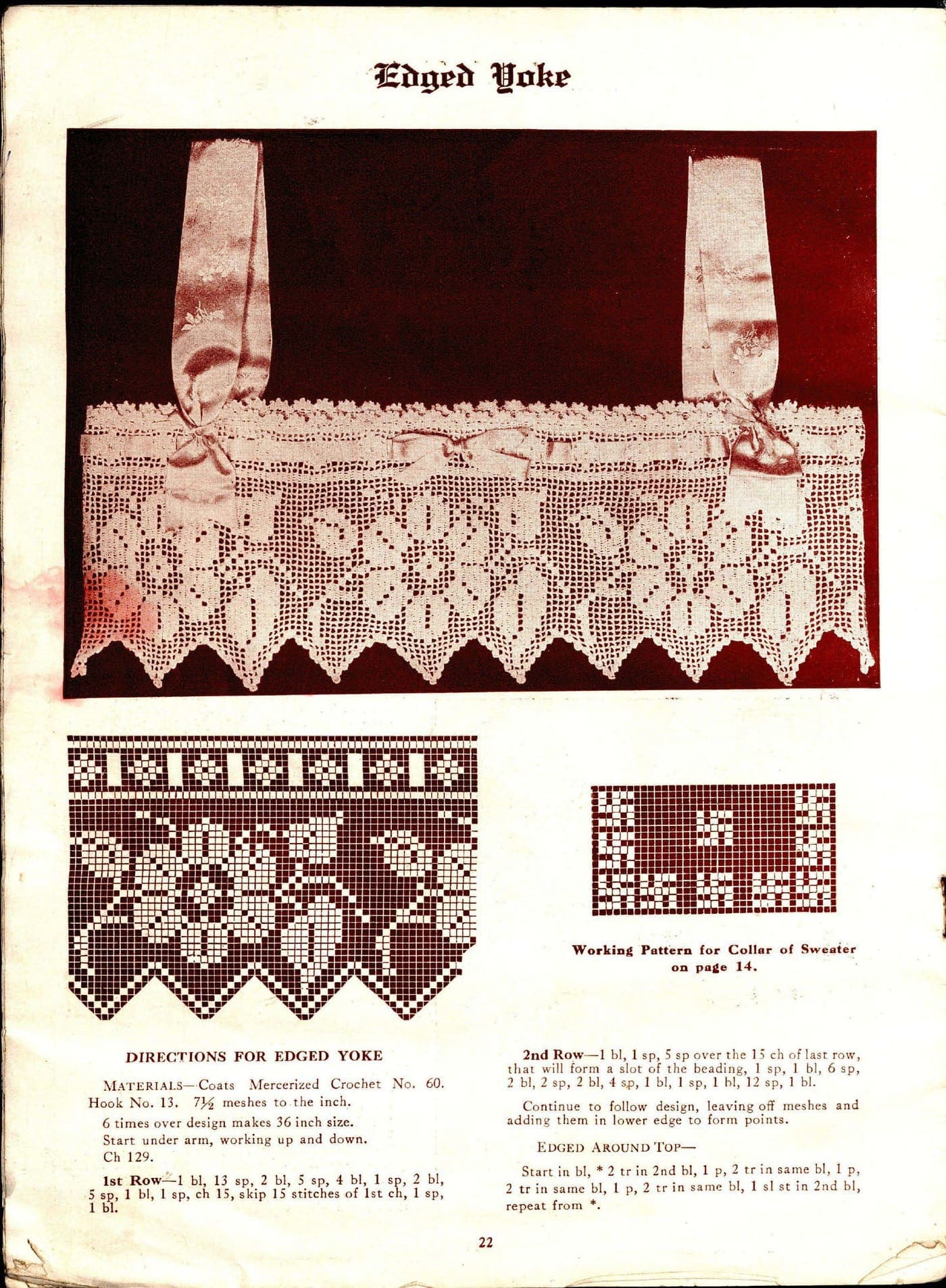
A straight filet crochet lingerie yoke with a band of large flowers and leaves above a pointed lower edge, a ribbon slot beading along the top and a picot shell edge. Originally published as "Edged Yoke" in J. & P. Coats Crochet Book No. 7: Sweaters, Yokes, and Boudoir Caps (designed by Anne Orr) by J. & P..
By the crochetpatterns.io editorial team · Updated · Editorial policy · pattern testing in progress
| Detail | Value |
|---|---|
| Skill level | Intermediate |
| Yarn weight | Lace (#0) |
| Yardage | Not printed. (as printed; yardage not given) |
| Hook | 0.85 mm |
| Gauge | 7½ filet meshes = 1 in (2.5 cm). |
| Finished size | 36 inch size with 6 repeats of the design. Yoke is 42 meshes deep at 7½ meshes to the inch (calculated: about 5⅝ in / 14 cm) at the start. |
| Time | about 2 hours |
Materials
- Size 60 mercerized cotton crochet thread — approximate equivalent of Coats Mercerized Crochet No. 60
- Steel crochet hook (original: No. 13)
- Ribbon for the beading slots
- Sewing needle and thread
- Hook: Start with 0.85 mm (steel hook US steel No. 13) — approximate conversion of the printed No. 13 hook; change size to match the printed meshes to the inch.
Yarn Kit & Substitution Options
This pattern calls for 350 yards of weight #0 yarn. Select a suggested yarn to see required skeins and estimated cost:
Caron Simply Soft · 100% Acrylic
315 yds per skein · High-yield yardage, silky no-scratch texture
2 skeins required
approx. $$10.98 total
Abbreviations (US terms)
- chain
- slip stitch
- double crochet
- skip
- stitches
- space
- repeat
- row
Notes before you start
- Source: "Edged Yoke", J. & P. Coats Crochet Book No. 7: Sweaters, Yokes, and Boudoir Caps (designed by Anne Orr), J. & P. Coats, Pawtucket, R.I., 1921. Public domain in the USA.
- As printed — materials: Coats Mercerized Crochet No. 60; Hook No. 13. Gauge: 7½ meshes to the inch. 6 times over design makes 36 inch size..
- Modernisation note: Stitches converted by the book's own stitch key (“Abbreviation Stitches and How to Make Them”), not by name. Its slip stitch (sl st) = sl st. Its single stitch (s st: “insert the needle in the stitch directed, draw the working thread through this stitch, making two on the needle, then draw the working thread through these two loops”) = modern US sc. Its treble crochet (tr: thread around the needle once, draw through, then through two loops twice; “three chains equal one treble”) = modern US dc. Its double treble (dtr: thread around twice, loops worked off two at a time three times) = modern US tr. Its triple treble (tr tr: thread around three times) = modern US dtr. So every “s st” is written sc, every “tr” dc, and every “d tr” tr.
- Modernisation note: Filet crochet as the book defines it: a space (sp) is 1 dc, ch 2, sk 2 sts, 1 dc (“For a space at the beginning of a row, chain five, which allows three for the treble on the edge, and two for the usual chain”); a block (bl, written “block” here) is dc worked in consecutive sts — “there are four trebles in the first block and three trebles in each following block”, so a row of blocks has 3 dc per block plus 1. Ch 3 at the beginning of a row counts as the first dc.
- Modernisation note: The book's “New Method of Adding Meshes at Last End of Row” (book page 4), for rows where the directions or chart add meshes at the end of a row: instead of making the last dc of the block already there, ch 2 and sl st into the loop where that last dc would go; then ch long enough for the extra meshes (ch 6 for 1 mesh, ch 9 for 2, ch 12 for 3, adding 3 ch for each further mesh); turn and work spaces or blocks along the ch as the chart shows; sl st to the top of the last mesh before the added ch; turn, sl st to the end of the added meshes, and you are ready to start the next row. Adding meshes at the beginning of a row is done the usual way, by working extra blocks or spaces on a ch made at the end of the preceding row.
- Modernisation note: Period wording modernised: s st, tr, d tr written as sc, dc, tr (see the stitch note); “bl” written as block; “sp” kept as sp (filet space); “p” written as picot; “needle” (the crochet hook) as hook; “throw cotton over” as yo; “skip” as sk; “fasten”/“fasten cotton” as join thread; “break cotton” as fasten off; “repeat” as rep; “drop off”/“leave off” meshes kept as printed (stop working over those meshes); ordinal row names (“1st Row”) written as Row 1, and “Row” is kept even where a piece is worked round (as the book does).
- Modernisation note: Picot as the book defines it: “usually made by a chain of three or five, then a slip stitch in the first chain.” The size is not given in the individual designs, so use ch 3 (or ch 5 for a larger picot), sl st in the first ch.
- Modernisation note: The filet charts (the book's “working patterns” or “design”) are printed as pictures and are not transcribed square by square here; rows that say “follow design” are kept as printed, and the chart page is listed with this pattern's images. Each chart square is one mesh: a filled square is a block, an open square is a space.
- Modernisation note: Long printed paragraphs are split into one row or step per line; stitch order and counts unchanged. Section headings added for navigation.
- Modernisation note: Hooks are 1921 steel crochet hook numbers; the book prints no diameters. The metric sizes given use the modern US steel-hook scale (No. 2 ≈ 2.2 mm, No. 7 ≈ 1.65 mm, No. 8 ≈ 1.5 mm, No. 10 ≈ 1.3 mm, No. 12 ≈ 1.0 mm, No. 13 ≈ 0.85 mm, No. 14 ≈ 0.75 mm) and are approximate only — period numbering may differ, so match the printed meshes to the inch instead. The book's own table pairs, for example, size 5 thread with a No. 2 hook for 3 meshes to the inch, size 70 thread with a No. 12 hook for 8 meshes, and size 100 thread with a No. 14 hook for 9½–10 meshes, and warns that “if the thread is loosely held, the meshes will increase to the inch”.
- Modernisation note: Threads are 1921 J. & P. Coats products with no exact modern equivalent. Approximate modern equivalents: Coats Mercerized Crochet No. 30–100 as mercerized cotton crochet thread of the same size number; Coats Pearl Cotton No. 5 as size 5 pearl (perle) cotton. The book prints no yardage or ball counts, so no yardage is given.
- Modernisation note: “Meshes to the inch” is the book's gauge: count filet meshes (spaces or blocks) across 1 in (2.5 cm) of work.
- Modernisation note: The book's heading “Edged Around Top” is written “Edge around top”.
- Modernisation note: Row counts check: Row 1 totals 42 meshes (counting the ch-15 slot as 5 meshes), which matches the ch 129.
- Modernisation note: Check: Row 2 as printed totals 41 meshes, one fewer than Row 1; follow the chart (the lower edge begins shaping the points here).
- Modernisation note: Check: the top edge's sl st is in the “2nd bl” after the shell, so each rep spans about 2 blocks; adjust to fit the beading.
- Modernisation note: Metric conversions added.
Row progress: 0 of 6 done (0%)
Yoke
0 of 6 done- 6 times over the design makes 36 inch size.Mark row complete
- Start under arm, working up and down.Mark row complete
- Ch 129.Mark row complete
- Row 1: 1 block, 13 sp, 2 blocks, 5 sp, 4 blocks, 1 sp, 2 blocks, 5 sp, 1 block, 1 sp, ch 15, sk 15 sts of 1st ch, 1 sp, 1 block.Mark row complete
- Row 2: 1 block, 1 sp, 5 sp over the 15 ch of last row (that will form a slot of the beading), 1 sp, 1 block, 6 sp, 2 blocks, 2 sp, 2 blocks, 4 sp, 1 block, 1 sp, 1 block, 12 sp, 1 block.Mark row complete
- Continue to follow the design, leaving off meshes and adding them in the lower edge to form points.Mark row complete
Working on:
6 times over the design makes 36 inch size.
Continue this pattern
The rest of the Edged Filet Yoke with Large Flowers (1921) pattern is in the Vintage Crochet Edgings & Trims
Still to come in the full pattern:
- Edge around top
- Finishing
Included with 618 patterns for $9 — $0.01 per pattern.
Errata
No corrections have been published for this pattern. Found a mistake? Tell us and we will log the fix here with a date.
Your notes on this pattern
Keep track of the yarn, hook and changes you used. Saved in this browser only — nobody else can see it.
Frequently asked questions
Where is the Edged Yoke pattern from?
It was published as "Edged Yoke" in J. & P. Coats Crochet Book No. 7: Sweaters, Yokes, and Boudoir Caps (designed by Anne Orr) by J. & P. Coats, Pawtucket, R.I. in 1921. The publication is in the public domain in the United States; this version is transcribed and modernised by crochetpatterns.io.
What yarn or thread do I need for the Edged Yoke?
Size 60 crochet cotton (approximate; original Coats Mercerized Crochet No. 60). Not printed.
What hook should I use?
Start with 0.85 mm (steel hook US steel No. 13) — approximate conversion of the printed No. 13 hook; change size to match the printed meshes to the inch. Gauge: 7½ filet meshes = 1 in (2.5 cm).