Free preview · full pattern in the Vintage Crochet Fashion
Butterfly Filet Breakfast Jacket (1921): vintage crochet pattern
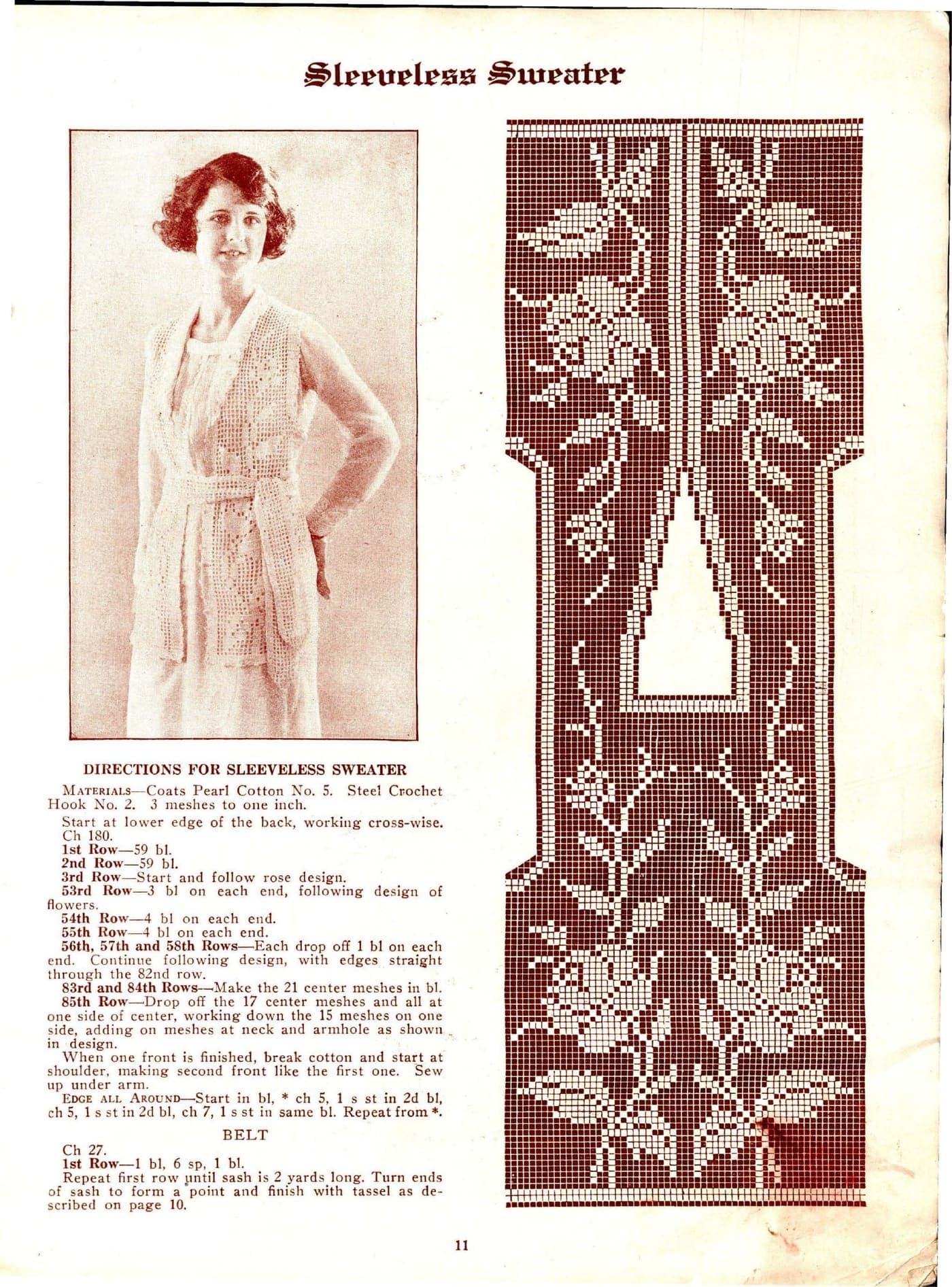
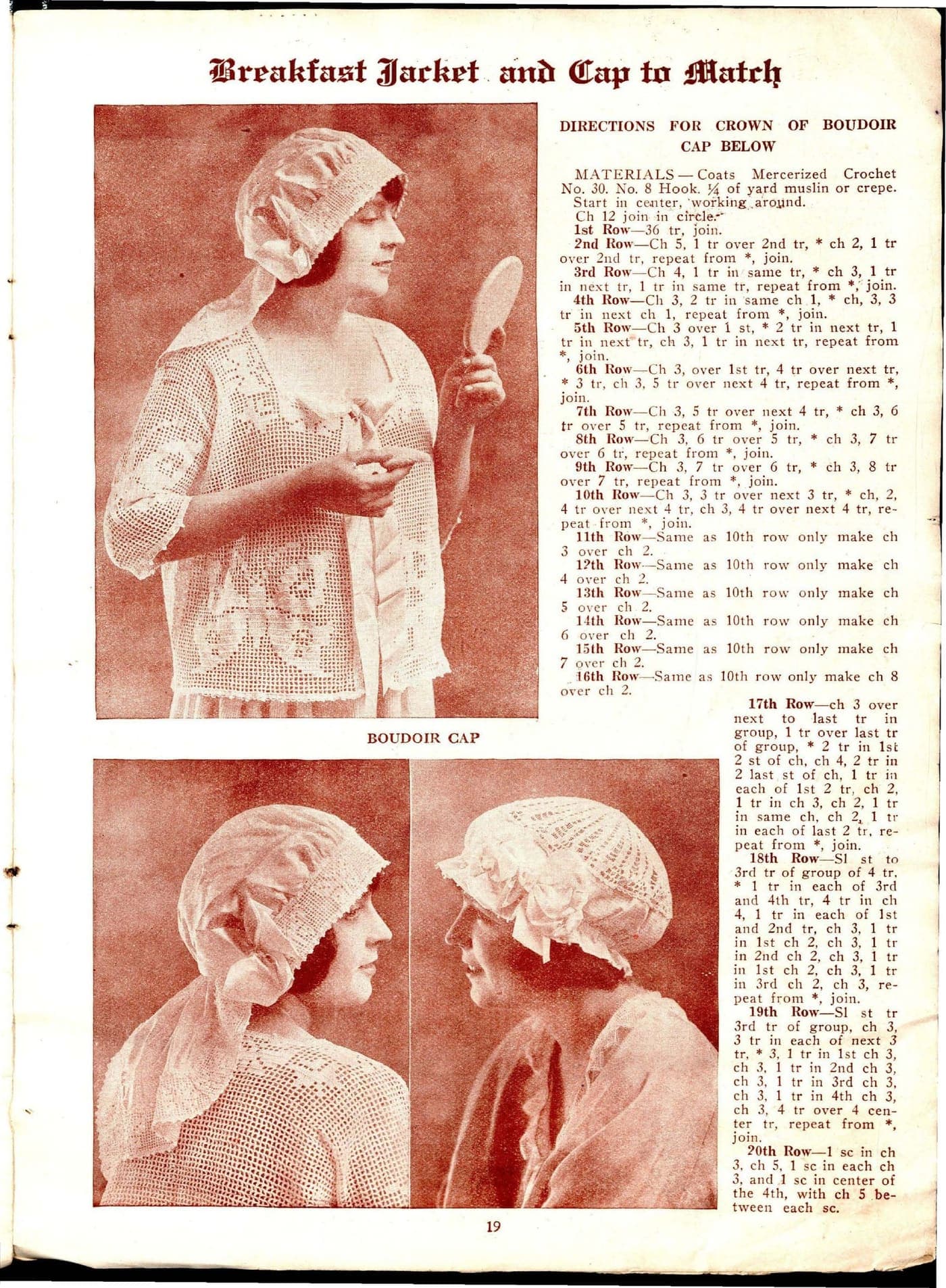
A short filet crochet breakfast (bed) jacket in pearl cotton with elbow-length kimono sleeves and large butterflies, worked crosswise in one piece from the lower back, with a picot loop edge and ribbon keepers. Originally published as "Breakfast Jacket (Butterflies)" in J. & P. Coats Crochet Book No. 7: Sweaters, Yokes, and Boudoir Caps (designed by Anne Orr).
By the crochetpatterns.io editorial team · Updated · Editorial policy · pattern testing in progress
| Detail | Value |
|---|---|
| Skill level | Intermediate |
| Yarn weight | Lace (#0) |
| Yardage | Not printed. (as printed; yardage not given) |
| Hook | 1.65 mm |
| Gauge | 4½ filet meshes = 1 in (2.5 cm). |
| Finished size | Not printed. Back 95 meshes wide by Row 6 at 4½ meshes to the inch (calculated: about 21 in / 53.5 cm); see the Check note on Row 1. |
| Time | about 5 hours |
Materials
- Size 5 pearl (perle) cotton — approximate equivalent of Coats Pearl Cotton No. 5
- Steel crochet hook (original: No. 7)
- Ribbon for the ties (not printed; shown in the photograph)
- Tapestry needle
- Hook: Start with 1.65 mm (steel hook US steel No. 7) — approximate conversion of the printed No. 7 hook; change size to match the printed meshes to the inch.
Yarn Kit & Substitution Options
This pattern calls for 350 yards of weight #0 yarn. Select a suggested yarn to see required skeins and estimated cost:
Caron Simply Soft · 100% Acrylic
315 yds per skein · High-yield yardage, silky no-scratch texture
2 skeins required
approx. $$10.98 total
Abbreviations (US terms)
- chain
- single crochet
- double crochet
- space
- repeat
- row
Notes before you start
- Source: "Breakfast Jacket (Butterflies)", J. & P. Coats Crochet Book No. 7: Sweaters, Yokes, and Boudoir Caps (designed by Anne Orr), J. & P. Coats, Pawtucket, R.I., 1921. Public domain in the USA.
- As printed — materials: Coats Pearl Cotton No. 5; No. 7 Hook. Gauge: 4½ meshes to inch.
- Modernisation note: Stitches converted by the book's own stitch key (“Abbreviation Stitches and How to Make Them”), not by name. Its slip stitch (sl st) = sl st. Its single stitch (s st: “insert the needle in the stitch directed, draw the working thread through this stitch, making two on the needle, then draw the working thread through these two loops”) = modern US sc. Its treble crochet (tr: thread around the needle once, draw through, then through two loops twice; “three chains equal one treble”) = modern US dc. Its double treble (dtr: thread around twice, loops worked off two at a time three times) = modern US tr. Its triple treble (tr tr: thread around three times) = modern US dtr. So every “s st” is written sc, every “tr” dc, and every “d tr” tr.
- Modernisation note: Filet crochet as the book defines it: a space (sp) is 1 dc, ch 2, sk 2 sts, 1 dc (“For a space at the beginning of a row, chain five, which allows three for the treble on the edge, and two for the usual chain”); a block (bl, written “block” here) is dc worked in consecutive sts — “there are four trebles in the first block and three trebles in each following block”, so a row of blocks has 3 dc per block plus 1. Ch 3 at the beginning of a row counts as the first dc.
- Modernisation note: The book's “New Method of Adding Meshes at Last End of Row” (book page 4), for rows where the directions or chart add meshes at the end of a row: instead of making the last dc of the block already there, ch 2 and sl st into the loop where that last dc would go; then ch long enough for the extra meshes (ch 6 for 1 mesh, ch 9 for 2, ch 12 for 3, adding 3 ch for each further mesh); turn and work spaces or blocks along the ch as the chart shows; sl st to the top of the last mesh before the added ch; turn, sl st to the end of the added meshes, and you are ready to start the next row. Adding meshes at the beginning of a row is done the usual way, by working extra blocks or spaces on a ch made at the end of the preceding row.
- Modernisation note: Period wording modernised: s st, tr, d tr written as sc, dc, tr (see the stitch note); “bl” written as block; “sp” kept as sp (filet space); “p” written as picot; “needle” (the crochet hook) as hook; “throw cotton over” as yo; “skip” as sk; “fasten”/“fasten cotton” as join thread; “break cotton” as fasten off; “repeat” as rep; “drop off”/“leave off” meshes kept as printed (stop working over those meshes); ordinal row names (“1st Row”) written as Row 1, and “Row” is kept even where a piece is worked round (as the book does).
- Modernisation note: Picot as the book defines it: “usually made by a chain of three or five, then a slip stitch in the first chain.” The size is not given in the individual designs, so use ch 3 (or ch 5 for a larger picot), sl st in the first ch.
- Modernisation note: The filet charts (the book's “working patterns” or “design”) are printed as pictures and are not transcribed square by square here; rows that say “follow design” are kept as printed, and the chart page is listed with this pattern's images. Each chart square is one mesh: a filled square is a block, an open square is a space.
- Modernisation note: Long printed paragraphs are split into one row or step per line; stitch order and counts unchanged. Section headings added for navigation.
- Modernisation note: Hooks are 1921 steel crochet hook numbers; the book prints no diameters. The metric sizes given use the modern US steel-hook scale (No. 2 ≈ 2.2 mm, No. 7 ≈ 1.65 mm, No. 8 ≈ 1.5 mm, No. 10 ≈ 1.3 mm, No. 12 ≈ 1.0 mm, No. 13 ≈ 0.85 mm, No. 14 ≈ 0.75 mm) and are approximate only — period numbering may differ, so match the printed meshes to the inch instead. The book's own table pairs, for example, size 5 thread with a No. 2 hook for 3 meshes to the inch, size 70 thread with a No. 12 hook for 8 meshes, and size 100 thread with a No. 14 hook for 9½–10 meshes, and warns that “if the thread is loosely held, the meshes will increase to the inch”.
- Modernisation note: Threads are 1921 J. & P. Coats products with no exact modern equivalent. Approximate modern equivalents: Coats Mercerized Crochet No. 30–100 as mercerized cotton crochet thread of the same size number; Coats Pearl Cotton No. 5 as size 5 pearl (perle) cotton. The book prints no yardage or ball counts, so no yardage is given.
- Modernisation note: “Meshes to the inch” is the book's gauge: count filet meshes (spaces or blocks) across 1 in (2.5 cm) of work.
- Modernisation note: Sizes are rarely printed; vintage fit and ease differ from today's. Widths marked “calculated” are ours, from the printed mesh count and meshes to the inch — compare them with a garment that fits before starting.
- Modernisation note: Check: Row 1 is printed as 148 blocks and Rows 2–5 as 1 block, 146 sp, 1 block (148 meshes), but the foundation of ch 288 and Row 6 (1 + 9 + 4 + 25 + 4 + 9 + 4 + 25 + 4 + 9 + 1) both give 95 meshes. 148 is probably a misprint for 95 (Rows 2–5: 1 block, 93 sp, 1 block). Check against the chart before starting.
- Modernisation note: Check: “On the 64th row start to widen for the sleeves as shown on the 94th row” is kept as printed; the chart shows the sleeve shaping.
- Modernisation note: Check: the book does not say how many keepers to make or where to sew them.
- Modernisation note: Finishing line added.
- Modernisation note: Metric conversions added.
Row progress: 0 of 10 done (0%)
Jacket
0 of 10 done- Start at lower edge of back, working crosswise.Mark row complete
- Ch 288.Mark row complete
- Row 1: 148 blocks [see note].Mark row complete
- Rows 2, 3, 4 and 5: Each 1 block, 146 sp, 1 block [see note].Mark row complete
- Row 6: 1 block, 9 sp, 4 blocks, 25 sp, 4 blocks, 9 sp, 4 blocks, 25 sp, 4 blocks, 9 sp, 1 block.Mark row complete
- Follow the design.Mark row complete
- On Row 64 start to widen for the sleeves as shown on Row 94 [see note].Mark row complete
- Leave off the 29 center blocks for the back of the neck; also leave off one sleeve, working up one sleeve and down one front.Mark row complete
- When that is completed, fasten off and start back on the sleeve that was left, and work that and the other front to match the first one.Mark row complete
- Sew up sleeve and under arm.Mark row complete
Working on:
Start at lower edge of back, working crosswise.
Continue this pattern
The rest of the Butterfly Filet Breakfast Jacket (1921) pattern is in the Vintage Crochet Fashion
Still to come in the full pattern:
- Edge all around
- Keepers for ribbon
- Finishing
Included with 71 patterns for $15 — $0.21 per pattern.
Errata
No corrections have been published for this pattern. Found a mistake? Tell us and we will log the fix here with a date.
Your notes on this pattern
Keep track of the yarn, hook and changes you used. Saved in this browser only — nobody else can see it.
Frequently asked questions
Where is the Breakfast Jacket (Butterflies) pattern from?
It was published as "Breakfast Jacket (Butterflies)" in J. & P. Coats Crochet Book No. 7: Sweaters, Yokes, and Boudoir Caps (designed by Anne Orr) by J. & P. Coats, Pawtucket, R.I. in 1921. The publication is in the public domain in the United States; this version is transcribed and modernised by crochetpatterns.io.
What yarn or thread do I need for the Breakfast Jacket (Butterflies)?
Size 5 pearl cotton (approximate; original Coats Pearl Cotton No. 5). Not printed.
What hook should I use?
Start with 1.65 mm (steel hook US steel No. 7) — approximate conversion of the printed No. 7 hook; change size to match the printed meshes to the inch. Gauge: 4½ filet meshes = 1 in (2.5 cm).