Free preview · full pattern in the Vintage Crochet Fashion
Collar No. 34 (1915): vintage crochet pattern
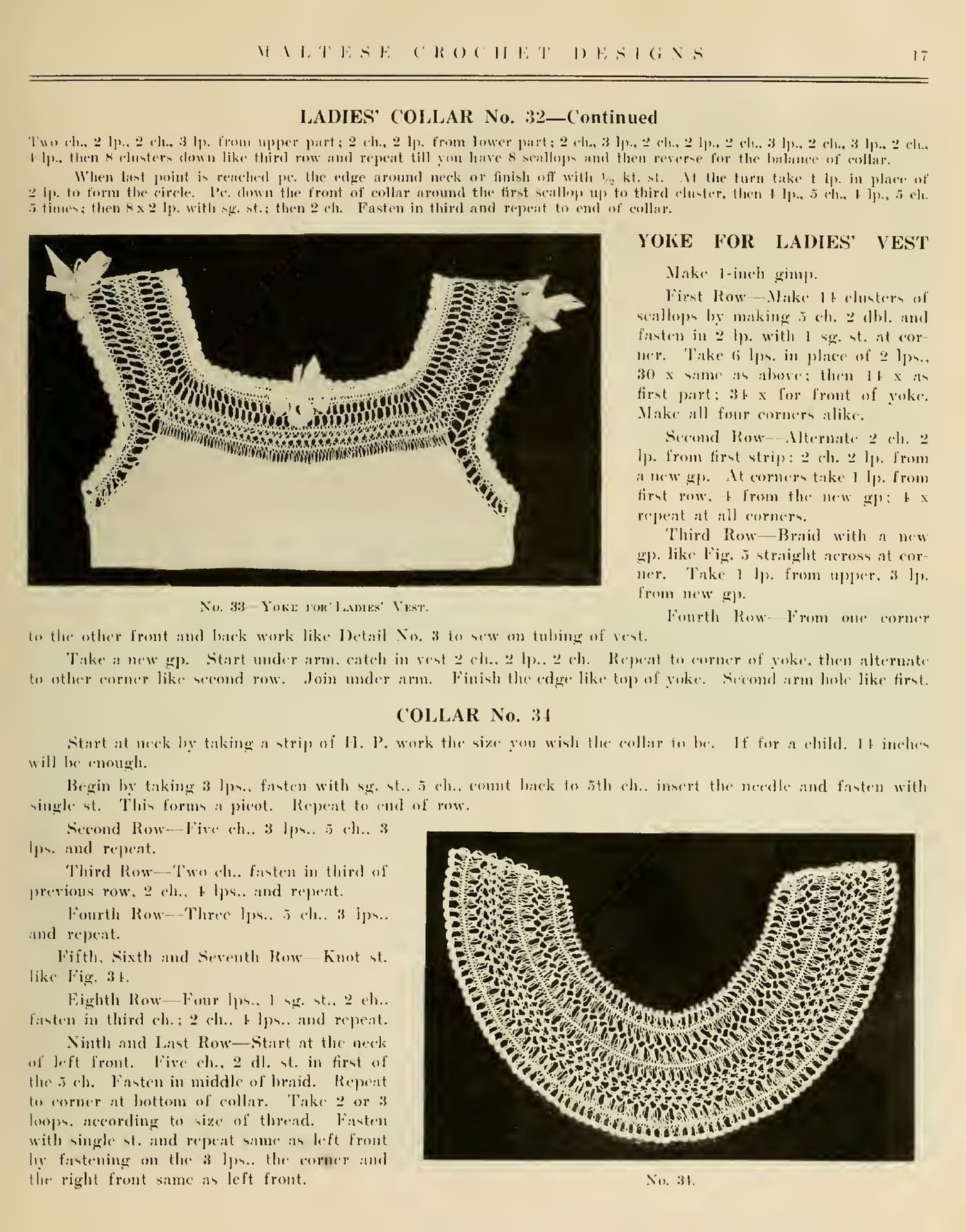
A nine-row hairpin collar started at the neck: a picot row, a chain-five row grouping three loops, a beading row, another grouped row, three rows of knot stitch, a chained row, and a last row of chains and double stitches worked down one front, round the bottom and up the other.
By the crochetpatterns.io editorial team · Updated · Editorial policy · pattern testing in progress
| Detail | Value |
|---|---|
| Skill level | Intermediate |
| Yarn weight | Lace (#0) |
| Yardage | the book gives no total yardage. (as printed; yardage not given) |
| Hook | 1.25 mm |
| Gauge | No gauge printed; the book sets the fork width instead. |
| Finished size | Not printed for an adult. The book says 14 inches (about 36 cm) of hairpin work is enough for a child's collar. |
| Time | about 3 hours |
Materials
- Size 30 mercerized cotton crochet thread — approximate; the book prints no thread number for this design
- Hairpin lace loom or fork, adjustable to the width printed for this design
- Steel crochet hook
- Tapestry needle for the ends
- Hook: Start with a 1.25 mm (US steel 8) hook — approximate, and ours: the book prints no hook size. Change size until the joining rows lie flat.
Yarn Kit & Substitution Options
This pattern calls for 350 yards of weight #0 yarn. Select a suggested yarn to see required skeins and estimated cost:
Caron Simply Soft · 100% Acrylic
315 yds per skein · High-yield yardage, silky no-scratch texture
2 skeins required
approx. $$10.98 total
Abbreviations (US terms)
- chain
- slip stitch
- single crochet
- double crochet
- loop
- puff stitch
- repeat
- row
Notes before you start
- Source: "Collar No. 34" (34), The New Maltese Crochet Designs, Complete With Instructions, The Riley-Francis Co., Covington, Kentucky, 1915. Public domain in the USA.
- As printed — materials: A strip of hairpin work the size the collar is to be — 14 inches for a child. Gauge: Not given.
- Modernisation note: Stitches are converted by this book's own key (“Abbreviations of Terms”, book page 6, images/p-08.jpg) read together with the working text, not by the look of the abbreviation or the date. The key list is: Ch. chain; S. C. single crochet; D. C. double crochet; Sl. St. slip stitch; P. picot; R. row; Ro. round; St. stitch; Sts. stitches; Sk. skip; Lp. loop; Gp. gimp. Unusually, the same page then defines the stitches. Its D. C. is worked thread over the needle, into the next stitch, draw through, take off two, take off the two last — the modern US DOUBLE crochet, so dc is written unchanged here. Note that Clark's 1923 book elsewhere in this collection prints “D c” for a stitch that is the modern half double, and the London books in this collection use the British ladder in which a double is the US single; this book is neither, which is why its ladder was checked against its own page rather than carried across. The key's S. C. definition is defective as printed — it reads as a slip stitch, and the key's separate Slip Stitch definition repeats nearly the same words — so s. c. was settled from the working text instead: Figure 1 on book page 7 tells the worker to take up the front of the left-hand loop and “make an ordinary single crochet”, the standard hairpin move, so s. c. is the modern US SINGLE crochet and is written sc here. The key defines Picot as chain 5 closed into the first chain, so every unqualified picot below is a ch-5 picot. Tr. and dbl. tr. occur in some designs but are defined nowhere in the book.
- Modernisation note: This is hairpin lace, which the book calls Maltese crochet. The loop braid (the book's “gimp”, abbreviated gp. or H. P.) is made first on a two-pronged fork set to the printed width, then joined and edged with a crochet hook. The book explains the whole technique itself and refers nothing outside its own covers: making the gimp on the fork is Figure 1 (book page 7), the finished gimp is Figure 2, the plain single-crochet heading row is Figure 3, the Lovers' Knot or knot stitch and the chain-5 beading row (Figure 4) and the braiding join (Figure 5) are on book page 8, and the medallion is Detail No. 1 on book page 10. The book sells its own adjustable fork, but any hairpin lace loom or fork set to the printed width will do; the printed widths are carried through below exactly as given.
- Modernisation note: The knot stitch (the book's Lovers' Knot) is defined on book page 8: draw one long chain, take the thread on the hook from the back of that long chain so the single back thread and the chain link are both on the hook, then draw the thread through both — that half is what the book calls the half knot stitch — and repeat the half a second time to complete the whole knot. The book adds two working cautions kept here: make every stitch the same length, and “No widening done in Lovers' Knot. You must provide for that in first row.”
- Modernisation note: The book's wording is written in modern US form: lp./lps. = loop(s); gp. and H. P. = the hairpin gimp (the loop braid); sg. st. and se. st. = sc; kt. st. = knot stitch; dbl. = dc; pc. = picot; ch. = ch; sl. = sl st or slip the loops onto the hook, according to what the row is doing. “Fasten” is written join or sl st according to the row.
- Modernisation note: The printed paragraphs are split into one row or step per line; stitch order and counts are unchanged. Ordinal row names (“First Row”, “Second Row”) are written Row 1, Row 2. Section headings are added for navigation. The OCR of this scan garbles numerals badly — it prints 4 as “t” or “f”, 3 as “8”, and “lps.” as “Ips.” or “lps” — and those quirks are kept in the excerpts and not in the rows, where the page image was used instead.
- Modernisation note: Book page 5 warns that thread numbers were not standard between makers: “There are so many domestic threads on the market that even with the same number they differ in size.” It recommends cordonnet rather than a soft finish, and sizes 15 to 30 for beginners. Any modern size given here is approximate for that reason.
- Modernisation note: No hook size is printed for any design in this book. Book page 5 says so explicitly: “The size and number of crochet hook depends entirely upon the size of thread used and on the worker, as no two individuals work alike.” Any metric hook suggested here is therefore ours, read across from the thread, not from the page.
- Modernisation note: No gauge is printed for this design; the book prints no gauge or tension anywhere. Instead it sets the fork width, which fixes the depth of the loop braid, and that printed width is given above. Work a sample and change hook size until the joining rows lie flat.
- Modernisation note: No yardage is printed for this design. The book gives a quantity only for a handful of pieces (a spool, a ball, or a length of gimp in yards) and never a total yardage of thread, so none is given here.
- Modernisation note: Check: no colour is printed for this design. The plates photograph as a plain light thread, and the book's only colour remarks are general ones — an edge of coloured silk “in any preferred shade” for the handkerchief, and pale blue, pale green or old gold suggested for a two-colour fringe.
- Modernisation note: Figure 4, the book's beading row, is defined on book page 8: “Ch. 5 and sl. 4 loops of either edge of strip. Add another strip of Hairpin lace by crocheting 2 ch., 4 sl. 2 ch. and fasten to strip above in center of 5 ch. Repeat. Then make a row of knot stitch and fasten in center of 5 chain.”
- Modernisation note: Check: the printed page reads “Knot st. like Fig. 34” for Rows 5 to 7. There is no Figure 34 in this book — its figures stop in the teens and 34 is this design's own number — and the knot-stitch row the book defines is Figure 4 on book page 8. Figure 4 is the reading used above; the printed “34” is treated as a misprint for “4”, and the substitution is flagged here rather than made silently.
- Modernisation note: Check: Row 9's “2 or 3 loops, according to size of thread” is the book's own latitude and is kept as printed; no count has been fixed for it.
- Modernisation note: Check: the OCR drops the middle of the opening line entirely, running “Start at neck by taking a strip of TH. P.” straight into “will be enough.” The page image (book page 17) reads “Start at neck by taking a strip of H. P. work the size you wish the collar to be. If for a child, 14 inches will be enough”, which is the reading used above.
- Modernisation note: Check: no thread number, no fork width and no adult measurement is printed for this collar. None has been invented.
- Modernisation note: Check: the book does not print how the collar is shaped at the neck edge; Row 1 simply follows the strip, so the fit depends on the length of gimp made.
Row progress: 0 of 8 done (0%)
Collar
0 of 8 done- Start at the neck by taking a strip of hairpin work the size you wish the collar to be. For a child, 36 cm (14 in) will be enough.Mark row complete
- Row 1: take 3 loops together, join with 1 sc, ch 5, count back to the 5th ch, insert the hook and join with 1 sc. That forms a picot. Rep to the end of the row.Mark row complete
- Row 2: ch 5, 3 loops together, ch 5, 3 loops together, and rep.Mark row complete
- Row 3: ch 2, join in the third ch of the previous row, ch 2, 4 loops together, and rep.Mark row complete
- Row 4: 3 loops together, ch 5, 3 loops together, and rep.Mark row complete
- Rows 5, 6 and 7: knot stitch, as in Figure 4.Mark row complete
- Row 8: 4 loops together, 1 sc, ch 2, join in the third ch, ch 2, 4 loops together, and rep.Mark row complete
- Row 9 (last row): start at the neck of the left front. Ch 5, 2 dc in the first of the ch-5, join in the middle of the braid. Rep to the corner at the bottom of the collar. Take 2 or 3 loops, according to the size of the thread, join with 1 sc, and rep the same as the left front by fastening on the 3 loops, then the corner, then the right front the same as the left front.Mark row complete
Working on:
Start at the neck by taking a strip of hairpin work the size you wish the collar to be. For a child, 36 cm (14 in) will be enough.
Continue this pattern
The rest of the Collar No. 34 (1915) pattern is in the Vintage Crochet Fashion
Still to come in the full pattern:
- Finishing
Included with 71 patterns for $15 — $0.21 per pattern.
Errata
No corrections have been published for this pattern. Found a mistake? Tell us and we will log the fix here with a date.
Your notes on this pattern
Keep track of the yarn, hook and changes you used. Saved in this browser only — nobody else can see it.
Frequently asked questions
Where is the Collar No. 34 pattern from?
It was published as "Collar No. 34" in The New Maltese Crochet Designs, Complete With Instructions by The Riley-Francis Co., Covington, Kentucky in 1915. The publication is in the public domain in the United States; this version is transcribed and modernised by crochetpatterns.io.
What yarn or thread do I need for the Collar No. 34?
Size 30 crochet cotton (approximate). Not printed — the book gives no total yardage.
What hook should I use?
Start with a 1.25 mm (US steel 8) hook — approximate, and ours: the book prints no hook size. Change size until the joining rows lie flat. Gauge: No gauge printed; the book sets the fork width instead.