Free preview · full pattern in the Vintage Crochet Hats, Bags & Accessories
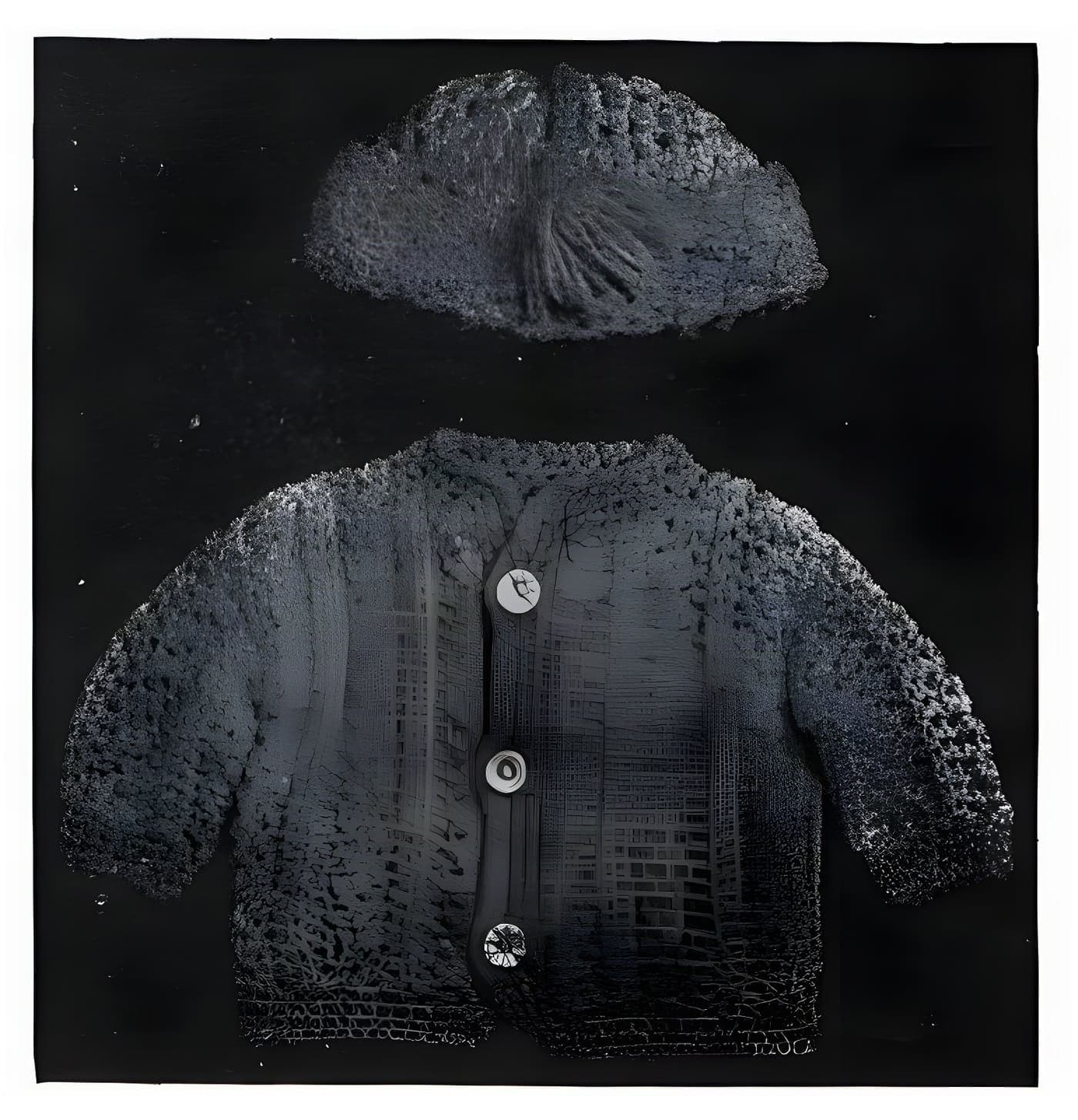
Sweater and Cap for Dolly (1918): vintage crochet pattern
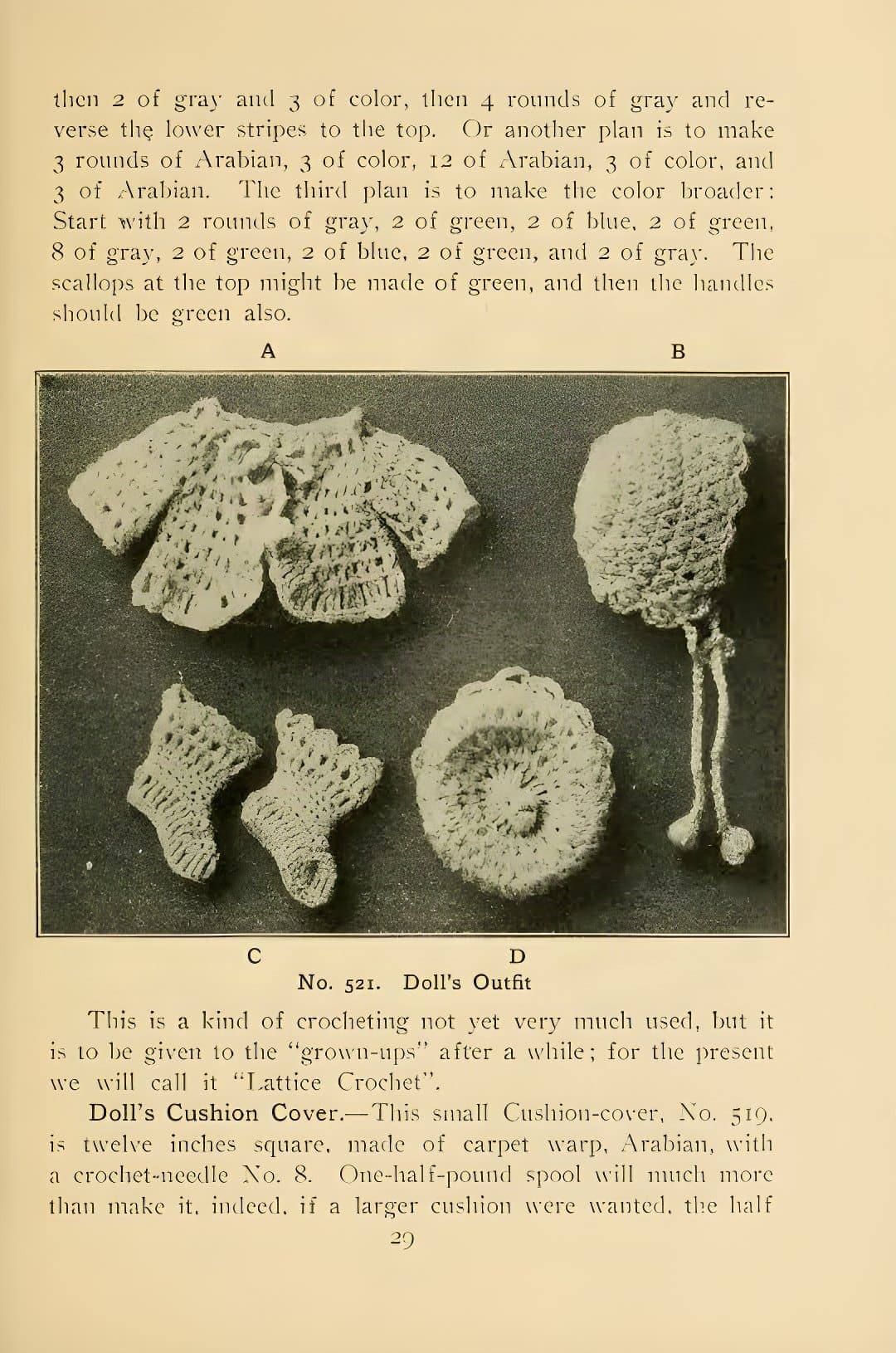
A doll's cardigan worked across the shoulders in a textured dc-and-sc pattern with sc ridges, edged in blue with buttonholes, and a matching cap in bean stitch with a turned-up star-stitch band and tassel. Originally published as "A Sweater and Cap for Dolly" in Handbook of Wool Knitting and Crochet by Needlecraft Publishing Company, Augusta, Maine in 1918.
By the crochetpatterns.io editorial team · Updated · Editorial policy · pattern testing in progress
| Detail | Value |
|---|---|
| Skill level | Easy |
| Yarn weight | Super fine (#1) |
| Yardage | the book gives 1 skein each of white and blue Saxony for 2 sets; skein weight and yardage are not stated. (as printed; yardage not given) |
| Hook | 3 mm |
| Gauge | No stitch gauge or finished measurements printed; fit to the doll. |
| Finished size | Doll size (not stated). The book says fourfold Germantown makes the sweater large enough for a small child, and the cap can be made child-size by adding bean stitches. |
| Time | about 8 hours |
Materials
- Super fine (CYC #1) wool yarn in white and blue — the original was Saxony, 1 skein of each, enough for 2 sets
- Crochet hook
- Small pearl buttons
- Tapestry needle
- Hook: Start with 3 mm (US C-2/D-3) — approximate; size the pieces to the doll (no gauge is printed)
Yarn Kit & Substitution Options
This pattern calls for 350 yards of weight #1 yarn. Select a suggested yarn to see required skeins and estimated cost:
Knit Picks Stroll Sock · 75% Superwash Merino, 25% Nylon
231 yds per skein · Durable stitch definition, machine washable
2 skeins required
approx. $$13.98 total
Abbreviations (US terms)
- chain
- single crochet
- double crochet
- skip
- stitch
- stitches
- repeat
- row
- round
- increase
- yarn over
- loop
- back loop only
- wrong side
- right side
Notes before you start
- Source: "A Sweater and Cap for Dolly", Handbook of Wool Knitting and Crochet, Needlecraft Publishing Company, Augusta, Maine, 1918. Public domain in the USA.
- As printed — materials: One skein of white and blue Saxony will be sufficient for two sets; use a crochet-hook that will carry the wool easily.. Gauge: Not given.
- Modernisation note: Stitches converted by the book's own definitions ("A Lesson in Crochet"), not by name. The book uses the older names it calls "in general use", which are one step taller in name than modern US terms: its single crochet ("insert hook in work, take up the thread and draw it through the work and the stitch on the needle at the same time") = modern US sl st; its double (draw through, "giving you two stitches on the needle; take up thread and draw through the two") = sc; half-treble or short-treble = hdc; treble (thread over, insert, draw through, then through two loops twice) = dc; double-treble (thread over twice) = tr; triple-treble (thread over three times) = dtr. Its slip-stitch (drop the loop, insert the hook where you wish to join, pull the dropped loop through) is a joining stitch and is written as "join" or sl st. So every "double" in the original is written here as sc and every "treble" as dc.
- Modernisation note: The book's turning rule ("one chain-stitch corresponds to a double, two chain-stitches to a half or short treble, three chain to a treble") means ch 1 = sc height and ch 3 = dc height in modern terms. Turning chains are kept exactly as printed, even where they do not follow that rule.
- Modernisation note: Period wording modernised: "miss" written as sk; "widen" as inc; "narrow" as dec; "vein" of a stitch as loop ("back vein" = back loop only, "both veins" = both loops); "take up thread/wool" and "over" as yo; "needle" (the crochet hook) as hook; "wool"/"thread" as yarn; "fasten in" as join yarn; "break and fasten wool" as fasten off; "fasten"/"catch" (to a stitch) as sl st; "armscye" as armhole; "repeat" as rep; numbered rows written as Row/Rnd n.
- Modernisation note: Long printed paragraphs split into one row, round or step per line; stitch order and counts unchanged. Section headings added for navigation.
- Modernisation note: The book gives almost no hook sizes (one design names "bone hook size 4"); otherwise it says to use a hook "large enough to carry the yarn", and explains that "no two manufacturers use like numbers for the same sizes". The modern hook given is an approximate starting point for the yarn weight only.
- Modernisation note: No stitch gauge is printed for any crocheted design in the book; work a swatch and match any printed lengths (given in the modern gauge line) before starting.
- Modernisation note: 1918 yarn names have no exact modern equivalent. Approximate modern CYC weights used: fourfold (4-fold) Germantown wool/zephyr/worsted as light (CYC #3); knitting-worsted as medium (CYC #4); Shetland floss (a soft, lofty yarn) as fine (CYC #2); 2-fold Shetland zephyr as fine (CYC #2); Saxony as super fine (CYC #1); eiderdown wool and "very heavy Germantown worsted" as medium (CYC #4); Angora wool is a fluffy trim yarn used with worsted. The book gives skeins, hanks or balls only — never yardage or skein weight — so no yardage is given.
- Modernisation note: "In back of double" written as "in the back loop of a sc".
- Modernisation note: "Bean-stitch" and "star-stitch" are the book's names; each is defined in this design and kept.
- Modernisation note: Line: listed with accessories because the set is made for a doll; the book says it can be enlarged for a child.
- Modernisation note: Check: the book does not say how the cap's crocheted cord is made (chain or sc cord). Left as printed.
Row progress: 0 of 10 done (0%)
Sweater
0 of 10 done- Foundation: Ch 60.Mark row complete
- Row 1: Sc in each ch, turn.Mark row complete
- Row 2: (Dc and sc) in the back loop of a sc of the last row (ch 3 for the first dc of the row), sk 1 sc; rep to end of row, turn.Mark row complete
- Row 3: (Dc and sc) between the dc and sc of the last row; rep.Mark row complete
- Row 4: Sc in the back loop of each st of the last row (ch 1 for the first sc).Mark row complete
- Row 5: Same as Row 4. This completes the part over the shoulder.Mark row complete
- On one half of the length, rep Rows 2, 3, 4, 5 and again Row 2; this completes one front.Mark row complete
- Work the same way on the other half of the length, which brings you to the center of the back and makes half of the sweater.Mark row complete
- Make the other half to correspond, and join neatly down the center of the back.Mark row complete
- Fold and join under the arms, making the armhole the desired size.Mark row complete
Working on:
Foundation: Ch 60.
Continue this pattern
The rest of the Sweater and Cap for Dolly (1918) pattern is in the Vintage Crochet Hats, Bags & Accessories
Still to come in the full pattern:
- Sleeves
- Border
- Cap
- Cap Border
- Finishing
Included with 202 patterns for $12 — $0.06 per pattern.
Errata
No corrections have been published for this pattern. Found a mistake? Tell us and we will log the fix here with a date.
Your notes on this pattern
Keep track of the yarn, hook and changes you used. Saved in this browser only — nobody else can see it.
Frequently asked questions
Where is the A Sweater and Cap for Dolly pattern from?
It was published as "A Sweater and Cap for Dolly" in Handbook of Wool Knitting and Crochet by Needlecraft Publishing Company, Augusta, Maine in 1918. The publication is in the public domain in the United States; this version is transcribed and modernised by crochetpatterns.io.
What yarn or thread do I need for the A Sweater and Cap for Dolly?
super fine (#1) yarn. Not printed — the book gives 1 skein each of white and blue Saxony for 2 sets; skein weight and yardage are not stated.
What hook should I use?
Start with 3 mm (US C-2/D-3) — approximate; size the pieces to the doll (no gauge is printed) Gauge: No stitch gauge or finished measurements printed; fit to the doll.