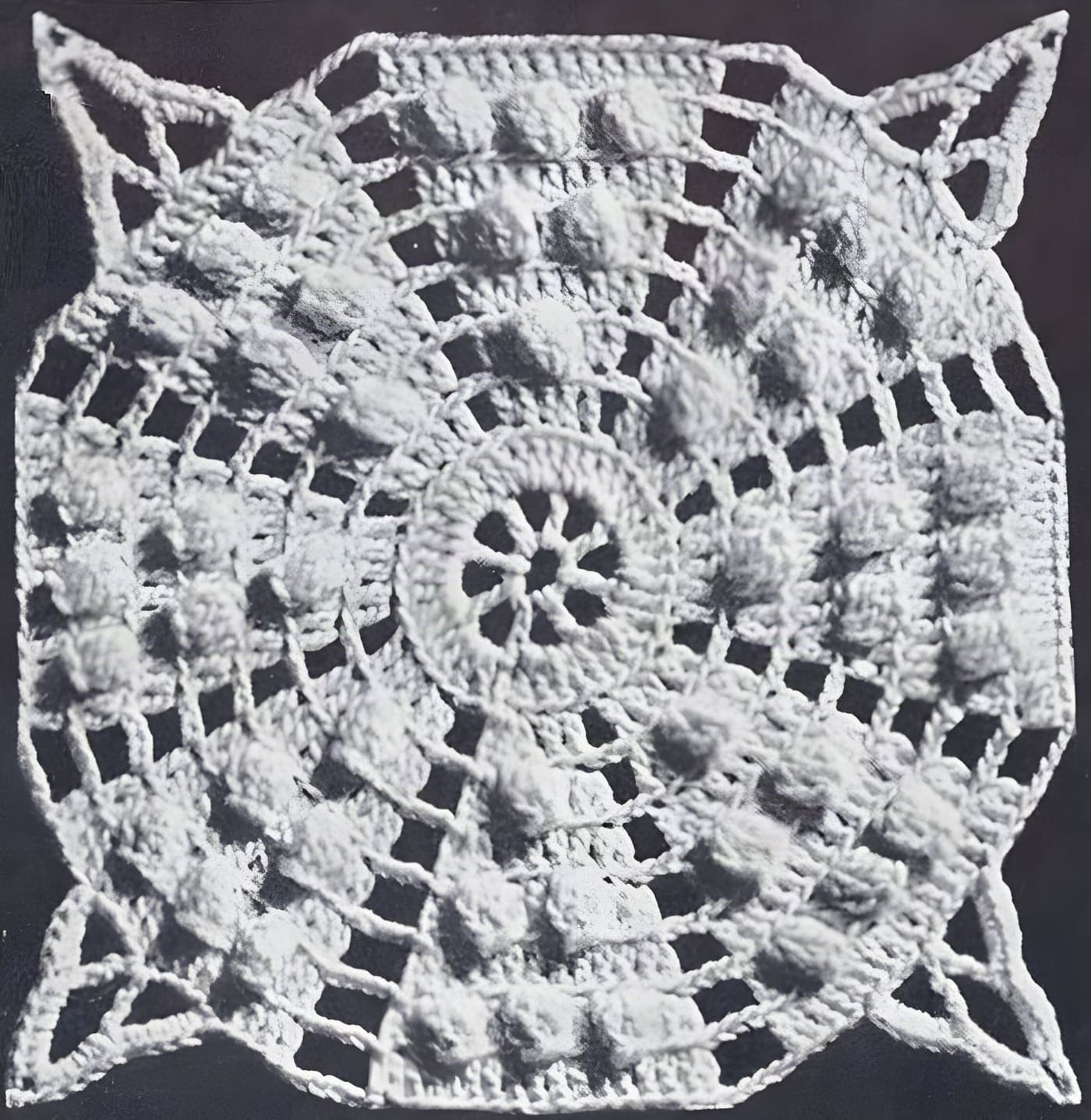
Free preview · full pattern in the Vintage Afghans & Bedspreads
Daisy Bedspread Textured in Beauty, No. 8 (1970): vintage crochet pattern
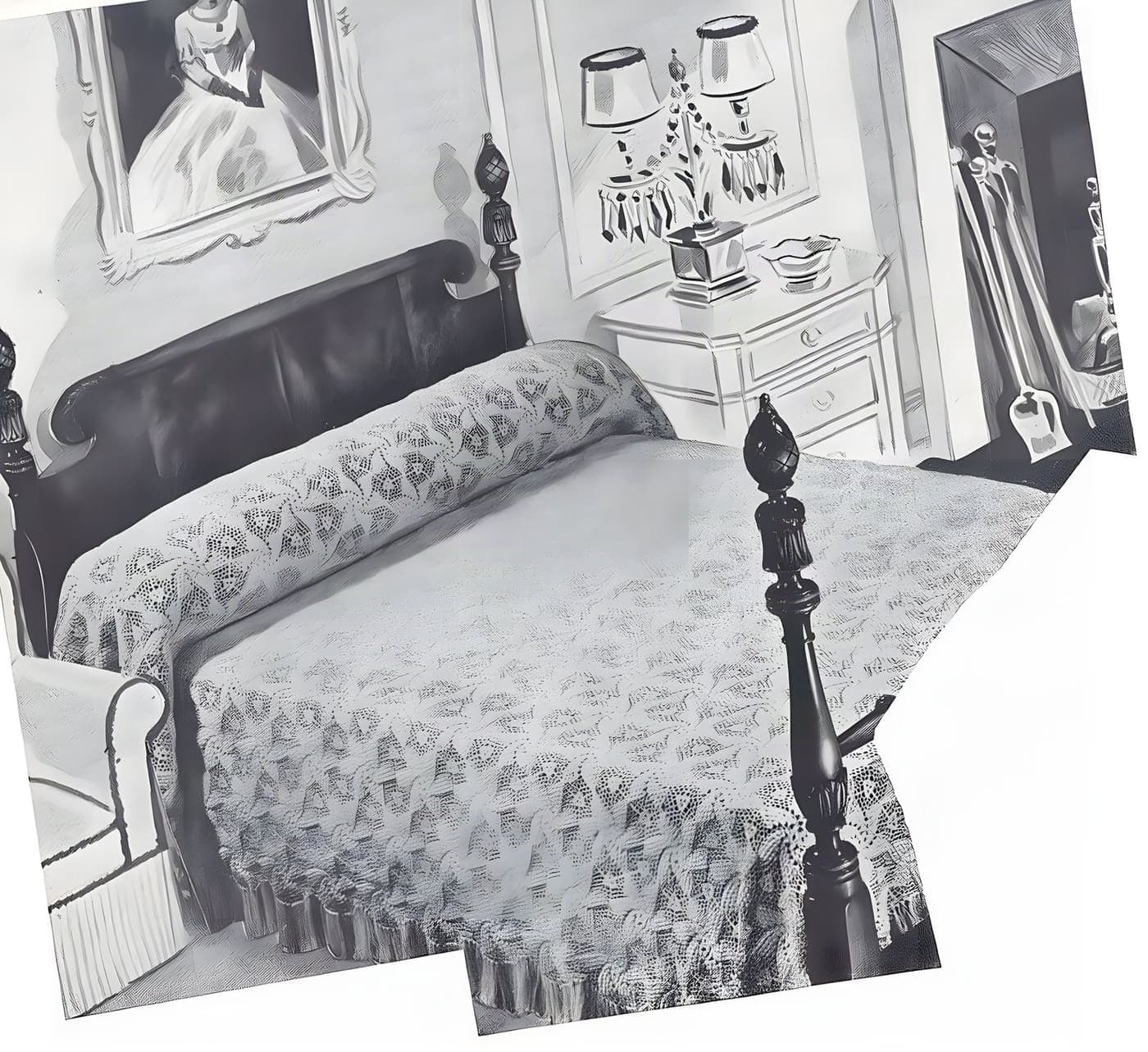
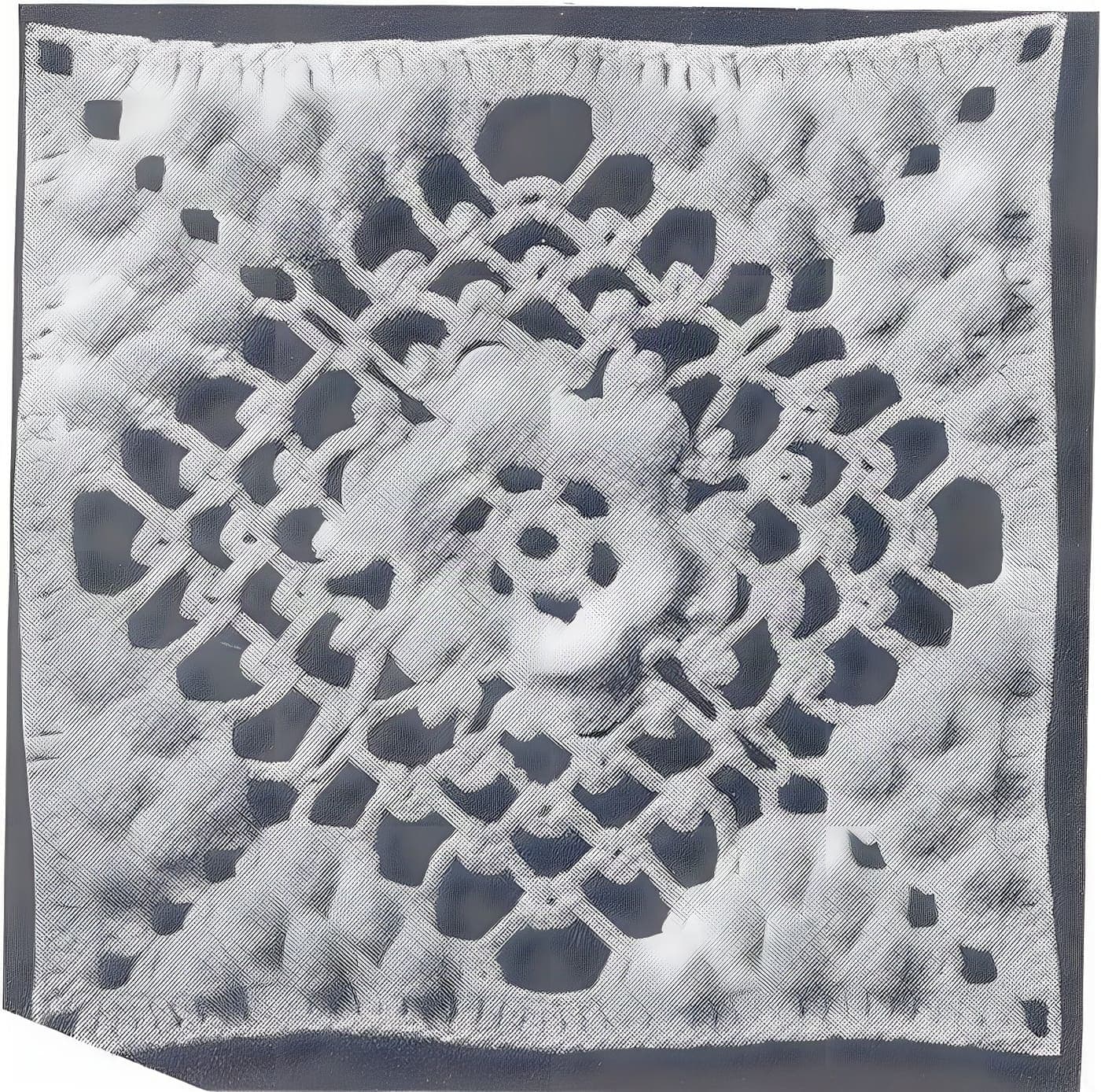
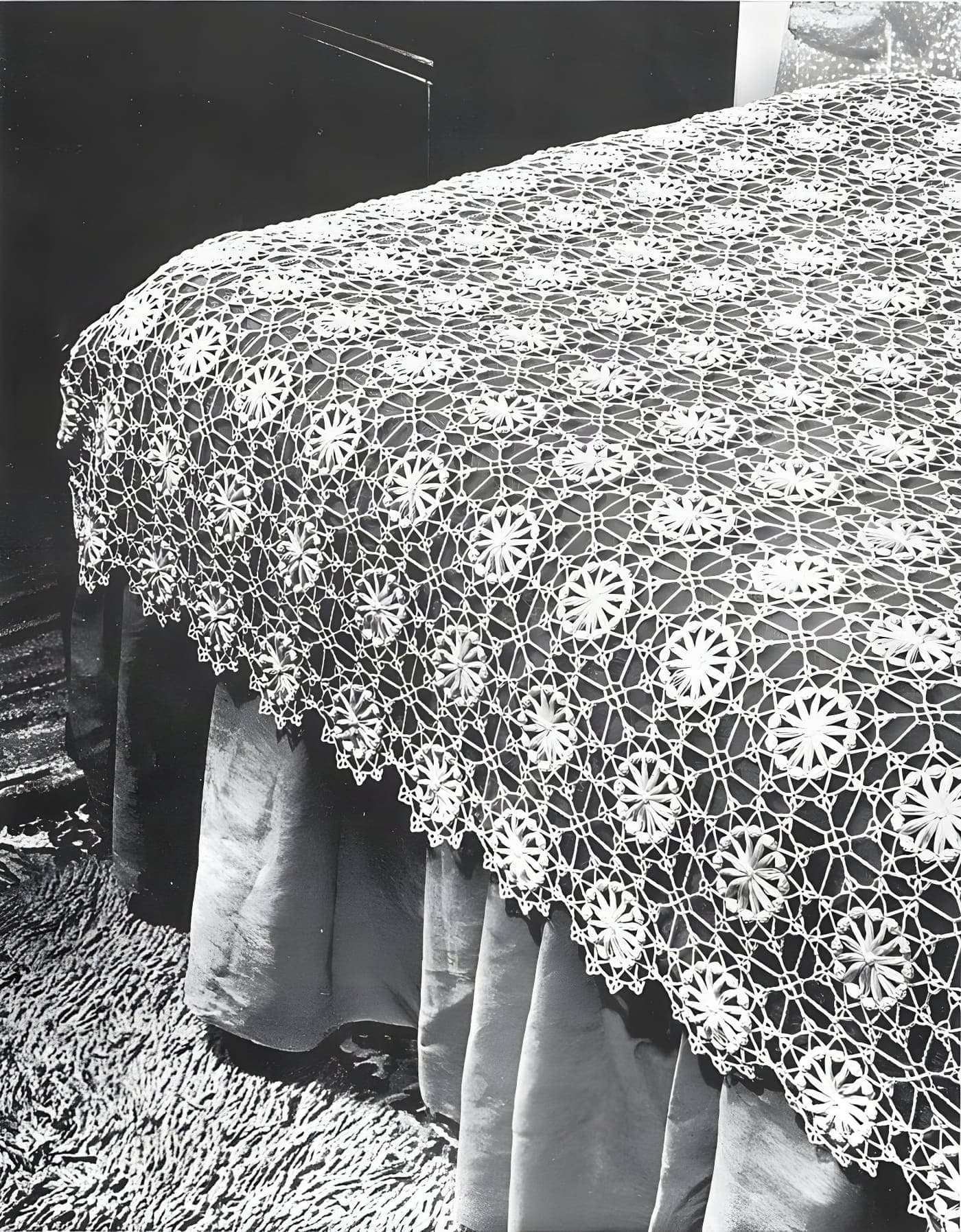
A cotton bedspread of 4½-inch blocks: each is a six-loop daisy made on a daisy winder (flower loom), edged with crochet puff clusters and a round of chain loops and shells, joined by shells, with a small long-treble fill-in motif in each opening. Single size 17 × 24 blocks, double size 19 × 24.
By the crochetpatterns.io editorial team · Updated · Editorial policy · pattern testing in progress
| Detail | Value |
|---|---|
| Skill level | Intermediate |
| Yarn weight | Lace (#0) |
| Yardage | Printed in skeins or balls only (see materials); yardage per skein or ball is not printed — (as printed; yardage not given) |
| Hook | 1.3 mm |
| Gauge | As printed: each block about 4½ in (11.5 cm). |
| Finished size | Single about 77 × 108 in (196 × 274 cm), 17 × 24 blocks; double about 86 × 108 in (218 × 274 cm), 19 × 24 blocks. |
| Time | about 8 hours |
Materials
- A daisy winder or flower loom that makes daisies of the printed size (e.g. 2 in / 5 cm)
- Heavy crochet-and-knitting cotton (skein and ball size not printed): single size 26 skeins ecru or 32 skeins white (or 22 balls ecru, 26 balls white or cream); double size 29 skeins ecru or 36 skeins white (or 24 balls ecru, 29 balls white or cream).
- 1.3 mm (US steel 10) crochet hook, or the size that gives 4½ in blocks.
- Tapestry needle for weaving daisy centers and fastening off
- Hook: Start with 1.3 mm (US steel 10); change size to match the printed size.
Yarn Kit & Substitution Options
This pattern calls for 350 yards of weight #0 yarn. Select a suggested yarn to see required skeins and estimated cost:
Caron Simply Soft · 100% Acrylic
315 yds per skein · High-yield yardage, silky no-scratch texture
2 skeins required
approx. $$10.98 total
Abbreviations (US terms)
- chain
- slip stitch
- single crochet
- double crochet
- treble crochet
- double treble crochet
- skip
- stitch
- cluster
- yarn over
- row
Notes before you start
- Source: "Daisy Bedspread "Textured in Beauty"" (No. 8), Designs for Crazy Daisy Winder: Crochet Time Cut in Half, Hero Manufacturing Company, 1970. Public domain in the USA.
- As printed — materials: Lily Homestead Crochet and Knitting Cotton, Art. 131 in skeins or Art. 205 in balls:—; Single Size—26-sks. Ecru or 32-sks. White; or 22-balls Ecru or 26-balls White or Cream.; Double Size—29-sks. Ecru or 36 sks. White; or 24-balls Ecru or 29-balls White or Cream.; Crochet hook size 10.; CRAZY DAISY WINDER.. Gauge: Gauge—Each Block measures about 4½”. For single size spread about 77” x 108”, make 17 x 24 Blocks; for double size spread about 86” x 108” make 19 x 24 Blocks..
- Modernisation note: The first section is the book's general "To Make Daisies" directions, printed once on page 2 and referenced by each design as "following instructions on page 2"; it is repeated here so the pattern stands alone. "Ill." is written as "Illustration".
- Modernisation note: The book was written for its maker's 12-spoke daisy winder. Any daisy winder or flower loom with 12 spokes that makes daisies of the same size will work; the book does not print the daisy diameter, so make and edge one daisy first and compare it with the printed block or article size.
- Modernisation note: The original is already in US terms. Abbreviations were modernised: "lp/lps" → loop(s), "p" → picot, "2d/3d" → 2nd/3rd, "thru" → through, "tog." → tog, "bal. of" → rest of, "thread over" → yo, "ch st" → ch, "Cluster" → cluster. Run-on paragraphs were split into one row or step per line; no stitches were added, removed or reordered.
- Modernisation note: "Cut 6″ long, thread to a needle and fasten off on back" is kept as printed ("6 in"); it means cut the working yarn leaving a 6 in (15 cm) tail.
- Modernisation note: The book prints plain hook numbers. For cotton thread they are read as US steel hook sizes (13 = 0.85 mm, 10 = 1.3 mm, 9 = 1.4 mm, 7 = 1.65 mm, 5 = 1.9 mm, 3 = 2.1 mm). Check: the book does not say steel or aluminum; match the printed block size rather than the number.
- Modernisation note: "See Blocking Instructions on page 31" is replaced by the book's general blocking directions, printed in the finishing steps.
- Modernisation note: "Cluster puff st" is kept as printed; it is a 5-tr cluster.
- Modernisation note: Check: the book does not print the weight of Lily Homestead cotton; it was a heavier cotton than ordinary crochet thread, so match the printed 4½ in block rather than the hook number.
- Modernisation note: Check: the materials run "Gauge" and block counts into the same paragraph; the gauge field keeps that paragraph as printed.
- Modernisation note: Metric conversions and modern yarn/thread suggestions were added; they are not in the original.
Row progress: 0 of 16 done (0%)
To make daisies (the book's general directions)
0 of 16 done- Illustration A — back view with spokes released: Hold winder in left hand with flat side toward you. Holding knob between thumb and forefinger of right hand with thumb at bottom, push thumb to left to turn knob and release spokes.Mark row complete
- Illustration B — single petal daisy wrapped over 1 spoke: With left thumb, hold yarn across center of winder leaving end extended about 1 in beyond center.Mark row complete
- With right hand, pass yarn from left to right around spoke at top (No. 1); across center of winder from right to left around spoke directly opposite (No. 2); across center of winder from left to right around spoke No. 3 at right of 1st spoke wrapped; across center, from right to left around spoke No. 4 at left of 2nd spoke wrapped; across center, from left to right around spoke No. 5; across center, from right to left around spoke No. 6.Mark row complete
- Continue in this way wrapping each spoke once, always passing across center to wrap spoke opposite, until the 12th spoke is wrapped. Bring yarn across center and cut end about 1 in beyond center. Make center before removing daisy from winder (see Illustration E).Mark row complete
- Illustration C — double petal daisy wrapped over 1 spoke: With left thumb hold yarn at center leaving end to extend about 1 in; with right hand, pass yarn from left to right around spoke No. 1 at top; across center; from right to left around spoke No. 2 directly opposite; wrap around these 2 spokes once more in same way.Mark row complete
- Across center, from left to right around spoke No. 3 at right of spoke 1st wrapped; across center, from right to left around spoke No. 4 at left of 2nd spoke wrapped; wrap these 2 spokes once more; across center, from left to right around spoke No. 5; from right to left around spoke No. 6; around these 2 once more.Mark row complete
- Continue in this way wrapping twice around 2 spokes exactly opposite then passing on to the next 2, until all spokes are wrapped twice ending with No. 12; bring yarn across center and cut end about 1 in beyond center.Mark row complete
- If a daisy of more layers of petals is desired, wrap as many times as you desire layers of petals. Make center before removing daisy from winder (see Illustration E).Mark row complete
- Illustration D — single petal daisy wrapped over 2 spokes: With left thumb, hold yarn at center allowing end to extend about 1 in. With right hand, pass yarn from left to right around spokes Nos. 1 and 2; across center, from right to left around Nos. 3 and 4; across center, around 5 and 6; across center, around 7 and 8; across center, around 9 and 10; across center, around 11 and 1; across center, around 12 and 3; across center, around 2 and 5; across center, around 4 and 7; across center, around 6 and 9; across center, around 8 and 11; across center, around 10 and 12; across center, cut end about 1 in beyond center. Make center before removing daisy from winder (see Illustration E).Mark row complete
- To make double petal daisy wrapped over 2 spokes: Make same as single petal over 2 spokes, then continue to wrap in same way as many times as desired.Mark row complete
- Illustration E — center: Thread needle with yarn for center. Fasten at center of wrong side of daisy as for embroidery. The side of daisy toward you is the wrong side.Mark row complete
- Insert needle under 4 petals, draw yarn through tightly; bring yarn back over the last 3 of these 4 petals, insert needle under these 3 petals and 1 more making 4 petals in all; draw yarn through.Mark row complete
- Continue to bring yarn back over 3 petals and draw it under 4 petals each time until you have made 13 sts. Be sure there are 13, otherwise your center will not be complete.Mark row complete
- As the weaving sts are worked, be careful to carry around the starting yarn end of daisy, taking each weaving st over this end for at least 10 sts so as to fasten it securely. This is particularly necessary with all the cotton threads. Fasten yarn on wrong side. Cut off all ends close to center.Mark row complete
- Turn knob in opposite direction to draw in spokes and release daisy.Mark row complete
- Illustration F: right side of complete daisy.Mark row complete
Working on:
Illustration A — back view with spokes released: Hold winder in left hand with flat side toward you. Holding knob between thumb and forefinger of right hand with thumb at bottom, push thumb to left to turn knob and release spokes.
Continue this pattern
The rest of the Daisy Bedspread Textured in Beauty, No. 8 (1970) pattern is in the Vintage Afghans & Bedspreads
Still to come in the full pattern:
- Block
- Joining blocks
- Fill-in motif
- Finishing
Included with 73 patterns for $19 — $0.26 per pattern.
Errata
No corrections have been published for this pattern. Found a mistake? Tell us and we will log the fix here with a date.
Your notes on this pattern
Keep track of the yarn, hook and changes you used. Saved in this browser only — nobody else can see it.
Frequently asked questions
Where is the Daisy Bedspread "Textured in Beauty" pattern from?
It was published as "Daisy Bedspread "Textured in Beauty"" in Designs for Crazy Daisy Winder: Crochet Time Cut in Half by Hero Manufacturing Company in 1970. The publication is in the public domain in the United States; this version is transcribed and modernised by crochetpatterns.io.
What yarn or thread do I need for the Daisy Bedspread "Textured in Beauty"?
Heavy crochet-and-knitting cotton (size not printed; match the 4½ in block). Printed in skeins or balls only (see materials); yardage per skein or ball is not printed — check your label.
What hook should I use?
Start with 1.3 mm (US steel 10); change size to match the printed size. Gauge: As printed: each block about 4½ in (11.5 cm).