Free preview · full pattern in the Vintage Crochet Edgings & Trims
Graduated Fan Edge No. 421 (1916): vintage crochet pattern
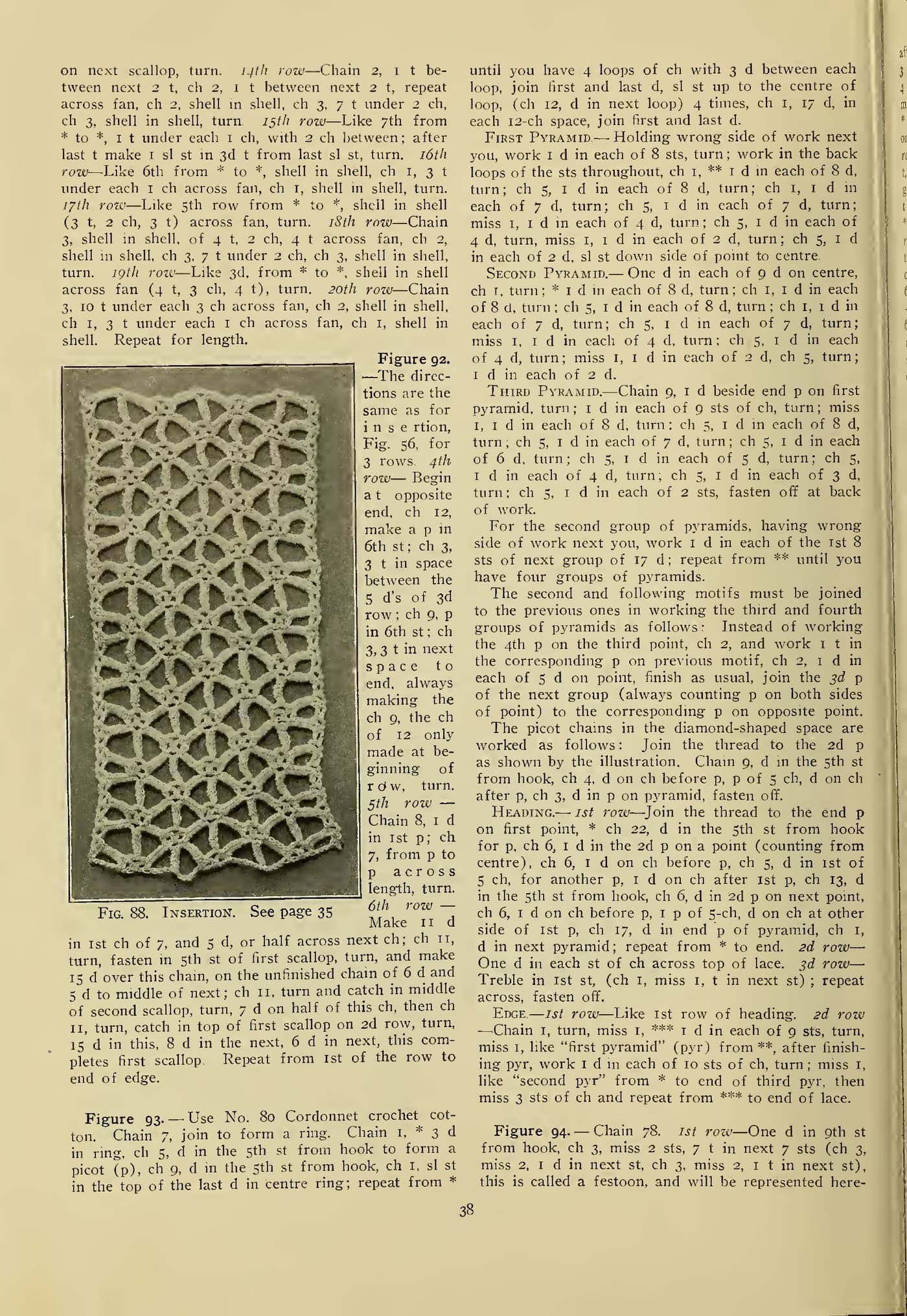
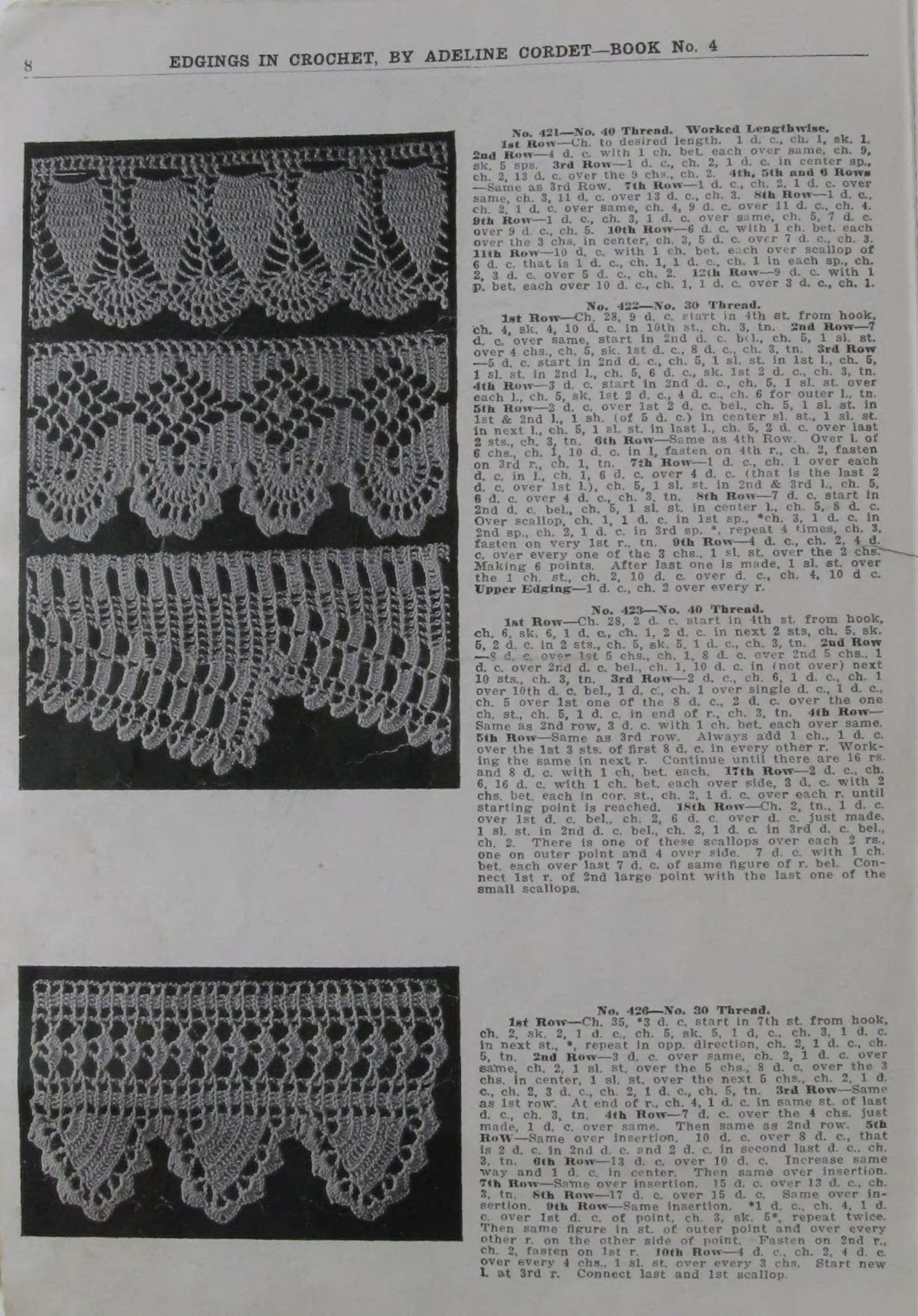
A twelve-row edging worked lengthwise, in which a fan of thirteen double crochet over a chain-9 loop is narrowed row by row to eleven, nine, seven, five and three stitches, while the chain between the heading stitches widens to match, and the last row sets a picot between each stitch.
By the crochetpatterns.io editorial team · Updated · Editorial policy · pattern testing in progress
| Detail | Value |
|---|---|
| Skill level | Intermediate |
| Yarn weight | Lace (#0) |
| Yardage | the book gives only the thread number. (as printed; yardage not given) |
| Hook | 1.15 mm |
| Gauge | No gauge printed. |
| Finished size | Not printed. |
| Time | about 3 hours |
Materials
- Size 40 mercerized cotton crochet thread — approximate; the book prints only “No. 40 Thread”, with no brand
- Steel crochet hook
- Tapestry needle for the ends
- Hook: Start with a 1.15 mm (US steel 9–10) hook — approximate, and ours: the book prints no hook size. Change size until the edging lies flat.
Yarn Kit & Substitution Options
This pattern calls for 350 yards of weight #0 yarn. Select a suggested yarn to see required skeins and estimated cost:
Caron Simply Soft · 100% Acrylic
315 yds per skein · High-yield yardage, silky no-scratch texture
2 skeins required
approx. $$10.98 total
Abbreviations (US terms)
- chain
- slip stitch
- double crochet
- space
- chain space
- stitch
- skip
- puff stitch
- repeat
- row
Notes before you start
- Source: "No. 421" (421), Edgings in Crochet, Book No. Four, Valley Supply Co., St. Louis, Mo., 1916. Public domain in the USA.
- As printed — materials: No. 40 Thread. Gauge: Not given.
- Modernisation note: Stitches are converted by this book's own key (“Abbreviations Used”, book page 2) read together with the designs, not by the look of the abbreviation. The key is a bare name list with no working definitions: sh. shell; d. c. double crochet; s. c. single crochet; tr. t. triple treble crochet; tn. turn; ch. chain; sk. skip; s. t. stitch; sts. stitches; Rep. repeat; * repeater; r. row; bel. below; cor. corner; sl. st. slip stitch; bet. between; l. loop; o. m. open mesh; s. m. solid mesh; lac. lacet stitch; d. t. double treble; opp. opposite; m. mesh; x cross stitch; s. sl. st. single slip stitch; pt. point; pf. puff stitch. Because the key defines nothing, the ladder was settled from the designs themselves. The book's d. c. is the modern US DOUBLE crochet: ten designs start their first d. c. “in 4th st. from hook”, the modern 3-chain turning convention, and the filet foundations follow the double-crochet formula of 3 chains a mesh plus 4. The book's d. t. (“double treble”) is the modern US TREBLE: it is started with ch 4, the modern treble turning chain, and No. 407's graduated point climbs sl st, s c, d c, d t without a missing rung. The book's tr. t. (“triple treble”) is by the same one-step shift the modern US double treble. So the short stitches carry modern US names while the treble names stand one step taller than modern US. Every book d. t. is written tr here and every tr. t. is written dtr; the book's d. c. is written dc unchanged. Note that Clark's 1923 book in this same collection abbreviates “D c” for a stitch that is the modern half double — the identical abbreviation means a different stitch there, which is why this book's ladder was checked against its own designs rather than carried across.
- Modernisation note: The book's wording is written in modern US form: tn. = turn; sk. = sk; bet. = between; bel. = below (“the row below”); cor. = corner; opp. = opposite; l./ls. = loop(s); p./ps. = picot(s); sh. = shell; r./rs. = row(s); sp. = sp. “Fasten” is written join or sl st according to what the row is doing, and “work thread up” is written as working up the side of the previous loop, which is what the book means by it.
- Modernisation note: The printed paragraphs are split into one row or step per line; stitch order and counts are unchanged. Section headings are added for navigation. Ordinal row names (“1st Row”, “2nd Row”) are written Row 1, Row 2. The OCR prints the ordinal “1st” variously as “Ist”, “ist” and “4st”, and prints “No.” as “No,” and “Noe,”; those quirks are kept in the excerpts and not in the rows.
- Modernisation note: The book names only a thread number for each design (“No. 40 Thread”), with no brand and no hook number anywhere in it. Those numbers are read as roughly equal to the modern crochet cotton sizes of the same number — approximate only.
- Modernisation note: No hook size is printed for any design in this book, so any metric hook suggested here is ours, read across from the thread size rather than from the page.
- Modernisation note: No gauge is printed for this design — the book prints no gauge, tension or mesh count anywhere. Work a sample and change hook size until the edging lies flat.
- Modernisation note: No finished measurement is printed for this design; it is worked to the length of the piece it trims, so its length is set by that piece.
- Modernisation note: Check: no colour is printed for this design. The book names no colour anywhere, and the plates photograph as a plain light thread.
- Modernisation note: Check: the book heads this design “Worked Lengthwise”, so the foundation runs the whole length of the edging and the rows are worked along it, rather than a short repeat worked over and over.
- Modernisation note: No yardage is printed for this design. The book gives ball counts for a few large pieces only (the table runner and the cover borders), and no edging on these pages is among them, so no yardage is given here.
- Modernisation note: Check: the book prints Rows 4, 5 and 6 as one instruction, “4th, 5th and 6 Rows—Same as 3rd Row”, and they are grouped above as the book groups them.
- Modernisation note: Check: the OCR of Row 1 reads “Ch. to desired length. 1ae, ch: i, ake. L”. The page image reads “Ch. to desired length. 1 d. c., ch. 1, sk. 1.”, which is the reading used above. This is the one line of the design the OCR loses, and it is confirmed from the plate.
- Modernisation note: Check: the book's “ch. 1” at the very end of Row 12 closes the last repeat; no turn is printed for any row of this design, because it is worked lengthwise along a single long foundation.
- Modernisation note: Check: the narrowing of the fan and the widening of the chain are both printed counts throughout — 13, 11, 9, 7, 5, 3 double crochet against ch 2, 3, 4, 5, 3, 2 — so nothing is reconstructed here.
- Modernisation note: The repeat lines in Rows 1 and 2 are ours; the book leaves the repeats to the length of the foundation.
Row progress: 0 of 10 done (0%)
Edge
0 of 10 done- Row 1: Ch to the length wanted. 1 dc, ch 1, sk 1. Rep to the end.Mark row complete
- Row 2: 4 dc with ch 1 between each over the same, ch 9, sk 5 sps. Rep to the end.Mark row complete
- Row 3: 1 dc, ch 2, 1 dc in the centre sp, ch 2, 13 dc over the ch-9, ch 2.Mark row complete
- Rows 4, 5 and 6: Same as Row 3.Mark row complete
- Row 7: 1 dc, ch 2, 1 dc over the same, ch 3, 11 dc over the 13 dc, ch 3.Mark row complete
- Row 8: 1 dc, ch 2, 1 dc over the same, ch 4, 9 dc over the 11 dc, ch 4.Mark row complete
- Row 9: 1 dc, ch 3, 1 dc over the same, ch 5, 7 dc over the 9 dc, ch 5.Mark row complete
- Row 10: 6 dc with ch 1 between each over the ch-3 in the centre, ch 3, 5 dc over the 7 dc, ch 3.Mark row complete
- Row 11: 10 dc with ch 1 between each over the scallop of 6 dc — that is 1 dc, ch 1, 1 dc, ch 1 in each sp — ch 2, 3 dc over the 5 dc, ch 2.Mark row complete
- Row 12: 9 dc with 1 picot between each over the 10 dc, ch 1, 1 dc over the 3 dc, ch 1.Mark row complete
Working on:
Row 1: Ch to the length wanted. 1 dc, ch 1, sk 1. Rep to the end.
Continue this pattern
The rest of the Graduated Fan Edge No. 421 (1916) pattern is in the Vintage Crochet Edgings & Trims
Still to come in the full pattern:
- Finishing
Included with 618 patterns for $9 — $0.01 per pattern.
Errata
No corrections have been published for this pattern. Found a mistake? Tell us and we will log the fix here with a date.
Your notes on this pattern
Keep track of the yarn, hook and changes you used. Saved in this browser only — nobody else can see it.
Frequently asked questions
Where is the No. 421 pattern from?
It was published as "No. 421" in Edgings in Crochet, Book No. Four by Valley Supply Co., St. Louis, Mo. in 1916. The publication is in the public domain in the United States; this version is transcribed and modernised by crochetpatterns.io.
What yarn or thread do I need for the No. 421?
Size 40 crochet cotton (approximate). Not printed — the book gives only the thread number.
What hook should I use?
Start with a 1.15 mm (US steel 9–10) hook — approximate, and ours: the book prints no hook size. Change size until the edging lies flat. Gauge: No gauge printed.