Free preview · full pattern in the Heirloom Doilies & Tablecloths
No. 227 Shell Doily (1915): vintage crochet pattern
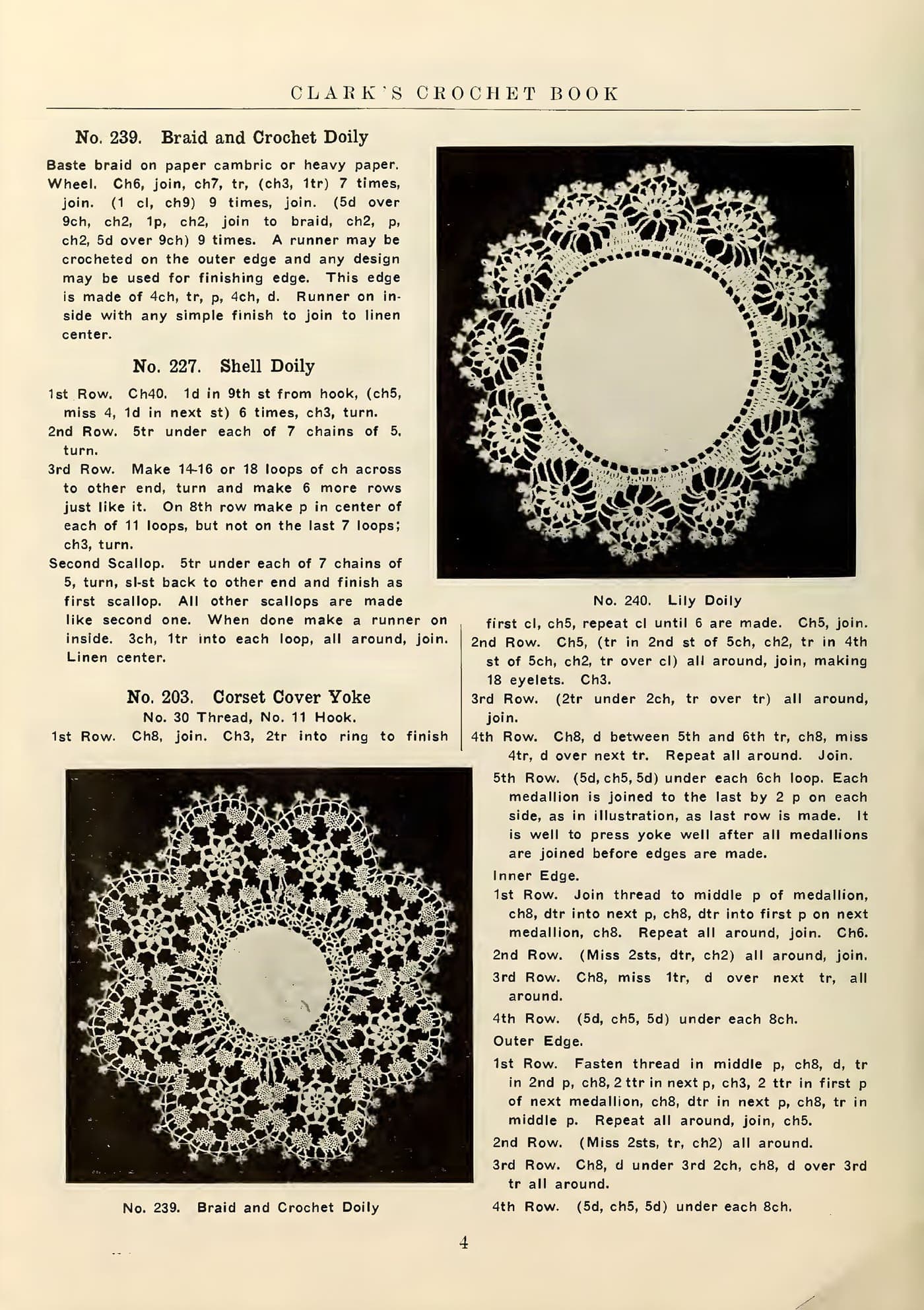
A doily edging of scallops: a row of chain loops carries a fan of five double crochet under each loop, seven rows of chain loops are worked above it, and picots mark the centre of the loops before the next scallop is begun.
By the crochetpatterns.io editorial team · Updated · Editorial policy · pattern testing in progress
| Detail | Value |
|---|---|
| Skill level | Intermediate |
| Yarn weight | Lace (#0) |
| Yardage | Not printed. (as printed; yardage not given) |
| Hook | 1.3 mm |
| Gauge | No gauge printed. |
| Finished size | Not printed; the number of scallops is set by the linen centre. |
| Time | about 2 hours |
Materials
- Size 30 mercerized cotton crochet thread — approximate; the book prints no thread for this design
- Steel crochet hook — the book prints no hook for this design
- Linen for the centre
- Tapestry needle and sewing thread
- Hook: Start with 1.3 mm (US steel 10) — approximate and not printed; change size until the scallops lie flat
Yarn Kit & Substitution Options
This pattern calls for 350 yards of weight #0 yarn. Select a suggested yarn to see required skeins and estimated cost:
Caron Simply Soft · 100% Acrylic
315 yds per skein · High-yield yardage, silky no-scratch texture
2 skeins required
approx. $$10.98 total
Abbreviations (US terms)
- chain
- slip stitch
- single crochet
- double crochet
- stitch
- stitches
- skip
- repeat
- row
- loop
Notes before you start
- Source: "No. 227. Shell Doily" (No. 227), Clark's Crochet Book, Miller-Clark Designing Company, St. Joseph, Missouri, 1915. Public domain in the USA.
- As printed — materials: Linen center. Gauge: Not given.
- Modernisation note: Stitches are converted by this book's own key (“Key to Terms Used in This Book”, book page 2), not by name. The key defines: chain (ch); slip stitch (sl-st), drawing the thread through the stitch and the loop on the needle without throwing thread over; “double (d)” — put the needle through the work, draw a stitch through (2 on the needle), thread over and draw through both, which is the modern US single crochet; “treble (tr)” — thread over, put the needle through, draw a stitch through (3 on the needle), thread over and draw through 2, thread over and draw through the 2 remaining, which is the modern US double crochet; “double treble (dtr)” — thread over twice, cast off three times, the modern US treble; “triple treble (ttr)” — thread over three times, cast off four times, the modern US double treble. So throughout this transcription d = sc, tr = dc, dtr = tr and ttr = dtr. This book is one of the 1915 US books that uses the older British heights, so its “treble” must not be read as a modern treble.
- Modernisation note: The book's shorthand is written in modern US form: ch = ch, sl-st = sl st, d = sc, tr = dc, dtr = tr, ttr = dtr, p = picot, pc = popcorn, cl = cluster, st(s) = st(s); “miss” = sk; “thread over (the hook)” = yo; “join” at the end of a circuit = sl st to join. Ordinal row names (“1st Row”, “2nd Row”) are written Row 1, Row 2 and so on; where the book calls a circuit of a piece worked in the round a “row”, it is written Rnd and the change is noted in the section heading.
- Modernisation note: Picot (p) is the book's own: chain 3, 4 or 5 as you like, insert the hook in the first of those chains, thread over and draw through the chain stitch and the stitch on the hook. A triple picot is three picots in succession. Picots are written out as picots, with the book's chain count wherever it is printed.
- Modernisation note: Long printed paragraphs are split into one row, round or step per line; stitch order and counts are unchanged. Section headings added for navigation.
- Modernisation note: No thread and no hook are printed for this design, so the sizes suggested in the modern materials are ours and are a starting point only. The book names No. 30 crochet cotton wherever it names a thread at all, and that is the basis of the suggestion.
- Modernisation note: Hooks are printed only as steel hook numbers (No. 8, No. 10 and No. 11 are the only ones named in the book) with no diameters, so no exact metric size can be read from it. The metric sizes given are approximate starting points read across to the modern US steel-hook scale, in which a higher number is finer; work a swatch and change size to match the photograph.
- Modernisation note: No gauge is printed for this design — the book prints no gauge anywhere. Work a swatch and change hook size until the work lies flat and matches the photograph.
- Modernisation note: The book names a thread for only a handful of designs, always as “No. 30 thread”, “No. 30 mercerized crochet cotton” or “knitting cotton”, and prints no yardage anywhere. The modern equivalents given here are approximations only: No. 30 crochet cotton reads as modern size 30 mercerized cotton crochet thread; “knitting cotton” reads as a heavier cotton crochet thread about size 3–5. No yardage is estimated, because none is printed.
- Modernisation note: Check: Row 3 is printed exactly as transcribed and is the one loose place in this design — the book does not say what the chain loops are worked into, how long each chain is, or how the 14, 16 or 18 loops relate to the 7 fans below. Read the loops from the photograph and settle the count on a sample before working the whole doily.
- Modernisation note: Check: the picot chain count is not printed for this design, so use the book's own picot of 3, 4 or 5 chain.
- Modernisation note: Check: the number of scallops is not printed; work as many as the linen centre needs.
- Modernisation note: Check: no colour is printed; the design photographs as white or ecru.
- Modernisation note: No finished measurement is printed for this design.
- Modernisation note: Metric conversions added where a measurement is printed.
Row progress: 0 of 3 done (0%)
First scallop
0 of 3 done- Row 1: Ch 40. 1 sc in the 9th st from the hook, (ch 5, sk 4, 1 sc in the next st) 6 times, ch 3, turn.Mark row complete
- Row 2: 5 dc under each of the 7 ch-5 loops, turn.Mark row complete
- Row 3: Make 14, 16 or 18 loops of chain across to the other end, turn and make 6 more rows just like it. On the 8th row make a picot in the centre of each of 11 loops, but not on the last 7 loops; ch 3, turn.Mark row complete
Working on:
Row 1: Ch 40. 1 sc in the 9th st from the hook, (ch 5, sk 4, 1 sc in the next st) 6 times, ch 3, turn.
Continue this pattern
The rest of the No. 227 Shell Doily (1915) pattern is in the Heirloom Doilies & Tablecloths
Still to come in the full pattern:
- Second scallop
- Runner
- Finishing
Included with 236 patterns for $19 — $0.08 per pattern.
Errata
No corrections have been published for this pattern. Found a mistake? Tell us and we will log the fix here with a date.
Your notes on this pattern
Keep track of the yarn, hook and changes you used. Saved in this browser only — nobody else can see it.
Frequently asked questions
Where is the No. 227. Shell Doily pattern from?
It was published as "No. 227. Shell Doily" in Clark's Crochet Book by Miller-Clark Designing Company, St. Joseph, Missouri in 1915. The publication is in the public domain in the United States; this version is transcribed and modernised by crochetpatterns.io.
What yarn or thread do I need for the No. 227. Shell Doily?
Size 30 crochet cotton (approximate; not printed). Not printed.
What hook should I use?
Start with 1.3 mm (US steel 10) — approximate and not printed; change size until the scallops lie flat Gauge: No gauge printed.