Free preview · full pattern in the Vintage Afghans & Bedspreads
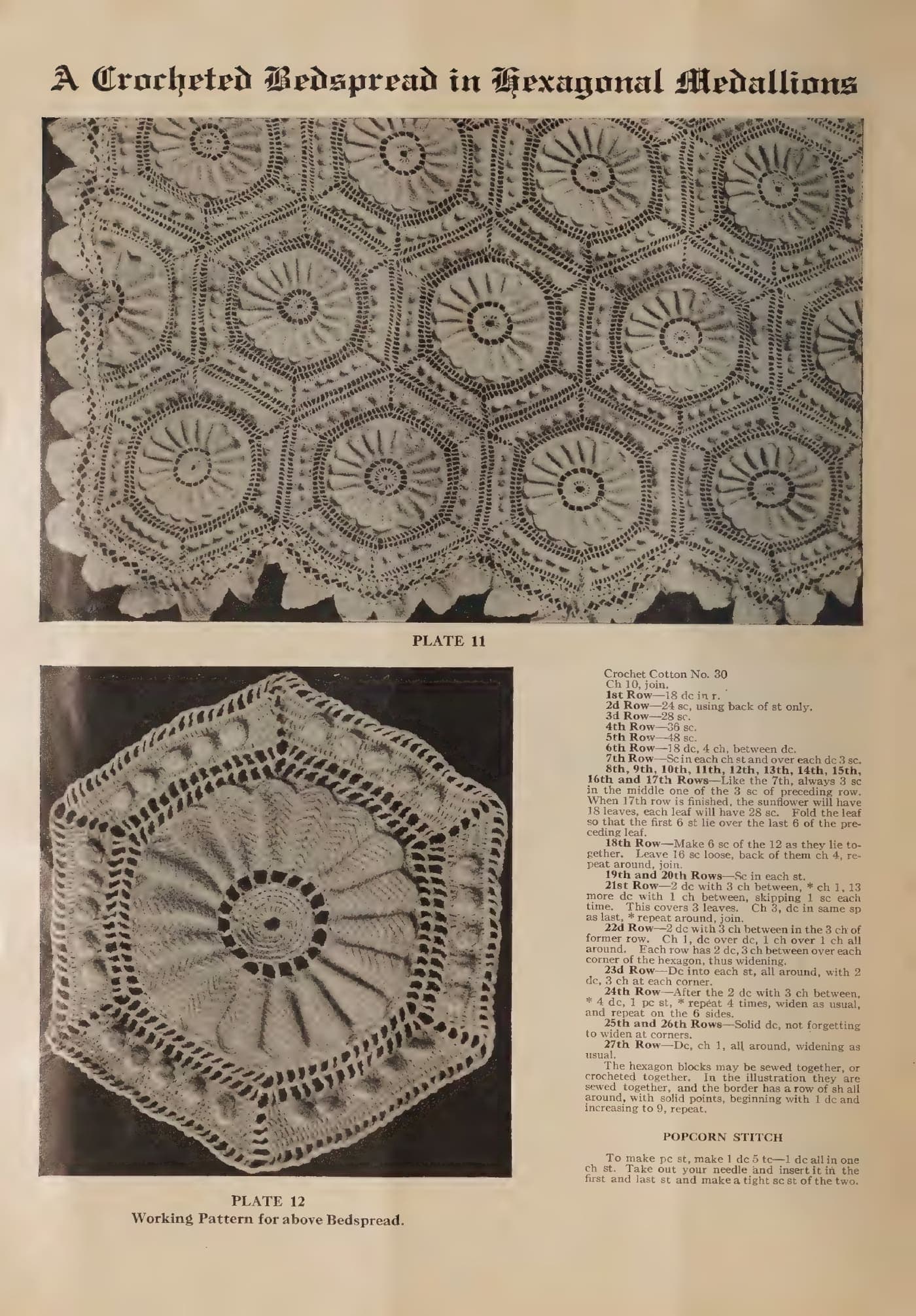
Hexagonal Medallion Bedspread, Plates 11 and 12 (1918): vintage crochet pattern
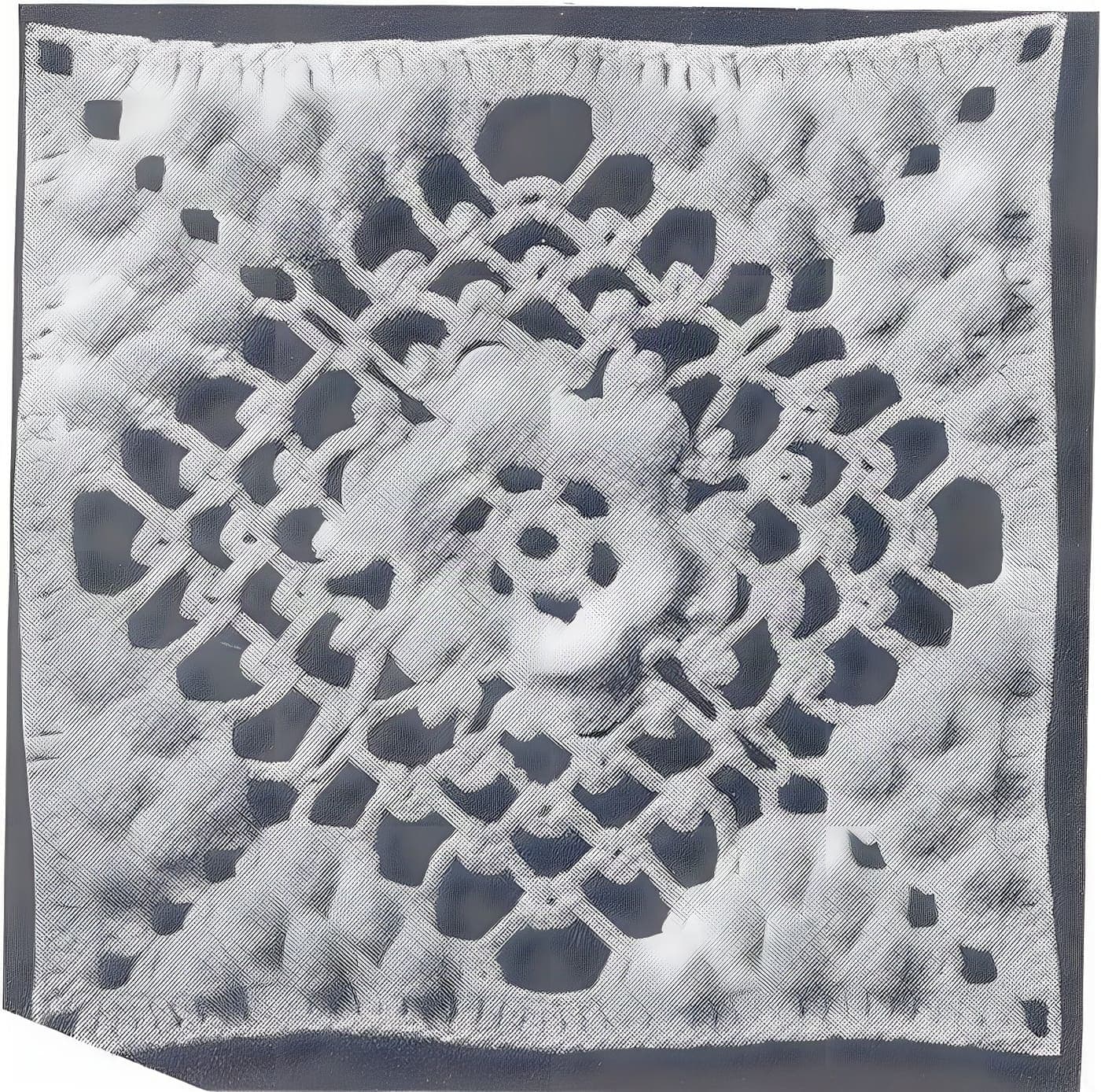
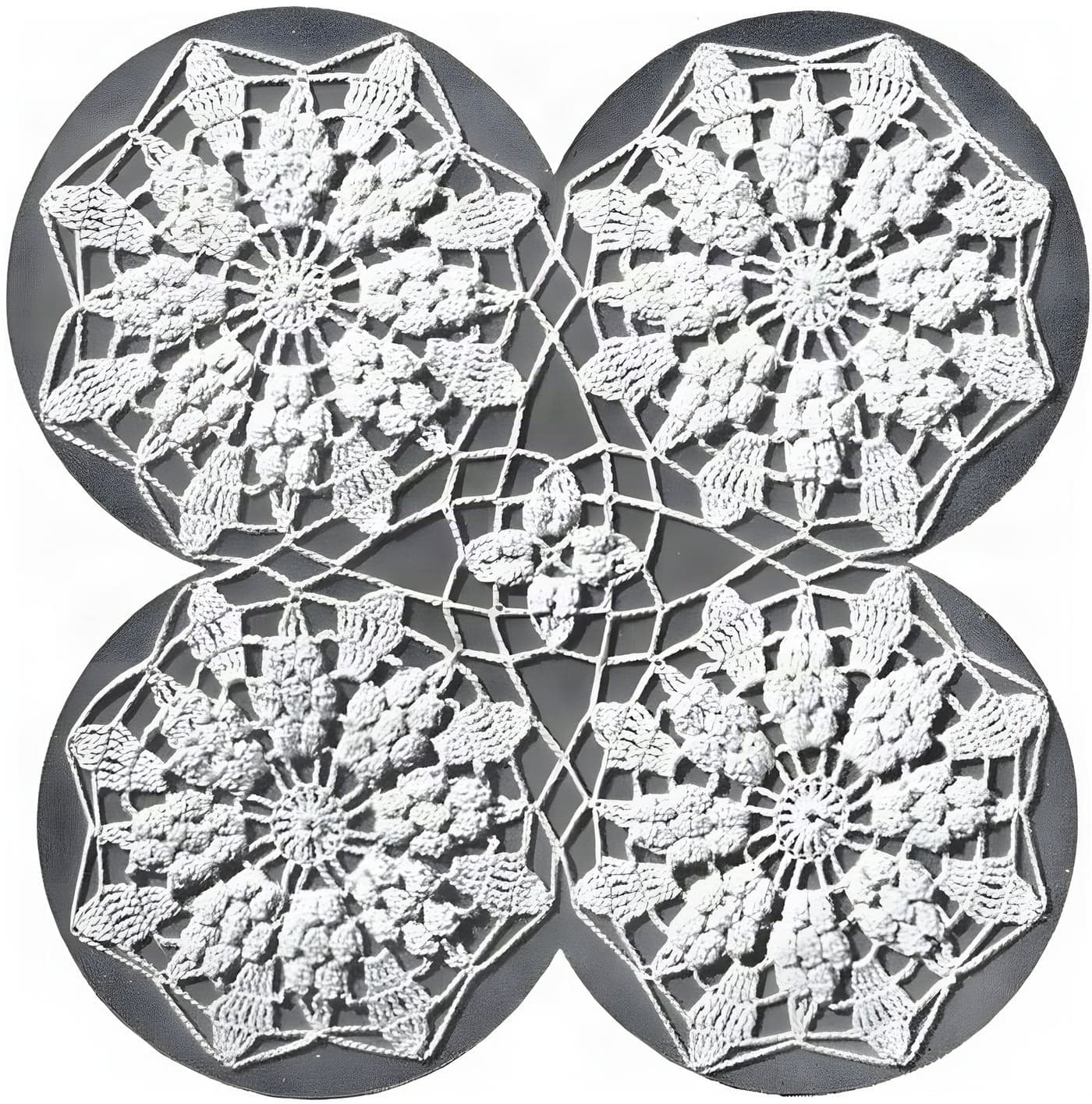
A hexagon medallion worked outward from a chain ring. A raised sunflower of eighteen overlapping single-crochet leaves fills the centre; the leaves are folded and caught down, and the work then squares out into a six-cornered frame of double crochet with a round of popcorns. The book gives both ways of joining the hexagons and a shell border.
By the crochetpatterns.io editorial team · Updated · Editorial policy · pattern testing in progress
| Detail | Value |
|---|---|
| Skill level | Advanced |
| Yarn weight | Lace (#0) |
| Yardage | Not printed. (as printed; yardage not given) |
| Hook | 1.5 mm |
| Gauge | No gauge printed. |
| Finished size | Not printed. |
| Time | about 6 hours |
Materials
- Size 30 cotton crochet thread — the modern thread of the printed number ("Crochet Cotton No. 30")
- Steel crochet hook to suit the thread (no hook number is printed in the original)
- Tapestry needle for joining and for the ends
- Sewing thread if the medallions are to be sewn together rather than crocheted
- Hook: Check: this book prints no hook number and no needle number for any design — not on the cover, not on the abbreviations page and not beside any plate. No modern hook can therefore be read across from a printed size. Match the hook to the thread the design names and change size until the fabric matches the photograph.
Yarn Kit & Substitution Options
This pattern calls for 350 yards of weight #0 yarn. Select a suggested yarn to see required skeins and estimated cost:
Caron Simply Soft · 100% Acrylic
315 yds per skein · High-yield yardage, silky no-scratch texture
2 skeins required
approx. $$10.98 total
Abbreviations (US terms)
- chain
- slip stitch
- single crochet
- double crochet
- treble crochet
- stitch
- stitches
- space
- round
- repeat
- shell
- popcorn
Notes before you start
- Source: "A Crocheted Bedspread in Hexagonal Medallions" (Plates 11 and 12), Knitted and Crocheted Bed Spreads, Book No. 11, Anne Orr, Nashville, Tennessee, 1918. Public domain in the USA.
- As printed — materials: Crochet Cotton No. 30. Gauge: Not given.
- Modernisation note: Stitches are converted by this book's own printed definitions under “DIRECTIONS OF STITCHES”, printed page 2 (image p-02.jpg), not by the look of the abbreviation. The naming is MODERN US. Its “SINGLE CROCHET” (No. 3) is: “Make chain, insert hook through second last chain, throw thread over hook, draw through, throw thread over hook, draw through both loops at once.” That is the modern US sc. Its “DOUBLE CROCHET” (No. 4) is: “Throw thread over hook and draw a loop through foundation chain; throw thread over hook and draw through two loops, thread over hook and draw through last two loops.” That is the modern US dc, not a single. Its “TREBLE CROCHET” (No. 5) is: “Throw thread over hook twice, draw a loop through foundation chain, throw thread over again, draw through the two loops, throw thread over and draw through two, thread over and draw through last two.” That is the modern US tr. Its “SLIP STITCH” (No. 2) is: “Insert hook in foundation chain, draw a loop through it and the loop on hook.” Its “PICOT” (No. 6) is: “Chain 4 and make single crochet in fourth chain from hook.” So this book's sc, dc and tc/tr are written sc, dc and tr here with no shift of height.
- Modernisation note: The book's “CROCHET ABBREVIATIONS” list, printed page 2 (image p-02.jpg), reads: “ch—stands for chain. sc—stands for single crochet. dc—stands for double crochet. tc—stands for treble crochet. sl st—stands for slip stitch. st—stands for stitch. blk—stands for block. hdc—stands for half double crochet. lat—stands for lattice. sp—stands for space. h tr—stands for half treble. tr—stands for treble. p—stands for picot. m—stands for mesh. f m—stands for fancy mesh. l m—stands for long mesh. sk—stands for skip. sh—stands for shell. r st—stands for roll stitch. tr tr—stands for triple treble. ks—stands for knot stitch. d tr—stands for double treble.” The book lists both “tc” and “tr” for the same stitch, treble; both are written tr below and that is the only abbreviation changed.
- Modernisation note: The book's own definitions for the fancy stitches used in these designs, all printed page 2 (image p-02.jpg), quoted so nothing has to be guessed. ROLL STITCH (No. 17): “Roll thread around needle 15 times, put thread over and draw loop through the entire 15 loops, then make one chain stitch.” KNOT STITCH (No. 8): “Having a st on the needle, drawing the loop out to the length of 3 ch, draw the thread through for ch st. Take up the single thread of this loop and work one sc st on it. Repeat once. Skip 5 sts of the previous row, if not knot st, and work 1 sc. If the previous row be knot st, make 1 sc each side of the sc between the long loops of last row.” SHELL (No. 14): “Make chain required length. Ch 3 for 1st tr, 3 tr in 4th st of ch, ch 2, 3 tr in same st *, sk 5, 3 tr in next st, ch 2, 3 tr in same st. Repeat from *. 2d Row of Shells—Make sh in each ch 2.” FANCY MESH (No. 13): “Also called Lacet. This consists of two rows. The first a row of long meshes, 1 dc, 5 ch, skip 5 st, 1 dc, repeat. For the second row, 1 dc in dc of long mesh, ch 3, catch in center of 5 ch of 1 m, ch 3, dc over dc.” SPACE (No. 7): “This is for Filet Crochet Work. Chain two stitches, skip two stitches, one double crochet into next stitch.” BLOCK (No. 9): “Also for Filet Crochet. Four dc in adjoining sts. The number of dc in adjoining blocks is found by multiplying the number of blocks by 3 and adding one.”
- Modernisation note: The book calls every round and every row a “Row” (“1st Row—”, “2d Row—”). Pieces worked outward in joined rounds from a centre ring are labelled “Rnd” below and pieces worked back and forth keep “Row”; the numbering is the book's own and nothing has been renumbered. Run-on paragraphs are split at the book's own row marks, one row or step per line. No stitch has been added, removed or reordered.
- Modernisation note: Every figure below was read back against the page image, because the scanned text of this book carries the usual optical slips: its “8” and “38” very often stand for the printed 3 (the scan's “ch 8” is “ch 3” on the page in most places), its “Ist” and “ist” are 1st, its “de” is dc, its “bik” is blk, its “si st” is sl st, its “\4”, “}%”, “14” and “1%” all stand for the printed ½, its “trin” and “scinto” are “tr in” and “sc into”, and its “WMake” is Make. The rows below follow what the printed page actually shows; the quoted extract for each design is left exactly as the scan reads, untidied.
- Modernisation note: No gauge is printed anywhere in this book.
- Modernisation note: No finished size is printed for this design — the book gives no bed size, no motif measurement and no stitch-to-inch figure — so none is stated here.
- Modernisation note: Check: no quantity of thread is printed. The book names a cotton number for some designs and nothing at all for others; it never says how many balls a bedspread takes, and no yardage has been invented.
- Modernisation note: Check: no colour is printed for any design in this book. The photographs show a plain light thread. White and écru are recorded below as the usual period choices for a cotton bedspread, not as this design's printed colour.
- Modernisation note: Modern thread suggestions below are added by this transcription and are not in the original; the original's own cotton number is kept in the materials exactly as printed.
- Modernisation note: This design prints both a joining method and a border, which is why it is transcribed in full rather than skipped as a motif with no assembly.
- Modernisation note: The book's popcorn is defined on the same page and is transcribed above as its own step; the scan's “1 dc 5 tc—1 dc all in one ch st” is written “1 dc, 5 tr, 1 dc all in one ch st” — commas supplied, and tc written tr by the book's own abbreviation list.
- Modernisation note: Check: rnd 6 is printed “18 dc, 4 ch, between dc”, the stray comma being in the book. It reads as 18 dc with 4 ch between them.
- Modernisation note: Check: rnds 2 to 5 give only a stitch count (“24 sc”, “28 sc”, “36 sc”, “48 sc”) and do not say where the increases fall. Space them evenly; the book does not say.
- Modernisation note: Check: the rounds are unnumbered from rnd 22 onward in one respect — the book keeps saying “widen as usual”, meaning the 2 dc with 3 ch between at each of the six corners established in rnd 22. That is the book's own shorthand and is kept.
- Modernisation note: Check: the book does not say how many hexagons a bedspread needs, or how many rounds of the shell border to work. Follow the photograph of Plate 11.
- Modernisation note: Plate 12 is a photograph of a single finished medallion captioned “Working Pattern for above Bedspread” — a picture of the motif, not a squared chart, so nothing in this design depends on reading a chart.
Row progress: 0 of 16 done (0%)
Medallion (ch 10, join)
0 of 16 done- Rnd 1: 18 dc in ring.Mark row complete
- Rnd 2: 24 sc, using back of st only.Mark row complete
- Rnd 3: 28 sc.Mark row complete
- Rnd 4: 36 sc.Mark row complete
- Rnd 5: 48 sc.Mark row complete
- Rnd 6: 18 dc, 4 ch between dc.Mark row complete
- Rnd 7: Sc in each ch st and over each dc 3 sc.Mark row complete
- Rnds 8, 9, 10, 11, 12, 13, 14, 15, 16 and 17: Like rnd 7, always 3 sc in the middle one of the 3 sc of preceding row. When the 17th row is finished, the sunflower will have 18 leaves, each leaf will have 28 sc. Fold the leaf so that the first 6 st lie over the last 6 of the preceding leaf.Mark row complete
- Rnd 18: Make 6 sc of the 12 as they lie together. Leave 16 sc loose, back of them ch 4, repeat around, join.Mark row complete
- Rnds 19 and 20: Sc in each st.Mark row complete
- Rnd 21: 2 dc with 3 ch between, * ch 1, 13 more dc with 1 ch between, skipping 1 sc each time. This covers 3 leaves. Ch 3, dc in same sp as last, * repeat around, join.Mark row complete
- Rnd 22: 2 dc with 3 ch between in the 3 ch of former row. Ch 1, dc over dc, 1 ch over 1 ch all around. Each row has 2 dc, 3 ch between over each corner of the hexagon, thus widening.Mark row complete
- Rnd 23: Dc into each st, all around, with 2 dc, 3 ch at each corner.Mark row complete
- Rnd 24: After the 2 dc with 3 ch between, * 4 dc, 1 pc st, * repeat 4 times, widen as usual, and repeat on the 6 sides.Mark row complete
- Rnds 25 and 26: Solid dc, not forgetting to widen at corners.Mark row complete
- Rnd 27: Dc, ch 1, all around, widening as usual.Mark row complete
Working on:
Rnd 1: 18 dc in ring.
Continue this pattern
The rest of the Hexagonal Medallion Bedspread, Plates 11 and 12 (1918) pattern is in the Vintage Afghans & Bedspreads
Still to come in the full pattern:
- Popcorn stitch
- Finishing
Included with 73 patterns for $19 — $0.26 per pattern.
Errata
No corrections have been published for this pattern. Found a mistake? Tell us and we will log the fix here with a date.
Your notes on this pattern
Keep track of the yarn, hook and changes you used. Saved in this browser only — nobody else can see it.
Frequently asked questions
Where is the A Crocheted Bedspread in Hexagonal Medallions pattern from?
It was published as "A Crocheted Bedspread in Hexagonal Medallions" in Knitted and Crocheted Bed Spreads, Book No. 11 by Anne Orr, Nashville, Tennessee in 1918. The publication is in the public domain in the United States; this version is transcribed and modernised by crochetpatterns.io.
What yarn or thread do I need for the A Crocheted Bedspread in Hexagonal Medallions?
Size 30 cotton crochet thread. Not printed.
What hook should I use?
Check: this book prints no hook number and no needle number for any design — not on the cover, not on the abbreviations page and not beside any plate. No modern hook can therefore be read across from a printed size. Match the hook to the thread the design names and change size until the fabric matches the photograph. Gauge: No gauge printed.