Free preview · full pattern in the Heirloom Doilies & Tablecloths
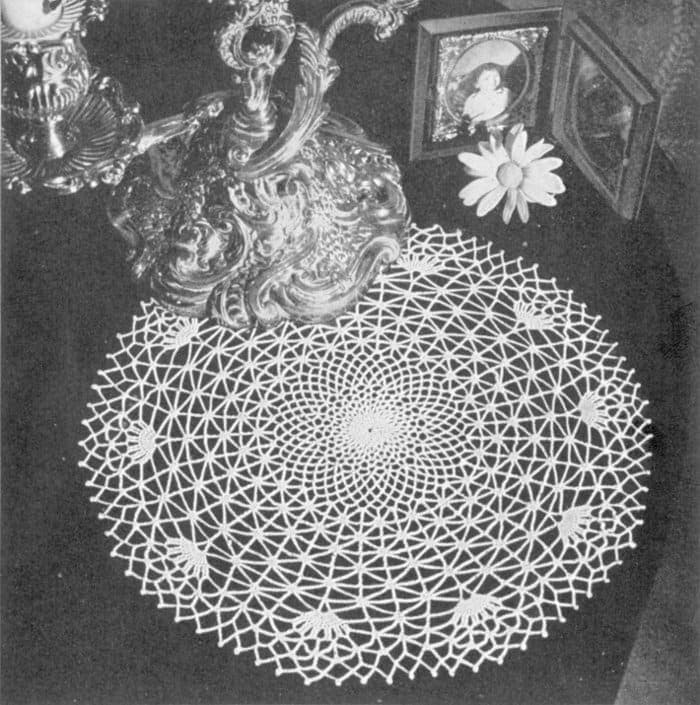
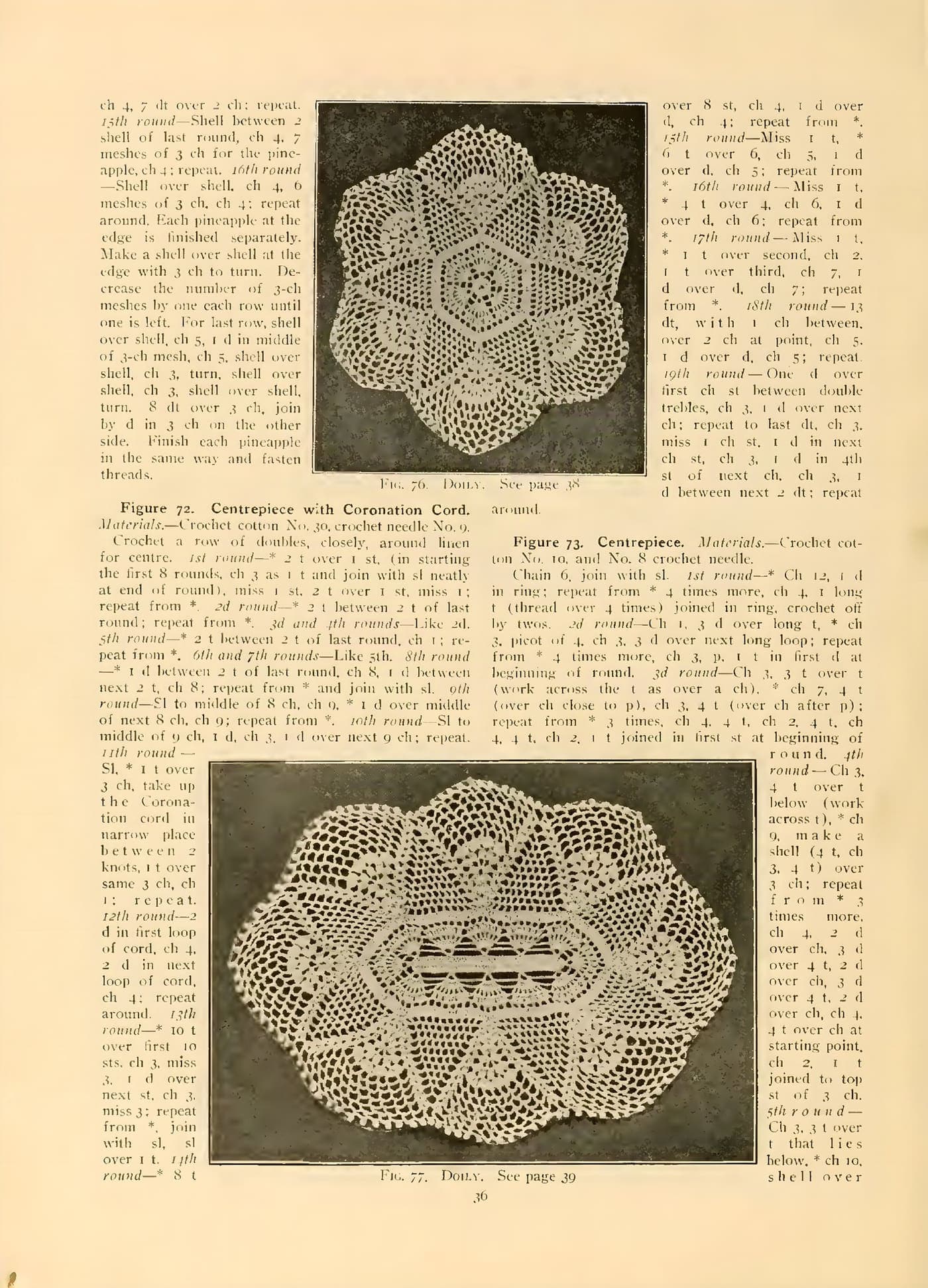
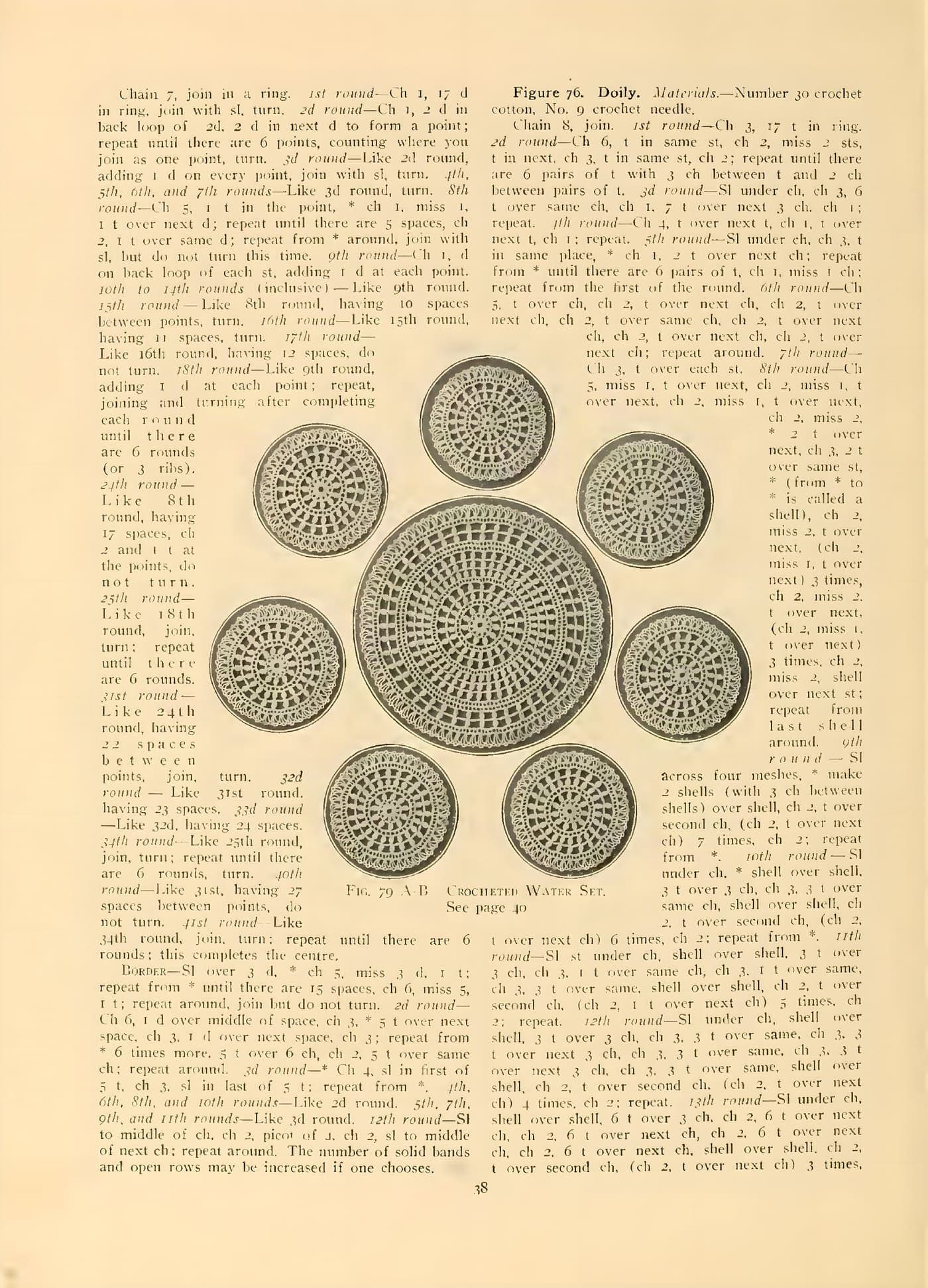
Figure 76 Shell and Fan Doily (1915): vintage crochet pattern
A round doily set out in six pairs of double crochet from a ring of 17: shells grow between the pairs round by round, fans of seven double crochet open at the edge, and a picot round of treble crochet finishes it.
By the crochetpatterns.io editorial team · Updated · Editorial policy · pattern testing in progress
| Detail | Value |
|---|---|
| Skill level | Advanced |
| Yarn weight | Lace (#0) |
| Yardage | the book gives no thread quantity for this design. (as printed; yardage not given) |
| Hook | 1.4 mm |
| Gauge | No gauge printed. Work the first few rounds and match the hook to the thread so the work lies flat. |
| Finished size | Not printed. |
| Time | about 6 hours |
Materials
- Size 30 crochet thread — approximate modern equivalent of the book's No. 30 crochet cotton
- 1.4 mm steel hook (US steel 9) — approximate for the book's No. 9 hook
- Fine tapestry or sewing needle for the ends
- Hook: Start with 1.4 mm (US steel 9) — approximate for the book's No. 9 hook; change size until the thread runs easily and the work lies flat.
Yarn Kit & Substitution Options
This pattern calls for 350 yards of weight #0 yarn. Select a suggested yarn to see required skeins and estimated cost:
Caron Simply Soft · 100% Acrylic
315 yds per skein · High-yield yardage, silky no-scratch texture
2 skeins required
approx. $$10.98 total
Abbreviations (US terms)
- chain
- slip stitch
- single crochet
- double crochet
- stitch
- stitches
- skip
- repeat
- round
- shell
- space
Notes before you start
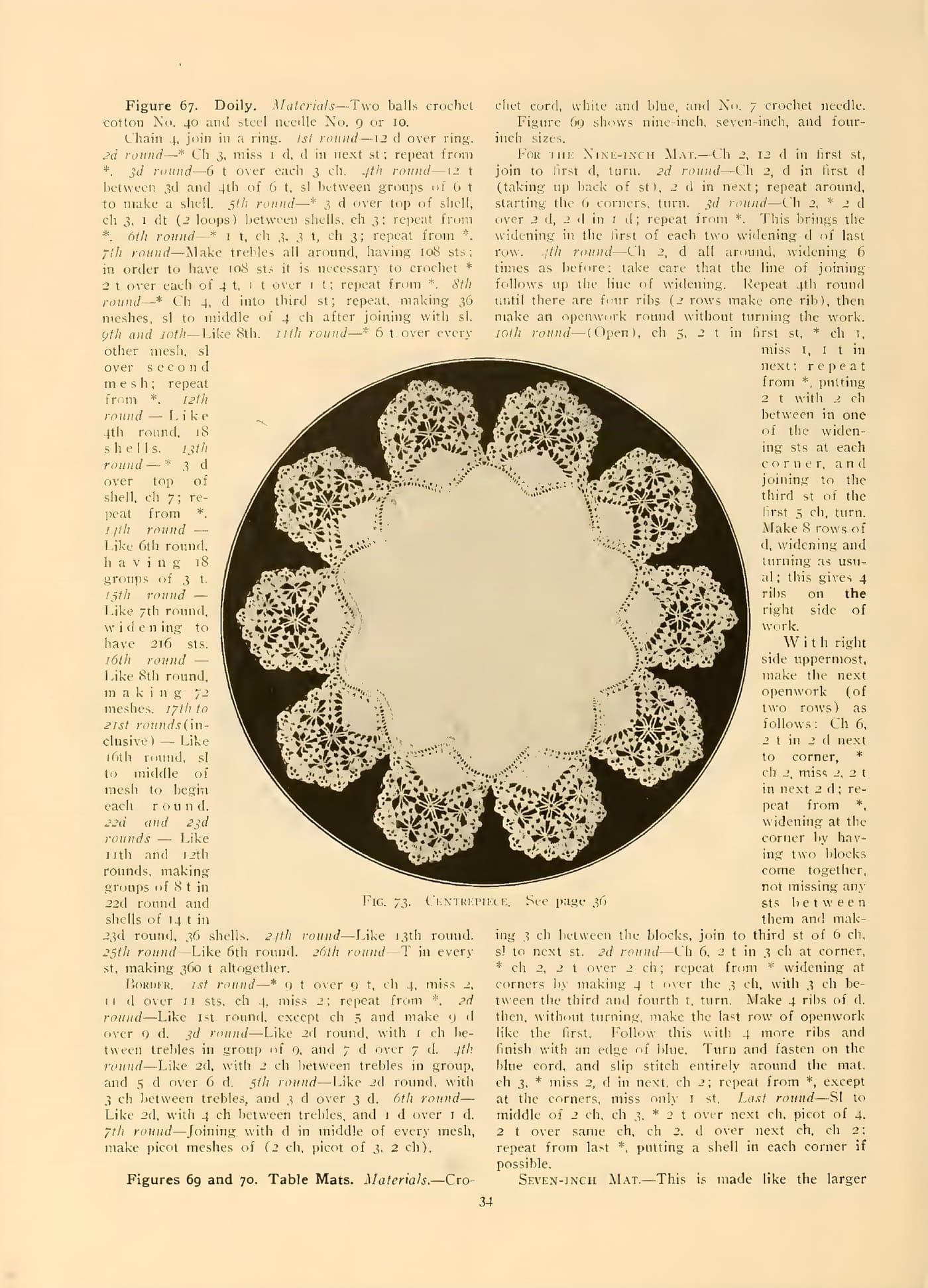
- Source: "Figure 76. Doily", The Priscilla Crochet Book: Centerpieces and Doilies (edited by Belle Robinson), The Priscilla Publishing Company, Boston, 1915. Public domain in the USA.
- As printed — materials: Number 30 crochet cotton; No. 9 crochet needle. Gauge: Not given.
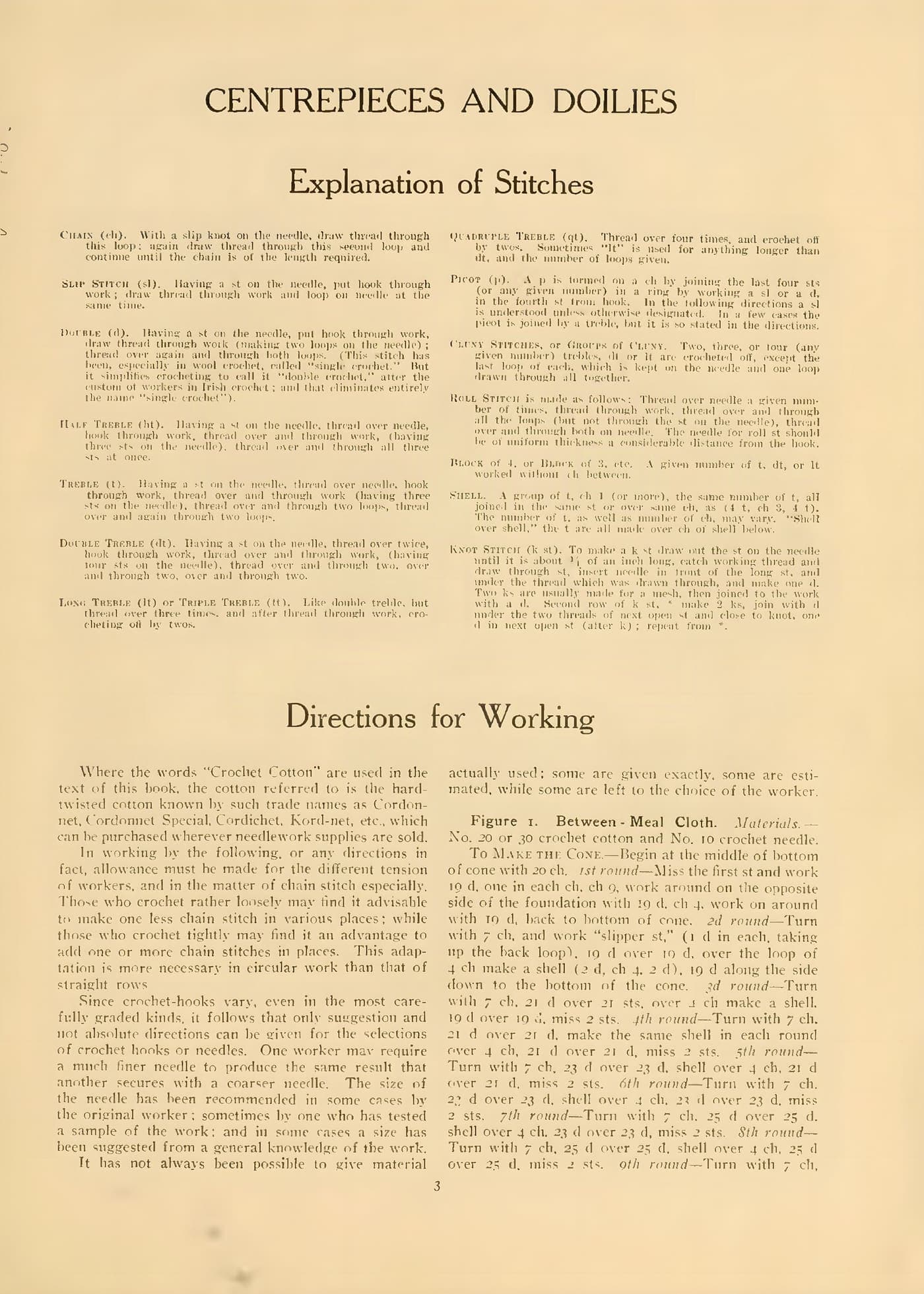
- Modernisation note: Stitches converted by the book's own “Explanation of Stitches” (printed page 3), not by name. This book uses the older British-style naming, so its stitch names do NOT match modern US names: chain (ch) = ch; slip stitch (sl) = sl st; “double” (d), hook through work, draw thread through, “thread over again and through both loops” = modern US single crochet (sc) — the book adds that this stitch “has been, especially in wool crochet, called ‘single crochet’”; “half treble” (h t), thread over, through work, then “thread over and through all three sts at once” = modern US half double crochet (hdc); “treble” (t), thread over, through work, “thread over and through two loops, thread over and again through two loops” = modern US double crochet (dc); “double treble” (d t), thread over twice and worked off by twos three times = modern US treble crochet (tr); “long treble” (l t) or “triple treble” (t t), thread over three times, worked off by twos = modern US double treble (dtr); “quadruple treble” (q t), thread over four times = modern US triple treble. Every stitch below has been rewritten in the modern US name and abbreviation on that basis.
- Modernisation note: The book's picot (p) is defined on the same page: it is formed on a chain by joining the last four stitches (or any given number) in a ring by working a slip stitch or a single crochet in the fourth stitch from the hook, and “a sl is understood unless otherwise designated.” Picots are written out as “picot” with the chain count the design gives, since the site's abbreviation list has no picot entry.
- Modernisation note: The book's abbreviations are written in modern US form: d = sc, h t = hdc, t = dc, d t = tr, l t = dtr, st(s) = st(s), sp = sp, “miss” = sk, “thread over (the needle)” = yo, “repeat” = rep, “needle” (for the crochet hook) = hook. Ordinal row and round names (“1st round”, “2d round”) are written Rnd 1, Rnd 2 and Row 1, Row 2. Section headings (Border, Edge, Heading) are the book's own where it prints them. The book's British spelling “centrepiece” is kept inside quoted names.
- Modernisation note: The book prints each design as one or two solid paragraphs; these have been split into one round, row or step per line. Stitch order and counts are unchanged. Where the book's own repeat markers (*, **) span several lines they are kept as printed.
- Modernisation note: Thread sizes are the 1915 numbering. “No. N crochet cotton” is given as modern size N crochet thread, which is an approximation: modern size numbering runs the same way (higher number = finer thread) but the exact diameters are not identical. The book states that where it says “crochet cotton” it means the hard-twisted cotton sold as Cordonnet, Cordonnet Special, Cordichet, Kord-net and similar. No yardage is printed for any design, so none is given here.
- Modernisation note: Hook sizes are the book's own steel numbering, and the book itself says only a suggestion can be given: “since crochet-hooks vary, even in the most carefully graded kinds, it follows that only suggestion and not absolute directions can be given for the selections of crochet hooks.” The 1915 steel numbering is not identical to the modern one, so every metric size below is approximate and should be adjusted to the thread.
- Modernisation note: The book's general “Directions for Working” asks the worker to allow for tension, especially in chain stitches: loose workers may need one chain fewer in places and tight workers one or more chains more, “more necessary in circular work than that of straight rows.” That allowance applies to every design here.
- Modernisation note: No gauge is printed for this design; work the centre rounds and adjust the hook until the piece lies flat.
- Modernisation note: Metric conversions added.
- Modernisation note: Check: the OCR of Rnd 1 drops the stitch count, printing only “Ch 3,”; the page reads “Ch 3, 17 t in ring”, which is what is given above.
Row progress: 0 of 19 done (0%)
Doily
0 of 19 done- Ch 8, join.Mark row complete
- Rnd 1: Ch 3, 17 dc in the ring.Mark row complete
- Rnd 2: Ch 6, dc in the same st, ch 2, sk 2 sts, dc in the next, ch 3, dc in the same st, ch 2; rep until there are 6 pairs of dc with ch 3 between the dc and ch 2 between the pairs.Mark row complete
- Rnd 3: Sl st under the ch, ch 3, 6 dc over the same ch, ch 1, 7 dc over the next 3 ch, ch 1; rep.Mark row complete
- Rnd 4: Ch 4, dc over the next dc, ch 1, dc over the next dc, ch 1; rep.Mark row complete
- Rnd 5: Sl st under the ch, ch 3, dc in the same place, * ch 1, 2 dc over the next ch; rep from * until there are 6 pairs of dc, ch 1, sk 1 ch; rep from the first of the round.Mark row complete
- Rnd 6: Ch 5, dc over the ch, ch 2, dc over the next ch, ch 2, dc over the next ch, ch 2, dc over the same ch, ch 2, dc over the next ch, ch 2, dc over the next ch, ch 2, dc over the next ch; rep around.Mark row complete
- Rnd 7: Ch 3, dc over each st.Mark row complete
- Rnd 8: Ch 5, sk 1, dc over the next, ch 2, sk 1, dc over the next, ch 2, sk 1, dc over the next, ch 2, sk 2, * 2 dc over the next, ch 3, 2 dc over the same st * (from * to * is called a shell), ch 2, sk 2, dc over the next, (ch 2, sk 1, dc over the next) 3 times, ch 2, sk 2, dc over the next, (ch 2, sk 1, dc over the next) 3 times, ch 2, sk 2, shell over the next st; rep from the last shell around.Mark row complete
- Rnd 9: Sl st across four meshes, * make 2 shells (with ch 3 between shells) over the shell, ch 2, dc over the second ch, (ch 2, dc over the next ch) 7 times, ch 2; rep from *.Mark row complete
- Rnd 10: Sl st under the ch, * shell over shell, 3 dc over the 3 ch, ch 3, 3 dc over the same ch, shell over shell, ch 2, dc over the second ch, (ch 2, dc over the next ch) 6 times, ch 2; rep from *.Mark row complete
- Rnd 11: Sl st under the ch, shell over shell, 3 dc over the 3 ch, ch 3, 1 dc over the same ch, ch 3, 1 dc over the same, ch 3, 3 dc over the same, shell over shell, ch 2, dc over the second ch, (ch 2, 1 dc over the next ch) 5 times, ch 2; rep.Mark row complete
- Rnd 12: Sl st under the ch, shell over shell, 3 dc over the 3 ch, ch 3, 3 dc over the same, ch 3, 3 dc over the next 3 ch, ch 3, 3 dc over the same, ch 3, 3 dc over the next 3 ch, ch 3, 3 dc over the same, shell over shell, ch 2, dc over the second ch, (ch 2, dc over the next ch) 4 times, ch 2; rep.Mark row complete
- Rnd 13: Sl st under the ch, shell over shell, 6 dc over the 3 ch, ch 2, 6 dc over the next ch, ch 2, 6 dc over the next ch, ch 2, 6 dc over the next ch, ch 2, 6 dc over the next ch, shell over shell, ch 2, dc over the second ch, (ch 2, dc over the next ch) 3 times, ch 2, shell over shell; rep around.Mark row complete
- Rnd 14: Sl st under the ch, shell over shell, ch 4, dc between the shell and the next dc, ch 4, * dc in the middle of the group of 6, ch 4, dc between the groups, ch 4; rep from * to the shell, shell over shell, ch 2, dc over the second ch, ch 2, dc over the next ch, ch 2, dc over the next ch, ch 2, shell over shell; rep around.Mark row complete
- Rnd 15: Sl st under the ch, shell over shell, * ch 4, dc over the next ch; rep from * to the shell, shell over shell, ch 2, dc over the second ch, ch 2, dc over the next ch, ch 2, shell over shell; rep around.Mark row complete
- Rnd 16: Like Rnd 15, but there are only (ch 2, 1 dc, ch 2) between scallops.Mark row complete
- Rnd 17: Like Rnd 15, but shell meets shell without ch between.Mark row complete
- Rnd 18: Sl st under the ch, ch 5, picot of 5 joined with sc, ch 2, dc over the next ch, * ch 2, picot of 5, ch 2, dc over the next ch; rep from * around.Mark row complete
Working on:
Ch 8, join.
Continue this pattern
The rest of the Figure 76 Shell and Fan Doily (1915) pattern is in the Heirloom Doilies & Tablecloths
Still to come in the full pattern:
- Finishing
Included with 236 patterns for $19 — $0.08 per pattern.
Errata
No corrections have been published for this pattern. Found a mistake? Tell us and we will log the fix here with a date.
Your notes on this pattern
Keep track of the yarn, hook and changes you used. Saved in this browser only — nobody else can see it.
Frequently asked questions
Where is the Figure 76. Doily pattern from?
It was published as "Figure 76. Doily" in The Priscilla Crochet Book: Centerpieces and Doilies (edited by Belle Robinson) by The Priscilla Publishing Company, Boston in 1915. The publication is in the public domain in the United States; this version is transcribed and modernised by crochetpatterns.io.
What yarn or thread do I need for the Figure 76. Doily?
Size 30 crochet thread. Not printed — the book gives no thread quantity for this design.
What hook should I use?
Start with 1.4 mm (US steel 9) — approximate for the book's No. 9 hook; change size until the thread runs easily and the work lies flat. Gauge: No gauge printed. Work the first few rounds and match the hook to the thread so the work lies flat.