Free preview · full pattern in the Heirloom Doilies & Tablecloths
Spider Web Doily (1950): vintage crochet pattern
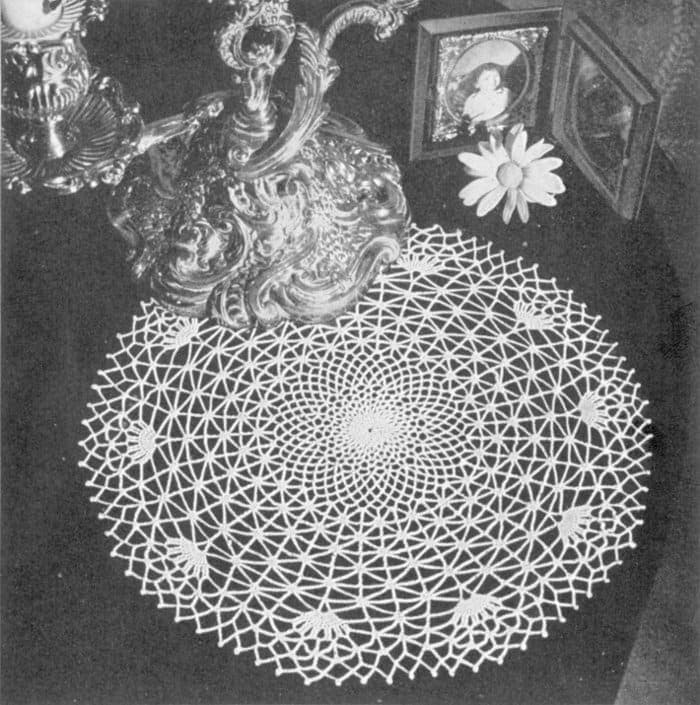
A round white doily worked from a centre of single crochet into shell rounds, then long chain loops caught with trebles so the mesh reads as a spider's web, finished with a picot chain edge. Originally published as "Spider Web Doily" in Doily Bouquet (Star Book No. 71) by American Thread Company in 1950, it is now in.
By the crochetpatterns.io editorial team · Updated · Editorial policy · pattern testing in progress
| Detail | Value |
|---|---|
| Skill level | Advanced |
| Yarn weight | Lace (#0) |
| Yardage | 1 to 3 balls as printed for the thread chosen; ball yardage is not printed. |
| Hook | 1.65 mm |
| Gauge | Not given in the original — work to the finished size printed for your thread. |
| Finished size | 9–13 inches (23–33 cm) across, depending on the thread: 13 in (33 cm) in "Puritan", "De Luxe" or "Star" Pearl Cotton size 5; 12 in (30 cm) in "Sillateen Sansil"; 11 in (28 cm) in "Gem" or "Star" Crochet Cotton size 30 or 50; 9 in (23 cm) in "Star" Tatting Cotton. |
| Time | about 10 hours |
Materials
- White cotton crochet thread — size 30 or 50 where the original names those sizes (size 20 is the nearest widely stocked weight to size 30); size 5 pearl cotton for the pearl-cotton line
- 1–3 balls, following the printed count for the thread you choose
- Tapestry needle, rustproof pins and starch for blocking
- Hook: The book prints a steel hook number beside each thread: No. 7 (about 1.65 mm), No. 10 (about 1.3 mm), No. 12 (about 1.0 mm), No. 13 (about 0.85 mm). Start with the modern US steel hook of the number printed for the thread you buy and change size until the piece reaches the size printed for that thread.
Yarn Kit & Substitution Options
This pattern calls for 350 yards of weight #0 yarn. Select a suggested yarn to see required skeins and estimated cost:
Caron Simply Soft · 100% Acrylic
315 yds per skein · High-yield yardage, silky no-scratch texture
2 skeins required
approx. $$10.98 total
Abbreviations (US terms)
- chain
- slip stitch
- single crochet
- double crochet
- treble crochet
- stitch
- stitches
- space
- skip
- loop
- round
Notes before you start
- Source: "Spider Web Doily", Doily Bouquet (Star Book No. 71), American Thread Company, 1950. Public domain in the USA.
- As printed — materials: "GEM" Crochet Cotton Article 35, Size 30 or 50 — 1 Ball White — approx. 11 inches — Steel 12; "PURITAN" Crochet Cotton Article 40 — 1 Ball White — approx. 13 inches — Steel 7; "DE LUXE" Crochet Cotton Article 346 — 1 Ball White — approx. 13 inches — Steel 7; "STAR" Tatting Cotton Article 25 — 2 Balls White — approx. 9 inches — Steel 13; "STAR" Crochet Cotton Article 20, Size 30 or 50 — 1 Ball White — approx. 11 inches — Steel 12; "STAR" Crochet Cotton Article 30, Size 30 or 50 — 2 Balls White — approx. 11 inches — Steel 12; "STAR" Pearl Cotton Article 90, Size 5 — 3 Balls White — approx. 13 inches — Steel 7; "SILLATEEN SANSIL" Article 102 — 2 Balls White — approx. 12 inches — Steel 10. Gauge: Not given.
- Modernisation note: The book prints no abbreviation list. It defines each stitch inline instead, in brackets where it is first used, and by those definitions its terms are already modern US terms: s c = sc, d c = dc, s d c = half double crochet (hdc), tr c = tr, d tr c (3 times over needle) = dtr, tr tr c (4 times over needle) = a triple treble worked with 4 yarn-overs. No stitch has been converted; only the spacing of the letters changes, and "thread over" is written "yo".
- Modernisation note: The original calls every round a "Row" ("2nd Row—"). Pieces worked round and round are labelled "Rnd" here and pieces worked back and forth keep "Row". Run-on paragraphs were split so there is one round, row or step per line. No stitch was added, removed or reordered.
- Modernisation note: In the last round the original prints "ch s" where a chain number belongs — the figure is mis-set on the page. Nothing has been substituted for it; the round is marked "ch [see note]" so you can see exactly where the book is unreadable. Work enough chains for the picot loop to lie flat against the round below.
- Modernisation note: Rounds 27 to 33 are printed on a later page of the book under a "continued" line; they are placed in sequence here.
- Modernisation note: No gauge is printed anywhere in the book. The printed finished size for the thread you choose is the only check on tension.
- Modernisation note: Thread is printed in balls only — no yardage is given for any article number, so none has been supplied. Buy the printed number of balls of a comparable modern thread and check your ball band.
- Modernisation note: "Gem" (Article 35), "Puritan" (Article 40), "De Luxe" (Article 346), "Star" (Articles 20 and 30), "Star" Tatting Cotton (Article 25), "Star" Pearl Cotton (Article 90) and "Sillateen Sansil" (Article 102) are all discontinued. Where a thread size is printed it is repeated above; where it is not, match the printed finished size instead of guessing a size.
- Modernisation note: Metric conversions and the modern thread and hook suggestions were added; they are not in the original.
Row progress: 0 of 30 done (0%)
Doily
0 of 30 done- Rnd 1: Ch 2, 8 sc in 2nd st from hook, join in 1st sc.Mark row complete
- Rnd 2: Ch 1 and work 2 sc in each sc (16 sc), join.Mark row complete
- Rnd 3: Working in sc increase in every other sc, join.Mark row complete
- Rnd 4: Increase in every 3rd sc, join.Mark row complete
- Rnd 5: Increase in every 4th sc (40 sc), join.Mark row complete
- Rnd 6: Ch 5, dc in same space, * skip 1 sc, 1 dc, ch 2, 1 dc (shell) in next sc, repeat from * all around ending row with skip 1 sc, join in 3rd st of ch.Mark row complete
- Rnd 7: Sl st into shell, ch 5, dc in same space, * 1 dc, ch 2, 1 dc (shell) in center of next shell, repeat from * all around, join in 3rd st of ch.Mark row complete
- Rnd 8: Sl st into shell, ch 7 and work same as last row but working 1 dc, ch 4, 1 dc in center of each shell.Mark row complete
- Rnd 9: Sl st into shell, ch 8 and work same as last row but working 1 dc, ch 5, 1 dc in center of each shell.Mark row complete
- Rnd 10: * Ch 6, sc in center of next shell, ch 6, sc between next 2 dc, repeat from * all around ending row with ch 3, dc in same space as beginning (this brings thread in position for next row).Mark row complete
- Rnds 11–14: Work ch 6 loops all around ending each row with ch 3, dc in dc (40 loops in each row).Mark row complete
- Rnd 15: Ch 9, 3 sc in next loop, * ch 5, tr in next loop, ch 5, 3 sc in next loop, repeat from * all around, ch 5, join in 4th st of ch.Mark row complete
- Rnd 16: Ch 1, sc in same space, * sc in 1st st of ch of next loop, ch 5, tr in center sc of next sc group, ch 5, 1 sc in last st of ch of next loop, 1 sc in tr, repeat from * all around ending row with sc in 1st st of ch of next loop, ch 5, tr in center sc of next sc group, ch 5, sc in last st of ch of next loop, join.Mark row complete
- Rnd 17: Ch 1, sc in same space, 1 sc in next sc, * ch 6, tr in next tr, ch 6, 1 sc in each of the next 3 sc, repeat from * all around ending row with ch 6, tr in tr, ch 6, sc in next sc, join in 1st sc.Mark row complete
- Rnd 18: Ch 11, * 1 sc in last st of ch of next loop, 1 sc in tr, 1 sc in 1st st of ch of next loop, ch 7, tr in center sc of next sc group, ch 7, repeat from * all around ending row to correspond, join in 4th st of ch.Mark row complete
- Rnd 19: Ch 11, * 1 sc in each of the next 3 sc, ch 7, tr in next tr, ch 7, repeat from * all around ending row to correspond, join in 4th st of ch.Mark row complete
- Rnd 20: Same as 16th row but having 8 chs in each loop.Mark row complete
- Rnd 21: Same as 17th row but having 8 chs in each loop.Mark row complete
- Rnd 22: Ch 12 and work same as 18th row but having 8 chs in each loop.Mark row complete
- Rnd 23: Ch 13 and work same as 19th row having 9 chs in each loop.Mark row complete
- Rnd 24: Same as 16th row but having 9 chs in each loop.Mark row complete
- Rnd 25: Same as 17th row but having 10 chs in each loop.Mark row complete
- Rnd 26: Ch 14 and work same as 18th row but having 10 chs in each loop.Mark row complete
- Rnd 27: Ch 7, tr in same space, * ch 10, 1 sc in each of the next 3 sc, ch 10, tr in next tr, ch 10, 1 sc in each of the next 3 sc, ch 10, 1 tr, ch 3, 1 tr in next tr, repeat from * all around ending row with ch 10, 1 sc in each of the next 3 sc, ch 10, tr in next tr, ch 10, 1 sc in each of the next 3 sc, ch 10, join in 4th st of ch.Mark row complete
- Rnd 28: Sl st into loop, ch 4, 11 tr in same loop, * ch 8, 1 tr in center sc of next sc group, ch 8, sc in last st of ch of next loop, sc in next tr, sc in 1st st of ch of next loop, ch 8, tr in center sc of next sc group, ch 8, skip 1 loop, 12 tr in next loop, repeat from * all around ending row to correspond, join.Mark row complete
- Rnd 29: Ch 4, ** tr in next tr, * ch 3, 1 tr in each of the next 2 tr, repeat from * 4 times, ch 9, tr in next tr, ch 9, 1 sc in each of the next 3 sc, ch 9, tr in next tr, ch 9, 1 tr in next tr, repeat from ** all around ending row to correspond, join.Mark row complete
- Rnd 30: Sl st into loop, ch 11, sc in next loop, * ch 7, tr in next loop, ch 7, sc in next loop, ch 7, tr in next loop, ch 8, 1 sc in last st of ch of next loop, sc in next tr, sc in 1st st of ch of next loop, ch 8, tr in center sc of next sc group, ch 8, sc in last st of ch of next loop, sc in next tr, sc in 1st st of ch of next loop, ch 8, skip 1 loop, tr in next ch 3 loop, ch 7, sc in next loop, repeat from * all around ending row to correspond and joining last ch 8 loop in 4th st of ch.Mark row complete
- Rnd 31: Ch 1, sc in same space, 1 sc in 1st st of ch of next loop, ** ch 7, tr in next sc, ch 7, sc in last st of ch of next loop, sc in next tr, sc in 1st st of ch of next loop, repeat from * once, * ch 8, tr in center sc of next sc group, ch 8, sc in last st of ch of next loop, sc in next tr, sc in 1st st of ch of next loop, repeat from * once, repeat from ** all around in same manner ending row to correspond, join.Mark row complete
- Rnd 32: Ch 12, * sc in last st of ch of next loop, sc in tr, sc in 1st st of next loop, ch 8, tr in center sc of next sc group, ch 8, repeat from * all around ending row to correspond and joining last ch 8 in 4th st of ch 12.Mark row complete
- Rnd 33: Sl st to center of loop, * ch 9, sl st in 4th st from hook for picot, ch [see note], sc in next loop, repeat from * all around, join, break thread.Mark row complete
Working on:
Rnd 1: Ch 2, 8 sc in 2nd st from hook, join in 1st sc.
Continue this pattern
The rest of the Spider Web Doily (1950) pattern is in the Heirloom Doilies & Tablecloths
Still to come in the full pattern:
- Finishing
Included with 236 patterns for $19 — $0.08 per pattern.
Errata
No corrections have been published for this pattern. Found a mistake? Tell us and we will log the fix here with a date.
Your notes on this pattern
Keep track of the yarn, hook and changes you used. Saved in this browser only — nobody else can see it.
Frequently asked questions
Where is the Spider Web Doily pattern from?
It was published as "Spider Web Doily" in Doily Bouquet (Star Book No. 71) by American Thread Company in 1950. The publication is in the public domain in the United States; this version is transcribed and modernised by crochetpatterns.io.
What yarn or thread do I need for the Spider Web Doily?
Size 30 or 50 cotton crochet thread (size 20 is the nearest common substitute); size 5 pearl cotton for that line. 1 to 3 balls as printed for the thread chosen; ball yardage is not printed.
What hook should I use?
The book prints a steel hook number beside each thread: No. 7 (about 1.65 mm), No. 10 (about 1.3 mm), No. 12 (about 1.0 mm), No. 13 (about 0.85 mm). Start with the modern US steel hook of the number printed for the thread you buy and change size until the piece reaches the size printed for that thread. Gauge: Not given in the original — work to the finished size printed for your thread.