Free preview · full pattern in the Vintage Crochet Hats, Bags & Accessories
Irish Crochet Collar and Cuff Set (1910): vintage crochet pattern
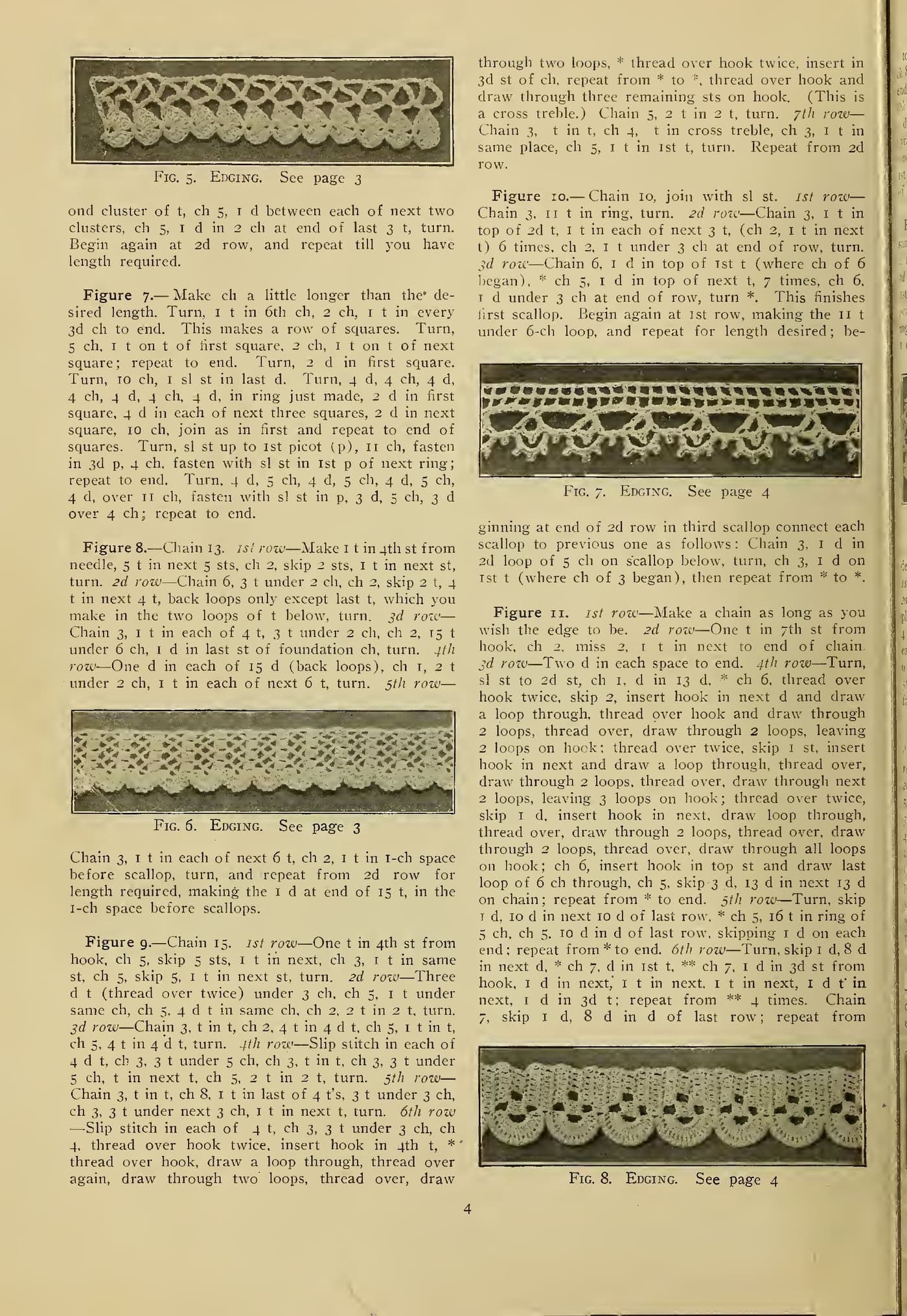
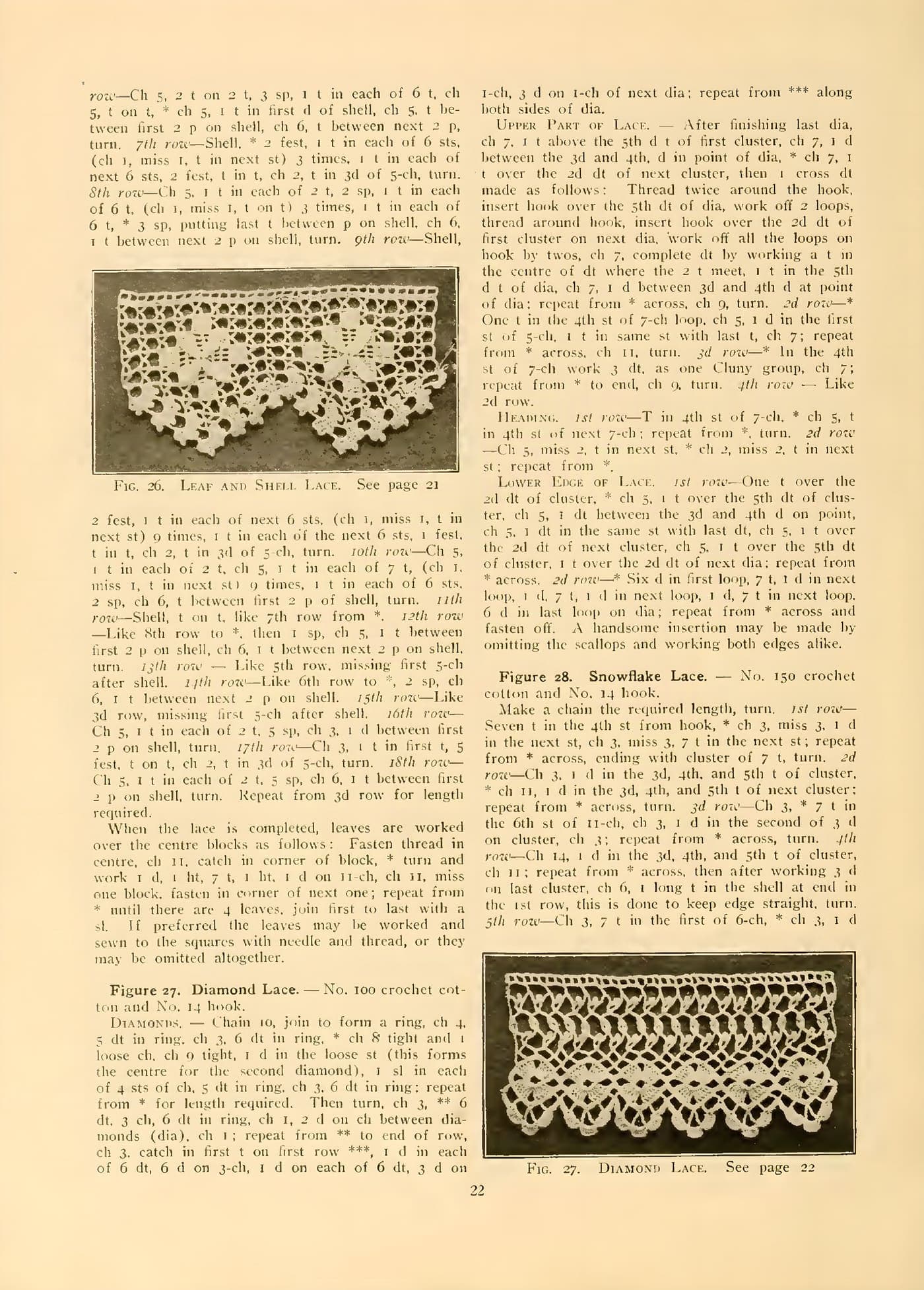
The book's introductory lesson. A nine-petal flower is worked over a padding cord on a thick wound ring, carried on a curved stem into one- and two-flower sprays, basted to a pink cambric foundation, joined with picot-bar filling and finished with the Figure 3 edging.
By the crochetpatterns.io editorial team · Updated · Editorial policy · pattern testing in progress
| Detail | Value |
|---|---|
| Skill level | Intermediate |
| Yarn weight | Lace (#0) |
| Yardage | the book gives no thread quantity for any design. (as printed; yardage not given) |
| Hook | 1 mm |
| Gauge | No gauge printed. Work one motif, measure it, and let the thread and the tension of the padding cord set the size. |
| Finished size | Not printed — the collar and cuffs are worked to the size of the worker's own pink foundation pattern. |
| Time | about 6 hours |
Materials
- Size 40 crochet cotton — approximate modern equivalent of the Manlove's No. 42 the book names for this piece
- A smooth firm padding cord (the original is a No. 30 linen lace thread), or several strands of the working thread held together
- A fine steel hook (see below)
- A ⅜-inch (1 cm) mesh pin, knitting needle or dowel to wind the heavy rings on
- Pink cotton lawn or cambric for the foundation pattern, plus basting thread
- A fine sewing needle
- Hook: Start with 1.00 mm (US steel 11); change size until the thread runs easily without splitting and the motif lies flat.
Yarn Kit & Substitution Options
This pattern calls for 350 yards of weight #0 yarn. Select a suggested yarn to see required skeins and estimated cost:
Caron Simply Soft · 100% Acrylic
315 yds per skein · High-yield yardage, silky no-scratch texture
2 skeins required
approx. $$10.98 total
Abbreviations (US terms)
- chain
- slip stitch
- single crochet
- half double crochet
- double crochet
- stitch
- stitches
- skip
- repeat
- row
- loop
Notes before you start
- Source: "Collar and Cuff Set. Figure 1", Designs and Instructions for Irish Crochet Lace, T. Buettner & Co., Inc., Chicago and New York, 1910. Public domain in the USA.
- As printed — materials: A spool of Manlove's Irish lace thread, size 42; Some No. 30 Au Cheval Rouge lace thread to form the cord; A fine crochet needle; A ⅜-inch mesh pin; A pink foundation pattern; A piece of any kind of braid, for practising the filling. Gauge: Not given.
- Modernisation note: Stitch key (British to modern US). The book lists “the ordinary crochet stitches, chain, single, double and treble”, joins its rings and closes its picots with a “single” (“join with a single stitch”; “1 single into the first of the 5 chain to form a picot”), calls the solid fabric worked over the padding cord “double stitch”, and grades its stitches double < half treble < treble < double treble. That is the older British and Irish naming, so: chain = ch; “single” and “single crochet” = slip stitch (sl st); “double”, “double stitch” and “double crochet” = modern US single crochet (sc); “half treble” = modern US half double crochet (hdc); “treble” = modern US double crochet (dc); “double treble” = modern US treble crochet (tr). Every stitch below has been rewritten in the modern US name on that basis.
- Modernisation note: Check: the book prints no stitch definitions and no wrap counts, so the stitch key above is derived from how the names are used in the directions, not from a printed table.
- Modernisation note: The book's other wording is written in modern form: “miss” = sk, “crochet needle” = hook, “repeat from” = rep from, “work 1 double into” = 1 sc in. Ordinal row names (“Second Row.”, “Third row”) are written Row 2, Row 3, and rounds worked continuously round a ring are written Rnd where the book itself calls them rounds. Section headings are the book's own where it prints them (First Petal, Second Leaf, Shamrock).
- Modernisation note: The book prints each design as one or two solid paragraphs; these have been split into one row, round or step per line. Stitch order and counts are unchanged, including counts that do not add up against the previous row — those are the book's own.
- Modernisation note: Almost everything here is worked over a padding cord (“over the cord” = the stitches enclose the cord; “on the cord alone” = a free loop of stitches over the cord with nothing worked into). The book's own warning is kept in the finishing steps: the shape is set by how tightly the cord is drawn, so the worker is expected to add or drop a stitch to keep the spray flat.
- Modernisation note: Thread numbers are the 1910 trade numbering of the two brands the book names (Manlove's Irish lace thread, made in sizes 36, 42, 50, 60, 70 and 80; No. 30 Au Cheval Rouge linen lace thread for the padding cord). Modern sizes given below are approximate equivalents only — the numbering runs the same way, higher number = finer thread, but the diameters are not identical. The scan prints the fifth Manlove's size as “jo”; it is 70.
- Modernisation note: The book gives no hook number at all — “any ordinary well made fine steel crochet needle is suitable for the work”. Every metric hook size below is a starting point chosen for the modern thread, not a conversion of a printed size.
- Modernisation note: Check: no gauge and no finished measurement is printed for this design. Work one motif, measure it, and adjust the hook and the tension of the padding cord before making the rest.
- Modernisation note: The heavy rings are wound on a ⅜-inch (about 1 cm) mesh pin; the page scan reads ⅜ where the OCR text renders it “34-inch” or “3%-inch”. For the smallest rings the book winds the thread round a lead pencil instead.
- Modernisation note: Metric conversions added in brackets; the inch measurements are the book's own.
- Modernisation note: The filling is printed as a practice exercise on a square of braid; it is transcribed here in that form because it is the only place the book describes the picot filling used in several later designs.
- Modernisation note: Check: the book gives no number of flowers, no collar or cuff dimensions and no foundation pattern; the worker draws her own foundation the size of the collar she wants.
Row progress: 0 of 3 done (0%)
The Center of Flower (Figure 2)
0 of 3 done- Make a thick ring by winding the padding thread 20 times around a ⅜-inch (1 cm) mesh pin; withdraw it carefully, work 54 sc over it and join.Mark row complete
- Take 2 long strands of padding thread, double them, and join with 1 sl st.Mark row complete
- * 15 sc over the cord alone, sk 1 st on the ring, 5 sc over the cord into the next 5 sts on the ring; rep from * all around until there are nine petals.Mark row complete
Working on:
Make a thick ring by winding the padding thread 20 times around a ⅜-inch (1 cm) mesh pin; withdraw it carefully, work 54 sc over it and join.
Continue this pattern
The rest of the Irish Crochet Collar and Cuff Set (1910) pattern is in the Vintage Crochet Hats, Bags & Accessories
Still to come in the full pattern:
- Stem and second flower
- Arranging the sprays
- Light picot filling
- Shaping line
- Edging (Figure 3)
- Finishing
Included with 202 patterns for $12 — $0.06 per pattern.
Errata
No corrections have been published for this pattern. Found a mistake? Tell us and we will log the fix here with a date.
Your notes on this pattern
Keep track of the yarn, hook and changes you used. Saved in this browser only — nobody else can see it.
Frequently asked questions
Where is the Collar and Cuff Set. Figure 1 pattern from?
It was published as "Collar and Cuff Set. Figure 1" in Designs and Instructions for Irish Crochet Lace by T. Buettner & Co., Inc., Chicago and New York in 1910. The publication is in the public domain in the United States; this version is transcribed and modernised by crochetpatterns.io.
What yarn or thread do I need for the Collar and Cuff Set. Figure 1?
Size 40 crochet thread. Not printed — the book gives no thread quantity for any design.
What hook should I use?
Start with 1.00 mm (US steel 11); change size until the thread runs easily without splitting and the motif lies flat. Gauge: No gauge printed. Work one motif, measure it, and let the thread and the tension of the padding cord set the size.