Free preview · full pattern in the Vintage Crochet Hats, Bags & Accessories
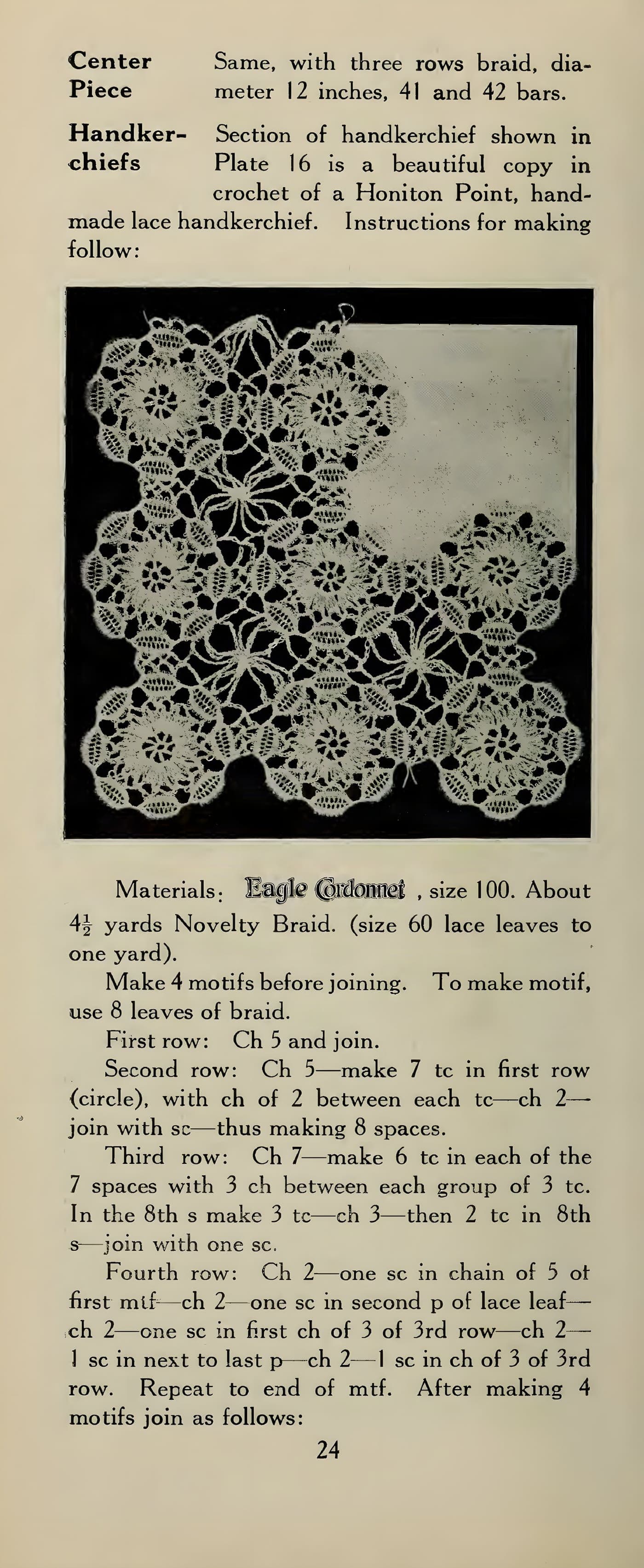
Honiton Point Handkerchief Corner (1915): vintage crochet pattern
A crocheted copy of a Honiton Point lace handkerchief border. Four motifs are made first, each a small treble-crochet wheel caught to eight leaves of Novelty Braid, and the motifs are then joined to one another with chain bars and a worked chain web between the leaves.
By the crochetpatterns.io editorial team · Updated · Editorial policy · pattern testing in progress
| Detail | Value |
|---|---|
| Skill level | Advanced |
| Yarn weight | Lace (#0) |
| Yardage | Not printed. (as printed; yardage not given) |
| Hook | 0.75 mm |
| Gauge | No gauge printed. |
| Finished size | Not printed; the section shown is a corner, and the border is made up of repeated motifs. |
| Time | about 4 hours |
Materials
- Size 100 cotton crochet thread (original: size 100)
- About 4½ yards (4.1 m) Novelty braid — a picot-edged lace-leaf braid running about 60 leaves to the yard
- Steel crochet hook (the original prints no hook for this design)
- Handkerchief or linen square to mount the border on
- Tapestry needle
- Hook: Start with 0.75 mm (US steel 14) — approximate and not printed for this design; the booklet's own table pairs cotton size 100 with its hook 13 or 14. Change size until the motifs lie flat.
Yarn Kit & Substitution Options
This pattern calls for 350 yards of weight #0 yarn. Select a suggested yarn to see required skeins and estimated cost:
Caron Simply Soft · 100% Acrylic
315 yds per skein · High-yield yardage, silky no-scratch texture
2 skeins required
approx. $$10.98 total
Abbreviations (US terms)
- chain
- single crochet
- treble crochet
- stitch
- stitches
- space
- round
- repeat
Notes before you start
- Source: "Handkerchiefs (Plate 16)" (Plate Sixteen), The Eagle's Call to Crochet, Pratt and Farmer Co., Notion Specialists, New York City, 1915. Public domain in the USA.
- As printed — materials: Eagle Cordonnet, size 100; About 4½ yards Novelty Braid (size 60 lace leaves to one yard). Gauge: Not given.
- Modernisation note: Stitches follow this booklet's own printed key, not the stitch names alone. The abbreviation table is on book page 5 and the worked definitions are on book pages 6 and 7, and they define MODERN US terms: “Single Crochet” — put the needle through the stitch, thread over needle, pull through, thread over needle again, pull through both loops (the modern US sc); “Double Crochet” — thread over needle first, then put the needle through the work, thread over and pull through, showing three stitches on the needle, thread over and pull through two loops, thread over again and draw through the remaining two (the modern US dc); “Half Double Crochet” — thread over, through the work, pull through, thread over, pull through all three loops (the modern US hdc); “Triple or Treble Crochet” — wind thread over the needle twice, insert, pull through showing four stitches on the needle, then cast off two at a time three times (the modern US tr). Because the key is already modern US, NO stitch conversion was needed anywhere in this transcription. The booklet's spelled-out forms map straight across: “s cr” = sc, “d cr” = dc, “tr cr” and “tc” = tr. This matters because several 1915 US books use the older British heights; this one does not.
- Modernisation note: The booklet's shorthand is written in modern US form: ch = ch, s cr / sc = sc, d cr / dc = dc, tr cr / tc = tr, st(s) = st(s), sp = sp, p = picot, mtf / mf = motif, and “r to c” = return to centre (the printed table on book page 5 gives “rtoc return to center”). Ordinal row names (“First row”, “Second row”) are written Row 1, Row 2 and so on. The booklet punctuates with long dashes between every instruction; those are written as ordinary sentence punctuation here, with no change to stitch order or count.
- Modernisation note: Long printed paragraphs are split into one row, round or step per line; stitch order and counts are unchanged. Section headings added for navigation.
- Modernisation note: The booklet prints a cotton-to-hook table on book page 10: cotton size 1 takes hook 2; size 2, hook 3; size 3, hook 4 or 5; size 5, hook 6; size 10, hook 7; size 20, hook 8; size 30, hook 8 or 9; size 40, hook 9; size 50, hook 9 or 10; size 60, hook 10 or 11; size 70, hook 11 or 12; size 80, hook 12 or 13; size 100, hook 13 or 14. These are the booklet's own steel-hook numbers with no diameters given, so the metric sizes below are approximate read-across to the modern US steel scale, in which a higher number is finer. Work a swatch and change size to match the photograph.
- Modernisation note: No gauge is printed for this design — the booklet prints no gauge anywhere. Work a swatch and change hook size until the work lies flat and matches the photograph.
- Modernisation note: Finishing follows the booklet's own instruction on book pages 9 and 10: at the completion of the piece make an extra chain stitch and cut the thread so as to leave a one-inch end, then draw that end in and out where it does not show until the end is used up.
- Modernisation note: The booklet is a thread advertisement and names its own brand in almost every line of materials. The brand name is dropped here and only the thread size is kept, which is the part that carries pattern information.
- Modernisation note: The booklet writes the treble as “tc” in this design and defines it on book page 7 as the modern US treble, so it is written tr throughout with no change of height.
- Modernisation note: The original calls each circuit of the motif a “row” although the motif is worked in the round; these are written Rnd, and the change is noted here rather than silently made.
- Modernisation note: “mtf” and “p” are the booklet's own abbreviations for motif and picot, given in the table on book page 5; they are spelled out. “r to c of web” is the table's “rtoc — return to center”, and is spelled out as “return to the centre of the web”.
- Modernisation note: Check: Rnd 4 reads “one sc in chain of 5 of first mtf” while the motif itself is still being made. It is read as the ch-5 ring of Rnd 1, which is the only chain of five in the motif at that point.
- Modernisation note: Check: the joining reads “1 sc in center of web, catching to cl of 8 chs”. “cl” is the table's abbreviation for cluster, but no cluster has been made anywhere in this design; the only ch-8 at that point is the one just worked, so it is read as catching to the ch-8. The original wording is kept in this note because the reading is ours.
- Modernisation note: Check: Rnd 3 reads “make 6 tc in each of the 7 spaces with 3 ch between each group of 3 tc”, which is read as 3 tr, ch 3, 3 tr in each space — six trebles in two groups of three.
- Modernisation note: Check: the original prints no hook for this design; the size given in the modern materials is read across from the booklet's own cotton-to-hook table on book page 10.
- Modernisation note: Check: the OCR reads the braid quantity as “4 yards”; the page image plainly prints 4½ yards, and the thread is printed as size 100, which the OCR drops entirely.
- Modernisation note: Check: no colour is printed; the design is photographed in white against a black ground. The booklet notes that Eagle Cordonnet was also sold in colours in sizes 30 and 70.
Row progress: 0 of 4 done (0%)
Motif — make 4 before joining, using 8 leaves of braid for each
0 of 4 done- Rnd 1: Ch 5 and join.Mark row complete
- Rnd 2: Ch 5, make 7 tr in Rnd 1 (the circle), with ch 2 between each tr, ch 2, join with sc — making 8 spaces.Mark row complete
- Rnd 3: Ch 7, make 6 tr in each of the 7 spaces, with ch 3 between each group of 3 tr. In the 8th space make 3 tr, ch 3, then 2 tr in the 8th space; join with one sc.Mark row complete
- Rnd 4: Ch 2, one sc in the ch-5 of Rnd 1, ch 2, one sc in the second picot of the lace leaf, ch 2, one sc in the first ch-3 of Rnd 3, ch 2, 1 sc in the next to last picot, ch 2, 1 sc in the ch-3 of Rnd 3. Rep to the end of the motif.Mark row complete
Working on:
Rnd 1: Ch 5 and join.
Continue this pattern
The rest of the Honiton Point Handkerchief Corner (1915) pattern is in the Vintage Crochet Hats, Bags & Accessories
Still to come in the full pattern:
- Joining — first motif, right side
- Joining — second motif to first
- Finishing
Included with 202 patterns for $12 — $0.06 per pattern.
Errata
No corrections have been published for this pattern. Found a mistake? Tell us and we will log the fix here with a date.
Your notes on this pattern
Keep track of the yarn, hook and changes you used. Saved in this browser only — nobody else can see it.
Frequently asked questions
Where is the Handkerchiefs (Plate 16) pattern from?
It was published as "Handkerchiefs (Plate 16)" in The Eagle's Call to Crochet by Pratt and Farmer Co., Notion Specialists, New York City in 1915. The publication is in the public domain in the United States; this version is transcribed and modernised by crochetpatterns.io.
What yarn or thread do I need for the Handkerchiefs (Plate 16)?
Size 100 crochet cotton. Not printed.
What hook should I use?
Start with 0.75 mm (US steel 14) — approximate and not printed for this design; the booklet's own table pairs cotton size 100 with its hook 13 or 14. Change size until the motifs lie flat. Gauge: No gauge printed.