Free preview · full pattern in the Vintage Crochet Fashion
Ladies’ Filet Crochet Sweater No. 855 (1919): vintage crochet pattern
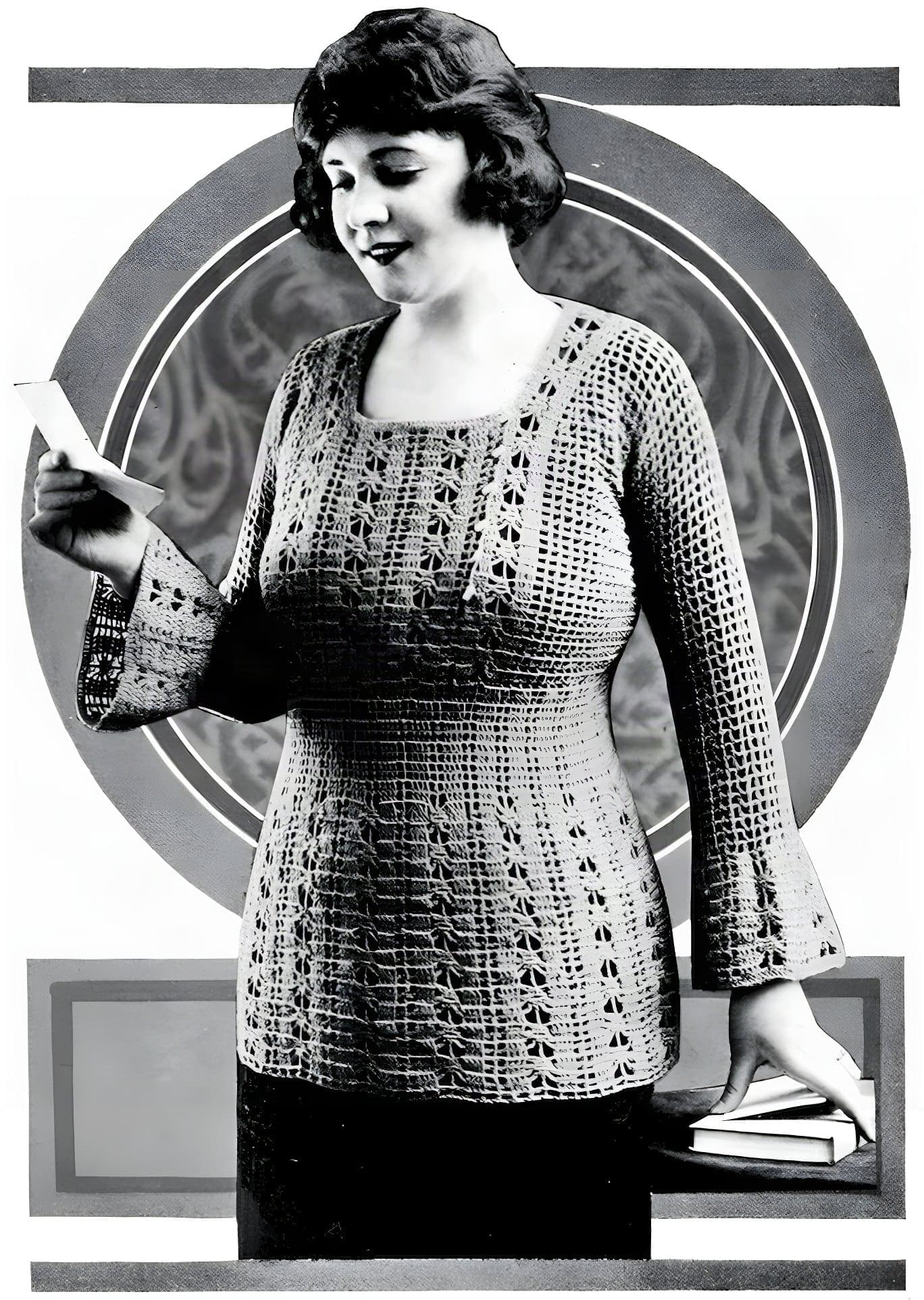
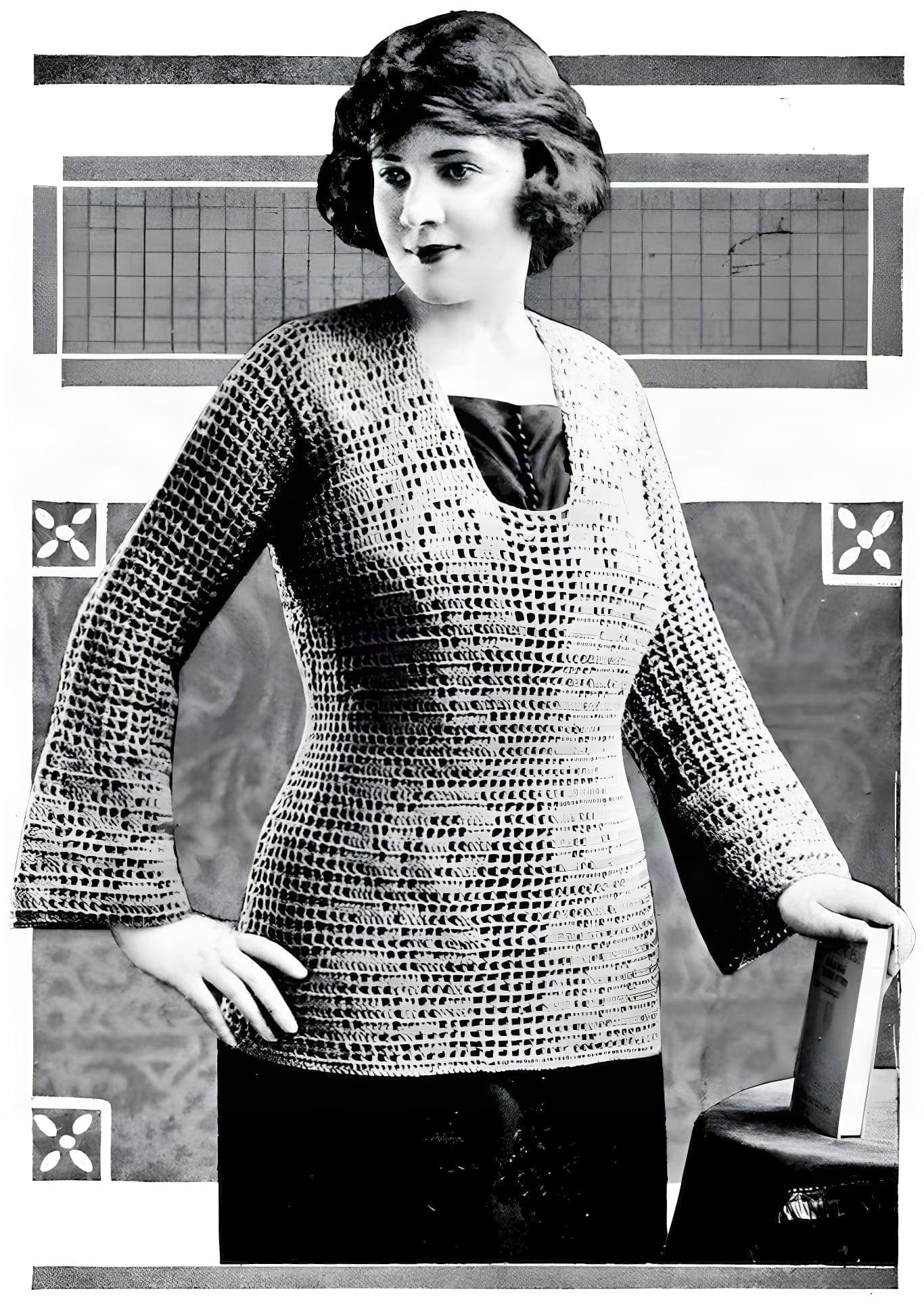
A size 36–38 alpaca pullover in fine filet with a scrolling floral design worked in blocks on the back and front, framed by 9 open meshes at each side and 4 up the center back. The waist is drawn in by tightening the meshes, and the sleeves carry a separate filet chart.
By the crochetpatterns.io editorial team · Updated · Editorial policy · pattern testing in progress
| Detail | Value |
|---|---|
| Skill level | Advanced |
| Yarn weight | Light (#3) |
| Yardage | the book gives 10 balls of Utopia Alpaca Wool; ball weight and yardage are not stated. (as printed; yardage not given) |
| Hook | 4 mm |
| Gauge | Not printed. |
| Finished size | Size 36–38 (1919 bust size). No finished measurements printed. |
| Time | about 18 hours |
Materials
- Light (CYC #3) alpaca yarn — the original was Utopia Alpaca Wool, 10 balls (color not named)
- Crochet hook (original: No. 3)
- Tapestry needle
- Hook: Start with 4 mm (US G-6); no gauge or measurement is printed, so swatch and compare with a size 36–38 garment
Yarn Kit & Substitution Options
This pattern calls for 350 yards of weight #3 yarn. Select a suggested yarn to see required skeins and estimated cost:
Caron Simply Soft Light · 100% Premium Acrylic
330 yds per skein · Gentle sheen, ultra soft against skin
2 skeins required
approx. $$11.98 total
Abbreviations (US terms)
- chain
- double crochet
- slip stitch
- skip
- stitch
- repeat
- row
Notes before you start
- Source: "Ladies’ Utopia Filet Crochet Sweater No. 855" (No. 855), Utopia Yarn Book: Being a Practical Treatise on Knitting and Crocheting (Fourteenth Edition), Henry E. Frankenberg Co., New York, 1919. Public domain in the USA.
- As printed — materials: 10 balls Utopia Alpaca Wool. 1 crochet hook No. 3.. Gauge: Not given.
- Modernisation note: Stitches converted by the book's own definitions ("Explanation of Terms Used in Crocheting"), not by name: s. c. ("insert hook in ch. or st., draw the wool through, over, and draw through both loops on hook") = modern US sc; h. d. c. (over, insert, draw a loop through, over, draw through the three loops) = hdc; d. c. (over, insert, draw a loop through, over and through two loops twice) = dc; t. c. / treble crochet ("over twice", then through two loops three times) = tr; sl. st. (insert, over, draw through st and loop on hook) = sl st; ch. = ch; "over" = yo. For these stitches the 1919 American names already match modern US usage, so no stitch changes height.
- Modernisation note: The book's abbreviation "M." is defined as "Mesh; Ch. 2, skip 2 sts., 1 d. c. on d. c." and is written as "mesh" (ch 2, sk 2, dc in next dc); where a design says its meshes have 1 ch between, that is stated in the row. "Space" and "block" are kept as printed. Dc counts printed between meshes (e.g. "7 d. c.") are kept exactly as printed.
- Modernisation note: Period abbreviations and wording modernised: s. c., h. d. c., d. c., t. c., sl. st., ch. written as sc, hdc, dc, tr, sl st, ch; "m." written as mesh; "st. of ch." written as "ch" where the stitch is a chain; "wool"/"thread" written as yarn; "needle" (used for the crochet hook) written as hook; "break off yarn" written as "fasten off"; "repeat" written as "rep"; ordinal row names ("Second Row", "Twenty-first Row") written as Row 2, Row 21.
- Modernisation note: Long printed paragraphs split into one row, round or step per line; stitch order and counts unchanged. Section headings added for navigation where the text runs on.
- Modernisation note: Hook numbers (bone, ivory, amber/celluloid No. 1–5) refer to the book's own illustrated scale of 1919 hooks, which pictures the hooks but prints no diameters, so no exact metric size can be read from the book. The suggested modern hook is a starting point chosen for the yarn weight.
- Modernisation note: No stitch gauge is printed anywhere in the book; work a swatch and match any printed measurements (in the modern gauge line) before starting.
- Modernisation note: Utopia yarns are 1919 trade names with no exact modern equivalent. The modern CYC weight given is an approximation only: Utopia Shetland Floss was a soft, fine, lofty 2-ply wool (treated here as fine, CYC #2); Utopia Alpaca and Llama wools, and the Worsted and Silk Mixture, as light (CYC #3); Utopia Germantown (zephyr) as light (CYC #3) and 8 Fold Germantown as medium (CYC #4); Scotch Knitting Yarn/Worsted as medium (CYC #4); 3 Fold Saxony as super fine (CYC #1). Yardage is never printed — the book gives skeins, balls or hanks only, and their weight is not stated.
- Modernisation note: Size is given only as a 1919 bust size; vintage sizing and ease differ from today's — compare the printed lengths with a garment that fits before starting.
- Modernisation note: Each back pattern row is printed as the first half followed by "* 4 m., repeat from *" (Row 3: "* repeat from * backwards to dash every row for other half, work 4 m. with the 2 ch. between"); this is written as "4 center meshes; rep backwards" in every row. The printed Rows 4–23 do not repeat the closing 9 meshes, which the setup note says start and finish every row.
- Modernisation note: The book prints the Twenty-fourth Row label twice: first for the waistline instruction and then for the pattern row. The instruction is labelled "Waistline" here and the pattern row kept as Row 24.
- Modernisation note: The book gives no instruction for where the sleeve pattern is placed on the 28-mesh sleeves, nor for the neck edge or seams. Nothing has been added.
- Modernisation note: Check: "after working the 10 rows for belt line, work the 9 m. … with 2 ch. between" — the word "again" is added for clarity, since Rows 24–33 used ch 1 at the sides and center.
- Modernisation note: Check: the stitch counts across the sleeve pattern rows are not equal. Left exactly as printed.
- Modernisation note: A filet chart of a mirrored scroll motif is printed between the back and sleeve directions (i_027.jpg); the book does not say which part it charts.
- Modernisation note: Metric conversions added.
Row progress: 0 of 4 done (0%)
Back — Setting Up
0 of 4 done- Row 1: Ch 120, sk 2 ch, dc in every ch.Mark row complete
- Row 2: 9 meshes with ch 2 between, 13 meshes with ch 1 between, 4 meshes with ch 2 between, 13 meshes with ch 1 between, 9 meshes with ch 2 between.Mark row complete
- Note: Start and finish every row with 9 meshes with ch 2 between; also work the 4 meshes that run up the center of the back with ch 2 between each mesh. Throughout the pattern, work the meshes with ch 1 between; this is not referred to again.Mark row complete
- Note: In each of the following rows the first half is given; after it, work the 4 center meshes and then rep the half backwards for the other half.Mark row complete
Working on:
Row 1: Ch 120, sk 2 ch, dc in every ch.
Continue this pattern
The rest of the Ladies’ Filet Crochet Sweater No. 855 (1919) pattern is in the Vintage Crochet Fashion
Still to come in the full pattern:
- Back — Pattern Rows
- Body, Sleeves and Front
- Sleeve Pattern
Included with 71 patterns for $15 — $0.21 per pattern.
Errata
No corrections have been published for this pattern. Found a mistake? Tell us and we will log the fix here with a date.
Your notes on this pattern
Keep track of the yarn, hook and changes you used. Saved in this browser only — nobody else can see it.
Frequently asked questions
Where is the Ladies’ Utopia Filet Crochet Sweater No. 855 pattern from?
It was published as "Ladies’ Utopia Filet Crochet Sweater No. 855" in Utopia Yarn Book: Being a Practical Treatise on Knitting and Crocheting (Fourteenth Edition) by Henry E. Frankenberg Co., New York in 1919. The publication is in the public domain in the United States; this version is transcribed and modernised by crochetpatterns.io.
What yarn or thread do I need for the Ladies’ Utopia Filet Crochet Sweater No. 855?
light (#3) yarn. Not printed — the book gives 10 balls of Utopia Alpaca Wool; ball weight and yardage are not stated.
What hook should I use?
Start with 4 mm (US G-6); no gauge or measurement is printed, so swatch and compare with a size 36–38 garment Gauge: Not printed.