Free preview · full pattern in the Vintage Afghans & Bedspreads
New Cluster Afghan (1915): vintage crochet pattern
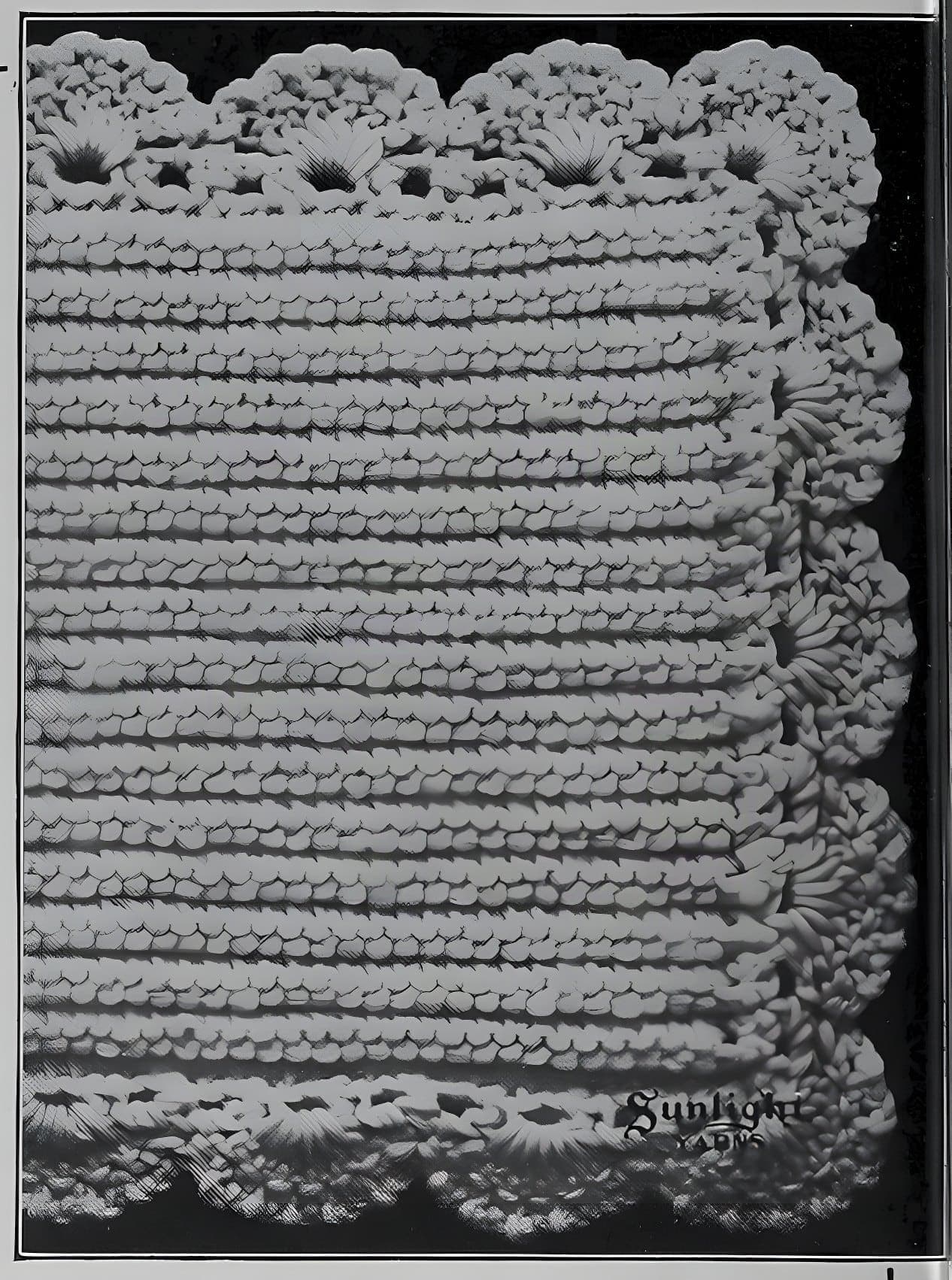
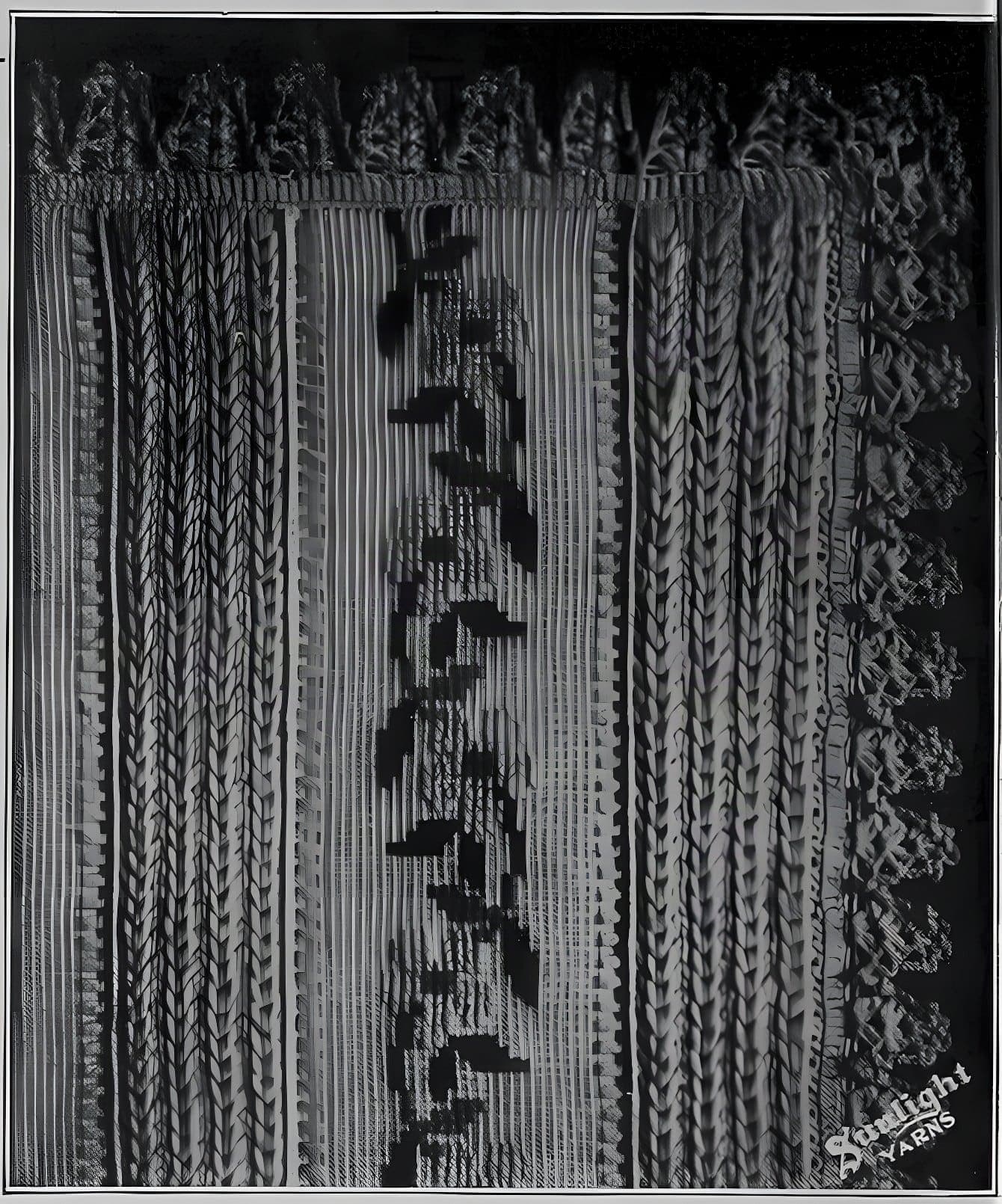
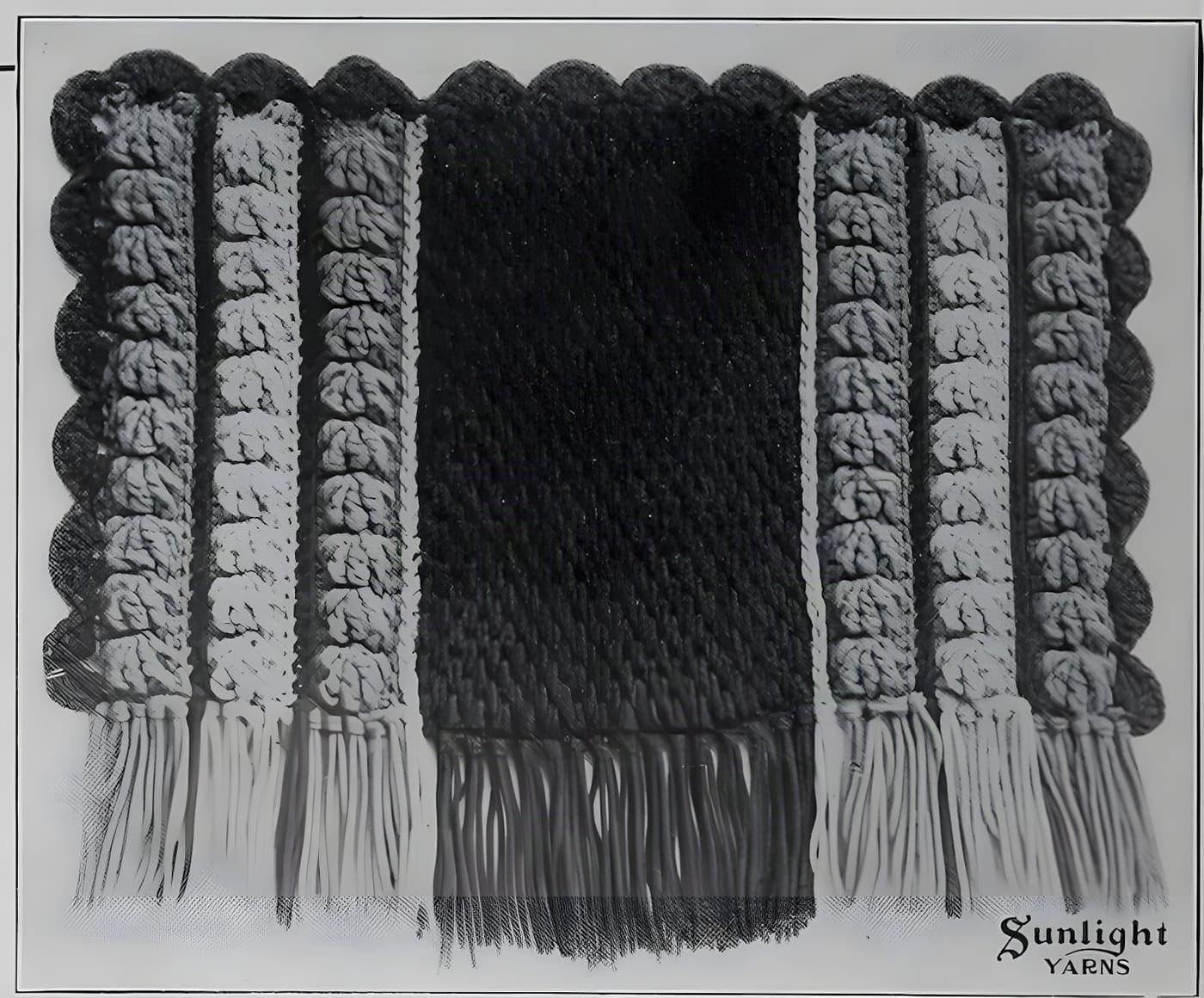
A large robe in three shades of one color (old rose in the original): four dark panels in cluster stitch alternate with five fancy panels, each of three narrow afghan-stitch stripes with raised clusters, finished with shell scallops at the sides and a shaded fringe.
By the crochetpatterns.io editorial team · Updated · Editorial policy · pattern testing in progress
| Detail | Value |
|---|---|
| Skill level | Intermediate |
| Yarn weight | Medium (#4) |
| Yardage | the book gives 32 skeins dark, 32 skeins medium and 16 skeins light Eight-fold Germantown; skein weight and yardage are not stated. (as printed; yardage not given) |
| Hook | 6 mm |
| Gauge | No stitch gauge printed. Printed check: nine panels (4 plain of 32 ch, 5 fancy of three 7-lp stripes) = 1¾ yards (1.6 m) wide. |
| Finished size | 1¾ × 2¾ yards (1.6 × 2.5 m). Nine panels, each 2¾ yards (2.5 m) long. |
| Time | about 6 hours |
Materials
- Medium (CYC #4) wool yarn — the original was Sunlight Eight-fold Germantown in 3 shades of one color: 32 skeins dark, 32 skeins medium, 16 skeins light
- Crochet hook (original: 10-inch bone No. 8)
- Tapestry needle
- Hook: Start with 6 mm (US J-10) — approximate; change size so the nine panels make the printed width of 1¾ yards (1.6 m)
Yarn Kit & Substitution Options
This pattern calls for 350 yards of weight #4 yarn. Select a suggested yarn to see required skeins and estimated cost:
Caron Simply Soft · 100% Acrylic
315 yds per skein · High-yield yardage, silky no-scratch texture
2 skeins required
approx. $$10.98 total
Abbreviations (US terms)
- chain
- single crochet
- double crochet
- stitch
- stitches
- loop
- yarn over
- repeat
- row
- cluster
- shell
Notes before you start
- Source: "New Cluster Afghan", The Sunlight Book of Knitting and Crocheting, W. G. Perry, Chicago, 1915. Public domain in the USA.
- As printed — materials: SUNLIGHT Germantown—eight-fold; 3 shades of one color—32 skeins dark, 32 skeins medium and 16 skeins light; 1 10-inch Bone Crochet Hook, No. 8. Gauge: Not given.
- Modernisation note: Stitches converted by the book's own definitions (“First Stitches — Crocheting”), not by name: chain stitch (“make a chain of loops, pulling out 1 loop through the other”) = ch; slip stitch (“place the hook in a loop on the chain, put yarn over hook and pull through both loops on needle at once”) = sl st; single crochet (“take up 1 loop on the chain, put yarn over hook and pull through both loops on needle at once”) = sc; double crochet (“put yarn around hook, take up 1 loop on the chain, yarn over hook and pull through 2 loops at a time”) = dc; long crochet (yarn over, pick up a loop, yarn over and pull through 1 loop, then through 2 loops twice) = modern extended double crochet, not used in these designs; treble crochet (“put yarn around hook twice”, pick up a loop, then pull through 2 loops three times) = tr. For these stitches the 1915 American names already match modern US usage, so no stitch changes height.
- Modernisation note: The book prints no abbreviations (“No abbreviations are used in this book”); its words are written as modern US abbreviations: chain = ch, slip stitch = sl st, single crochet = sc, double crochet = dc, treble crochet = tr, stitch(es) = st(s), skip = sk, space = sp, loop = lp, yarn over hook = yo, repeat = rep. “Needle” (used for the crochet hook) is written as hook; “take up / pick up 1 loop” as “draw up a lp”; “break off the yarn” as “fasten off”; “fasten the yarn” as “join yarn”; ordinal row names (“1st row”, “2nd row”) as Row 1, Row 2.
- Modernisation note: “Taking up in the double stitch” (the book's phrase for inserting the hook under both top loops of the stitch below) is written as “through both loops”; “taking up in the back of the stitches” is written as “in back loop only (blo)”. “Plain” (a row with no increases, or 1 sc in every st) is kept and explained where it first appears.
- Modernisation note: The book's afghan stitches are Tunisian crochet worked on an ordinary long hook: loops are picked up on the forward pass and worked off on the return pass, both passes counting as one row. Its Old Afghan Stitch (loops picked up “in the front” of the loops on the row below) is modern Tunisian simple stitch; its Purled Afghan Stitch (loops picked up “in the back of the loops” on the row below) is Tunisian simple stitch worked through the back vertical bar. The return, “put yarn over hook and pull through 1 loop at a time”, is explained elsewhere in the book as pulling through “1 loop (of those picked up) at a time” — the standard Tunisian return (yo and draw through 1 lp, then yo and draw through 2 lps until 1 lp remains). The book's names are kept, with this reading.
- Modernisation note: The book's own rule for the asterisk is kept: “A star (*) is often used before and after a group of words to indicate that the work described between the stars must be repeated.” Repeats are written “rep from *” as printed.
- Modernisation note: Long printed paragraphs are split into one row, round or step per line; stitch order and counts unchanged. Section headings added for navigation. The book calls rounds “rows” and ridges of 2 rows “ribs”; both words are kept as printed.
- Modernisation note: Hook numbers (bone, amber, celluloid and steel, with steel “Style” numbers) refer to the book's actual-size pictures of 1915 hooks, which print no diameters, so no exact metric size can be read from the book. The suggested modern hook is an approximate starting point chosen for the yarn weight and tied to any printed measurement.
- Modernisation note: No stitch gauge is printed anywhere in the book; work a swatch and match any printed measurement (given in the modern gauge line) before starting.
- Modernisation note: Sunlight yarns are 1915 trade names with no exact modern equivalent. The CYC weights given are approximations only, based on the book's own descriptions: Saxony (“a fine, soft, three-ply thread”) as super fine (CYC #1); Shetland Floss (“a very lofty, fluffy yarn”) as fine (CYC #2); Four-fold Germantown as light (CYC #3); Eight-fold Germantown (“about twice as heavy” as the four-fold) as medium (CYC #4); Golf Yarn (“a four-ply, lofty yarn”) and German Knitting Worsted/Yarn as medium (CYC #4). Yardage is never printed — the book gives skeins (or balls) only, and their weight and length are not stated.
- Modernisation note: The design says “For detail see Cluster Stitch, page 33”; the design's own rows describe the cluster stitch as printed.
- Modernisation note: The book suggests the robe in “old rose”, adding that brown or green would look well also.
- Modernisation note: Panel order from the printed description: 9 panels, 5 fancy and 4 plain, with a fancy panel at each side (the scallops are worked “on the fancy panel on both sides of afghan”).
- Modernisation note: Check: the fancy stripe's raised cluster (Row 4) is left exactly as printed; the loops “on 2nd row below” and “on 3rd row below” are the vertical bars of those rows.
- Modernisation note: Metric conversions added.
Row progress: 0 of 6 done (0%)
Dark Panel in Cluster Stitch (make 4)
0 of 6 done- With the dark shade, ch 32.Mark row complete
- Row 1: Draw the lp on the hook out half an inch (13 mm) long, *draw up 1 lp in the 2nd ch, yo and draw up another lp in the same place; rep from * to end of row.Mark row complete
- Yo and draw through 1 cluster at a time; at the end draw through the 1st lp and ch 1.Mark row complete
- Row 2: Same as Row 1: make 1 cluster between the 1st lp and the 1st cluster of the row below, then rep, making 1 cluster between each cluster of the row below. At the end of the row draw up 1 lp in the back of the last cluster below; yo and draw through the lp, then work off as before, and at the end of the row draw through the lp with the cluster and ch 1.Mark row complete
- Row 3: Same as Row 1, making 1 cluster between each cluster of the previous row.Mark row complete
- Rep Rows 2 and 3. Make the panel 2¾ yards (2.5 m) long.Mark row complete
Working on:
With the dark shade, ch 32.
Continue this pattern
The rest of the New Cluster Afghan (1915) pattern is in the Vintage Afghans & Bedspreads
Still to come in the full pattern:
- Fancy Panel Stripes (make 2 medium and 1 light for each panel)
- Assembly
- Finishing
Included with 73 patterns for $19 — $0.26 per pattern.
Errata
No corrections have been published for this pattern. Found a mistake? Tell us and we will log the fix here with a date.
Your notes on this pattern
Keep track of the yarn, hook and changes you used. Saved in this browser only — nobody else can see it.
Frequently asked questions
Where is the New Cluster Afghan pattern from?
It was published as "New Cluster Afghan" in The Sunlight Book of Knitting and Crocheting by W. G. Perry, Chicago in 1915. The publication is in the public domain in the United States; this version is transcribed and modernised by crochetpatterns.io.
What yarn or thread do I need for the New Cluster Afghan?
medium (worsted) (#4) yarn. Not printed — the book gives 32 skeins dark, 32 skeins medium and 16 skeins light Eight-fold Germantown; skein weight and yardage are not stated.
What hook should I use?
Start with 6 mm (US J-10) — approximate; change size so the nine panels make the printed width of 1¾ yards (1.6 m) Gauge: No stitch gauge printed. Printed check: nine panels (4 plain of 32 ch, 5 fancy of three 7-lp stripes) = 1¾ yards (1.6 m) wide.