Free preview · full pattern in the Vintage Crochet Hats, Bags & Accessories
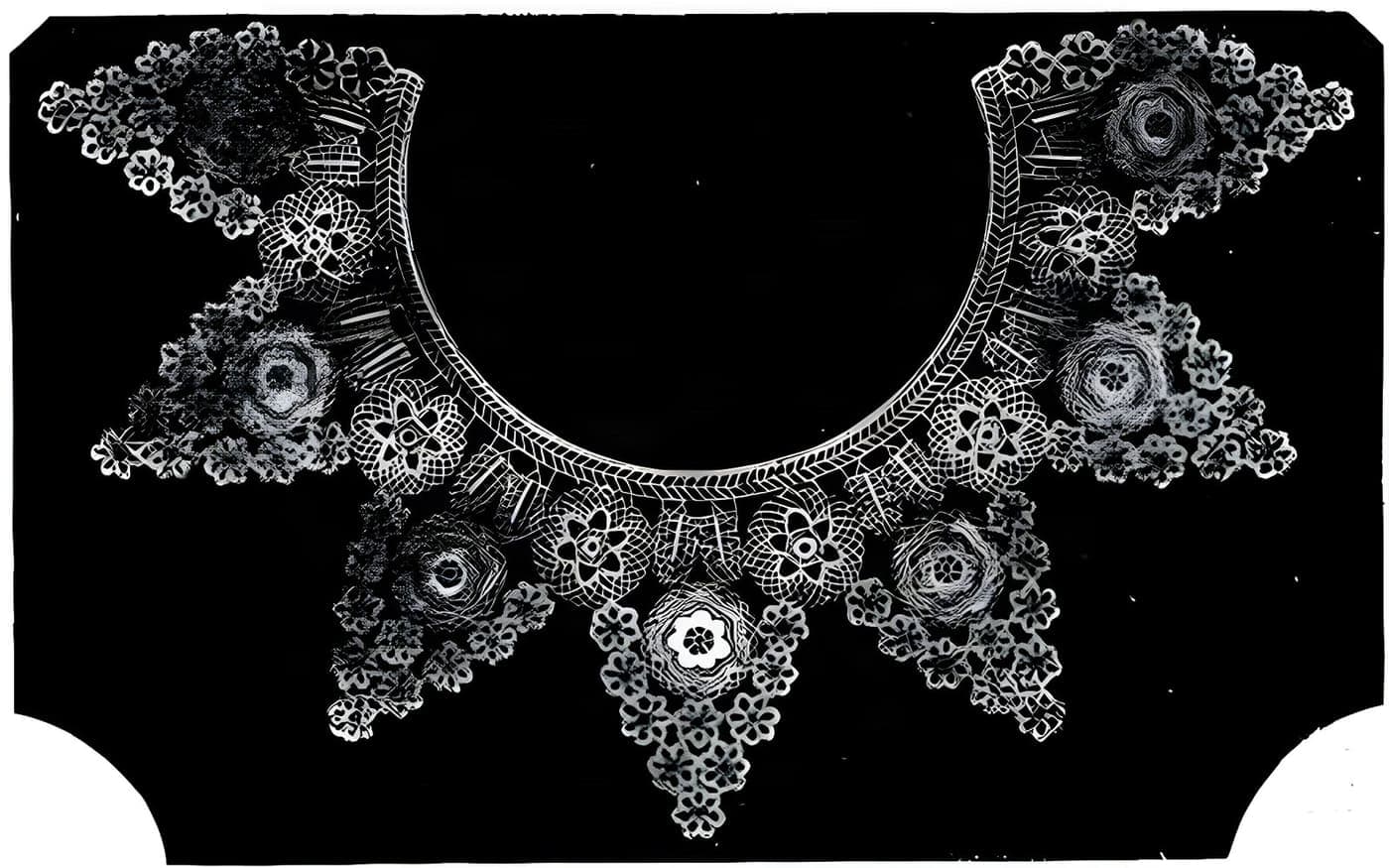
Crochet Collar with Treble Points (1854): vintage crochet pattern
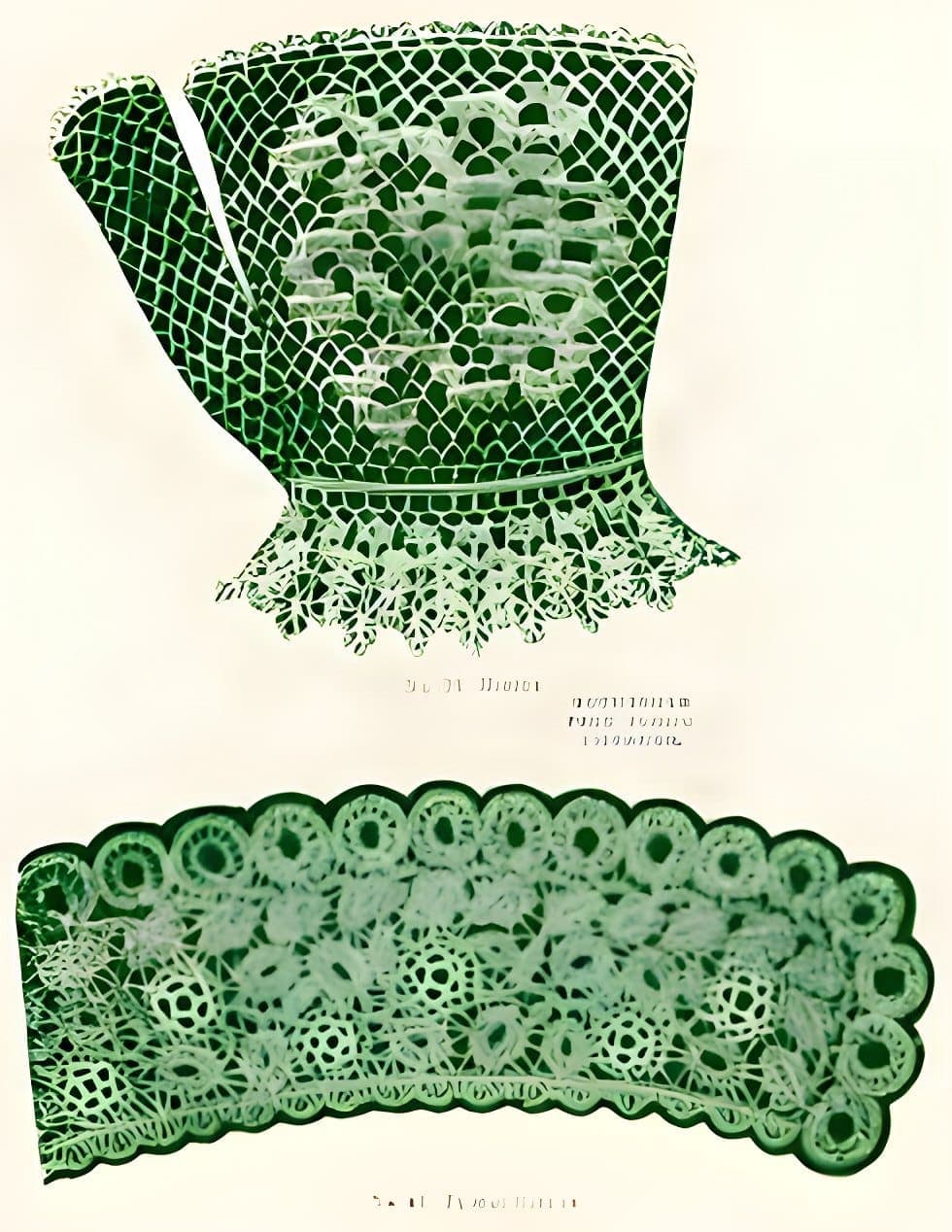
A deep collar begun on a long foundation chain with treble and chain-loop rows, then worked into eleven pointed panels of treble crochet divided by fans of chain loops, with a looped outer edge. Worked tightly in No. 30 crochet cotton.
By the crochetpatterns.io editorial team · Updated · Editorial policy · pattern testing in progress
| Detail | Value |
|---|---|
| Skill level | Advanced |
| Yarn weight | Lace (#0) |
| Yardage | Not printed. (as printed; yardage not given) |
| Hook | 1 mm |
| Gauge | Not printed. |
| Finished size | Not printed. The foundation is 320 ch. |
| Time | about 8 hours |
Materials
- Cotton crochet thread about size 30 (period: crochet cotton No. 30; approximate), white
- Fine sewing needle for running in the ends
- Hook: Start with a 1 mm (US steel 12) hook and adjust to suit your thread (original: crochet hook No. 20, eagle card-board gauge; approximate conversion). No gauge is printed. The book says loose crocheters should use a still smaller hook, because the collar should be worked very tightly.
Yarn Kit & Substitution Options
This pattern calls for 350 yards of weight #0 yarn. Select a suggested yarn to see required skeins and estimated cost:
Caron Simply Soft · 100% Acrylic
315 yds per skein · High-yield yardage, silky no-scratch texture
2 skeins required
approx. $$10.98 total
Abbreviations (US terms)
- chain
- single crochet
- double crochet
- treble crochet
- stitch
- stitches
- row
- skip
- repeat
Notes before you start
- Source: "Crochet Collar", The Ladies' Complete Guide to Crochet, Fancy Knitting, and Needlework (Mrs. Ann S. Stephens), Dick & Fitzgerald, 1854. Public domain in the USA.
- As printed — materials: Crochet cotton, No. 30. Crochet hook, No. 20, or 21. Make 320 chain.. Gauge: Not given.
- Modernisation note: Stitch names checked against the book's own definitions (pp. 22–23), which describe the same stitches as modern US terms, so they are kept: “ch.” = ch; “sl.” / “slip” = sl st; “sc.” = sc; “dc.” = dc (US, not UK); “tc.” (treble crochet) = tr; “l tc.” / “long tc.” (long treble crochet) = dtr; “miss” = sk. Note that the book's “tc.” is a modern US tr, not a UK treble (US dc).
- Modernisation note: Period wording modernised: “needle” (meaning the hook) → hook; “commence” → begin; “close for a loop”, “close in a round” and “form it into a round” → join into a ring (the book does not name the joining stitch unless it says “slip”); “under” a chain → in the ch-sp; “fasten off” → FO; “alternative” → alternate. Repeat marks (✕, +, *, †, ¶, (a)) are written as parentheses with the book's total count.
- Modernisation note: Printed paragraphs split into one step per row, round or instruction; no stitches, counts, rows or rounds added, removed or reordered.
- Modernisation note: Crochet hook numbers belong to the book's “eagle card-board gauge”, a period bell-type gauge in which higher numbers are finer. The metric and US sizes given are approximate conversions only, and no gauge is printed.
- Modernisation note: Period cotton numbers (Evans's crochet cotton and “boar's-head” cotton) do not match modern thread sizes exactly; the modern thread size is a starting approximation. Choose the thread that suits the hook and gives lace of the right fineness.
- Modernisation note: No yardage or weight of thread is printed for this design, and none is estimated.
- Modernisation note: Check: row 6 (“dc. in every loop”) does not say how many dc go in each ch-8 loop. Row 3 leaves 80 loops, and row 7 as printed uses about 383 sts, i.e. about 5 dc per loop; the book does not state it.
- Modernisation note: Check: rows 4 and 5 say “sc. through every loop”; by the book's definition of working “through”, the hook goes under the whole loop.
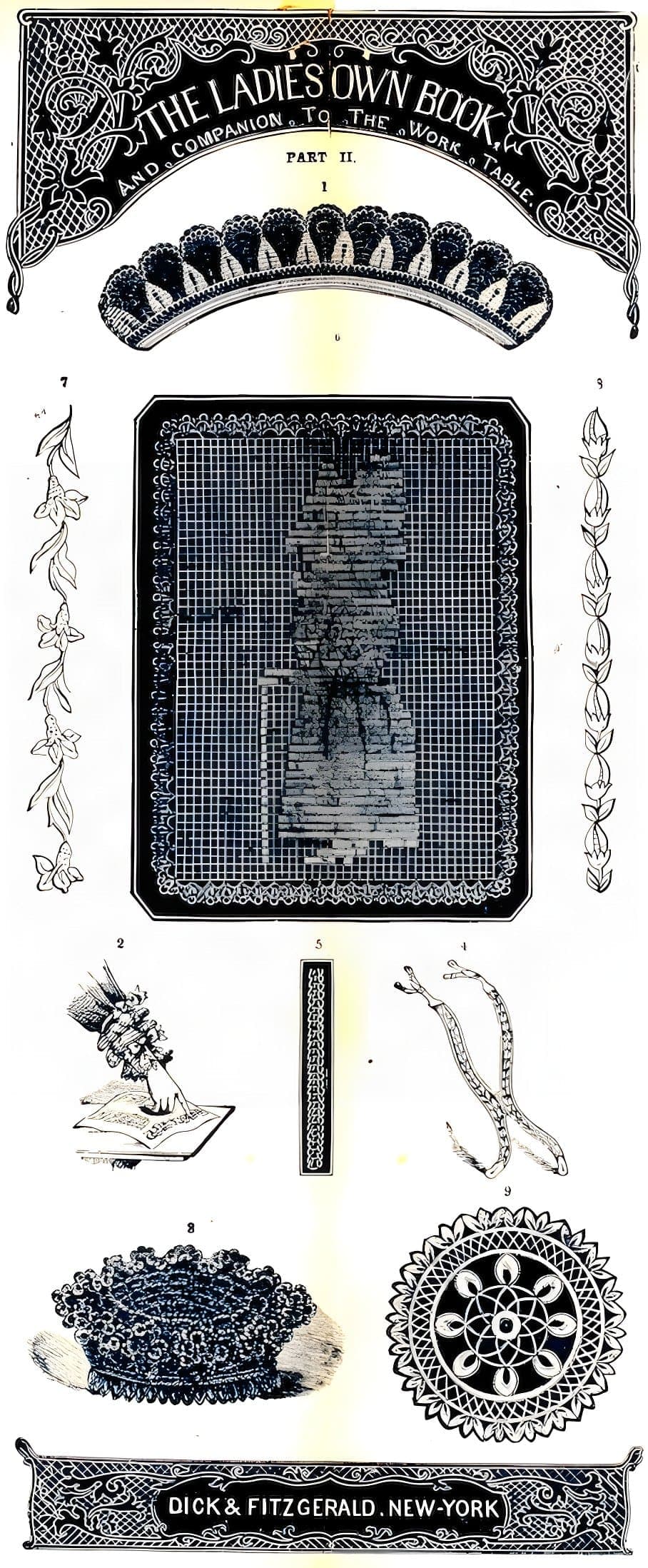
- Modernisation note: Check: rows 7–14 are wide rows with 12 treble panels (the first and last are half-panels at the ends of the collar); stitch counts within a row are not always consistent, and the book gives no turning directions. Compare with Fig. 1 of the Part II plate.
- Modernisation note: Check: row 15 works along the ends of rows (“sc. on 3rd row”, “sc. on 5th row”), which carries the edge round the ends of the collar.
- Modernisation note: “Run in the ends” added as finishing.
Row progress: 0 of 6 done (0%)
Stitches
0 of 6 done- Chain (book's definition, “ch.”): “A loop of thread made on the hook, and through this the thread is drawn, forming the first chain stitch; draw the thread through this one, and a second is formed.” = ch.Mark row complete
- Single crochet (book's definition, “sc.”): “Insert the hook in the chain, and draw the thread through it; this forms a second loop on the hook. Draw the thread through these two by a single movement and the stitch will be completed.” = modern US sc.Mark row complete
- Double crochet (book's definition, “dc.”): “Raise the thread over the hook, so as to pass it round, before inserting the latter in the chain; draw the thread through, and you will find three loops on the hook; bring the cotton through two … finish the stitch by drawing the thread through these.” = modern US dc (not the UK dc).Mark row complete
- Treble crochet (book's definition, “tc.”): as dc, “but as the thread is passed twice round the hook before the insertion of the latter in the chain, there will be four loops on … Bring the thread three times through two loops to finish the stitch.” = modern US tr.Mark row complete
- Working “through” a stitch (book's definition): “To work THROUGH a stitch, is to draw the thread under instead of in it. This is stronger than the usual method, but not so neat” — insert the hook under the whole stitch or chain instead of into it.Mark row complete
- Repeat marks (book's definition): stitches between two similar marks (✕, +, *, †) “are to be done as many times as directed; thus, ✕ 3 dc. 2 ch. ✕ three times, means 3 dc. 2 ch., 3 dc. 2 ch., 3 dc. 2 ch.” So “twice” or “3 times” is the total number of times the group is worked. Written here as (…) twice, (…) 3 times.Mark row complete
Working on:
Chain (book's definition, “ch.”): “A loop of thread made on the hook, and through this the thread is drawn, forming the first chain stitch; draw the thread through this one, and a second is formed.” = ch.
Continue this pattern
The rest of the Crochet Collar with Treble Points (1854) pattern is in the Vintage Crochet Hats, Bags & Accessories
Still to come in the full pattern:
- Band
- Points
- Edge
- Finishing
Included with 202 patterns for $12 — $0.06 per pattern.
Errata
No corrections have been published for this pattern. Found a mistake? Tell us and we will log the fix here with a date.
Your notes on this pattern
Keep track of the yarn, hook and changes you used. Saved in this browser only — nobody else can see it.
Frequently asked questions
Where is the Crochet Collar pattern from?
It was published as "Crochet Collar" in The Ladies' Complete Guide to Crochet, Fancy Knitting, and Needlework (Mrs. Ann S. Stephens) by Dick & Fitzgerald in 1854. The publication is in the public domain in the United States; this version is transcribed and modernised by crochetpatterns.io.
What yarn or thread do I need for the Crochet Collar?
Size 30 crochet cotton (approximate). Not printed.
What hook should I use?
Start with a 1 mm (US steel 12) hook and adjust to suit your thread (original: crochet hook No. 20, eagle card-board gauge; approximate conversion). No gauge is printed. The book says loose crocheters should use a still smaller hook, because the collar should be worked very tightly. Gauge: Not printed.