Free preview · full pattern in the Vintage Crochet Fashion
Crochet Dress for Child (1888): vintage crochet pattern
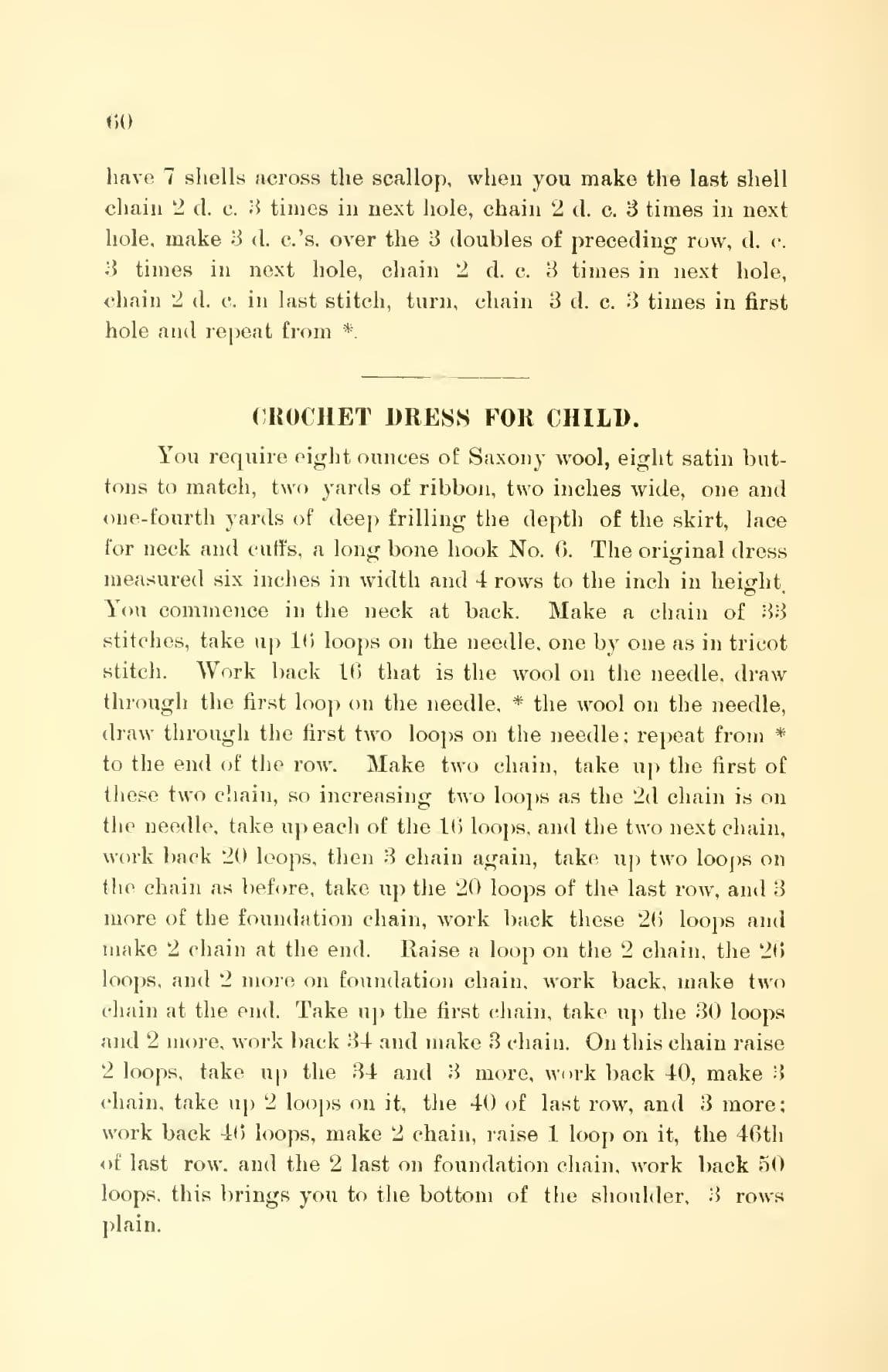
The book's one fully counted garment and the only design in it that prints both its materials and a gauge: a child's dress worked in tricot from a chain of thirty-three at the back neck, the back widened stitch by stitch to fifty over eight diagonal increases and then shaped through forty-five numbered rows, the two fronts picked.
By the crochetpatterns.io editorial team · Updated · Editorial policy · pattern testing in progress
| Detail | Value |
|---|---|
| Skill level | Advanced |
| Yarn weight | Fine (#2) |
| Yardage | The book prints a quantity — eight ounces of Saxony wool — but no yardage, and none is estimated here. (as printed; yardage not given) |
| Hook | 5 mm |
| Gauge | The book's own: “The original dress measured six inches in width and 4 rows to the inch in height.” Work a tricot sample and change hook size until the row gauge is 4 rows to the inch. See the notes on how the width half of that sentence reads. |
| Finished size | No finished measurement is printed for the dress. What is printed is a gauge — “The original dress measured six inches in width and 4 rows to the inch in height.” — and the counts then set the size: the back neck is a chain of 33, the back widens to 58 loops at Row 17 and is 42 loops at Row 35, each front reaches 36 loops, and each sleeve is 48 loops. |
| Time | about 33 hours |
Materials
- 8 oz (about 225 g) of a Saxony wool or a modern soft light wool of the same character — the book prints the quantity, which it does for no other design in the book
- 8 satin buttons to match the wool
- 2 yd (about 1.8 m) of ribbon 2 in (5 cm) wide for the sash and strings
- 1¼ yd (about 1.15 m) of deep frilling, the depth of the skirt, to go under the first skirt
- Lace for the neck and cuffs
- A length of galloon ribbon to back the buttonhole band and the button band
- A long bone hook No. 6 as printed, or a modern long tricot/afghan hook that gives the printed gauge
- Tapestry needle for the ends and for sewing on the frilling, ribbon and buttons
- Hook: The book prints a hook for this design and for only one other in its 114 pages: “a long bone hook No. 6”. It is an 1888 bone-hook number and does not read across to a modern millimetre size, so it is recorded rather than converted. Use a long tricot (afghan) hook, because every piece but the skirt, the flounce and the borders is worked in tricot and carries the whole row of loops; change size until you meet the printed gauge.
Yarn Kit & Substitution Options
This pattern calls for 350 yards of weight #2 yarn. Select a suggested yarn to see required skeins and estimated cost:
Lion Brand Coboo · 50% Cotton, 50% Bamboo
232 yds per skein · Silky breathable drape, lovely stitch shine
2 skeins required
approx. $$12.98 total
Abbreviations (US terms)
- chain
- slip stitch
- single crochet
- double crochet
- stitch
- stitches
- repeat
- skip
- increase
- decrease
- together
- loop
- row
- round
Notes before you start
- Source: "Crochet Dress for Child", Instructions for Crochet Work, Western Lace Manufacturing Company, 218 State Street, Chicago, Ill., 1888. Public domain in the USA.
- As printed — materials: “You require eight ounces of Saxony wool, eight satin buttons to match, two yards of ribbon, two inches wide, one and one-fourth yards of deep frilling the depth of the skirt, lace for neck and cuffs, a long bone hook No. 6.” (printed at the head of the design, book page 60); “sew a piece of galloon ribbon under the row of button holes, and also under the row on which the buttons are placed; sew strings in the front, a sash just over the flounce…” (printed with the making up, book page 67). Gauge: “The original dress measured six inches in width and 4 rows to the inch in height.” (book page 60).
- Modernisation note: Stitches are converted by this book's own printed key, “DESCRIPTION OF TERMS USED IN CROCHET”, book page 5 (image p-011.jpg) — not by the look of the abbreviation and not from the date. The key settles the question outright: this 1888 Chicago book uses MODERN US stitch names, the same ladder our 1891 Butterick uses and the opposite of the British-style ladder in the 1913 to 1916 Priscilla books. Its “Single Crochet” is: “Pass the hook through a loop of the last row, bring cotton through, throw cotton around the needle and pass it through the two loops on the needle.” One pull-up and two loops worked off together — the modern US single crochet, not a British double. Its “Double Crochet” is: “Throw cotton once around the needle, pass the hook through a loop of the preceding row, bring cotton through, then take cotton up and bring it through two loops twice.” One wrap before insertion, three loops worked off two at a time twice — the modern US double crochet, not a US single. Its “Half Double Crochet” is: “Like double crochet, only pass the cotton through the three loops on the needle, instead of passing it through two loops twice.” — the modern US half double. Its “Treble” is: “Throw the cotton twice around the needle, and work as double crochet, but bring cotton through two loops three times.” — the modern US treble. Its “Double Double Crochet” is: “Throw the cotton over the needle three times, work as double crochet, but draw the cotton through two loops four times.” — the modern US double treble, written dtr below. The WRAP COUNTS are the decisive evidence and they are printed rather than inferred: none for single, one for double, two for treble, three for double double, with the loops worked off two at a time in every case. So this book's s. c., d. c., h. d. c., t. and d. d. c. are written sc, dc, hdc, tr and dtr below with no shift of height.
- Modernisation note: Two of the book's terms do NOT map straight across, and both are handled explicitly rather than quietly. Its “Close Chain Stitch” (page 5) is: “Insert the hook in the loop of preceding row, and draw cotton through it and the loop on the needle at the same time.” That is what we call a slip stitch worked into the fabric, and it is written sl st below. Its own “Slip Stitch” (page 6) is a different move — a joining, not a stitch: “This stitch is used in joining. Take the hook from the last loop worked, pass it through the loop where the work has to be joined; then take the first loop spoken of and draw it through.” Where a design uses sl. st. in that joining sense the row below says join with a sl st and keeps the book's own wording; where it plainly means travelling along a chain or a row, the row says sl st. Its “Ribbed Crochet” (page 6) is: “Make a single crochet in the back loop of each stitch of the row last worked. At the end of every row make a chain stitch and turn the work; then begin the next row.” — written sc in blo below.
- Modernisation note: The book prints its own short table, “ABBREVIATIONS USED IN DIRECTIONS”, book page 6 (image p-012.jpg): “l. — Loop. ch. st. — Chain Stitch. cl. ch. st. — Close Chain Stitch. s. c. — Single Crochet. d. c. — Double Crochet. h. d. c. — Half Double Crochet. t. — Treble. d. d. c. — Double Double Crochet. p. — Picot. r. c. — Ribbed Crochet. sl. st. — Slip Stitch.” Note that its letter for treble is a bare “t.”, not “tr.”; several designs also write “T” or “t. c.” for the same stitch, and all three are written tr below. Most designs spell the stitches out in words anyway, and both forms are written in modern shorthand here.
- Modernisation note: The book's wording is written in modern US form: “needle” always means the crochet hook and is written hook; “set the needle into” = insert the hook in; “fill the ring with” = work the stitches into the ring; “miss” = sk; “catch down” and “fasten” = join with a sl st or a sc, according to what the row is doing; “throw the cotton over the needle” = yo; “d. c. 3 times in the same place” is written 3 dc in the same place; “repeat from *” = rep from *. Ordinal row names (“Ist Row”, “2d Row”, “3d Row”) are written Row 1, Row 2, Row 3, and Round where the design works in the round. The book's own spellings are kept in the design names as printed.
- Modernisation note: Several of these designs print as one solid paragraph with no row numbering at all, the new row marked only by the word “turn”. Those are split here into one row or step per line at the book's own “turn”, and the book's own sub-headings (BORDER, SCALLOP FOR TOP OF BOOTEE, For the Heading and so on) are kept as section headings. Stitch order and counts are unchanged and nothing is added.
- Modernisation note: The scanned text of this book carries the usual optical-reading slips, and every figure below was read back against the 220 dpi page image rather than trusted from the scan: the scan's “Ist” is 1st, its “Sth” is 8th, its “LO” and “lO” are 10, its “+” and “-L” standing in place of a number are the figure 4, its “§” is 5, its “Y” and “)” are 9, its “S” inside a number is 8, and its “e”, “¢”, “«” and “@” are all the letter c, so that “d. ec.”, “d. «.”, “cd. c.” and “a. c.” are all d. c. Where the scan and the printed page disagree, the printed page is followed and the disagreement is recorded as a Check note.
- Modernisation note: THE ONE GAUGE AND THE ONE FULL MATERIALS LINE IN THE BOOK. This is the only design in the 114 pages that prints both, and both are quoted above exactly as they are set on book page 60 (image p-066.jpg), read off the page image rather than the scan. Nothing in either is converted, rounded or filled in. The back-page materials list on book page 113 has no line for page 60 at all, so the head-of-design sentence is the whole of what the book says about what to buy.
- Modernisation note: HOW THE PRINTED GAUGE READS, and this is our reading, not the book's. The sentence is “The original dress measured six inches in width and 4 rows to the inch in height.” Its second half is unambiguous — 4 rows to the inch. Its first half has no stitch count attached to the six inches, so as printed it cannot be used as a stitch gauge. The parallel construction (“… in width and … to the inch in height”) is the standard period formula for a stitch-and-row gauge, which would want six stitches to the inch in width, and six stitches to the inch reconciles with the garment: the chain of 33 at the back neck is then about 5½ in across, the back at its widest 58 loops is about 9¾ in, each front at 36 loops is about 6 in, and the chest measures about 21¾ in — a two- to three-year-old's dress, which is what the engraving shows. That reading is recorded here as a reading. The row above quotes the line as printed and nothing is silently changed.
- Modernisation note: WORKABLE, and here is the arithmetic that says so, because eight pages of tricot deserve to be checked rather than asserted. THE OPENING CLOSES ON THE NOSE. The eight diagonal increases consume the foundation chain exactly: 16 + 2 + 3 + 2 + 2 + 3 + 3 + 2 = 33, which is the chain of 33 the book casts on, and no stitch is left over. The running loop counts close with it — 16, then 2 + 16 + 2 = 20, then 3 + 20 + 3 = 26, then 2 + 26 + 2 = 30, then 2 + 30 + 2 = 34, then 3 + 34 + 3 = 40, then 3 + 40 + 3 = 46, then 2 + 46 + 2 = 50 — and every one of those eight figures is printed in the book. Fifty loops at the bottom of the shoulder.
- Modernisation note: THE BACK CLOSES TOO. Row 4 takes 50 and decreases twice to 48; Row 7 decreases twice to 46; Row 10 adds a ch at each end and Rows 11 to 16 take up two more loops each time, which carries 46 to the “(58 loops)” the book itself prints at Row 17. Row 19 then proves that 58 independently: it decreases “the 3rd and 4th loop together, and the 56th and 55th loops”, and 55 and 56 are the 4th and 3rd from the end only if the row is 58 long. Rows 25, 28 and 31 each consume exactly what the row before leaves — 2 + 2 + 19 + 2 + 4 + 2 + 19 + 2 + 2 = 54, then 2 + 2 + 17 + 2 + 4 + 2 + 17 + 2 + 2 = 50, then 2 + 2 + 15 + 2 + 4 + 2 + 15 + 2 + 2 = 46 — leaving 50, 46 and 42. And the skirt gores in Rows 36 to 45 close as well: the widening centre runs 4, 6, 8, 10, 12, 14 with 19 loops outside it on each side, so Row 44's “19, a ch, 14, a ch, the rest” is 19 + 14 + 19 = 52, which is exactly what 42 plus the five pairs of chains comes to.
- Modernisation note: THE SLEEVE PROVES ITSELF TWICE. The book says “48 loops must be on the work”, and 48 is what the foundation and the chains add up to: the whole chain of 30, plus the 3 ch of the first step, plus 4 + 4 + 4 + 3 in the repeats, is 30 + 18 = 48, the last repeat being the short one that finishes the foundation chain. Row 17 then checks it — “take up 20, 2 together, take up 4, 2 together, take up the rest” is 20 + 2 + 4 + 2 + 20 = 48, symmetrical about the 4 centre sts — and Row 19 checks the 46 that Row 17 leaves in the same way, 19 + 2 + 4 + 2 + 19 = 46. Row 20's “until you have worked 6 rows of decreasings” is a rule, but a bounded and countable one: six decrease rows are Rows 17, 19, 21, 23, 25 and 27, and the sleeve finishes at 36 loops.
- Modernisation note: THE TWO FRONTS MEET THE SAME TWO NUMBERS. The book prints only two loop counts for the fronts, both on the right front: 31 loops at the 4th row of neck and 36 loops at Row 20. The left front, which prints no count at all, reaches 31 by pure arithmetic and so confirms the right — its wedge takes up 4 loops, then 7, then 10, then three starred repeats of “3 more” with an increase in each (13, 16, 19 loops plus 3 increases = 22), then 3 rows each increasing 1 (25), then “make 6 chain, take up on this 5 loops, 1 on the chain” (31). That is the same 31 the right front reaches by casting on 6 over 25. The left front then increases once in each of Rows 9 to 13 and casts 2 more on in the fourth repetition, which carries 29 to 36 — the right front's printed figure again.
- Modernisation note: Check, and it is the one place on the right front where the count will not sit still. Row 20 says “you should have 36 loops”. Working from the 31 of the 4th row of neck, the decreases at Rows 5 and 8 leave 29, and the seven single increases at Rows 13 to 19 carry that to exactly 36 — so the printed figure is right. What does not fit is the extra clause “at the end of the 19th row make 2 chains as well as the increase before the 2 last stitches”, which would make 38. Those 2 chains have to be something Row 20 does not take up — the start of the underarm, on the reading that fits — and the row is printed above exactly as the book sets it, both halves, with the finding recorded here instead of being tidied away.
- Modernisation note: Check: the left front's row numbering has a hole in it. Row 10 is repeated “3 more times”, which is Rows 11, 12 and 13, and the next heading printed is “15th Row and next 3 Rows: Plain.” No 14th row is printed anywhere. It is the row that takes up the loops the 4th repetition made — 36 of them — and the book simply does not number it. Nothing is invented; the gap is recorded so a maker meets it knowing what it is.
- Modernisation note: Check: the collar's 3rd row is two short. Row 1 works off 2, 6, 1, 8, 2, 8, 1, 6, 2 — 36 in all — with 8 increases, and Row 2's 2, 7, 3, 9, 2, 9, 3, 7, 2 is exactly those 36 plus 8, which is 44. Row 2 makes 8 increases in its turn, so Row 3 has 52 loops on the hook; but Row 3 as printed works off 2, 8, 4, 10, 2, 10, 4, 8, 2, which is 50. The row is set out above exactly as the page has it. Two loops have to go somewhere, and the shape of the two earlier rows — where the segments that sit between two increases grew by 2 and the rest by 1 — points at the two “4”s, which would be 5s. That is a reading, not the book's word, so the row is left as printed and the maker can put the two extra loops wherever the collar wants them.
- Modernisation note: Check: the right front's shoulder wedge is the one passage that cannot be followed literally. “Take up 19 stitches, work back 3, take up the 2 first of these 3, work back 6…” asks to work back six loops where three were left, and the running figures in that sentence do not all reconcile. It is a short-row wedge worked three stitches at a time down the shoulder slope with an increase in each little row, and the book bounds it properly — “repeat this last little row until you have worked off all the loops” — and prints the target it must reach, 31 loops after 6 are cast on, which means 25 before them. The left front prints the same wedge with its counts intact and lands on the same 31. So the piece is workable: follow the left front's wedge mirrored and check against the book's own 25-then-31. Nothing has been rewritten in the row above.
- Modernisation note: Check: the scan reads the foundation as “take up 1 loops on the needle, one by one as m tricot stitch”; the printed page (book page 60, image p-066.jpg) reads “take up 16 loops on the needle, one by one as in tricot stitch”, and 16 is the figure the whole opening then uses. The scan's “work back 84” is work back 34, its “make 8 chain” is make 3 chain, its “the 384 and 83 more” is the 34 and 3 more, and its “work back 46 loops” is right.
- Modernisation note: Check: the scan runs the back's row numbers together as “Lith Row: Plain (58 loops). Lsth Row: Plain. 1th Row…”; the page reads 17th, 18th and 19th, and the 20th and 21st rows that follow confirm it. Its “Sth and 9th Rows” is 8th and 9th.
- Modernisation note: Check: the scan reads the sleeve as “Make a chain of 80 stitches… 45 loops must be on the work”; the printed page (book page 66, image p-072.jpg) reads “Make a chain of 30 stitches… 48 loops must be on the work”, and 48 is the only figure Rows 17 and 19 will take. Its “take np 18” is take up 18 and its “+ more” is 4 more.
- Modernisation note: Check: the scan reads the skirt as “There must be 66 d. stitches in this row”; the page (book page 65, image p-071.jpg) reads the same. The book gives that count as a target to hit rather than deriving it from the waist, so work the round to 66 doubles and adjust the missed stitches to suit your own waist edge, exactly as the book asks.
- Modernisation note: Check: the book prints “the 46th of last row” in the eighth increase where it means the 46 loops of the last row. The wording is kept and the sense recorded here.
- Modernisation note: The tricot. Every piece of this dress except the skirt, the flounce and the borders is worked in tricot — the book's own “one by one as in tricot stitch” — with a long hook that carries the whole row of loops; the return pass is printed in the design itself and is transcribed above in full rather than assumed. The book calls the same stitch “the tricotee (or Afghan) stitch” on page 16 where it builds its star stitch out of it. Tricot is crochet, not knitting. “Take up” is the forward pass and “work back” or “work off” the return, and both are kept in the book's own words because the counts hang on the distinction. The one place the book borrows a knitting word is the right front's “cast onto the needle as if you were knitting 6 loops”, which is kept as printed.
- Modernisation note: The picot is the book's own and is left in the form each row prints it, per its warning on page 6 that picots vary by pattern: the flounce's is “a double, a picot of 4 chain 6 times, a double again” and the little border's is “1 double, 4 chain, single crochet on 1st chain, 4 times”. Neither is standardised to the other and no picot abbreviation is used, the book's “p.” having no counterpart here.
- Modernisation note: The dress is joined with two kinds of slip stitch and both are the book's. The side seams and the shoulder joins say “join together with slip stitch”, which is the book's page-6 joining move; the skirt and flounce rounds close with a travelling slip stitch, the book's Close Chain Stitch. Both are written sl st above and the note on terms sets out the difference.
- Modernisation note: Not a reprint. Not a reprint: the opening sentence, the chain of 33, the printed hook and the phrase “commence in the neck at back” were checked against every other book in this library and return no match. Nothing matches. Home Work has no tricot child's dress at all — its garments in that stitch are the No. 23 and No. 25 tricot bootees and the No. 26 Ladies' Vest, which is a plain ribbed single-crochet rectangle worked to no count. This book's own other dress, the Tricot and Crochet Dress on pages 22 to 24, is a different design and is not transcribed anywhere in this file: it shapes by rule throughout (“make a chain the length required; about 118 will be sufficient”, “decreasing 6 times in every 3d row, until you have decreased to the size required for the waist”) and prints neither a gauge nor a finished measurement.
- Modernisation note: Check: no colour is printed for this dress. The engraving is not reproduced with the directions, and the back-page list names no shade for page 60. Cream and the soft period nursery shades are recorded here as the usual choices for Saxony wool, not as this design's printed colour.
Row progress: 0 of 10 done (0%)
The back — the neck and the shoulder increases, book page 60
0 of 10 done- You commence in the neck at back. Make a ch of 33 sts; take up 16 loops on the hook, one by one as in tricot stitch.Mark row complete
- Work back 16 — that is, the wool on the hook, draw through the first loop on the hook, *the wool on the hook, draw through the first two loops on the hook; rep from * to the end of the row.Mark row complete
- Make 2 ch; take up the first of these two ch, so increasing two loops as the 2nd ch is on the hook; take up each of the 16 loops, and the two next ch; work back 20 loops.Mark row complete
- Then 3 ch again; take up two loops on the ch as before, take up the 20 loops of the last row, and 3 more of the foundation ch; work back these 26 loops and make 2 ch at the end.Mark row complete
- Raise a loop on the 2 ch, the 26 loops, and 2 more on the foundation ch; work back; make two ch at the end.Mark row complete
- Take up the first ch, take up the 30 loops and 2 more; work back 34 and make 3 ch.Mark row complete
- On this ch raise 2 loops, take up the 34 and 3 more; work back 40; make 3 ch.Mark row complete
- Take up 2 loops on it, the 40 of the last row, and 3 more; work back 46 loops; make 2 ch.Mark row complete
- Raise 1 loop on it, the 46th of the last row, and the 2 last on the foundation ch; work back 50 loops. This brings you to the bottom of the shoulder.Mark row complete
- 3 rows plain.Mark row complete
Working on:
You commence in the neck at back. Make a ch of 33 sts; take up 16 loops on the hook, one by one as in tricot stitch.
Continue this pattern
The rest of the Crochet Dress for Child (1888) pattern is in the Vintage Crochet Fashion
Still to come in the full pattern:
- The back — Rows 4 to 35, book page 61
- The back — Rows 36 to 45 and the finish, book page 62
- The right front, book pages 62 to 63
- The left front, book pages 63 to 64
- Joining, the front edge and the little border, book page 64
- The skirt, book pages 64 to 65
- The fancy flounce, worked over the skirt, book page 65
- The collar, book pages 65 to 66
- The sleeve, book pages 66 to 67
- Finishing
Included with 71 patterns for $15 — $0.21 per pattern.
Errata
No corrections have been published for this pattern. Found a mistake? Tell us and we will log the fix here with a date.
Your notes on this pattern
Keep track of the yarn, hook and changes you used. Saved in this browser only — nobody else can see it.
Frequently asked questions
Where is the Crochet Dress for Child pattern from?
It was published as "Crochet Dress for Child" in Instructions for Crochet Work by Western Lace Manufacturing Company, 218 State Street, Chicago, Ill. in 1888. The publication is in the public domain in the United States; this version is transcribed and modernised by crochetpatterns.io.
What yarn or thread do I need for the Crochet Dress for Child?
fine (#2) yarn. The book prints a quantity — eight ounces of Saxony wool — but no yardage, and none is estimated here.
What hook should I use?
The book prints a hook for this design and for only one other in its 114 pages: “a long bone hook No. 6”. It is an 1888 bone-hook number and does not read across to a modern millimetre size, so it is recorded rather than converted. Use a long tricot (afghan) hook, because every piece but the skirt, the flounce and the borders is worked in tricot and carries the whole row of loops; change size until you meet the printed gauge. Gauge: The book's own: “The original dress measured six inches in width and 4 rows to the inch in height.” Work a tricot sample and change hook size until the row gauge is 4 rows to the inch. See the notes on how the width half of that sentence reads.