Free preview · full pattern in the Vintage Crochet Edgings & Trims
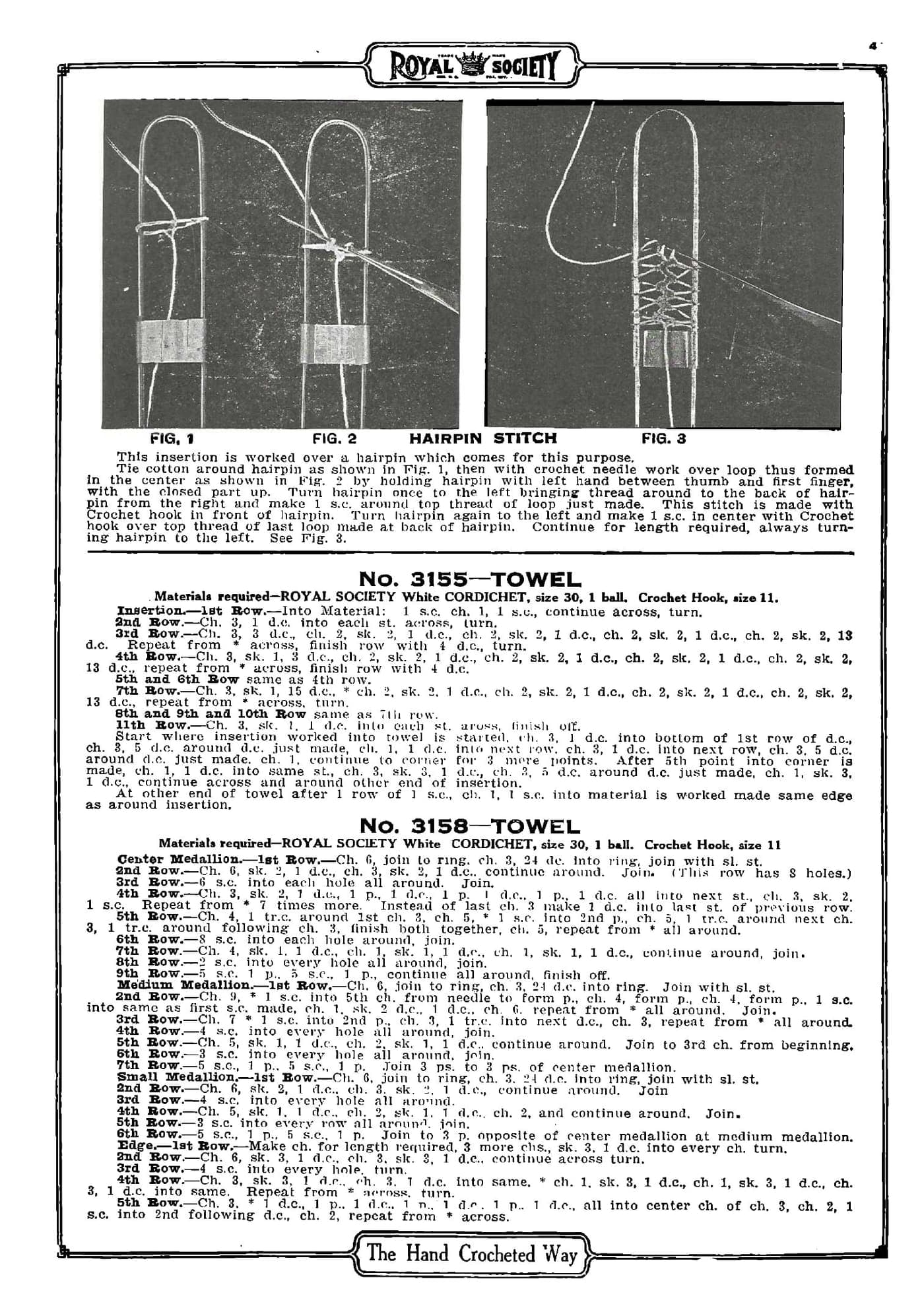
Filet Band Towel Insertion No. 3155 (1916): vintage crochet pattern
An eleven-row insertion worked straight into the linen of a towel: a solid double-crochet band gives way to a run of four chain-2 meshes between blocks of thirteen double crochet, the block widening to fifteen at the seventh row, and the whole band is then framed by a row of five-double-crochet points.
By the crochetpatterns.io editorial team · Updated · Editorial policy · pattern testing in progress
| Detail | Value |
|---|---|
| Skill level | Intermediate |
| Yarn weight | Lace (#0) |
| Yardage | the book gives only a ball count. (as printed; yardage not given) |
| Hook | 1.25 mm |
| Gauge | No gauge printed. |
| Finished size | Not printed — the band is worked to the width of the towel. |
| Time | about 4 hours |
Materials
- Size 30 mercerized cotton crochet thread — approximate; the book prints only its own trade name and size number
- Steel crochet hook
- Tapestry needle for the ends
- A towel to work the band into
- Hook: Start with a 1.25 mm (US steel 8) hook — approximate, and ours: the book prints “Crochet Hook, size 11”, a number on the maker's own scale that does not map onto modern steel sizes. Change size until the work lies flat.
Yarn Kit & Substitution Options
This pattern calls for 350 yards of weight #0 yarn. Select a suggested yarn to see required skeins and estimated cost:
Caron Simply Soft · 100% Acrylic
315 yds per skein · High-yield yardage, silky no-scratch texture
2 skeins required
approx. $$10.98 total
Abbreviations (US terms)
- chain
- slip stitch
- single crochet
- double crochet
- space
- chain space
- stitch
- stitches
- skip
- repeat
- row
Notes before you start
- Source: "No. 3155 — Towel" (3155), Royal Society Crochet Lessons, Vol. 1, No. 7, H. E. Verran Company, Inc., New York, 1916. Public domain in the USA.
- As printed — materials: ROYAL SOCIETY White CORDICHET, size 30, 1 ball; Crochet Hook, size 11; A towel to trim. Gauge: Not given.
- Modernisation note: Stitches are converted from the key this book prints itself, not from the date. The key is on book page 3, headed “CROCHET STITCHES”, facing a photographic plate of the same fifteen stitches on book page 2, and it defines every height in full. Single crochet is “insert needle in last chain and pull thread through, thus having two loops on needle. Wind thread once over needle and pull through the two loops” — the modern US single. Half double crochet is named and abbreviated separately, “wind thread once around needle, insert into chain and pull loop through. Wind thread around needle again and pull through three loops at once” — the modern US half double. Double crochet is “wind thread once around needle. Insert needle into chain and pull through; this leaves three loops on needle. Wind thread once around needle and pull through two. Wind thread again over needle and pull through two” — the modern US double, and because the book names the half double separately it cannot be the half double that Clark's 1923 book in another part of this library means by the same-looking abbreviation. Treble crochet is “made same way as Double Crochet, only at first wind thread twice over needle and pull thread through three times — two and two and two” — the modern US treble, written tr below; double treble takes three wraps and is written dtr. The key also defines the filet mesh as “chain two stitches, skip two stitches, one double crochet into next stitch” and a shell as “five double crochet in one stitch”. One trap in the printed abbreviation table on that page: it glosses “sp.” as spoke, not space, so no bare “sp.” anywhere in this book has been read as a space.
- Modernisation note: The book's wording is written in modern US form: “ch.” = ch; “s.c.” = sc; “h.d.c.” = hdc; “d.c.” = dc; “t.c.” and “tr.c.” = tr; “d.tr.c.” = dtr; “sl. st.” = sl st; “sk.” = sk; “p.” = picot; “m.” = mesh. Ordinal row names (“1st Row”, “2nd Row”) are written Row 1, Row 2; the book's “repeat from *” is written rep from *; and “finish off” is written fasten off. The book's own word “hole” for the gap it works into is kept, because that is the word it uses and it never abbreviates it.
- Modernisation note: The printed paragraphs are split into one row or step per line; stitch order and counts are unchanged. Section headings are the book's own where it prints them and ours where it does not. The OCR of this scan is rough — it prints “d.c.” variously as “dc”, “de” and “dic”, sets row labels as “lst Bow”, “Qnd Bow” and “8rd Row”, and drops words at the column breaks. Those quirks are kept in the excerpts and not in the rows.
- Modernisation note: The book names its threads by the maker's own trade name and colour number — Royal Society Cordichet in a stated size, sometimes with a colour number such as No. 3012. Those colour numbers were shade codes in the maker's own range and cannot be matched to any modern shade card, so they are recorded as printed and not converted. The stated thread size is read as roughly equal to the modern crochet cotton size of the same number — approximate only.
- Modernisation note: The book prints a hook number for most designs, but the number belongs to the maker's own scale rather than to any modern one, so it is recorded above as printed and the metric suggestion below is ours, read across from the thread size rather than from the page.
- Modernisation note: No gauge is printed for this design — the book prints no gauge, tension or stitch count per inch anywhere. Work a sample and change hook size until the piece lies flat.
- Modernisation note: Check: the first row is worked directly into the linen of the towel rather than into a foundation chain, so its stitch count is set by the towel and not printed. The book's own phrase is “into material”.
- Modernisation note: Check: this is a towel trimming, so its length is set by the towel it trims; the book prints no length and leaves the number of repeats to the worker.
- Modernisation note: No finished measurement is printed for this design.
- Modernisation note: No yardage is printed for this design. The book gives ball counts only, and where it does they are recorded above as printed; no length in yards or metres appears anywhere in the book.
- Modernisation note: Check: the book prints Row 3 with its repeat asterisk missing from the opening — it prints the first mesh group, then “repeat from * across”, so the star falls after the opening 3 dc, which is how it is set above. Row 7 does print its star, in the same place.
- Modernisation note: Check: the blocks between the meshes are printed as 13 dc in Rows 3 to 6 and as 15 dc at the start of Row 7. Both counts are the book's own and both are kept where the book puts them; nothing has been reconciled.
- Modernisation note: Check: every tall stitch in this design is the book's d.c., the modern US double crochet by the printed key. No treble appears in it.
- Modernisation note: Check: the number of mesh-and-block repeats is not printed, because it is set by the width of the towel.
Row progress: 0 of 8 done (0%)
Insertion
0 of 8 done- Row 1: into the material — 1 sc, ch 1, 1 sc, continue across, turn.Mark row complete
- Row 2: Ch 3, 1 dc into each st across, turn.Mark row complete
- Row 3: Ch 3, 3 dc, ch 2, sk 2, 1 dc, ch 2, sk 2, 1 dc, ch 2, sk 2, 1 dc, ch 2, sk 2, 13 dc. Rep from * across, finish the row with 4 dc, turn.Mark row complete
- Row 4: Ch 3, sk 1, 3 dc, ch 2, sk 2, 1 dc, ch 2, sk 2, 1 dc, ch 2, sk 2, 1 dc, ch 2, sk 2, 13 dc, rep from * across, finish the row with 4 dc.Mark row complete
- Rows 5 and 6: the same as Row 4.Mark row complete
- Row 7: Ch 3, sk 1, 15 dc, *ch 2, sk 2, 1 dc, ch 2, sk 2, 1 dc, ch 2, sk 2, 1 dc, ch 2, sk 2, 13 dc, rep from * across, turn.Mark row complete
- Rows 8, 9 and 10: the same as Row 7.Mark row complete
- Row 11: Ch 3, sk 1, 1 dc into each st across, fasten off.Mark row complete
Working on:
Row 1: into the material — 1 sc, ch 1, 1 sc, continue across, turn.
Continue this pattern
The rest of the Filet Band Towel Insertion No. 3155 (1916) pattern is in the Vintage Crochet Edgings & Trims
Still to come in the full pattern:
- Edge around the insertion
- Finishing
Included with 618 patterns for $9 — $0.01 per pattern.
Errata
No corrections have been published for this pattern. Found a mistake? Tell us and we will log the fix here with a date.
Your notes on this pattern
Keep track of the yarn, hook and changes you used. Saved in this browser only — nobody else can see it.
Frequently asked questions
Where is the No. 3155 — Towel pattern from?
It was published as "No. 3155 — Towel" in Royal Society Crochet Lessons, Vol. 1, No. 7 by H. E. Verran Company, Inc., New York in 1916. The publication is in the public domain in the United States; this version is transcribed and modernised by crochetpatterns.io.
What yarn or thread do I need for the No. 3155 — Towel?
Size 30 crochet cotton (approximate). Not printed — the book gives only a ball count.
What hook should I use?
Start with a 1.25 mm (US steel 8) hook — approximate, and ours: the book prints “Crochet Hook, size 11”, a number on the maker's own scale that does not map onto modern steel sizes. Change size until the work lies flat. Gauge: No gauge printed.