Free preview · full pattern in the Vintage Afghans & Bedspreads
Baby's Crocheted Afghan No. 792 (1915): vintage crochet pattern
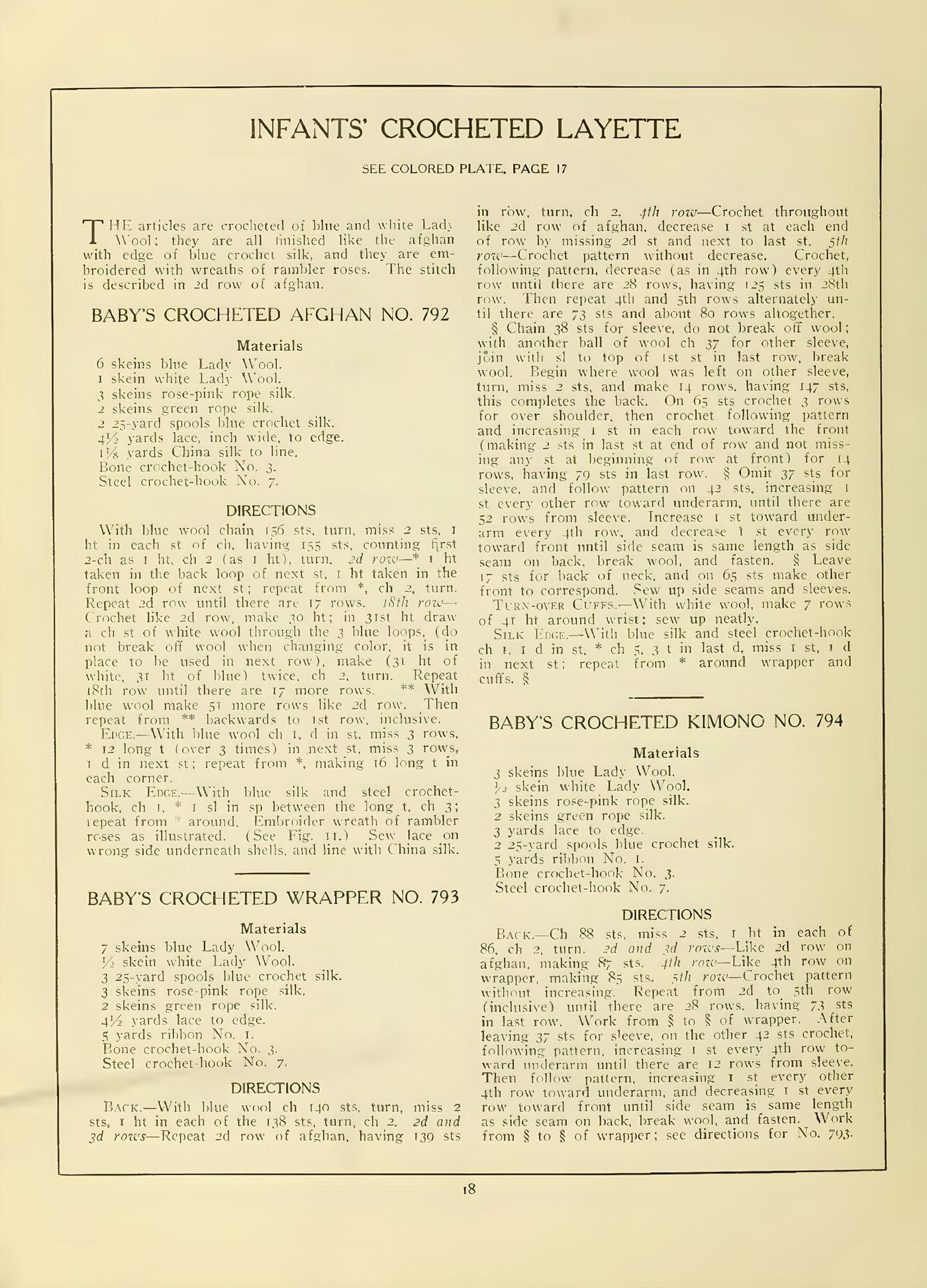
The afghan of the crocheted layette, worked the whole width in the book's alternating front- and back-loop half-treble stitch, with a band of white blocks set into the blue ground by changing colour mid-stitch, and finished with a border of twelve long trebles in a single stitch and a silk chain edge.
By the crochetpatterns.io editorial team · Updated · Editorial policy · pattern testing in progress
| Detail | Value |
|---|---|
| Skill level | Intermediate |
| Yarn weight | Super fine (#1) |
| Yardage | Not printed; see modernisation notes. (as printed; yardage not given) |
| Hook | 3.5 mm |
| Gauge | Not printed; work a sample and change hook size to suit. |
| Finished size | Not printed; the afghan is set by its counts — 155 stitches wide and about 155 rows. |
| Time | about 3 hours |
Materials
- Baby-weight (CYC 1, fingering) soft wool in place of the book's Lady Wool — ours, read across from the book's own note that Lady Wool was chosen for its special softness for baby garments
- A soft fine 2-ply baby wool in place of the book's crochet wool, which the book itself equates with twofold Saxony, Zephyr Shetland and Superfine Crochet
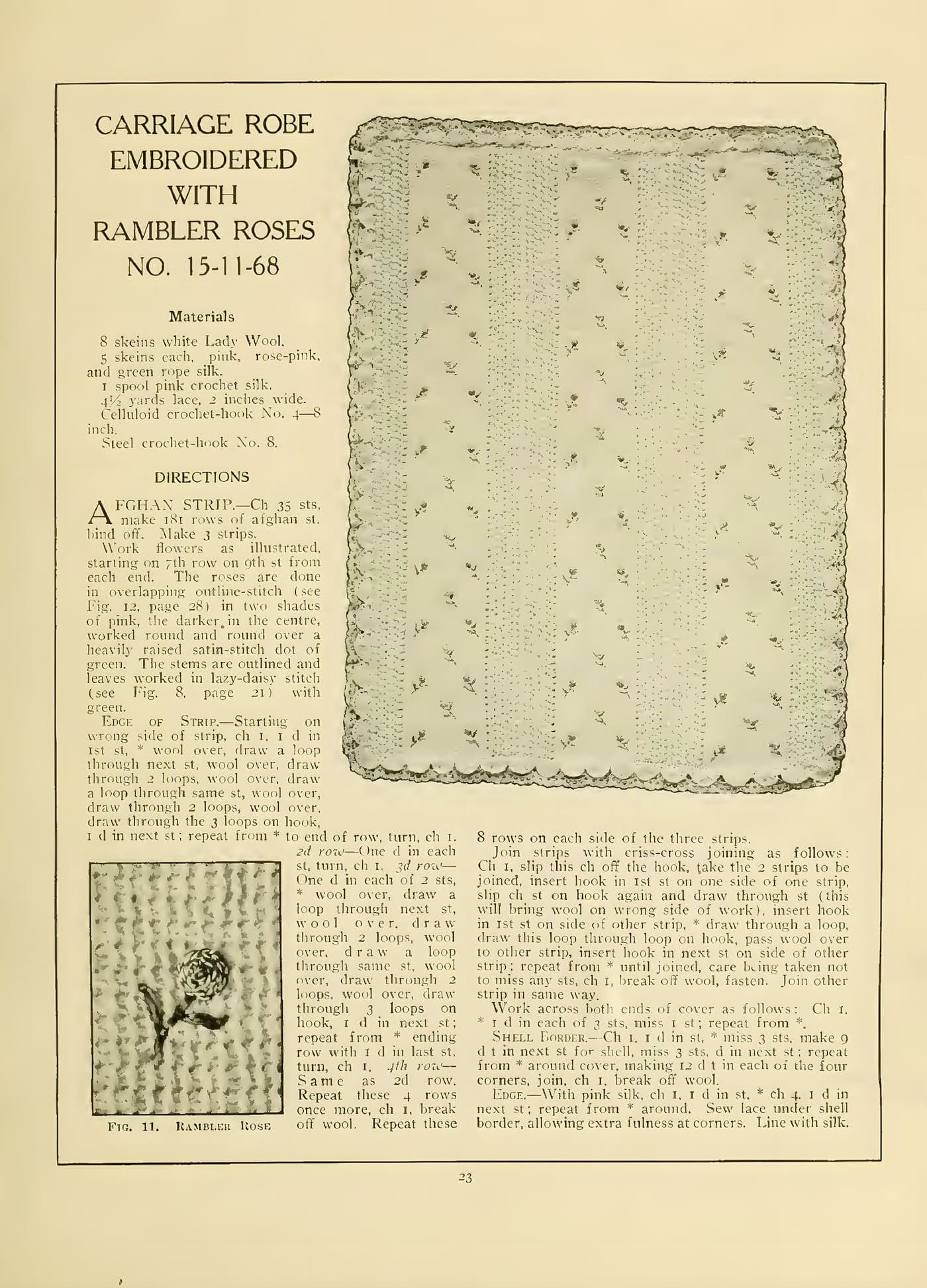
- 6-strand embroidery floss or a soft rayon/silk embroidery thread in place of the book's rope silk and twisted silk, for the silk stitches worked into the fabric and for the rambler-rose and cross-stitch embroidery
- A fine crochet silk or about a size 10 cotton crochet thread for the silk edges
- Ribbon and narrow lace as the design calls for, and lining silk where the book lines the piece
- Hook: Start with 3.5 mm (US E-4) for the wool and about 1.65 mm (US steel 7) for the silk edging — ours, approximate. The book prints only maker's hook numbers. Change size until the fabric is soft but not loose.
Yarn Kit & Substitution Options
This pattern calls for 350 yards of weight #1 yarn. Select a suggested yarn to see required skeins and estimated cost:
Knit Picks Stroll Sock · 75% Superwash Merino, 25% Nylon
231 yds per skein · Durable stitch definition, machine washable
2 skeins required
approx. $$13.98 total
Abbreviations (US terms)
- chain
- single crochet
- half double crochet
- double treble crochet
- slip stitch
- stitch
- stitches
- skip
- repeat
- row
- space
- front loop only
- back loop only
Notes before you start
- Source: "Baby's Crocheted Afghan No. 792" (No. 792), The Priscilla Baby Book No. 1: A Collection of Babies' Garments in Knitting and Crochet with Directions for Making (by Elsa Barsaloux), The Priscilla Publishing Company, 85 Broad Street, Boston, Mass., 1915. Public domain in the USA.
- As printed — materials: 6 skeins blue Lady Wool.; 1 skein white Lady Wool.; 3 skeins rose-pink rope silk.; 2 skeins green rope silk.; 2 25-yard spools blue crochet silk.; 4½ yards lace, inch wide, to edge.; 1½ yards China silk to line.; Bone crochet-hook No. 3.; Steel crochet-hook No. 7.. Gauge: Not given.
- Modernisation note: Stitches are converted by this book's own key (“Explanation of Stitches”, book page 3, image p-05.jpg), not by stitch name. The key is unusually explicit and settles the naming without guesswork. It defines “Double (d)” as: having a loop on the hook, put hook through work, draw thread through work making two loops on the hook, thread over again and through both loops — and it then says in so many words that this stitch has been called “single crochet”, especially in wool crochet, but that for the sake of standardising the terms it is called “double”, after the custom of workers in Irish crochet, eliminating entirely the name “single”. So the book's d is the modern US single crochet, stated outright rather than inferred. “Half Treble (h t)” takes one thread over, hook through work, thread over and through work giving three stitches on the hook, then thread over and through all three at once — the modern US half double crochet. “Treble (t)” takes one thread over, three stitches on the hook, off two and off two — the modern US double crochet. “Double Treble (d t)” takes thread over twice, four stitches on the hook, worked off two at a time — the modern US treble. “Long Treble (l t) or Triple Treble (t t)” takes thread over three times, five stitches on the hook, worked off by twos — the modern US double treble, with the key's own note that “l t” is used for anything longer than d t and the number of loops is then stated in the design. So this 1915 Priscilla book uses the older British heights, exactly like the 1913, 1915 and 1916 Priscilla crochet books in this repository and unlike the 1911 Priscilla Filet book: throughout this transcription the book's d is written sc, its h t is written hdc, its t is written dc, its d t is written tr, and its l t or t t is written dtr.
- Modernisation note: The book's shorthand is written in modern US form: ch = ch, sl = sl st, d = sc, h t = hdc, t = dc, d t = tr, l t and t t = dtr, p = picot, st(s) = st(s), sp = space. “Miss” is written sk; “wool over” and “silk over” are written yo, with the material named where the design changes between wool and silk mid-stitch; “repeat from *” is written rep from *. Ordinal row names (“1st Row”, “2d row”, “3d row”) are written Row 1, Row 2, Row 3, and where the book calls a circuit worked in the round a “row”, it is written Rnd and the change is noted.
- Modernisation note: The printed directions run as solid paragraphs under one DIRECTIONS heading per design; they are split here into one row, round or step per line, with the book's own sub-headings (Yoke, Body, Sleeves, Cuffs, Collar, Edge and so on) kept as section headings. Stitch order and counts are unchanged.
- Modernisation note: The scanned text of this book carries the usual optical-reading slips, and where a figure below looks odd it has been read back against the page image: the scan's “4o”, “3o”, “2oth”, “6oth” and the like are 40, 30, 20th and 60th, its “rst”, “ist” and “Ist” are 1st, its “gth” is 4th or 9th according to the sequence, its “tr” in a stitch count is 11, and its “Sth” is 8th. The row numbers below follow the sequence the printed page actually shows.
- Modernisation note: Materials are listed exactly as printed. The book's own IMPORTANT note (book page 3) explains two of its names: Lady Wool was chosen for its special softness for baby garments and may be found in shops under the names Lady Alice, Lady Jane, Ladyfair, Lady Grey and Lady Betty; and “the crochet wool mentioned is the same as the soft fine twofold Saxony, Zephyr Shetland, or Shetland Zephyr and Superfine Crochet”. Rope silk and twisted silk are the book's embroidery silks; crochet silk is its fine thread for the silk edges.
- Modernisation note: Hooks are printed only as period maker's numbers — bone, celluloid and amber hooks No. 3, No. 4 and No. 5 for the wool, and steel hooks No. 6 to No. 9 for the silk — with no diameters, and those numbers do not map onto the modern scale. Any metric size given in the modern materials is ours and is a starting point only.
- Modernisation note: No gauge is printed for this design, or for any design in the book. The book's own caution (book page 3) is the only guidance it gives: when wool is used the crocheting should not be too tight, nor loose enough to be sloppy, but loose enough to show the beauty of the wool, and all the garments were made at that tension. Work a sample and change hook size to suit.
- Modernisation note: No yardage is estimated. The book counts skeins, spools and yards of ribbon and lace, but never prints a skein or spool length, so there is no printed basis for a yardage figure and none is invented here.
- Modernisation note: No finished measurement is printed for this design. The book gives sizes for almost nothing it makes — the pieces are infant-sized and are worked to the stitch and row counts printed.
- Modernisation note: The book lines many of these pieces with China silk, messaline or satin and edges them with bought lace and ribbon. Those are finishing materials, not crochet, and they are listed as printed and left optional here.
- Modernisation note: The stitch of Row 2 — a half treble taken alternately in the back and front loops — is the stitch the book uses for the whole crocheted layette. Its heading note says so outright: the articles are all finished like the afghan with an edge of blue crochet silk, and the stitch is described in the second row of the afghan. That is why the wrapper, kimono, cap, bottle cover and high boots below all refer back to this row; it is written out again in each of them.
- Modernisation note: The book's “long t (over 3 times)” is a treble with the thread thrown over three times — five loops on the hook — which by the book's own key is the modern US double treble, so it is written dtr here.
- Modernisation note: Check: the scan prints the colour change as “in gist ht” and the row as “ISH row”; the page image reads 31st hdc and 18th row, and the block counts of 31 confirm it.
Row progress: 0 of 7 done (0%)
Afghan
0 of 7 done- Row 1: with blue wool, ch 156, turn, sk 2 sts, 1 hdc in each st of the chain, having 155 sts, counting the first ch-2 as 1 hdc. Ch 2 (as 1 hdc), turn.Mark row complete
- Row 2: *1 hdc taken in the back loop of the next st, 1 hdc taken in the front loop of the next st; rep from *. Ch 2, turn.Mark row complete
- Rep Row 2 until there are 17 rows.Mark row complete
- Row 18: work as Row 2, making 30 hdc; in the 31st hdc draw a ch st of white wool through the 3 blue loops — do not break off the wool when changing colour, it is in place to be used in the next row — then make (31 hdc of white, 31 hdc of blue) twice. Ch 2, turn.Mark row complete
- Rep Row 18 until there are 17 more rows.Mark row complete
- **With blue wool, work 51 more rows like Row 2.Mark row complete
- Then rep from ** backwards to Row 1 inclusive.Mark row complete
Working on:
Row 1: with blue wool, ch 156, turn, sk 2 sts, 1 hdc in each st of the chain, having 155 sts, counting the first ch-2 as 1 hdc. Ch 2 (as 1 hdc), turn.
Continue this pattern
The rest of the Baby's Crocheted Afghan No. 792 (1915) pattern is in the Vintage Afghans & Bedspreads
Still to come in the full pattern:
- Edge
- Silk edge
- Finishing
Included with 73 patterns for $19 — $0.26 per pattern.
Errata
No corrections have been published for this pattern. Found a mistake? Tell us and we will log the fix here with a date.
Your notes on this pattern
Keep track of the yarn, hook and changes you used. Saved in this browser only — nobody else can see it.
Frequently asked questions
Where is the Baby's Crocheted Afghan No. 792 pattern from?
It was published as "Baby's Crocheted Afghan No. 792" in The Priscilla Baby Book No. 1: A Collection of Babies' Garments in Knitting and Crochet with Directions for Making (by Elsa Barsaloux) by The Priscilla Publishing Company, 85 Broad Street, Boston, Mass. in 1915. The publication is in the public domain in the United States; this version is transcribed and modernised by crochetpatterns.io.
What yarn or thread do I need for the Baby's Crocheted Afghan No. 792?
super fine (#1) yarn. Not printed; see modernisation notes.
What hook should I use?
Start with 3.5 mm (US E-4) for the wool and about 1.65 mm (US steel 7) for the silk edging — ours, approximate. The book prints only maker's hook numbers. Change size until the fabric is soft but not loose. Gauge: Not printed; work a sample and change hook size to suit.