Free preview · full pattern in the Vintage Crochet Fashion
Child's Coat Sweater in Star Stitch (1918): vintage crochet pattern
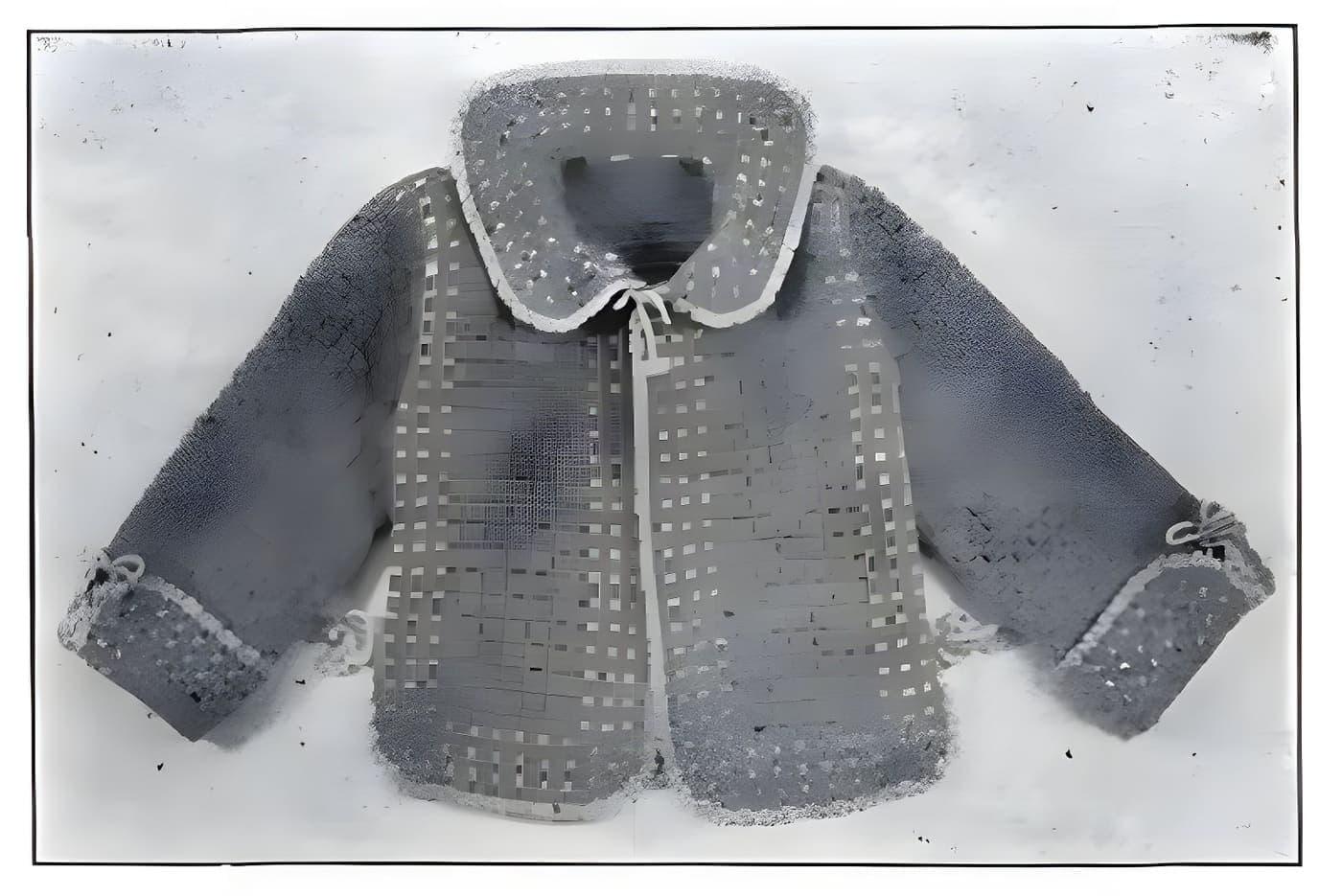
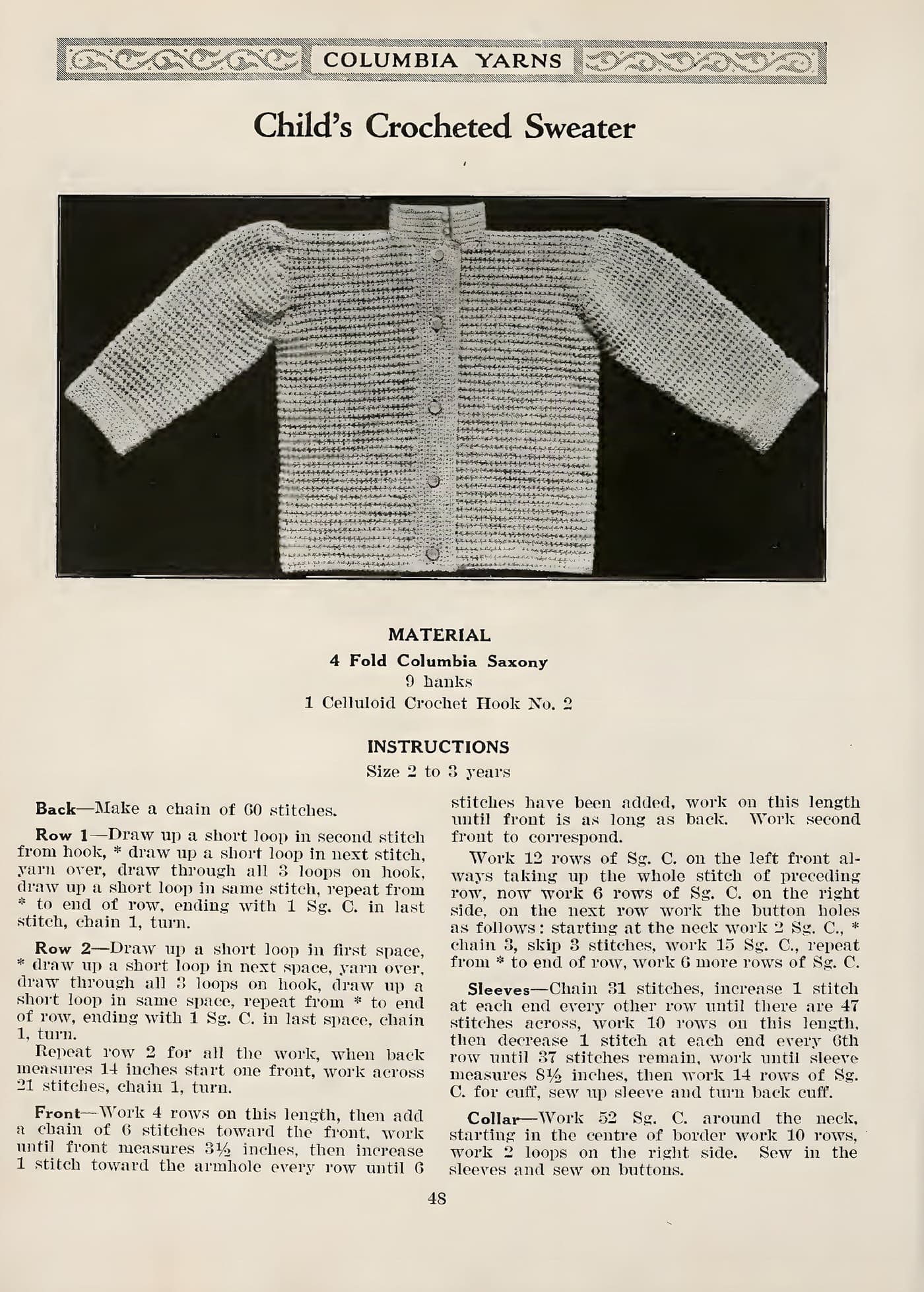
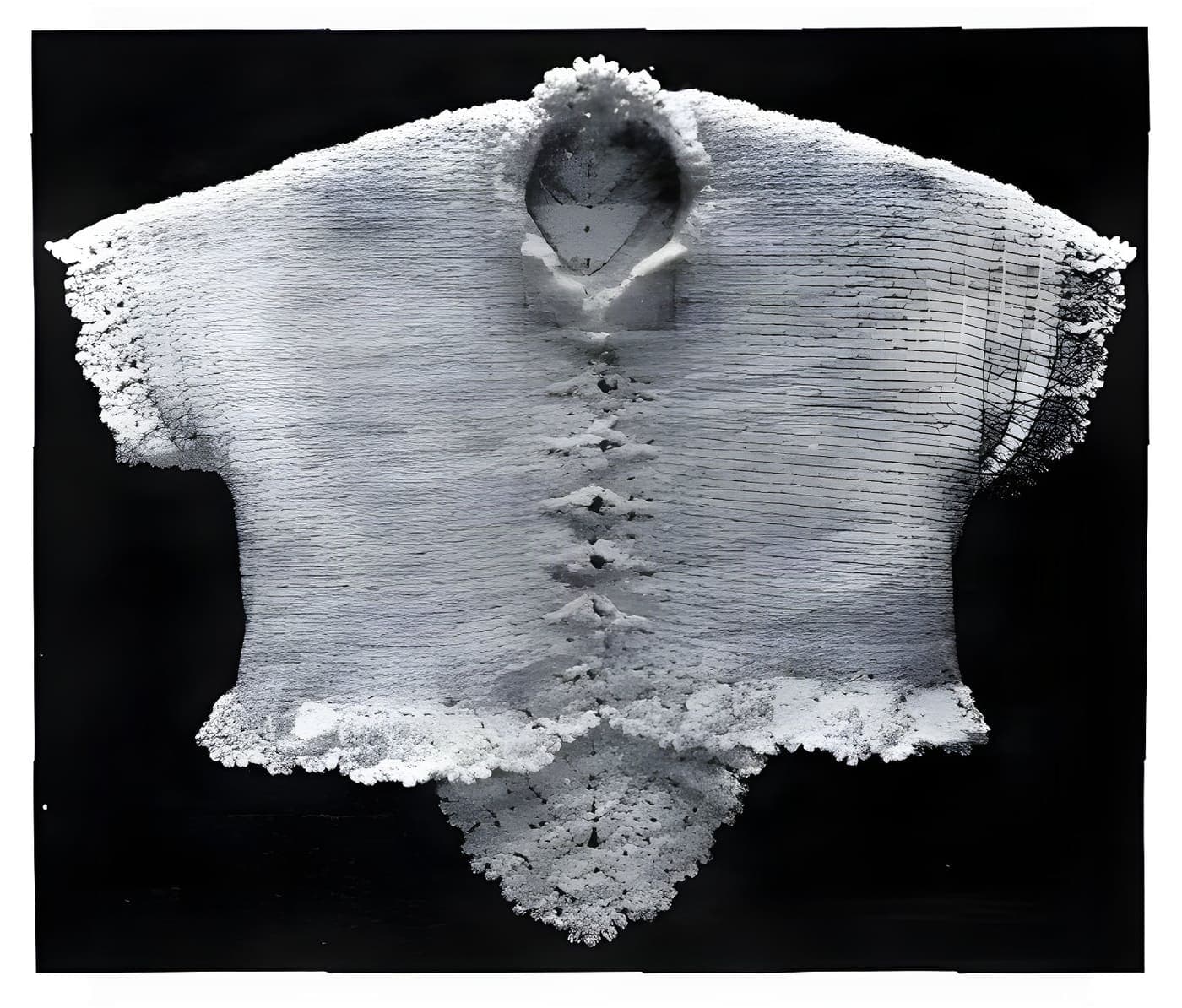
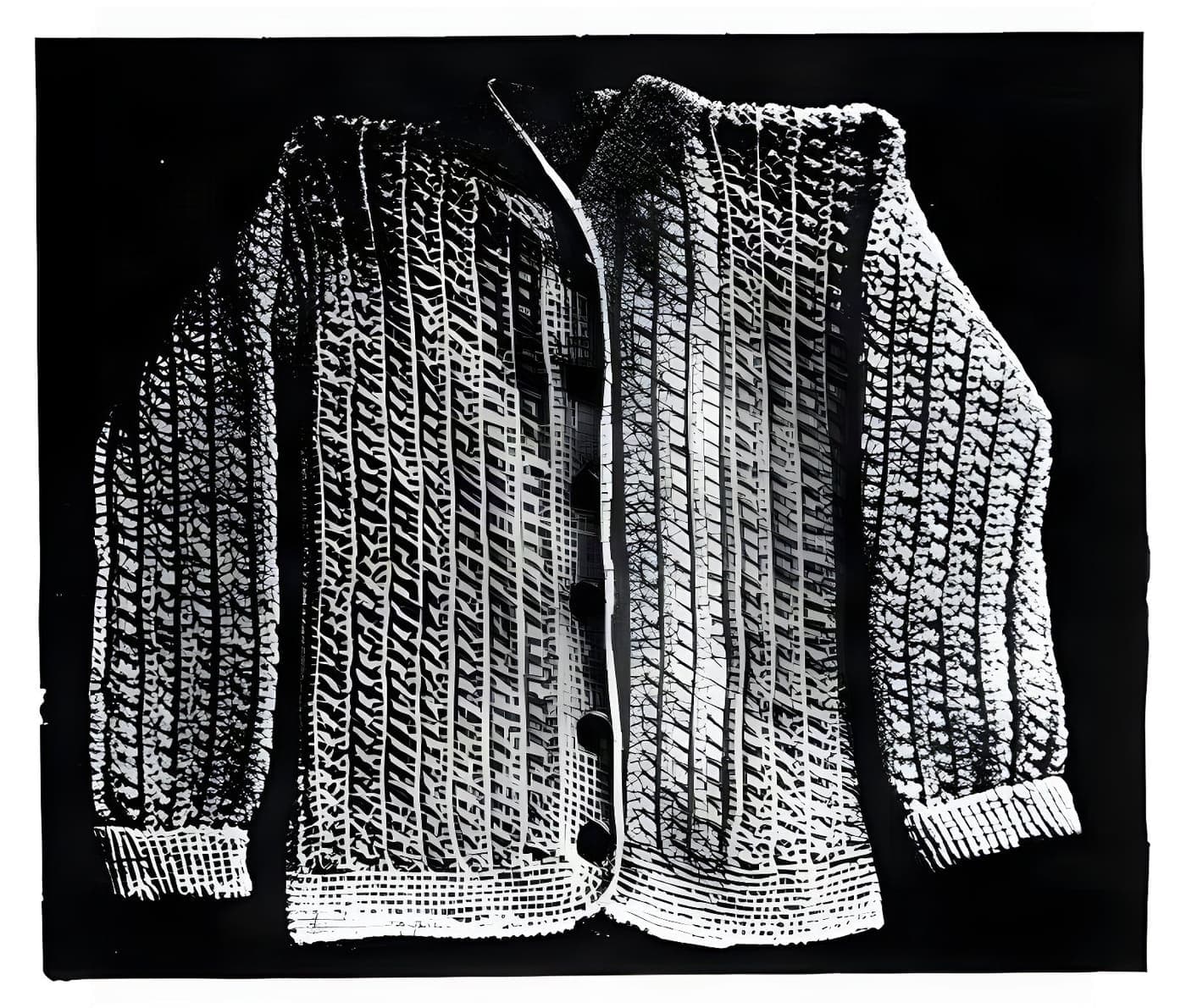
A child's cardigan crocheted lengthwise in two halves of star-stitch rows alternating with back-loop sc ribs, joined at the center back and underarms, with a mitred 10-row sc border carrying the buttonholes, star-stitch sleeves and turned-back sc cuffs. Originally published as "Child's Coat Sweater" in Handbook of Wool Knitting and Crochet by Needlecraft Publishing Company, Augusta, Maine in.
By the crochetpatterns.io editorial team · Updated · Editorial policy · pattern testing in progress
| Detail | Value |
|---|---|
| Skill level | Intermediate |
| Yarn weight | Light (#3) |
| Yardage | the book gives no quantity for this design. (as printed; yardage not given) |
| Hook | 4 mm |
| Gauge | No stitch gauge or finished measurements printed; compare a swatch of star-stitch rows and ribs with a child's sweater that fits. |
| Finished size | Child's size (age not printed). Foundation chain 160 per half; no finished measurements printed. The book says it can be enlarged by a longer chain and more rows. |
| Time | about 8 hours |
Materials
- Light (CYC #3) wool yarn — the original was Germantown wool, cream-white or any color (quantity not printed)
- Crochet hook (original: bone hook size 4)
- Buttons to suit the garment
- Tapestry needle
- Hook: Start with 4 mm (US G-6) — approximate, as the 1918 "size 4" bone hook has no printed diameter; change size to fit (no gauge is printed)
Yarn Kit & Substitution Options
This pattern calls for 350 yards of weight #3 yarn. Select a suggested yarn to see required skeins and estimated cost:
Caron Simply Soft Light · 100% Premium Acrylic
330 yds per skein · Gentle sheen, ultra soft against skin
2 skeins required
approx. $$11.98 total
Abbreviations (US terms)
- chain
- single crochet
- skip
- stitch
- stitches
- repeat
- row
- round
- increase
- yarn over
- loop
- back loop only
- slip stitch
- right side
- wrong side
Notes before you start
- Source: "Child's Coat Sweater", Handbook of Wool Knitting and Crochet, Needlecraft Publishing Company, Augusta, Maine, 1918. Public domain in the USA.
- As printed — materials: Use Germantown wool, cream-white or any color desired, and bone hook size 4, or a hook large enough to carry the wool easily.. Gauge: Not given.
- Modernisation note: Stitches converted by the book's own definitions ("A Lesson in Crochet"), not by name. The book uses the older names it calls "in general use", which are one step taller in name than modern US terms: its single crochet ("insert hook in work, take up the thread and draw it through the work and the stitch on the needle at the same time") = modern US sl st; its double (draw through, "giving you two stitches on the needle; take up thread and draw through the two") = sc; half-treble or short-treble = hdc; treble (thread over, insert, draw through, then through two loops twice) = dc; double-treble (thread over twice) = tr; triple-treble (thread over three times) = dtr. Its slip-stitch (drop the loop, insert the hook where you wish to join, pull the dropped loop through) is a joining stitch and is written as "join" or sl st. So every "double" in the original is written here as sc and every "treble" as dc.
- Modernisation note: The book's turning rule ("one chain-stitch corresponds to a double, two chain-stitches to a half or short treble, three chain to a treble") means ch 1 = sc height and ch 3 = dc height in modern terms. Turning chains are kept exactly as printed, even where they do not follow that rule.
- Modernisation note: Period wording modernised: "miss" written as sk; "widen" as inc; "narrow" as dec; "vein" of a stitch as loop ("back vein" = back loop only, "both veins" = both loops); "take up thread/wool" and "over" as yo; "needle" (the crochet hook) as hook; "wool"/"thread" as yarn; "fasten in" as join yarn; "break and fasten wool" as fasten off; "fasten"/"catch" (to a stitch) as sl st; "armscye" as armhole; "repeat" as rep; numbered rows written as Row/Rnd n.
- Modernisation note: Long printed paragraphs split into one row, round or step per line; stitch order and counts unchanged. Section headings added for navigation.
- Modernisation note: The book gives almost no hook sizes (one design names "bone hook size 4"); otherwise it says to use a hook "large enough to carry the yarn", and explains that "no two manufacturers use like numbers for the same sizes". The modern hook given is an approximate starting point for the yarn weight only.
- Modernisation note: No stitch gauge is printed for any crocheted design in the book; work a swatch and match any printed lengths (given in the modern gauge line) before starting.
- Modernisation note: 1918 yarn names have no exact modern equivalent. Approximate modern CYC weights used: fourfold (4-fold) Germantown wool/zephyr/worsted as light (CYC #3); knitting-worsted as medium (CYC #4); Shetland floss (a soft, lofty yarn) as fine (CYC #2); 2-fold Shetland zephyr as fine (CYC #2); Saxony as super fine (CYC #1); eiderdown wool and "very heavy Germantown worsted" as medium (CYC #4); Angora wool is a fluffy trim yarn used with worsted. The book gives skeins, hanks or balls only — never yardage or skein weight — so no yardage is given.
- Modernisation note: Sizes are given only loosely (e.g. "child", "three years"); vintage sizing and ease differ from today's — compare the printed lengths with a garment that fits before starting.
- Modernisation note: "Rib" is the book's word for two rows of back-loop sc ("working across twice"); it is kept.
- Modernisation note: "Perpendicular loop" written as "vertical lp".
- Modernisation note: "Join ... with single crochet" converted by the book's own definition (single crochet = modern sl st).
- Modernisation note: Check: the book does not say at which edge the shorter rows of 39 stars sit; presumably they run from the lower edge, leaving the upper part of the strip plain for the armhole. Left as printed.
- Modernisation note: Check: Row 1 prints no skipped chain before the first sc. Left as printed.
Row progress: 0 of 9 done (0%)
Body (make 2 halves, worked lengthwise)
0 of 9 done- The sweater is crocheted lengthwise in two parts and joined at the center of the back.Mark row complete
- Foundation: Ch 160, turn.Mark row complete
- Row 1: Sc in each ch, ch 1, turn.Mark row complete
- Row 2: Sc in each sc, working in the back loop only to form a rib.Mark row complete
- Row 3 (star stitch): Ch 3, draw up a lp through the 2nd and 3rd ch from the hook and a lp through each of 2 sc; yo and draw through the 5 lps on the hook, ch 1 to close the star; *draw up a lp through the eye of the star just made (under the ch 1), another through the back of the last vertical lp of the same star, and a lp through each of 2 sc; close the star by working off all the lps, ch 1; rep from * to end of row, turn.Mark row complete
- Make another rib of sc by working across twice, then a row of star stitches; continue until there are 4 rows of stars and 5 ribs.Mark row complete
- Next row: Work 39 stars, then a rib; continue until there are 3 rows of 39 star stitches each.Mark row complete
- Work a row of sc; fasten off securely.Mark row complete
- Note: All star-stitch rows must be worked on the right side. The first comes so, but the second will not unless the yarn is fastened off at the end of the 2nd rib and joined again at the other end; then ch 3 and proceed with the row.Mark row complete
Working on:
The sweater is crocheted lengthwise in two parts and joined at the center of the back.
Continue this pattern
The rest of the Child's Coat Sweater in Star Stitch (1918) pattern is in the Vintage Crochet Fashion
Still to come in the full pattern:
- Front Neck Shaping
- Joining
- Border
- Sleeves (make 2)
- Cuffs
- Finishing
Included with 71 patterns for $15 — $0.21 per pattern.
Errata
No corrections have been published for this pattern. Found a mistake? Tell us and we will log the fix here with a date.
Your notes on this pattern
Keep track of the yarn, hook and changes you used. Saved in this browser only — nobody else can see it.
Frequently asked questions
Where is the Child's Coat Sweater pattern from?
It was published as "Child's Coat Sweater" in Handbook of Wool Knitting and Crochet by Needlecraft Publishing Company, Augusta, Maine in 1918. The publication is in the public domain in the United States; this version is transcribed and modernised by crochetpatterns.io.
What yarn or thread do I need for the Child's Coat Sweater?
light (#3) yarn. Not printed — the book gives no quantity for this design.
What hook should I use?
Start with 4 mm (US G-6) — approximate, as the 1918 "size 4" bone hook has no printed diameter; change size to fit (no gauge is printed) Gauge: No stitch gauge or finished measurements printed; compare a swatch of star-stitch rows and ribs with a child's sweater that fits.