Free preview · full pattern in the Vintage Crochet Hats, Bags & Accessories
Russian Bag in Filet Blocks and Shell Points (1912): vintage crochet pattern
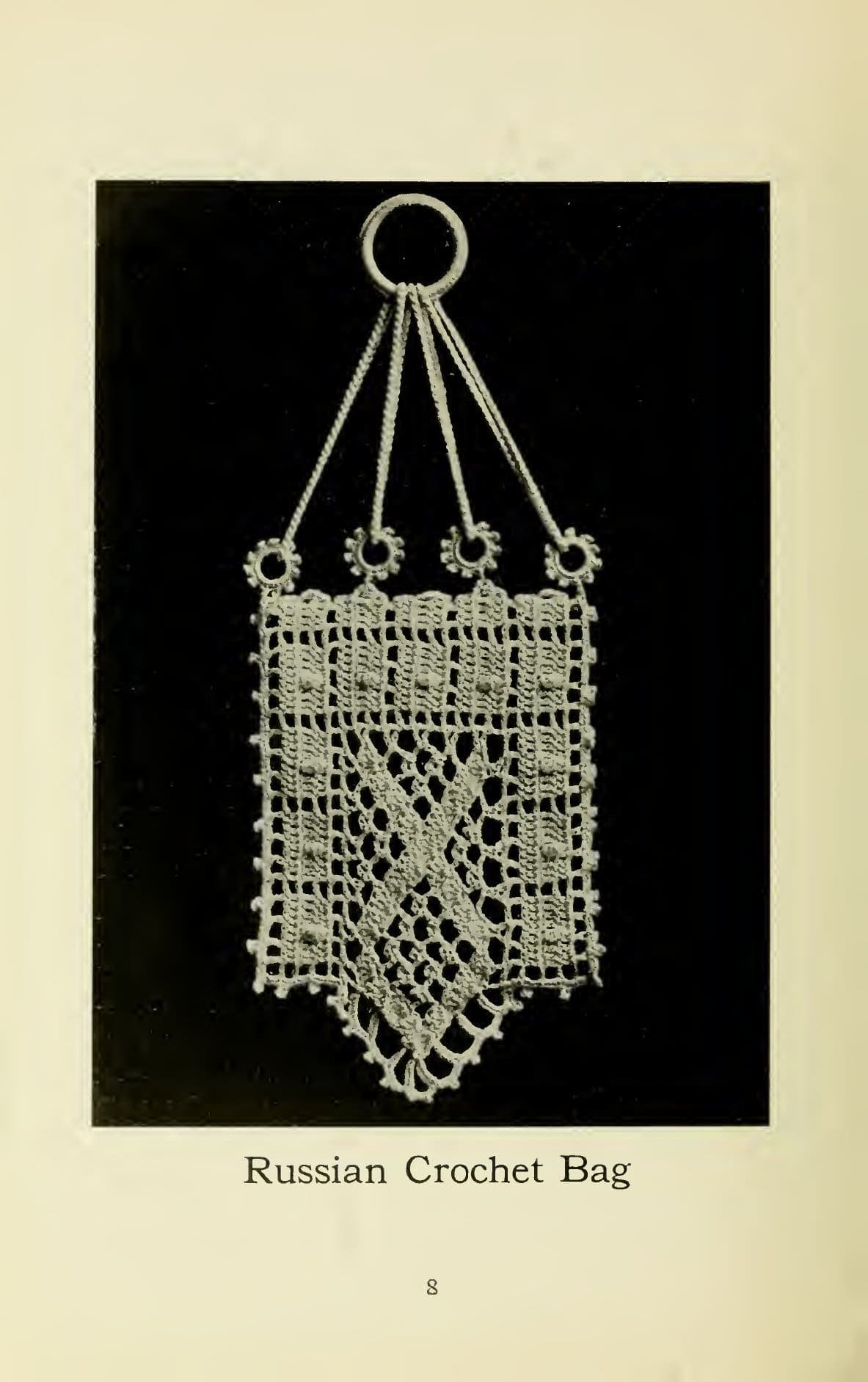
A flat bag worked from a long foundation chain: a band of filet spaces and solid blocks with long treble clusters, then a panel of shells, chain-5 picot loops and crossed trebles that narrows to a point at each side, finished with a chained cord run through four small covered rings and a large covered ring.
By the crochetpatterns.io editorial team · Updated · Editorial policy · pattern testing in progress
| Detail | Value |
|---|---|
| Skill level | Advanced |
| Yarn weight | Lace (#0) |
| Yardage | Not printed. The book gives balls, skeins, cards or pieces only, and their weight and yardage are not stated. (as printed; yardage not given) |
| Hook | 2.25 mm |
| Gauge | No gauge printed. |
| Finished size | No finished measurement is printed for this design. |
| Time | about 8 hours |
Materials
- Size 3 pearl cotton — approximate; the original was 1 skein of Perle cotton No. 3
- Steel crochet hook (original: Star crochet hook No. 2)
- 1 ring 2 in (5 cm) across and 4 rings 3/4 in (19 mm) across, to cover with single crochet (the original were bone)
- Lining fabric and featherbone for the hem and centre (see finishing)
- Sewing thread and needle
- Hook: Start with 2.25 mm (US steel 2) — approximate; change size until the filet blocks lie flat
Yarn Kit & Substitution Options
This pattern calls for 350 yards of weight #0 yarn. Select a suggested yarn to see required skeins and estimated cost:
Caron Simply Soft · 100% Acrylic
315 yds per skein · High-yield yardage, silky no-scratch texture
2 skeins required
approx. $$10.98 total
Abbreviations (US terms)
- chain
- slip stitch
- single crochet
- double crochet
- treble crochet
- stitch
- stitches
- row
- repeat
- skip
- space
- loop
- cluster
Notes before you start
- Source: "Russian Bag", The Glossilla Book of Crochet Novelties, Bernhard Ulmann & Co., New York City, 1912. Public domain in the USA.
- As printed — materials: 1 skein Perle cotton, No. 3; 1 Star crochet hook, No. 2; 1 bone ring, 2 inches in diameter; 4 bone rings, 3/4 inch in diameter. Gauge: Not given.
- Modernisation note: Stitches are converted by this book's own key ("DESCRIPTION OF STITCHES — TERMS USED", book pages 3-6; the designs themselves cite it as "see page 3", "see page 4", "see page 5"), not by name. The printed table is: "ch. … chain stitch; s. c. … single crochet; d. c. … double crochet; t. c. … treble crochet; * a sign of a repetition to begin at that point." The worked definitions show that this 1912 book already uses modern US heights: its single crochet ("frequently known as half stitch") is worked by inserting the hook in the second chain from the hook, drawing the thread through, then thread over and through the 2 loops on the hook — the modern US single crochet; its double crochet ("known by many as 'plains'") is thread over, hook into the fourth chain from the hook, draw a loop through (3 loops on the hook), then thread over and through 2 loops twice — the modern US double crochet; its treble crochet is the same "only winding the thread on the needle twice instead of once", worked off two at a time three times — the modern US treble; and its "long treble crochet" wraps the thread three or four times — the modern US double treble or triple treble. So throughout this transcription the book's s. c. = sc, d. c. = dc, t. c./tr. c. = tr, and long treble = dtr. No stitch changes height.
- Modernisation note: The asterisk is the book's own: "a sign of a repetition to begin at that point" (stitch key, book page 3). Repeat counts are kept exactly as printed — "repeat from * 4 times" is transcribed as printed and not re-counted.
- Modernisation note: Period wording modernised: "needle" (used for the crochet hook) written as hook; "thread over (the needle)" as yo; "pick up a loop"/"draw up a loop" kept; "catch" (with a slip stitch) as join or sl st as the sense requires; "skip" as sk; "taking up the back thread only" as "in the back loop only"; "taking up both threads" as "under both loops"; "widen"/"narrow" as increase/decrease; "fasten off" kept; spaced abbreviations s. c., d. c., t. c./tr. c., sl. st., ch. written sc, dc, tr, sl st, ch. Ordinal row and round names ("Second row", "Eleventh round") written Row 2, Rnd 11.
- Modernisation note: Long printed paragraphs are split into one row, round or step per line; stitch order and counts are unchanged. Section headings added for navigation where the printed text runs on.
- Modernisation note: The materials are Bernhard Ulmann trade names of 1912 and have no exact modern equivalent; every modern substitution given here is an approximation. The book's own materials page describes them: "Glossilla Crochet" — "used where the highest lustre is required, even superior to silk"; "Solitaire Yarn" — "the most lustrous ball cotton yarn … in a large assortment of colors"; "Klondyke Thread" — "a soft metal thread for crocheting … in a rich, bright, gold color; furthermore, in aluminum, antique gold and antique silver"; "Handicraft Macrame" and "Bear Macrame" cords; "D. M. C. Cordonnet, in numbers 3 to 30" and "D. M. C. Perle, numbers 3 and 5". Bear Brand wools (Shetland floss, Zephyr Shetland, Saxony 3-fold, 4-fold Germantown) are the publisher's knitting yarns; their weights are not printed, and the CYC weights suggested here are read from how they are used, not from the book.
- Modernisation note: Hooks are printed only as "Star crochet hook No. …" (the steel hooks) or "bone"/"amber" hook numbers, with no diameters anywhere in the book, so no exact metric size can be read from it. The millimetre and US sizes suggested here are approximate starting points; the bone- and amber-hook numbers were never standardised, so those suggestions are ours. Work a swatch and change size until the work lies flat and matches the photograph.
- Modernisation note: No gauge is printed for this design, and none is printed anywhere in the book.
- Modernisation note: Check: the printed Row 2 reads "making g d. c. in the 3 spaces" in this copy; the count is 9 dc (1 dc on dc and 2 dc in the space, three times). Transcribed as 9 dc.
- Modernisation note: Check: the book says the cluster is not described again after Row 3 ("No further description of this cluster will be given"); it is repeated here only by name.
- Modernisation note: Check: no colour is printed for this design beyond the thread named in the materials.
- Modernisation note: Metric conversions added where a measurement is printed; the printed inches are unchanged.
Row progress: 0 of 5 done (0%)
Border of blocks and spaces
0 of 5 done- Row 1: Ch 116 and turn. 1 dc in the eighth ch from the hook, * ch 2, sk 2, 1 dc in the next ch; rep from * to the end of the foundation ch — 37 spaces. Ch 5 and turn.Mark row complete
- Row 2: * 1 dc on dc, 2 dc in the space; rep twice more from * , making 9 dc over the 3 spaces, ch 2, sk one space; rep from * , ending the row with 1 dc. Ch 5 and turn.Mark row complete
- Row 3: * 1 dc in each of the first 4 dc, worked under both loops of the stitch of the preceding row, 1 long treble cluster around the post of the fifth stitch of the previous row, made as follows: thread over twice, pick up a loop, over and through 2, over and through 2, over and pick up another loop around the same stitch, over and through 2, over and pick up a third loop around the same stitch (5 loops on the hook), over and through 2 and rep until one loop remains. 1 dc in each of the last 4 sts of the block, ch 2; rep from * to the end of the row. Ch 5 and turn. (No further description of this cluster is given in the book.)Mark row complete
- Row 4: * 9 dc on the 9 sts of the last row, ch 2; rep from * . Ch 5 and turn.Mark row complete
- Row 5: * 1 dc on the first dc, ch 2, sk 2, 1 dc, ch 2, sk 2, 1 dc, ch 2, sk 1, 1 dc in the last dc of the block, ch 2; rep from * in each block to the end of the row, forming 37 spaces in the row. Ch 5 and turn.Mark row complete
Working on:
Row 1: Ch 116 and turn. 1 dc in the eighth ch from the hook, * ch 2, sk 2, 1 dc in the next ch; rep from * to the end of the foundation ch — 37 spaces. Ch 5 and turn.
Continue this pattern
The rest of the Russian Bag in Filet Blocks and Shell Points (1912) pattern is in the Vintage Crochet Hats, Bags & Accessories
Still to come in the full pattern:
- Shell and picot panel
- Points and edging
- Rings and cord
- Finishing
Included with 202 patterns for $12 — $0.06 per pattern.
Errata
No corrections have been published for this pattern. Found a mistake? Tell us and we will log the fix here with a date.
Your notes on this pattern
Keep track of the yarn, hook and changes you used. Saved in this browser only — nobody else can see it.
Frequently asked questions
Where is the Russian Bag pattern from?
It was published as "Russian Bag" in The Glossilla Book of Crochet Novelties by Bernhard Ulmann & Co., New York City in 1912. The publication is in the public domain in the United States; this version is transcribed and modernised by crochetpatterns.io.
What yarn or thread do I need for the Russian Bag?
Size 3 pearl cotton. Not printed. The book gives balls, skeins, cards or pieces only, and their weight and yardage are not stated.
What hook should I use?
Start with 2.25 mm (US steel 2) — approximate; change size until the filet blocks lie flat Gauge: No gauge printed.