Free preview · full pattern in the Vintage Crochet Baby & Kids' Patterns
Infant's Crocheted Hood in Star Stitch (1916): vintage crochet pattern
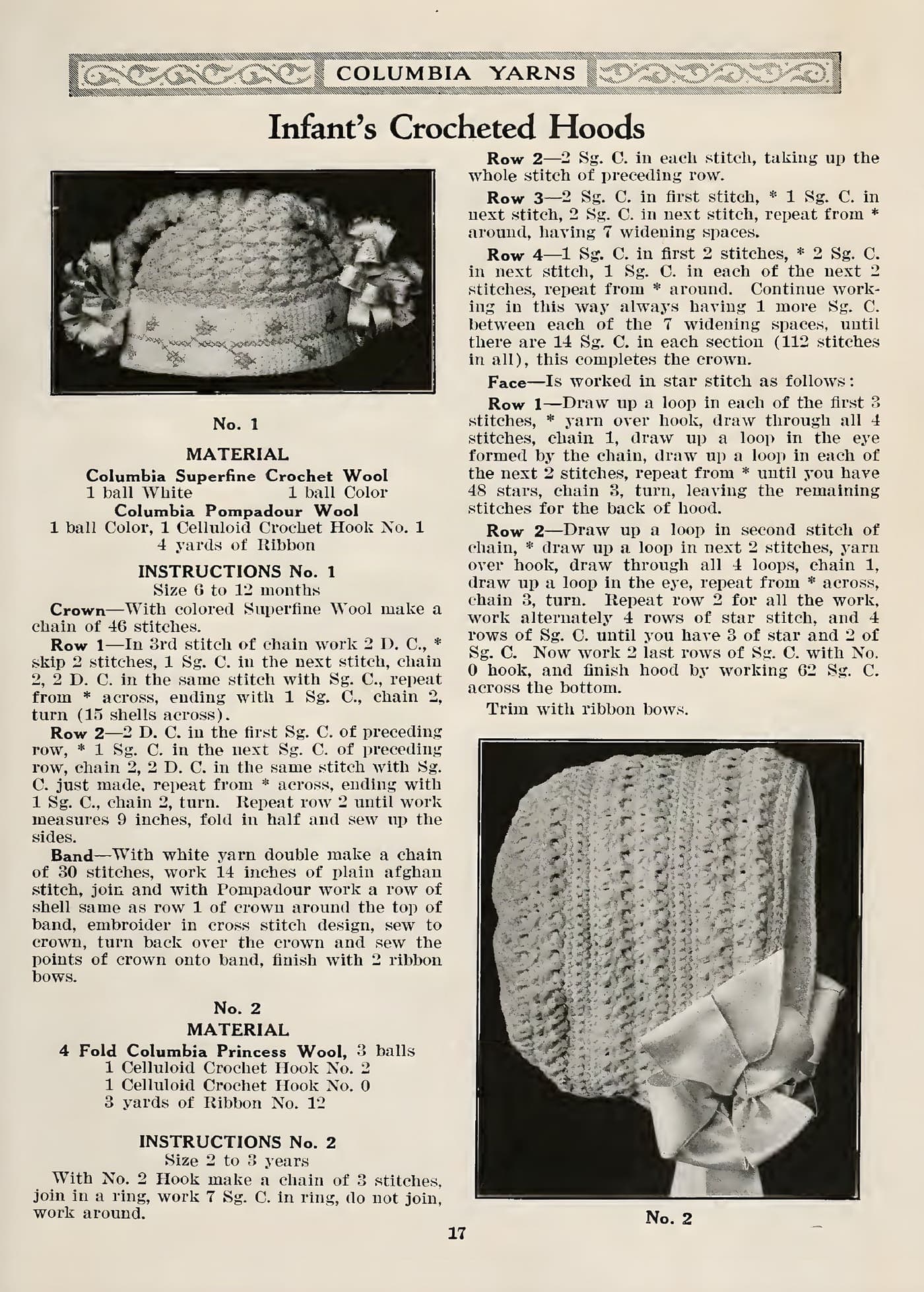
A hood begun at the centre of the crown: single crochet worked round from a chain-3 ring with seven widening points until there are 112 stitches, then the face worked back and forth over 48 stars in the book's star stitch, alternating four rows of star with four rows of single crochet.
By the crochetpatterns.io editorial team · Updated · Editorial policy · pattern testing in progress
| Detail | Value |
|---|---|
| Skill level | Intermediate |
| Yarn weight | Fine (#2) |
| Yardage | the book gives balls only, and no ball weight or length. (as printed; yardage not given) |
| Hook | 3.5 mm |
| Gauge | No stitch gauge printed. Printed check: the crown is finished when there are 14 sc in each of the 7 sections, 112 sts in all. |
| Finished size | Size 2 to 3 years, as printed. No finished measurement is printed; the crown is counted instead — 14 sc in each of 7 sections, 112 sts in all. |
| Time | about 4 hours |
Materials
- Fine (CYC #2) wool yarn, 3 balls — the original was 4 Fold Columbia Princess Wool (ball weight not printed)
- Crochet hooks in two sizes (original: Celluloid No. 2 for the hood, No. 0 for the last two rows)
- 3 yd (2.7 m) ribbon (original: No. 12)
- Tapestry needle for the ends
- Hook: Start with 3.5 mm (US E-4) for the hood and a smaller hook, about 2.75 mm (US C-2), for the last two rows as the book directs; change size to suit the yarn (no gauge is printed)
Yarn Kit & Substitution Options
This pattern calls for 350 yards of weight #2 yarn. Select a suggested yarn to see required skeins and estimated cost:
Lion Brand Coboo · 50% Cotton, 50% Bamboo
232 yds per skein · Silky breathable drape, lovely stitch shine
2 skeins required
approx. $$12.98 total
Abbreviations (US terms)
- chain
- single crochet
- stitch
- stitches
- repeat
- row
- round
- increase
- loop
- yarn over
Notes before you start
- Source: "Infant's Crocheted Hoods — Instructions No. 2", The Columbia Book of Yarns, containing a Manual of Knitting and Crocheting (Seventeenth Edition), by Anna Schumacker, Wm. H. Horstmann Company, Philadelphia — the manufacturers of Columbia Yarns, 1916. Public domain in the USA.
- As printed — materials: 4 Fold Columbia Princess Wool, 3 balls; 1 Celluloid Crochet Hook No. 2; 1 Celluloid Crochet Hook No. 0; 3 yards of Ribbon No. 12. Gauge: Not given.
- Modernisation note: Stitches are converted by this book's own key, not by name. The abbreviation list on book page 8 reads “Ch.—Chain stitch”, “Sl. St.—Slip a stitch”, “Sg. C.—Single crochet”, “D. C.—Double crochet”, “L. C.—Long crochet”, “T. C. or Tr. C.—Treble crochet”, “P.—Picot”, “C.—Crochet”, “Th. O.—Throw over”, and it points to book pages 11 and 12 for the working definitions. Those pages settle the naming: single crochet is “Insert hook, draw yarn through, pass yarn around the hook, and draw it through both loops on the hook” — the modern US single crochet, drawn off in one step, not a British double; double crochet is “Pass the yarn around the hook, insert the hook, draw yarn through; pass the yarn around the hook and draw yarn through 2 loops and again through 2” — one thread-over, the modern US double crochet; treble crochet is “Pass the yarn around the hook twice … draw through 2 loops, again through 2 loops, and again through 2” — the modern US treble. So this 1916 book is American naming that already matches modern US terms, and Sg. C., D. C. and T. C. are written sc, dc and tr here with no change of height. This is derived from the printed working definitions and wrap counts, not assumed from the publisher.
- Modernisation note: The book's own rule for asterisks is kept as printed: “Stars, thus * *, mean that the work described between them is to be repeated.” Where a design says “repeat from * across”, the repeat runs to the end of that row.
- Modernisation note: The book defines “Wrap—Means to throw yarn over needle”, and uses “yarn over hook” in the same sense; both are written yo.
- Modernisation note: Period wording is written in modern US form: “needle” (used for the crochet hook) = hook; “skip” = sk; “repeat from *” = rep from *; “break off yarn” = fasten off; “taking up the whole stitch” = working under both loops; “taking up the back loop” = blo; ordinal row names (“Row 2”, “2d row”, “3d row”) are written Row 2, Row 3. Stitch counts printed in the original are kept exactly as printed.
- Modernisation note: The printed paragraphs are split into one row, round or step per line; stitch order and counts are unchanged. Section headings in SMALL CAPS in the original (Instep, Sole, Band, Crown, Sleeves, Collar) are kept as section headings. Where the book runs several steps into one paragraph without numbering them, they are split onto separate lines and left unnumbered.
- Modernisation note: Hook numbers (bone, celluloid, amber, wood, rubber — No. 0 to No. 15) are Columbia's own 1916 scale. The book prints a “Columbia Gauge Card” on book page 7 showing the sizes, but the exact diameters are shown only as printed dots against each number, with no figures, so no millimetre size can be read out of the book. Every modern hook suggested here is ours, chosen for the yarn weight and not read off the card; the printed number is recorded in the original materials.
- Modernisation note: No stitch gauge is printed for this design — the book prints no gauge for any design. Its only advice is on book page 8: “We caution all Knitters and Crocheters who are inclined to knit or crochet tight to use a larger size needle or hook; and if loose a smaller size needle or hook; otherwise your garment will not work out in size according to instructions.” Work a swatch and change hook size until any printed measurement comes out right.
- Modernisation note: Columbia yarns are 1916 trade names with no exact modern equivalent, and the book prints hanks and balls without stating their weight or length, so no yardage can be given. The modern CYC weights below are approximations only: Columbia Saxony (2, 3 and 4 fold) was a soft fine wool, treated here as fine (CYC #2) in 2 and 3 fold and light (CYC #3) in 4 fold; Superfine Crochet Wool and Pompadour Wool as super fine to fine (CYC #1–2); Princess Wool and Lady Jane as fine (CYC #2); Columbia Floss as fine (CYC #2); 4 Fold Germantown, and its Imported version, as medium worsted (CYC #4).
- Modernisation note: The book names its colours in words only (White, Pink, Wisteria, Oregon Green, Black, Rose Antique Nos. 1, 3 and 5) and its plates are black-and-white halftones, so no printed colour value exists. Every hex below is ours, a plain reading of the period colour name, and is not taken from the book.
- Modernisation note: Ribbon numbers (No. 2, No. 3, No. 5, No. 9, No. 12) are the 1916 trade widths and are kept as printed. No width in inches or millimetres is printed for any of them, so none is given here.
- Modernisation note: Metric conversions added; the inch measurements are the book's own.
- Modernisation note: Star stitch is written out from the book's own directions at the point of use, which is the only place the book defines it for this hood; “the eye formed by the chain” is the book's own phrase and is kept.
- Modernisation note: Check: Row 1 of the crown makes 7 sc in the ring and the book says “do not join, work around”, so the crown is worked in a continuous spiral even though the book calls its rounds rows. The book's word “row” is kept.
- Modernisation note: The book prints no colour for this hood — the materials give only the yarn and a ball count.
Row progress: 0 of 5 done (0%)
Crown
0 of 5 done- With the No. 2 hook, ch 3 and join in a ring. Work 7 sc in the ring. Do not join — work around.Mark row complete
- Row 2: 2 sc in each st, working under both loops of the preceding row.Mark row complete
- Row 3: 2 sc in the first st, *1 sc in the next st, 2 sc in the next st; rep from * around, having 7 widening points.Mark row complete
- Row 4: 1 sc in each of the first 2 sts, *2 sc in the next st, 1 sc in each of the next 2 sts; rep from * around.Mark row complete
- Continue in this way, always having 1 more sc between each of the 7 widening points, until there are 14 sc in each section (112 sts in all). This completes the crown.Mark row complete
Working on:
With the No. 2 hook, ch 3 and join in a ring. Work 7 sc in the ring. Do not join — work around.
Continue this pattern
The rest of the Infant's Crocheted Hood in Star Stitch (1916) pattern is in the Vintage Crochet Baby & Kids' Patterns
Still to come in the full pattern:
- Face — worked in star stitch
- Finishing
Included with 133 patterns for $12 — $0.09 per pattern.
Errata
No corrections have been published for this pattern. Found a mistake? Tell us and we will log the fix here with a date.
Your notes on this pattern
Keep track of the yarn, hook and changes you used. Saved in this browser only — nobody else can see it.
Frequently asked questions
Where is the Infant's Crocheted Hoods — Instructions No. 2 pattern from?
It was published as "Infant's Crocheted Hoods — Instructions No. 2" in The Columbia Book of Yarns, containing a Manual of Knitting and Crocheting (Seventeenth Edition), by Anna Schumacker by Wm. H. Horstmann Company, Philadelphia — the manufacturers of Columbia Yarns in 1916. The publication is in the public domain in the United States; this version is transcribed and modernised by crochetpatterns.io.
What yarn or thread do I need for the Infant's Crocheted Hoods — Instructions No. 2?
fine (#2) yarn. Not printed — the book gives balls only, and no ball weight or length.
What hook should I use?
Start with 3.5 mm (US E-4) for the hood and a smaller hook, about 2.75 mm (US C-2), for the last two rows as the book directs; change size to suit the yarn (no gauge is printed) Gauge: No stitch gauge printed. Printed check: the crown is finished when there are 14 sc in each of the 7 sections, 112 sts in all.