Free preview · full pattern in the Vintage Crochet Edgings & Trims
Chain with Balls in Winding Stitches (1916): vintage crochet pattern
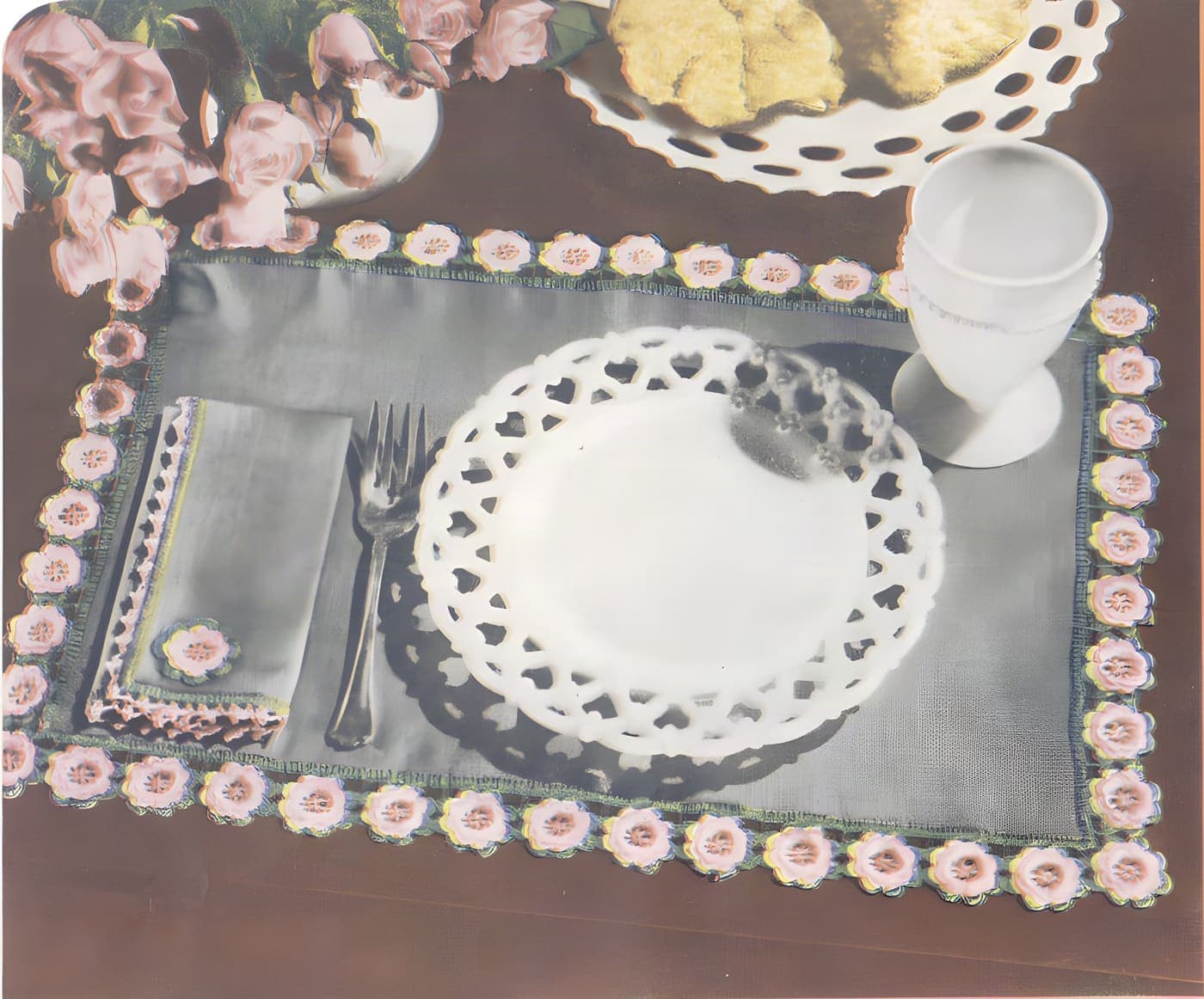
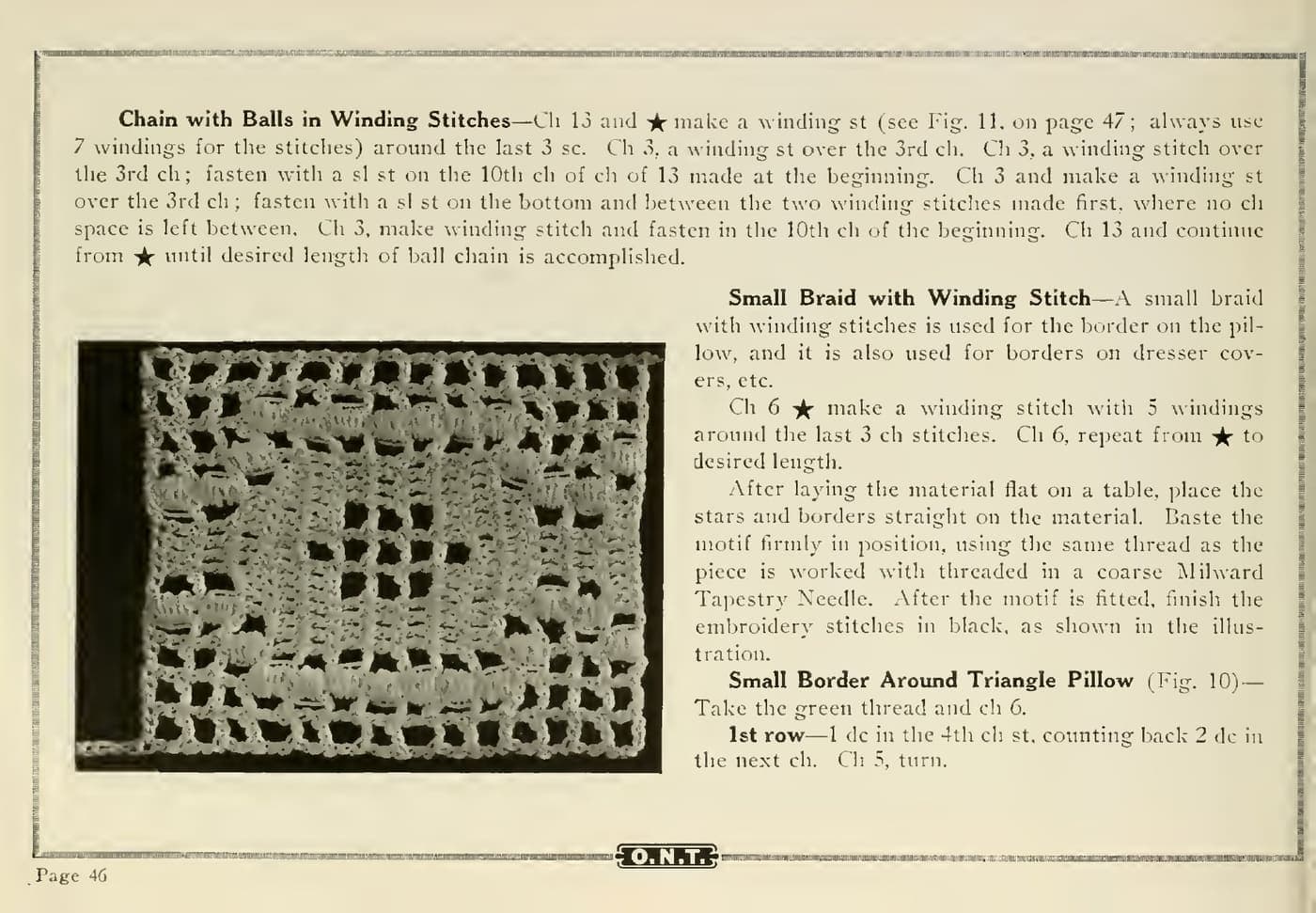
A narrow applied braid: a long chain with a cluster of winding stitches gathered back into it at intervals, so the strip reads as a plain chain carrying a small wound ball at each repeat. Originally published as "Chain with Balls in Winding Stitches" in Clark's O. N. T. Book of Needlework by The Clark Thread Company, Newark.
By the crochetpatterns.io editorial team · Updated · Editorial policy · pattern testing in progress
| Detail | Value |
|---|---|
| Skill level | Intermediate |
| Yarn weight | Lace (#0) |
| Yardage | the book gives only the ball size. (as printed; yardage not given) |
| Hook | 2.25 mm |
| Gauge | No gauge printed. |
| Finished size | Not printed. Worked to the length wanted. |
| Time | about 2 hours |
Materials
- Size 3 pearl cotton — approximate; the original was Clark's O. N. T. Pearl Cotton, No. 3, large balls
- Steel or fine aluminium crochet hook
- Coarse tapestry needle, for sewing the motif down
- Hook: Start with about 2.25 mm (US steel B-1/1) — approximate and ours, not printed. Change size until the work lies flat.
Yarn Kit & Substitution Options
This pattern calls for 350 yards of weight #0 yarn. Select a suggested yarn to see required skeins and estimated cost:
Caron Simply Soft · 100% Acrylic
315 yds per skein · High-yield yardage, silky no-scratch texture
2 skeins required
approx. $$10.98 total
Abbreviations (US terms)
- chain
- slip stitch
- stitch
- stitches
- repeat
- loop
Notes before you start
- Source: "Chain with Balls in Winding Stitches", Clark's O. N. T. Book of Needlework, The Clark Thread Company, Newark, New Jersey, 1916. Public domain in the USA.
- As printed — materials: Clark's O. N. T. Pearl Cotton, No. 3, large balls; Milward's Crochet Hook, No. 3; Colors as printed for the library set: 1130 Dark Olive Green, 1184 Russet, and Black; Coarse Milward Tapestry Needle No. 1, for sewing the motif to the ground. Gauge: Not given.
- Modernisation note: Stitches are converted by this book's own key, read for this book and not assumed from the brand or the year. The abbreviation list is printed on book page 41 under “Abbreviations Used in Crocheting” — “st = stitch; ch = chain stitch; sl st = slip stitch; sc = single crochet; dc = double crochet; tr c = treble crochet; p = picot; d = dot; w st = wound stitch; m = meshes”, with a star that “Means to repeat directions printed between them as many times as stated in each case.” The stitches are then defined in words on book page 42: Single Crochet — “Insert the hook in the foundation chain and draw thread through, catch thread around hook and draw through both loops on hook”, the modern US single crochet; Double Crochet — “Catch thread around hook, insert in chain, draw thread through; catch thread around hook, draw through two loops, thread around hook and draw through last two loops. Always start a d c row with 3 ch in place of the first dc”, the modern US DOUBLE crochet; Treble Crochet — “The treble crochet is made similarly to the double crochet. Start with 4 ch and take thread twice over needle, drawing three times through two”, the modern US treble. So this 1916 book uses modern US heights and no re-lettering is needed: its dc is written dc and its tr c is written tr. This matters because the same firm's 1923 Book No. 19 does the opposite, printing “D c” for a modern half double and “Tr” for a modern double; the two books were checked separately and do not agree.
- Modernisation note: The book's wording is written in modern US form: “needle” and “hook” both mean the hook and are written hook; “thread over needle” = yo; “skip” = sk; “catch”/“fasten” at the end of a circuit = sl st or join, according to what the row is doing; the book's star ★ is written * and “repeat from ★” = rep from *; tr c = tr; sh st = shell stitch. The OCR of this scan prints the ordinal “1st” as “Ist” and the letters c/e interchangeably in places (“de” for “dc”, “se” for “sc”); those quirks are kept in the excerpts and not in the rows.
- Modernisation note: The printed paragraphs are split into one row, round or step per line; stitch order and counts are unchanged. Section headings added for navigation. Ordinal row names (“1st row”, “2nd row”) are written Row 1, Row 2, and the book's word “row” is kept even where the work goes around, as the book itself does.
- Modernisation note: Clark's O. N. T. crochet cotton numbers are read as roughly equal to the modern crochet thread sizes of the same number — approximate only. The book's own Table of Cotton and Hook Sizes on book page 41 pairs Clark's O. N. T. Crochet Cotton Nos. 1, 3, 5, 10, 15, 20, 25, 30, 40, 50, 60, 70, 80 and 100 with Milward's Crochet Hooks Nos. 1 to 14 in that order, and that table is what ties each design's printed hook number to its printed thread.
- Modernisation note: The Milward's hook numbers printed here are 1916 maker's numbers and do not map onto the modern US steel scale, so any metric hook suggested below is ours, read across from the thread size and not printed in the book; the printed hook number is kept in the original materials. The book's own advice on page 41 is to test first: “it is wise to do a little experimenting with the cotton and needle in the sizes suggested in the directions in order to determine that the needle really is the correct size for each individual worker.”
- Modernisation note: No gauge is printed for this design. The book prints a stitch count per inch for its two filet yokes only, and those are the squared-diagram designs that are not transcribed here. Work a sample and change hook size until the work lies flat and matches the photograph.
- Modernisation note: No yardage is printed for this design. The book gives ball counts only for the baby jacket and cap, and no yardage anywhere, so none is estimated here.
- Modernisation note: Winding stitch (the key's “w st = wound stitch”) is the book's own, defined on book page 47: “First, make a foundation of either chain stitches or of double or treble crochet, as the pattern demands. Ch 3 stitches, ★ thread over needle, draw a loop underneath the ch st; thread over needle, draw loop again as described, and repeat from ★ 5 to 9 times, according to directions, then draw thread through all the loops at once. Do not work too tight or too loose. Hold the ch st with your left hand straight in working, and keep the hook of the needle downward.” The number of windings is taken from each design.
- Modernisation note: This design belongs to the book's Library Set, worked in O. N. T. Crochet Embroidery: crocheted motifs and braids made separately and then sewn onto a fabric ground. The book prints the ground for the set as golden brown burlap with the crochet and embroidery worked in green, brown and black.
- Modernisation note: No finished measurement is printed for this design.
- Modernisation note: Check: no colour is printed for this design. It photographs as a plain light thread, and the book's own O. N. T. Articles pages list Clark's O. N. T. crochet cottons in white and in colours.
- Modernisation note: Check: the book gives this braid's winding count in a parenthesis that the OCR splits across a line — “(see Fig. 11. on page 47; always use 7 windings for the stitches) around the last 3 sc”. Read from image p-052.jpg the count is 7 windings, and the parenthesis belongs to the first winding stitch of the repeat. The “3 sc” of the OCR is “3 ch” on the page.
- Modernisation note: Check: the printed paragraph runs on without row numbers. It is split here at each fastening point, which is where the directions themselves break; no step was added or removed.
Row progress: 0 of 7 done (0%)
Braid
0 of 7 done- Ch 13.Mark row complete
- *Make a winding stitch — always use 7 windings for the stitches of this braid — around the last ch-3.Mark row complete
- Ch 3, a winding stitch over the 3rd ch.Mark row complete
- Ch 3, a winding stitch over the 3rd ch; fasten with a sl st on the 10th ch of the ch-13 made at the beginning.Mark row complete
- Ch 3 and make a winding stitch over the 3rd ch; fasten with a sl st on the bottom and between the two winding stitches made first, where no chain space is left between.Mark row complete
- Ch 3, make a winding stitch and fasten in the 10th ch of the beginning.Mark row complete
- Ch 13 and continue from * until the desired length of ball chain is accomplished.Mark row complete
Working on:
Ch 13.
Continue this pattern
The rest of the Chain with Balls in Winding Stitches (1916) pattern is in the Vintage Crochet Edgings & Trims
Still to come in the full pattern:
- Finishing
Included with 618 patterns for $9 — $0.01 per pattern.
Errata
No corrections have been published for this pattern. Found a mistake? Tell us and we will log the fix here with a date.
Your notes on this pattern
Keep track of the yarn, hook and changes you used. Saved in this browser only — nobody else can see it.
Frequently asked questions
Where is the Chain with Balls in Winding Stitches pattern from?
It was published as "Chain with Balls in Winding Stitches" in Clark's O. N. T. Book of Needlework by The Clark Thread Company, Newark, New Jersey in 1916. The publication is in the public domain in the United States; this version is transcribed and modernised by crochetpatterns.io.
What yarn or thread do I need for the Chain with Balls in Winding Stitches?
Size 3 pearl cotton (approximate). Not printed — the book gives only the ball size.
What hook should I use?
Start with about 2.25 mm (US steel B-1/1) — approximate and ours, not printed. Change size until the work lies flat. Gauge: No gauge printed.