Free preview · full pattern in the Heirloom Doilies & Tablecloths
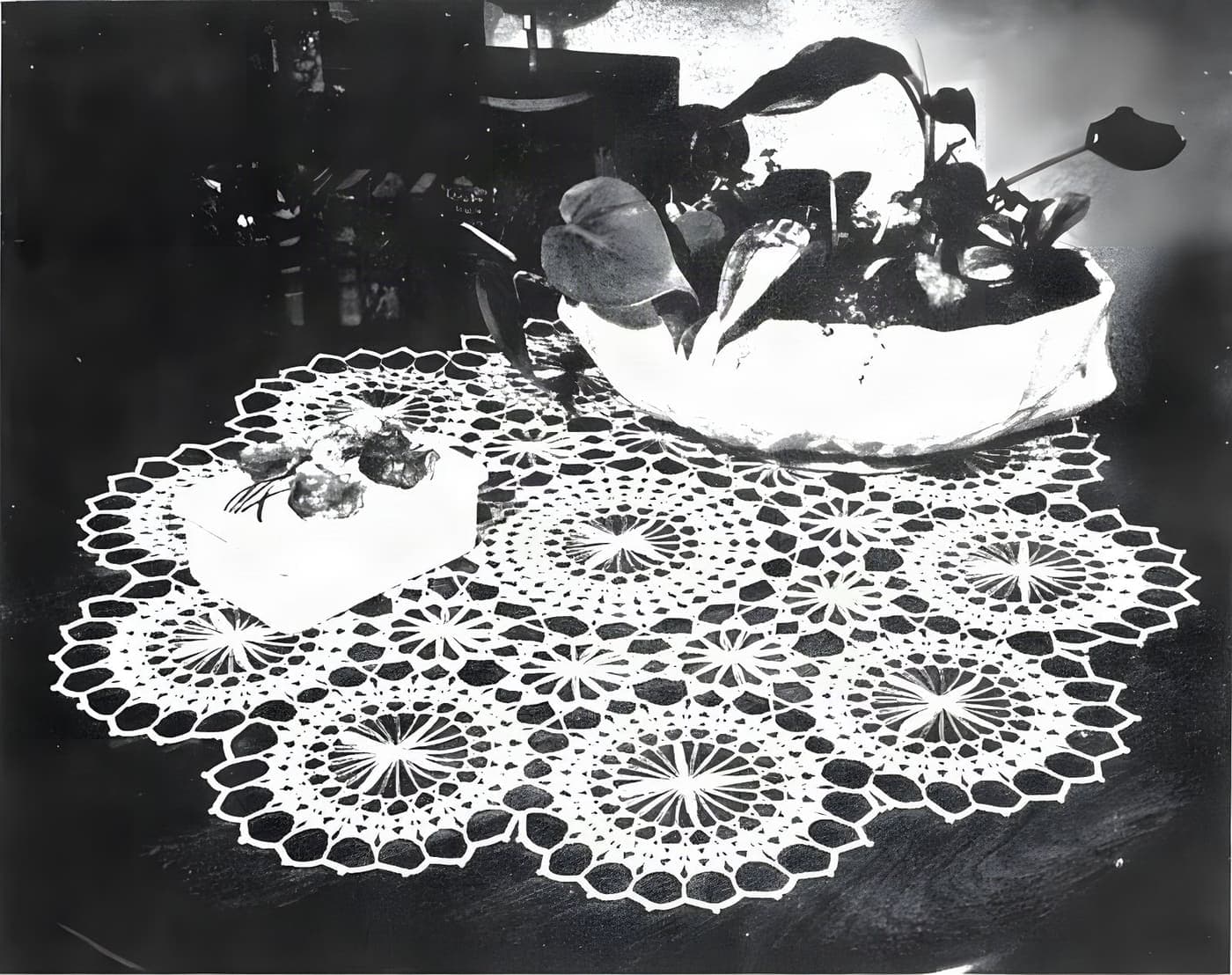
Spoke and Scallop Centerpiece, Plate 5 (1915): vintage crochet pattern
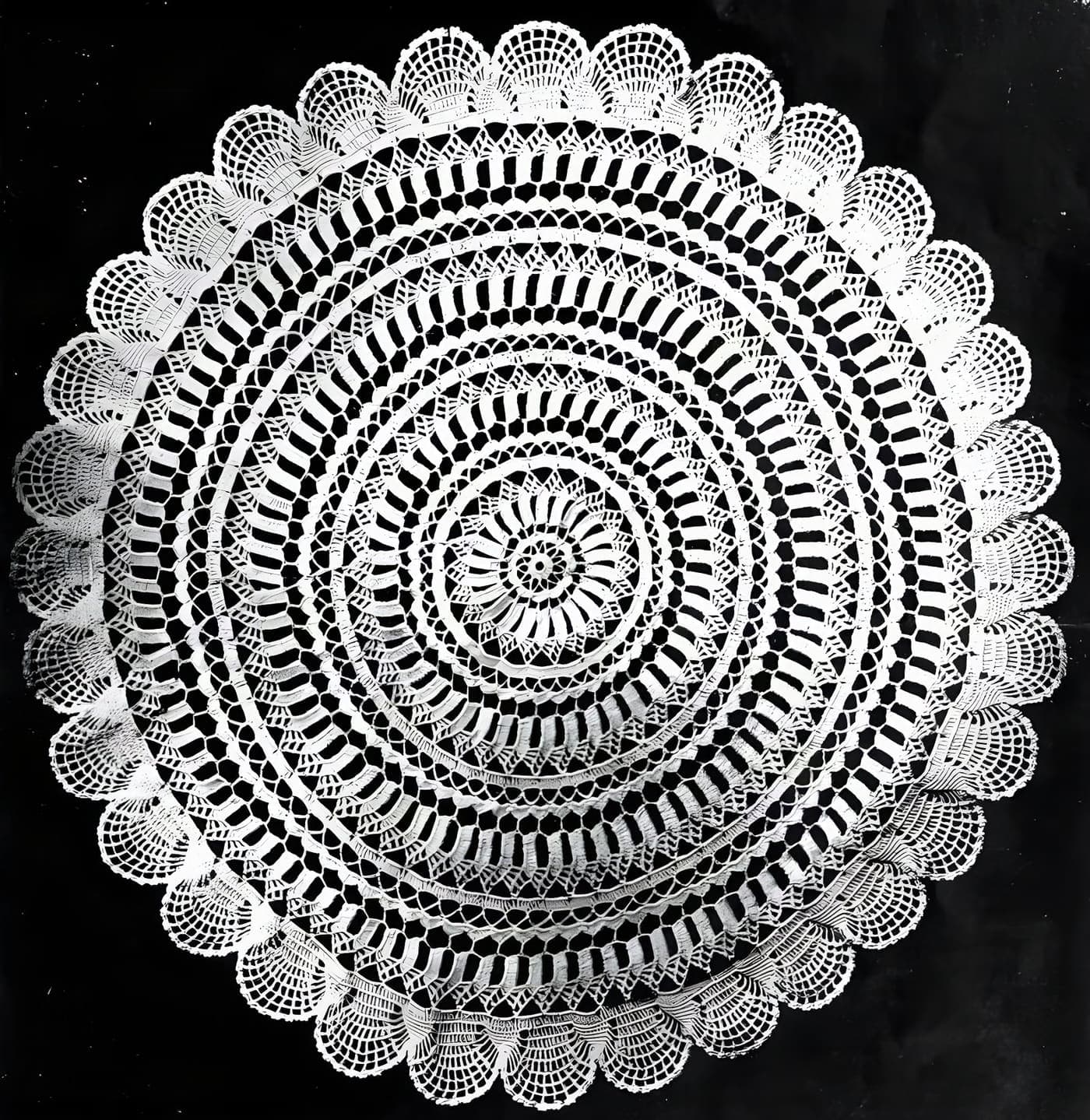
A 27-inch all-crochet round centerpiece of repeated rings of long single-crochet spokes separated by chain and single-crochet bands, finished with a deep border of mesh fan scallops. Originally published as "Instructions for Plate No. 5" in Center Pieces and Lunch Sets in Crochet Work by Anne Orr in 1915, it is now in the public domain.
By the crochetpatterns.io editorial team · Updated · Editorial policy · pattern testing in progress
| Detail | Value |
|---|---|
| Skill level | Advanced |
| Yarn weight | Lace (#0) |
| Yardage | 9 balls as printed; ball yardage not printed. |
| Hook | 1.4 mm |
| Gauge | Not given in the original — work to the printed size of 27 in (69 cm). |
| Finished size | 27 in (69 cm) as printed. |
| Time | about 7 hours |
Materials
- 9 balls size 15 mercerised cotton crochet thread, or size 20 (ball yardage not printed — check your ball band)
- Tapestry needle
- Hook: Start with 1.4 mm (US steel 9), the modern hook of the printed number, and change size to reach the printed finished size.
Yarn Kit & Substitution Options
This pattern calls for 350 yards of weight #0 yarn. Select a suggested yarn to see required skeins and estimated cost:
Caron Simply Soft · 100% Acrylic
315 yds per skein · High-yield yardage, silky no-scratch texture
2 skeins required
approx. $$10.98 total
Abbreviations (US terms)
- chain
- slip stitch
- single crochet
- stitch
- stitches
- space
- loop
- yarn over
- round
Notes before you start
- Source: "Instructions for Plate No. 5", Center Pieces and Lunch Sets in Crochet Work, Anne Orr, 1915. Public domain in the USA.
- As printed — materials: 9 balls of Cordonnet Crochet Cotton No. 15, Steel Crochet Needle No. 9.. Gauge: Not given.
- Modernisation note: "Throw thread over needle once" is written "yo once"; the book then says "join" or "go into" the stitch named. The stitch completed after this yarn-over is not spelled out — Check: it is most likely worked off as a dc (yo, insert, draw through, work off two loops twice).
- Modernisation note: Check: rnd 5 (the long spokes) is printed as one passage and is hard to follow (e.g. "top of 9th sc of 11th sc"); it is kept word for word. Compare with the photograph, which shows rings of long bar-like spokes.
- Modernisation note: Check: the rounds of the spoke ring are repeated "over 3 times in rotation"; the photograph shows four spoke rings in all, which fits rnd 5 plus three repeats.
- Modernisation note: The scallop border rows are labelled "Rnd 1" to "Rnd 7" (printed "Start scallop", "Second Row" … "Seventh Row").
- Modernisation note: Rnd 1 of the centre prints "22 sc, join into ch 6, join" — the 22 sc are worked into the ring.
- Modernisation note: Stitch names mapped by the book's own definitions: its single crochet = modern US sc, double crochet = modern US dc, treble crochet = modern US tr, slip stitch = sl st, picot = ch 4, sc in 4th ch from hook. These match modern US usage, so no stitch was converted; only the abbreviation "tc" (treble crochet) is written "tr".
- Modernisation note: The book calls every round a "Row" ("First Row—"). Pieces worked in joined rounds are labelled "Rnd 1:" etc.; pieces worked back and forth keep "Row". Run-on paragraphs were split into one round or step per line; no stitches were added, removed or reordered.
- Modernisation note: Anne Orr's phrasing "1 sc, join into …" / "join to top of sc" means work the stitch into the place named; it is kept as printed. "St of ch" (e.g. "middle st of ch 5") is kept.
- Modernisation note: Steel crochet needle (hook) numbers of 1915 were not standardised to millimetres; the starting hook is the modern US steel hook of the same number. Change size so the piece reaches the printed size.
- Modernisation note: Cordonnet Crochet Cotton No. 15 was a hard-twisted mercerised crochet cotton; the nearest modern equivalent is size 15 mercerised cotton crochet thread (size 15 is now uncommon — size 10 or 20 are the nearest common weights).
- Modernisation note: Thread is printed in balls only; ball yardage is not printed, so no yardage has been invented. Buy the printed number of balls of a comparable modern thread and check your ball band.
- Modernisation note: No gauge is printed in the book.
- Modernisation note: Metric conversions and modern thread and hook suggestions were added; they are not in the original.
Row progress: 0 of 13 done (0%)
Centre
0 of 13 done- Chain 6, join.Mark row complete
- Rnd 1: 22 sc, join into ch 6, join.Mark row complete
- Rnd 2: 5 ch, sl st to top st of 2d sc, 5 ch, sl st to top of 4th sc, repeat around, making 11 loops.Mark row complete
- Rnd 3: Draw thread up loosely and sl st into middle of 1st loop of 5 st, 3 ch, sl st into 2d loop of ch 5, and repeat around.Mark row complete
- Rnd 4: Sl st into ch 3, 4 sc, join into same ch 3, sl st into ch 3, sl st, join into 2d ch 3, 4 sc into same ch 3, sl st into same ch 3, sl st into 3d ch 3, and repeat around.Mark row complete
- Rnd 5 (spokes): 15 ch st, yo once and join back into 6th st of ch from last end, forming a small ring on end of ch, 1 ch, 1 sc, skip 1 st of ch, go into 2d st from ring, making a sp, 1 ch, 1 sc, skip 1 st, join into 2d st of ch from last sp, making 3 sps, 11 sc, joined over rest of ch of 15, filling it in, yo once and go into top of middle of lower fan, turn, 5 ch, yo once, go into top of 9th sc of 11th sc, 1 ch, 1 sc, join to top of 10th sc, 1 ch, 1 sc, join to top of 11th sc, 1 ch, 1 sc, join to top of 12th sc, turn, make 5 ch st, yo once, join to top of 1st sc, 1 ch, 1 sc, join to top of 2d sc, 1 ch, 12 sc, fill in ch 5, yo once and go in between lower fan's turn, repeat the same for each spoke until around and join.Mark row complete
- Rnd 6: 5 ch, sl st into ch 5 on point of spoke, repeat around.Mark row complete
- Rnd 7: 8 sc joined into ch 5, repeat same around and join.Mark row complete
- Rnd 8: 5 ch, sl st to top of middle st of 8 sc in ch 5, 5 ch, sl st between 8 sc into ch 5, repeat around.Mark row complete
- Rnd 9: 4 ch, sl st into middle of loop of ch 5, repeat around.Mark row complete
- Rnd 10: 1 sl st into ch 4, 5 sc into same ch of 4, 1 sl st into same ch of 4, 1 sl st into next ch 4, 5 sc, join into same ch of 4, sl st into same, and repeat around.Mark row complete
- Rnd 11: Same as 5th row.Mark row complete
- Repeat the 5th, 6th, 7th, 8th, 9th and 10th rows over 3 times in rotation, as given, and the last time leave off 8th, 9th and 10th rows, stopping on the one same as 7th row.Mark row complete
Working on:
Chain 6, join.
Continue this pattern
The rest of the Spoke and Scallop Centerpiece, Plate 5 (1915) pattern is in the Heirloom Doilies & Tablecloths
Still to come in the full pattern:
- Scallop border
Included with 236 patterns for $19 — $0.08 per pattern.
Errata
No corrections have been published for this pattern. Found a mistake? Tell us and we will log the fix here with a date.
Your notes on this pattern
Keep track of the yarn, hook and changes you used. Saved in this browser only — nobody else can see it.
Frequently asked questions
Where is the Instructions for Plate No. 5 pattern from?
It was published as "Instructions for Plate No. 5" in Center Pieces and Lunch Sets in Crochet Work by Anne Orr in 1915. The publication is in the public domain in the United States; this version is transcribed and modernised by crochetpatterns.io.
What yarn or thread do I need for the Instructions for Plate No. 5?
Size 15 mercerised cotton crochet thread (size 20 is the nearest common weight). 9 balls as printed; ball yardage not printed.
What hook should I use?
Start with 1.4 mm (US steel 9), the modern hook of the printed number, and change size to reach the printed finished size. Gauge: Not given in the original — work to the printed size of 27 in (69 cm).