Free preview · full pattern in the Vintage Crochet Hats, Bags & Accessories
Berlin Wool Watch Pocket with Ring Border (Victorian): vintage crochet pattern
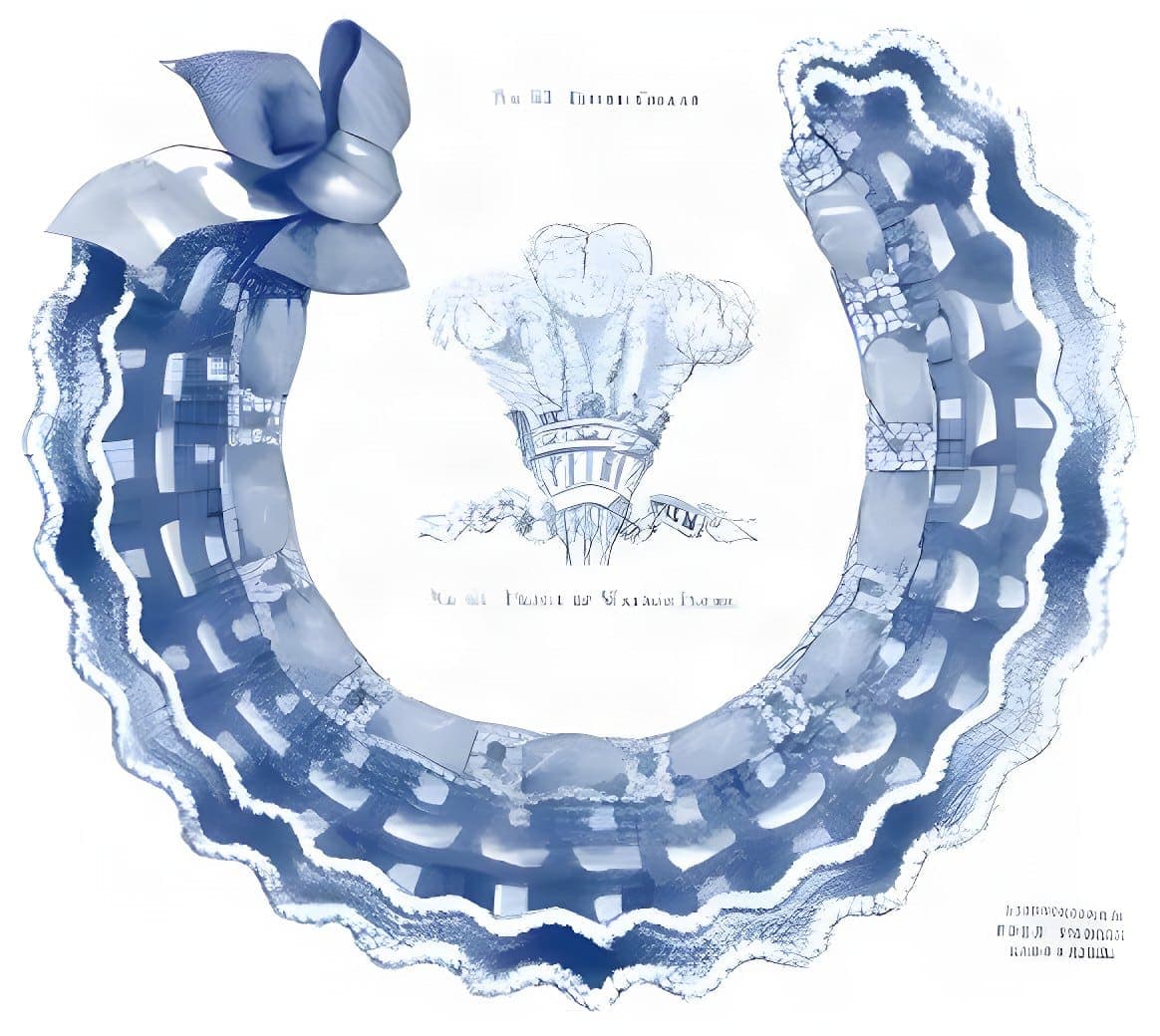
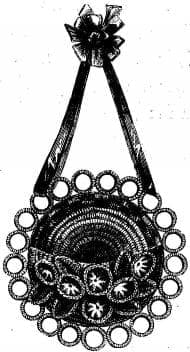
A Victorian hanging watch pocket in four-thread Berlin wool: a round mat of scarlet, maize and violet worked over blind cord, a pocket of four ridged-crochet points, a border of maize-covered curtain rings, and small blue flowers and green leaves stitched on the front.
By the crochetpatterns.io editorial team · Updated · Editorial policy · pattern testing in progress
| Detail | Value |
|---|---|
| Skill level | Intermediate |
| Yarn weight | Super fine (#1) |
| Yardage | As printed: skeins by colour (skein length not printed). |
| Hook | 3 mm |
| Gauge | 11 rnds over cord measure 4¼ in (11 cm) across, with 150 sts in the 11th rnd, as printed. |
| Finished size | Mat 4¼ in (11 cm) across, as printed, before the ring border. |
| Time | about 8 hours |
Materials
- Fingering-weight (CYC #1) soft wool, approximating four-thread Berlin wool, in skeins as printed: three scarlets (1 skein darkest, 2 each of the two lighter, the lightest a bright military scarlet), 4 maize, 1 shaded violet, 1 shaded scarlet, three greens (1 skein each, very dark to very light), two sky-blues (1 skein each), 1 white
- 24 curtain rings about ⅝–¾ in (16–19 mm) across (period: “the size of a fourpenny-piece, or a trifle larger”)
- 4 yd (3.7 m) of thin cord to work over (period: blind cord)
- 1¼ yd (1.1 m) scarlet satin ribbon ½ in (13 mm) wide for hanging
- A short length of flat elastic, black sewing cotton, fine wire (from ribbon wire), a narrow strip of boning covered with scarlet ribbon
- Tapestry needle for weaving in ends
- Hook: Start with 3.0 mm (US C-2/D-3) and adjust so the stitches cover the cord; the book names Penelope hook No. 2.
Yarn Kit & Substitution Options
This pattern calls for 350 yards of weight #1 yarn. Select a suggested yarn to see required skeins and estimated cost:
Knit Picks Stroll Sock · 75% Superwash Merino, 25% Nylon
231 yds per skein · Durable stitch definition, machine washable
2 skeins required
approx. $$13.98 total
Abbreviations (US terms)
- chain
- double crochet
- stitch
- stitches
- round
- row
- repeat
- back loop only
Notes before you start
- Source: "Watch Pocket", The Ladies' Work-Book, John Cassell, La Belle Sauvage Yard, Ludgate Hill, London (no year printed). Public domain in the USA.
- As printed — materials: 3 shades of scarlet, the lightest to be a very bright military scarlet, 1 skein of the darkest, 2 of each of the lighter shades; 4 skeins of bright maize colour; skein of shaded violet; 1 skein of shaded scarlet; 3 shades of green; 1 skein of each shade, the darkest to be very dark, and the lightest to be very light; 2 shades of sky-blue, 1 skein of each; 1 skein of white; all 4 thread Berlin wool; 24 curtain rings, the size of a fourpenny-piece, or a trifle larger; 4 yards of blind cord;; 1-1/4 yards of scarlet satin ribbon, half an inch in width, or covered curtain rings will answer the same purpose. No. 2 Penelope hook.. Gauge: The Mat should now measure 4-1/4 inches across [after the 11th row, 150 stitches].
- Modernisation note: Stitch names converted to modern US terms strictly by the book's own crochet lesson: “chain” / “ch.” = ch; “slip” / “slip-stitch” = sl st; “single crochet” / “s.c.” = sc; “double crochet” / “double” / “d.c.” = dc; “treble crochet” / “treble” / “t.c.” = tr; “long treble” / “long t.c.” = dtr; “long” / “l.” = dc (one wrap, from the book's “double long … twisting the cotton twice”); “open square” = dc, ch 2, sk 2; “close square” = 3 dc; “diminished” / “contracted” stitch = dc2tog; “miss” = sk; “loop” (of a chain or row) = st. In this book “double crochet” means the same stitch as the modern US dc, and “single crochet” the modern sc.
- Modernisation note: Check: this design names “d.c.” and “l.” side by side (the leaves go “3 d.c. up, 4 l.”), which suggests the writer meant d.c. as the shorter stitch. Both are written as dc, strictly by the book's definitions; if the leaves do not shape, try sc for “d.c.”.
- Modernisation note: “Ridged crochet” is not defined in this design. It is written as sc-row ribbed crochet in blo by the book's definition of ribbed crochet; the Flower Vase Screen describes it as “working into the lower loop instead of the upper one”. Check: which loop.
- Modernisation note: Period wording modernised: “needle” written as “hook”; “commence” as “begin”; “unite” / “close into a round” as “join into a ring”; “round loop” as “ring”; “receipt” as “directions”; “scollop” as “scallop”. Round and row numbers are kept as printed.
- Modernisation note: Printed paragraphs split into one step per round, row or instruction; no stitches, counts or rows added, removed or reordered. Words in square brackets or marked “Check:” are ours, and the printed wording is quoted wherever a reading was needed.
- Modernisation note: Berlin wool was a fine, soft worsted-spun wool sold by thread count. Four-thread Berlin wool is approximated as fingering weight (CYC #1) and eight-thread as sport to DK weight (CYC #2–3). “Shaded” wool changes gradually from light to dark along the strand (modern ombré). Check: approximate.
- Modernisation note: Penelope (and “tapered, indented”) crochet hooks were sold by number; the book notes its own hooks had “the size engraved on every handle”. These numbers have no exact modern equivalent and the book gives no conversion; the modern hook is an approximate starting point only. No gauge is printed.
- Modernisation note: Colour swatches are approximate modern readings of the period colour names; they are not in the book. “Cerise” is a deep cherry pink; “maize” a soft yellow; “stone-colour” and “drab” pale greyish browns; “slate” a blue-grey.
- Modernisation note: Coin sizes converted: a fourpenny-piece (groat) was about ⅝ in (16 mm) across and a sixpence about ¾ in (19 mm). Check: approximate.
- Modernisation note: Check: “work on the cord … 21 d.c. stitches” for the pocket is kept as printed; it is not clear whether the pocket points themselves are worked over cord.
- Modernisation note: Check: the book does not say whether the pocket points are worked into the edge of the mat or separately; the 21 sts are begun at the 42nd st of the last round, so the first point grows from the mat.
- Modernisation note: Check: “increasing as may be required” in Rnds 4–9 is kept as printed; increase to keep the mat flat and reach 150 sts at Rnd 11.
Row progress: 0 of 5 done (0%)
Stitches
0 of 5 done- Double crochet, “d.c.” (book's definition): “Twist the thread round the hook before inserting it in the stitch, through which you draw the thread in a loop. Three loops being then on the needle, draw the thread through two, and then through the one just formed and the remaining one.” = dc.Mark row complete
- Long stitch, “l.” (not in the book's crochet lesson): the Handkerchief Case explains a “double long” as “made by first twisting the cotton twice over the hook”, so a long stitch has one wrap = dc. The book's square-crochet patterns also write “l.” where its lesson on square crochet says d.c.Mark row complete
- To work over cord (book): “Hold it in the left hand, with the work, and work round it, as you would if it were merely an end of thread. The stitches must, however, be sufficiently close to cover it entirely.”Mark row complete
- To work with several colours (book): “Hold the threads not in use along the edge of the work, and work them in. When the colour is to be changed, begin the stitch with the old colour, and complete it with the new, which continue to work with, holding the other in.” = carry the unused strands inside the stitches and change colour on the last yo of the stitch before (tapestry crochet).Mark row complete
- Ribbed crochet (book's definition): “the top of a row of crochet, whether s.c., d.c., or t.c., presents an appearance of chain stitch; in working ribbed crochet, take up always that side of the chain which is furthest from you.” Worked backwards and forwards = sts in the back loop only (blo), turning each row.Mark row complete
Working on:
Double crochet, “d.c.” (book's definition): “Twist the thread round the hook before inserting it in the stitch, through which you draw the thread in a loop. Three loops being then on the needle, draw the thread through two, and then through the one just formed and the remaining one.” = dc.
Continue this pattern
The rest of the Berlin Wool Watch Pocket with Ring Border (Victorian) pattern is in the Vintage Crochet Hats, Bags & Accessories
Still to come in the full pattern:
- Mat
- Rings
- Flowers (make 4 small and 2 large)
- Leaves (make 6)
- Finishing
Included with 202 patterns for $12 — $0.06 per pattern.
Errata
No corrections have been published for this pattern. Found a mistake? Tell us and we will log the fix here with a date.
Your notes on this pattern
Keep track of the yarn, hook and changes you used. Saved in this browser only — nobody else can see it.
Frequently asked questions
Where is the Watch Pocket pattern from?
It was published as "Watch Pocket" in The Ladies' Work-Book by John Cassell, La Belle Sauvage Yard, Ludgate Hill, London (no year printed). The publication is in the public domain in the United States; this version is transcribed and modernised by crochetpatterns.io.
What yarn or thread do I need for the Watch Pocket?
super fine (#1) yarn. As printed: skeins by colour (skein length not printed).
What hook should I use?
Start with 3.0 mm (US C-2/D-3) and adjust so the stitches cover the cord; the book names Penelope hook No. 2. Gauge: 11 rnds over cord measure 4¼ in (11 cm) across, with 150 sts in the 11th rnd, as printed.