Free preview · full pattern in the Vintage Crochet Edgings & Trims
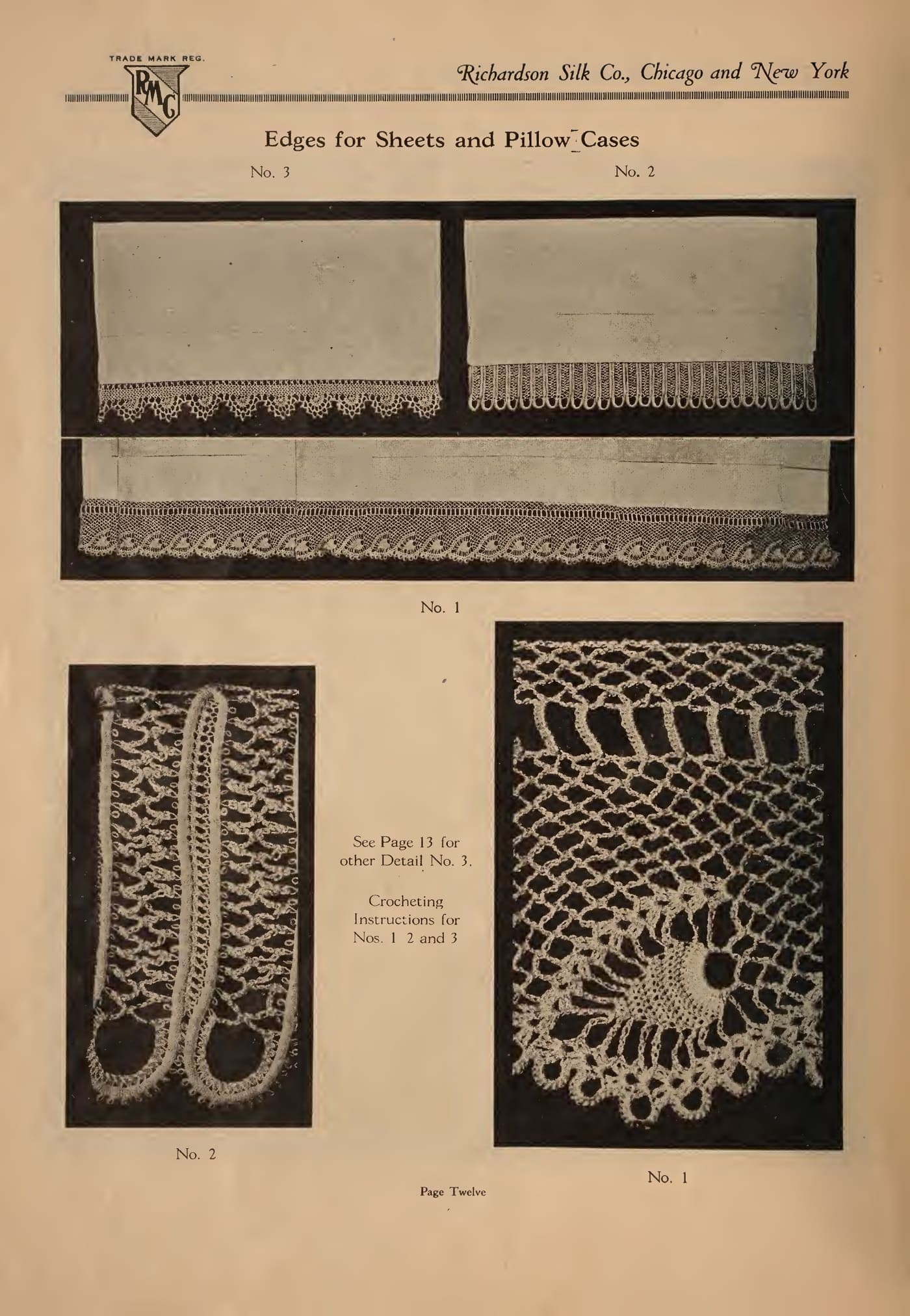
Lace Edge No. 2 on Featheredge Braid (1915): vintage crochet pattern
A lace worked on featheredge braid: sixteen chain-7 loops along one side, a turn of twenty-one single crochet, then chain-4 loops back along the opposite side. The braid is laid double and thirty-two picots are drawn onto the hook together and worked off two at a time to close the figure.
By the crochetpatterns.io editorial team · Updated · Editorial policy · pattern testing in progress
| Detail | Value |
|---|---|
| Skill level | Advanced |
| Yarn weight | Lace (#0) |
| Yardage | Not printed. (as printed; yardage not given) |
| Hook | 1.5 mm |
| Gauge | No gauge or measurement printed. |
| Finished size | Not printed. Each pattern repeat uses 16 chain-7 loops, a turn of 21 single crochet, and 32 picots of the doubled braid drawn together. |
| Time | about 2 hours |
Materials
- Size 12 pearl cotton — approximate; the original was Richardson's R. M. C. Perle No. 12
- Featheredge (picot-edged) lace braid
- Steel crochet hook (no hook size is printed for this design)
- Sewing needle and thread
- Hook: No hook size is printed for this design. Start with 1.5 mm (US steel 8) and change size so the braid is not drawn up
Yarn Kit & Substitution Options
This pattern calls for 350 yards of weight #0 yarn. Select a suggested yarn to see required skeins and estimated cost:
Caron Simply Soft · 100% Acrylic
315 yds per skein · High-yield yardage, silky no-scratch texture
2 skeins required
approx. $$10.98 total
Abbreviations (US terms)
- chain
- single crochet
- stitch
- stitches
- skip
- repeat
- loop
- together
Notes before you start
- Source: "Lace No. 2 (Lace Edges for Sheet and Pillow Cases)" (No. 2), Richardson's Crochet Book No. 2 (Complete Crochet Book No. 2), Richardson Silk Company, Chicago and New York, 1915. Public domain in the USA.
- As printed — materials: Richardsons R. M. C. Perle No. 12; Featheredge Braid. Gauge: Not given.
- Modernisation note: From Richardson's Crochet Book No. 2. That book prints only an abbreviation list (ch = chain stitch, s c = single crochet, d c = double crochet, t c = treble crochet, t t c = triple treble crochet, p = picot, la = lacet, gr = group, sp = space, cl = clover leaf) with no worked descriptions, so the stitches are read by the same key its companion Book No. 1 prints in full: s c = sc, d c = dc, t c = tr, t t c = trtr (triple treble). Book No. 2's heights therefore match modern US usage as well.
- Modernisation note: The book's abbreviations are written in modern US form: ch sts = ch, s c = sc, d c = dc, t c = tr, d t c = dtr, sl st = sl st, p = picot, sp(s) = space(s), gr = group (block), la = lacet, cl = clover leaf; “skip” = sk; “repeat *” = rep from *. Ordinal row names are written Row 1, Row 2, and so on.
- Modernisation note: The design is worked onto a manufactured lace braid (named in the materials). These braids are no longer sold under the 1915 trade names; substitute a modern insertion braid with the same number of picots, loops or medallions per length, or the stitch counts that fasten into the braid will not come out.
- Modernisation note: Long printed paragraphs are split into one row, round or step per line; stitch order and counts unchanged. Section headings added for navigation.
- Modernisation note: Hooks are printed only as Richardson steel hook numbers, with no diameters, so no exact metric size can be read from the books. The metric sizes given are approximate starting points read across to the modern US steel-hook scale (in which a higher number is finer); work a swatch and change size to match any printed measurement.
- Modernisation note: No stitch gauge is printed for this design; work a swatch and match any printed measurement (given in the modern gauge line) before starting.
- Modernisation note: The threads are 1915 Richardson trade names with no exact modern equivalent, and the books print no yardage except where quoted in the materials. The modern equivalents given are approximations only: R. M. C. Cordonnet and Cordonnet Special (the book says it “matches the D. M. C. thread”, sizes 3 to 150) as mercerized cotton crochet thread of the same size number; R. M. C. Perle Cotton (Art. 15 and 15-B in hanks, Art. 35 in balls, sizes 3, 5, 8 and 12) as modern pearl cotton of the same size; Richardson's Crochet and Knitting Silk (“Perfect”, ½ oz on the ball; “Our Art”, ¼ oz) as a fine silk or silk-blend crochet thread about the weight of size 10–20 cotton; Richardson's Tatting Silk (100 yd on the ball) as a fine hard-twisted silk thread about the weight of size 20–30 cotton; Bed Spread Thread on cones as a heavy cotton crochet thread about size 3–5. Grecian floss (a silk embroidery floss) is used only for embroidery where it is named.
- Modernisation note: Check: the publication year. The book is catalogued as 1915 and is recorded here as 1915, but its own title page carries a 1916 copyright line and the deposit stamp on book page 2 reads April 1916.
- Modernisation note: No hook size is printed for this design, so the suggested hook is ours and is approximate.
- Modernisation note: Check: the closing figure draws 32 loops onto the hook at once and works them off 2 at a time; the count depends on the braid's picot spacing, so count from your own braid before drawing up.
- Modernisation note: Check: how the lace is attached is not printed; the finishing line is ours.
- Modernisation note: Check: the colour is not printed; the lace photographs as white.
- Modernisation note: Metric conversions added.
Row progress: 0 of 5 done (0%)
Lace
0 of 5 done- Fasten the thread to the 2nd picot of the braid, 7 ch sts, sk 1 picot, 1 sc, forming a loop; rep for 16 loops.Mark row complete
- 1 sc into each picot for 21 sts, forming the turn.Mark row complete
- *4 ch sts, 1 sc over the opposite loop, 4 ch sts, sk 1 picot, 1 sc; rep from *.Mark row complete
- After fastening the last loop, make 3 ch sts; lay the braid double, with 1 picot from each side together, bring the chain across the back of the braid, draw the thread through both picots and hold this loop on the hook; rep, connecting picots until you have 32 sts on the hook.Mark row complete
- Take off 2 sts at a time to the last loop, catch across the braid to the next picot, 2 ch sts, 1 sc into the next picot — this completes the pattern.Mark row complete
Working on:
Fasten the thread to the 2nd picot of the braid, 7 ch sts, sk 1 picot, 1 sc, forming a loop; rep for 16 loops.
Continue this pattern
The rest of the Lace Edge No. 2 on Featheredge Braid (1915) pattern is in the Vintage Crochet Edgings & Trims
Still to come in the full pattern:
- Finishing
Included with 618 patterns for $9 — $0.01 per pattern.
Errata
No corrections have been published for this pattern. Found a mistake? Tell us and we will log the fix here with a date.
Your notes on this pattern
Keep track of the yarn, hook and changes you used. Saved in this browser only — nobody else can see it.
Frequently asked questions
Where is the Lace No. 2 (Lace Edges for Sheet and Pillow Cases) pattern from?
It was published as "Lace No. 2 (Lace Edges for Sheet and Pillow Cases)" in Richardson's Crochet Book No. 2 (Complete Crochet Book No. 2) by Richardson Silk Company, Chicago and New York in 1915. The publication is in the public domain in the United States; this version is transcribed and modernised by crochetpatterns.io.
What yarn or thread do I need for the Lace No. 2 (Lace Edges for Sheet and Pillow Cases)?
Size 12 pearl cotton. Not printed.
What hook should I use?
No hook size is printed for this design. Start with 1.5 mm (US steel 8) and change size so the braid is not drawn up Gauge: No gauge or measurement printed.