Free preview · full pattern in the Vintage Crochet Edgings & Trims
Ely Lace (1891): vintage crochet pattern
A picot-net lace: chains of five and six, each chain of six closed into a picot, make the ground, and blocks of eight doubles are folded back into it at intervals to form a solid check. The eighth row runs a line of eleven chain-seven points along the edge, and the whole is repeated from the third row.
By the crochetpatterns.io editorial team · Updated · Editorial policy · pattern testing in progress
| Detail | Value |
|---|---|
| Skill level | Advanced |
| Yarn weight | Lace (#0) |
| Yardage | Not printed. (as printed; yardage not given) |
| Hook | 5 mm |
| Gauge | No gauge printed. |
| Finished size | Not printed. |
| Time | about 3 hours |
Materials
- Crochet cotton or linen thread — the book prints no size; its own section title names cotton and linen
- Steel crochet hook to suit the thread
- Tapestry needle for the ends
- Hook: Check: the book prints no hook number for any design in this section, so no modern hook can be read across from a printed size. Match the hook to whatever thread you choose, and change size until the lace lies flat.
Yarn Kit & Substitution Options
This pattern calls for 350 yards of weight #0 yarn. Select a suggested yarn to see required skeins and estimated cost:
Caron Simply Soft · 100% Acrylic
315 yds per skein · High-yield yardage, silky no-scratch texture
2 skeins required
approx. $$10.98 total
Abbreviations (US terms)
- chain
- single crochet
- double crochet
- stitch
- stitches
- repeat
- space
- loop
- row
Notes before you start
- Source: "Ely Lace" (No. 63), Home Work: a choice collection of useful designs for the crochet and knitting needle, Rose Publishing Co. (Ltd.), Toronto, 1891. Public domain in the USA.
- As printed — materials: Not printed — the book names no thread, thread number, hook number or brand for the designs in this section; its printed section title is “Designs for Crocheting in Cotton and Linen”.. Gauge: Not given.
- Modernisation note: Stitches are converted by this book's own printed key, not by the look of the abbreviation. The key is headed “Terms used in Crochet” and stands at the head of PART ONE, SECTION I.—Terms and Stitches, BOOK PAGE 9 (image p-010.jpg), running onto book page 10 (image p-011.jpg). It prints ten entries: “Ch—Chain, a straight series of loops, each drawn with the hook through the preceding one.” “St—Stitch or Stitches.” “Sl st—Slip Stitch; put the hook through the work, thread over the hook, draw it through the stitch on the hook.” “S c—Single Crochet; having a stitch on the hook, put the hook through the work, thread over the hook, draw it through the work, thread over, draw it through the two stitches on the hook.” “D c—Double Crochet; having a stitch on the hook, put thread over the hook, then hook through the work, thread over, draw it through two stitches, thread over, draw it through the two remaining.” “Tr—Treble Crochet; like double, except that the thread is thrown twice round the hook before inserting the hook through the work. The stitches are worked off two at a time as in double crochet.” “H tr—Half Treble, sometimes called Short Treble crochet; like double crochet, except that when the three stitches are on the needle, instead of drawing thread through two stitches twice, it is drawn through all three at once.” “L tr—Long Treble; throw thread over needle three times before inserting hook in the work, work off two stitches at a time as in double crochet.” “P—Picot; make three, four, five, or as many chain stitches as you wish to have in the picot, and form them into a loop by making a single crochet or slip stitch on the first of them.” “Sh—Shell; this is usually made by putting two doubles, two chains, and two doubles in one stitch; or by putting three or more doubles in one stitch without chain stitches between.” “*—Star; this is used where certain stitches are to be repeated.” The heights are therefore MODERN US: the S c works off two loops (US single, not the British double); the D c works off three loops two at a time (US double); the Tr throws the thread twice (US treble); the L tr throws it three times (US double treble, written dtr here). The H tr is the decisive entry — it is defined as HALF OF THE DOUBLE, not of the treble, so despite its British-sounding name it is the modern US half double crochet, and its wording confirms that this book's D c really is the modern double. This book is therefore a hybrid: US heights under two British-flavoured names.
- Modernisation note: The book's wording is written in modern US form: “make a chain of N stitches” = ch N; “miss” and “pass over” = sk; “catch” and “fasten” = sl st or join, according to what the row is doing; “throw the thread over” = yo; “needle” and “hook” both mean the hook and are written hook; “under” a chain = into the chain space; “the 4th st. of ch.” = the 4th chain; “repeat from *” = rep from *. The book's numbered paragraphs (“1.”, “2.”, “3.”) are its rows and are written Row 1, Row 2, Row 3. The book's spelling “scallop” is kept.
- Modernisation note: The printed directions are already numbered row by row in this section, and are transcribed one row per line in the book's own order. The book's own sub-headings (Heading, For the edge, On the upper edge and so on) are kept as section headings. Stitch order and counts are unchanged and nothing is added; where the book stops without a stitch count, so does this transcription.
- Modernisation note: This is a microform scan and the optical reading of it carries the usual slips; every figure below was read back against the page image at 220 dpi. Recurring slips in this book's scanned text are “d. o” and “d. ¢” for d. c., “s. o” and “a. c.” for s. c., “at.” and “ata.” for st. and sts., “Ist” for 1st, “lst” for 1st, “1” and “l” for the figure 1, and “Bhell” for Shell. The rows below follow what the printed page actually shows, and any place where the scan and the page disagree is listed as a Check note.
- Modernisation note: No materials are printed for this design. This section of the book prints no thread brand, no thread number and no hook number for any of its designs — the only material guidance is the section's own printed title, “Designs for Crocheting in Cotton and Linen” (book page 23), which is recorded here as the book's own range rather than as this design's specification. Nothing is invented to fill the gap.
- Modernisation note: No gauge is printed for this design; the book prints no gauge, tension or mesh count anywhere in this section. Work a sample and change hook size until the lace lies flat.
- Modernisation note: No finished measurement is printed for this design. It is worked to the length of the piece it trims, so its length is set by that piece. The book's own word for its width is the one in the design's printed name — the designs called “Narrow” are narrow edgings.
- Modernisation note: Check: no colour is printed for this design. The engravings photograph as a plain light thread. The section's printed title names cotton and linen as its materials but names no colour; white and écru are recorded here as the ordinary choices for such thread, not as this design's printed colour.
- Modernisation note: No yardage is printed for this design, and none is estimated here — the book gives no thread size to estimate from.
- Modernisation note: The picot is defined by this design's own first row — “make a picot by catching thread through 3rd st. of ch. 6” — and the book's general key gives the same method, so “ch 6 picot” throughout means a chain of six closed back on its third stitch.
- Modernisation note: This design runs across a page turn (book page 69 to book page 70, images p-064.jpg and p-065.jpg); both leaves are present and were read. The name, the foundation and Rows 1 to 2 are on page 69, set in a column beside the engraving, and Rows 3 to 8 on page 70.
- Modernisation note: Book page 69 sets Rows 1 and 2 in a column beside the engraving and the optical reading interleaves that column with the design above it; both rows below follow the printed reading order of the page image.
- Modernisation note: Check: book page 70 carries a band of light glare across the right-hand ends of Rows 7 and 8, and two readings are taken from the scanned text rather than from the page. In Row 7 the page shows “1 d. c. with 2 ch. between in e…” and the scan gives the missing word; “each” is used above, which is also the word Row 6 uses for the same twelve doubles. In Row 8 the repeat figure is lost to the glare and the scan reads “repeat from * 9 tm”; 9 is used above, and the row's own “making 11 points” stands beside it as the book's check.
- Modernisation note: Check: also in Row 8, the chain figure after the first “8 d. c. over 8 d. c. of last row” is bleached out on the page. Chain 3 is used above, taken only from the design's own repeated wording — the same clause later in the same row, and Rows 2 and 5, all print “ch. 3” in that place.
- Modernisation note: Check: Row 4 prints “ch. 5 picot” once, where every other picot in the design is a chain of six. It is left as printed and nothing is corrected.
- Modernisation note: Check: the scan reads Row 1 as “8c. in 10th st. of ch.” and “e. @ in 25th st. of ch.”; the page image reads “s. c. in 10th st. of ch.” and “s. c. in 25th st. of ch.”
- Modernisation note: Check: the scan reads the foundation as “Make a chain of 40 atitchee,”; the page image reads “Make a chain of 40 stitches.”
- Modernisation note: Check: the scan reads Row 3 as “r. c. in last of 8d. c.” and “ivot, ch. 5”; the page image reads “s. c. in last of 8 d. c.” and “picot, ch. 5”.
- Modernisation note: Check: the scan reads Row 7's opening as “Chain 5, 8. c. in 3rd st. of ch. 5” and carries a stray “2,” into the middle of the row; the page image reads “Chain 5, s. c. in 3rd st. of ch. 5” and runs “8 d. c. under ch. 6, ch. 6 picot, ch. 5” with no chain of 2 between them.
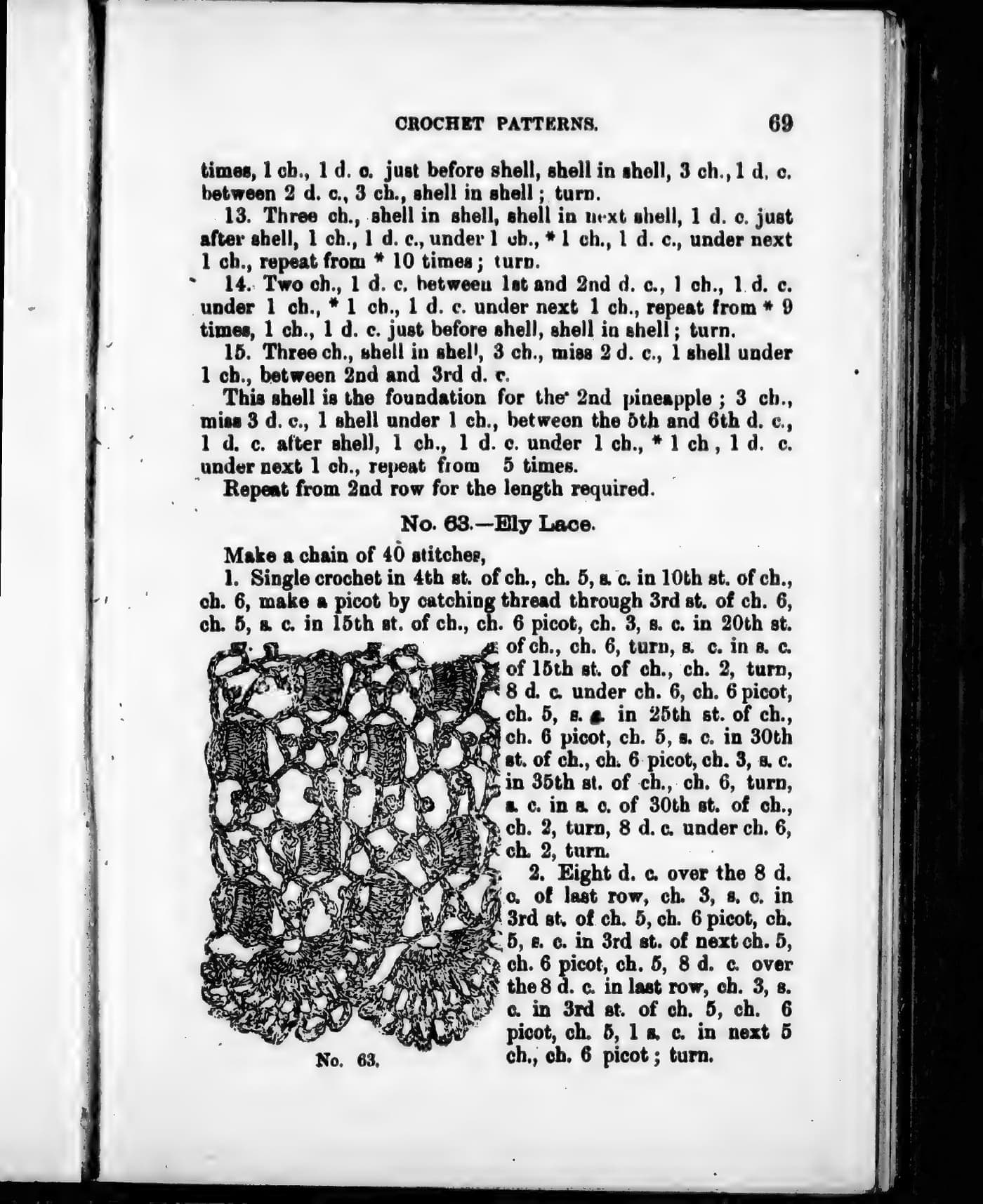
- Modernisation note: The engraving printed with this design survives the filming and shows the picot net with its blocks and its scalloped points, but it is a photograph of the finished lace and nothing is read from it.
Row progress: 0 of 10 done (0%)
The lace
0 of 10 done- Ch 40.Mark row complete
- Row 1: Single crochet in the 4th st of the ch, ch 5, sc in the 10th st of the ch, ch 6, make a picot by catching the thread through the 3rd st of ch 6, ch 5, sc in the 15th st of the ch, ch 6 picot, ch 3, sc in the 20th st of the ch, ch 6, turn, sc in the sc of the 15th st of the ch, ch 2, turn, 8 dc under ch 6, ch 6 picot, ch 5, sc in the 25th st of the ch, ch 6 picot, ch 5, sc in the 30th st of the ch, ch 6 picot, ch 3, sc in the 35th st of the ch, ch 6, turn, sc in the sc of the 30th st of the ch, ch 2, turn, 8 dc under ch 6, ch 2, turn.Mark row complete
- Row 2: Eight dc over the 8 dc of the last row, ch 3, sc in the 3rd st of ch 5, ch 6 picot, ch 5, sc in the 3rd st of the next ch 5, ch 6 picot, ch 5, 8 dc over the 8 dc in the last row, ch 3, sc in the 3rd st of ch 5, ch 6 picot, ch 5, 1 sc in the next 5 ch, ch 6 picot; turn.Mark row complete
- Row 3: Chain 5, sc in the 3rd st of ch 5, ch 6 picot, ch 5, sc in the first of the 8 dc, ch 6 picot, ch 5, sc in the last of the 8 dc, ch 6 picot, ch 5, sc in the 3rd st of the 2nd ch 5, ch 6 picot, ch 5, sc in the 1st of the 8 dc, ch 6 picot, ch 5, sc in the last of the 8 dc, ch 6; turn.Mark row complete
- Row 4: One sc in the 3rd st of ch 5, ch 6 picot, ch 5, sc in the 3rd st of the next ch 5, ch 6 picot, ch 3, sc in the 3rd st of the next ch 5, ch 6, turn, sc in the 2nd sc, ch 2, turn, 8 dc under ch 6, ch 5 picot, ch 5, sc in the 3rd st of ch 5 over the block of 8 dc, ch 6 picot, ch 5, sc in the 3rd st of the next ch 5, ch 6 picot, ch 3, sc in the 3rd st of the next ch 5, ch 6, turn, sc in the 2nd sc, ch 2, turn, 8 dc under ch 6, ch 2; turn.Mark row complete
- Row 5: Eight dc over the 8 dc of the last row, ch 3, sc in the 3rd st of ch 5, ch 6 picot, ch 5, sc in the 3rd st of the next ch 5, ch 6 picot, ch 5, 8 dc over the 8 dc of the last row, ch 3, sc in the 3rd st of ch 5, ch 6 picot, ch 5, 12 dc in the ch 6 of the last row, ch 3, turn.Mark row complete
- Row 6: One dc with 1 ch between, into each of 12 dc, ch 3, sc in the 3rd st of ch 5, ch 6 picot, ch 5, sc on the 1st of the 8 dc, ch 6 picot, ch 5, sc on the last of the 8 dc, ch 6 picot, ch 5, sc on the 3rd st of the 2nd ch 5, ch 6 picot, ch 5, sc on the 1st of the 8 dc, ch 6 picot, ch 5, sc on the last of the 8 dc, ch 6 picot; turn.Mark row complete
- Row 7: Chain 5, sc in the 3rd st of ch 5, ch 6 picot, ch 5, sc in the 3rd st of the next ch 5, ch 6 picot, ch 3, sc 3rd st of the next ch 5, turn, ch 6, sc in the 2nd sc, ch 2, turn, 8 dc under ch 6, ch 6 picot, ch 5, sc in the 3rd st of ch 5 over the block of 8 dc, ch 6 picot, ch 5, sc in the 3rd st of ch 5, ch 6 picot, ch 3, sc in the sc of the ch 3 of the last row, turn, ch 6, sc in the next sc, ch 2, turn, 8 dc under ch 6, 1 dc with 2 ch between in each of 12 dc in the last row, sc in the 40th st of the ch.Mark row complete
- Row 8: * Chain 7, sc under ch 2, repeat from * 9 times making 11 points, ch 2, 8 dc over 8 dc of the last row, ch 3, sc in the 3rd st of ch 5, ch 6 picot, ch 5, sc in the 3rd st of the 2nd ch 5, ch 6 picot, ch 5, 8 dc over 8 dc of the last row, ch 3, sc in the 3rd st of ch 5, ch 6 picot, ch 5, 1 sc in the next ch 5, ch 6 picot; turn.Mark row complete
- Repeat from the 3rd row. In the 7th row catch to the 3rd point of the preceding scallop.Mark row complete
Working on:
Ch 40.
Continue this pattern
The rest of the Ely Lace (1891) pattern is in the Vintage Crochet Edgings & Trims
Still to come in the full pattern:
- Finishing
Included with 618 patterns for $9 — $0.01 per pattern.
Errata
No corrections have been published for this pattern. Found a mistake? Tell us and we will log the fix here with a date.
Your notes on this pattern
Keep track of the yarn, hook and changes you used. Saved in this browser only — nobody else can see it.
Frequently asked questions
Where is the Ely Lace pattern from?
It was published as "Ely Lace" in Home Work: a choice collection of useful designs for the crochet and knitting needle by Rose Publishing Co. (Ltd.), Toronto in 1891. The publication is in the public domain in the United States; this version is transcribed and modernised by crochetpatterns.io.
What yarn or thread do I need for the Ely Lace?
See the materials list. Not printed.
What hook should I use?
Check: the book prints no hook number for any design in this section, so no modern hook can be read across from a printed size. Match the hook to whatever thread you choose, and change size until the lace lies flat. Gauge: No gauge printed.