Free preview · full pattern in the Vintage Crochet Edgings & Trims
Pine Needle Luncheon Set Edge (1916): vintage crochet pattern
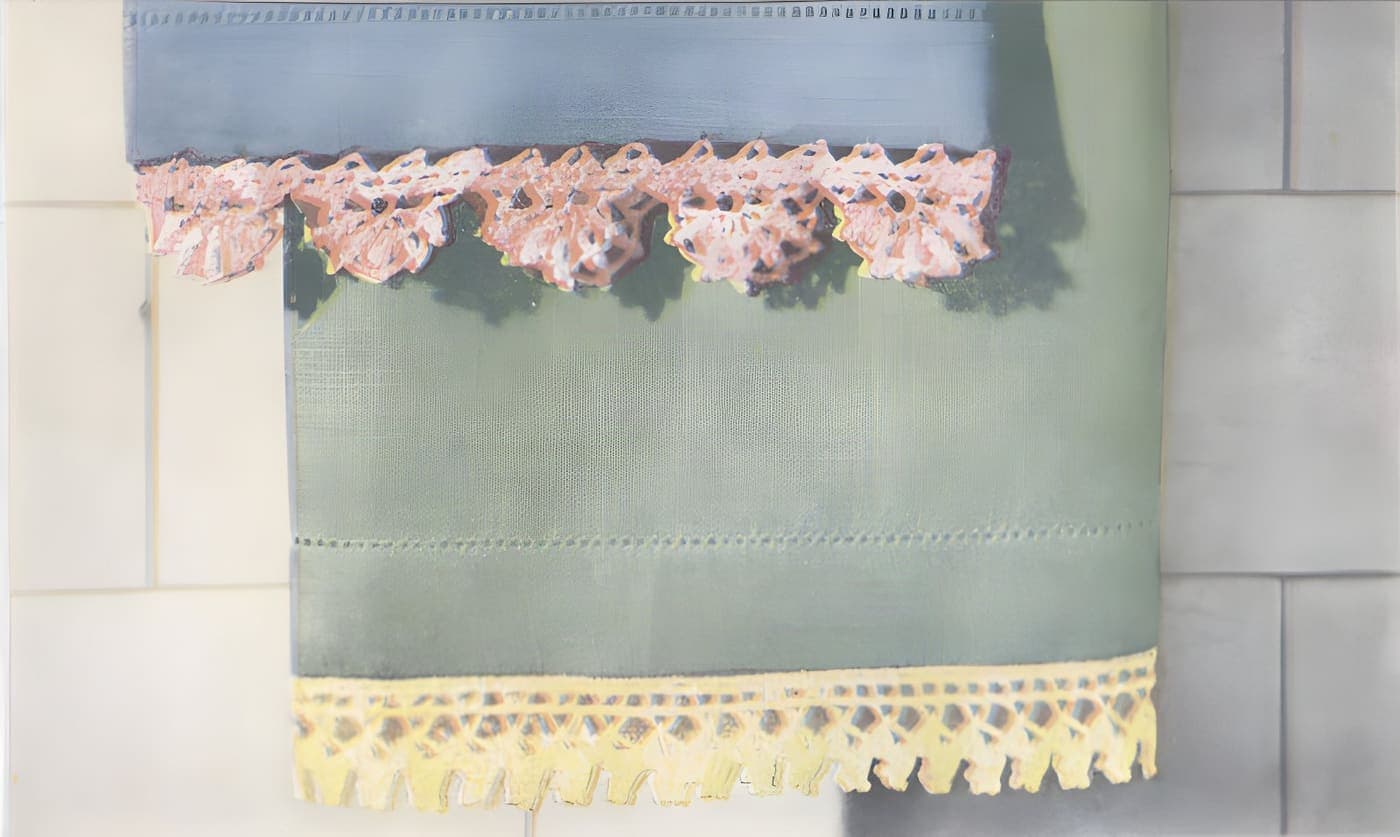
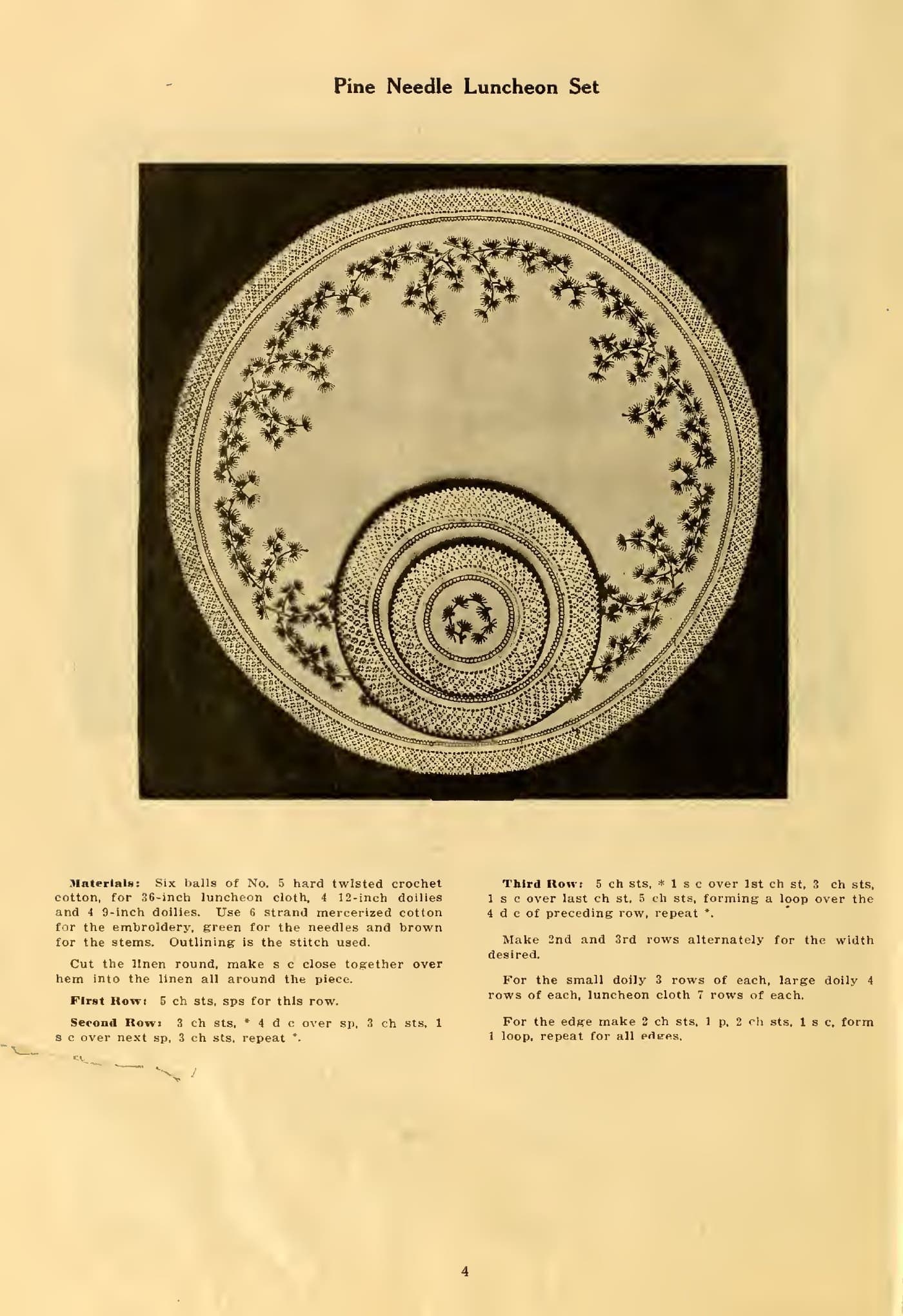
A two-row edging worked onto a round of linen: a block of four double crochet framed by chain-3 and a single crochet, answered by a row that throws a chain-5 loop over each block, the two rows alternating for the width wanted and finished with a picot loop.
By the crochetpatterns.io editorial team · Updated · Editorial policy · pattern testing in progress
| Detail | Value |
|---|---|
| Skill level | Easy |
| Yarn weight | Lace (#0) |
| Yardage | the book gives only the thread number. (as printed; yardage not given) |
| Hook | 1.75 mm |
| Gauge | No gauge printed. |
| Finished size | The linen rounds are printed as a 36-inch (about 91 cm) luncheon cloth, 12-inch (about 30 cm) doilies and 9-inch (about 23 cm) doilies. The width of the edge itself is not printed — it is set by how many times the two rows are repeated. |
| Time | about 2 hours |
Materials
- Size 5 mercerized cotton crochet thread — approximate; the book prints only “No. 5 mercerized crochet cotton”, with no brand
- Steel crochet hook
- Tapestry needle for the ends
- Six-strand embroidery cotton in green and brown for the outline embroidery
- Linen for the cloth and doilies
- Hook: Start with a 1.75 mm (US steel 4–5) hook — approximate, and ours: the book prints no hook size for this design. Change size until the work lies flat.
Yarn Kit & Substitution Options
This pattern calls for 350 yards of weight #0 yarn. Select a suggested yarn to see required skeins and estimated cost:
Caron Simply Soft · 100% Acrylic
315 yds per skein · High-yield yardage, silky no-scratch texture
2 skeins required
approx. $$10.98 total
Abbreviations (US terms)
- chain
- slip stitch
- single crochet
- double crochet
- space
- chain space
- stitch
- stitches
- skip
- puff stitch
- loop
- repeat
- row
Notes before you start
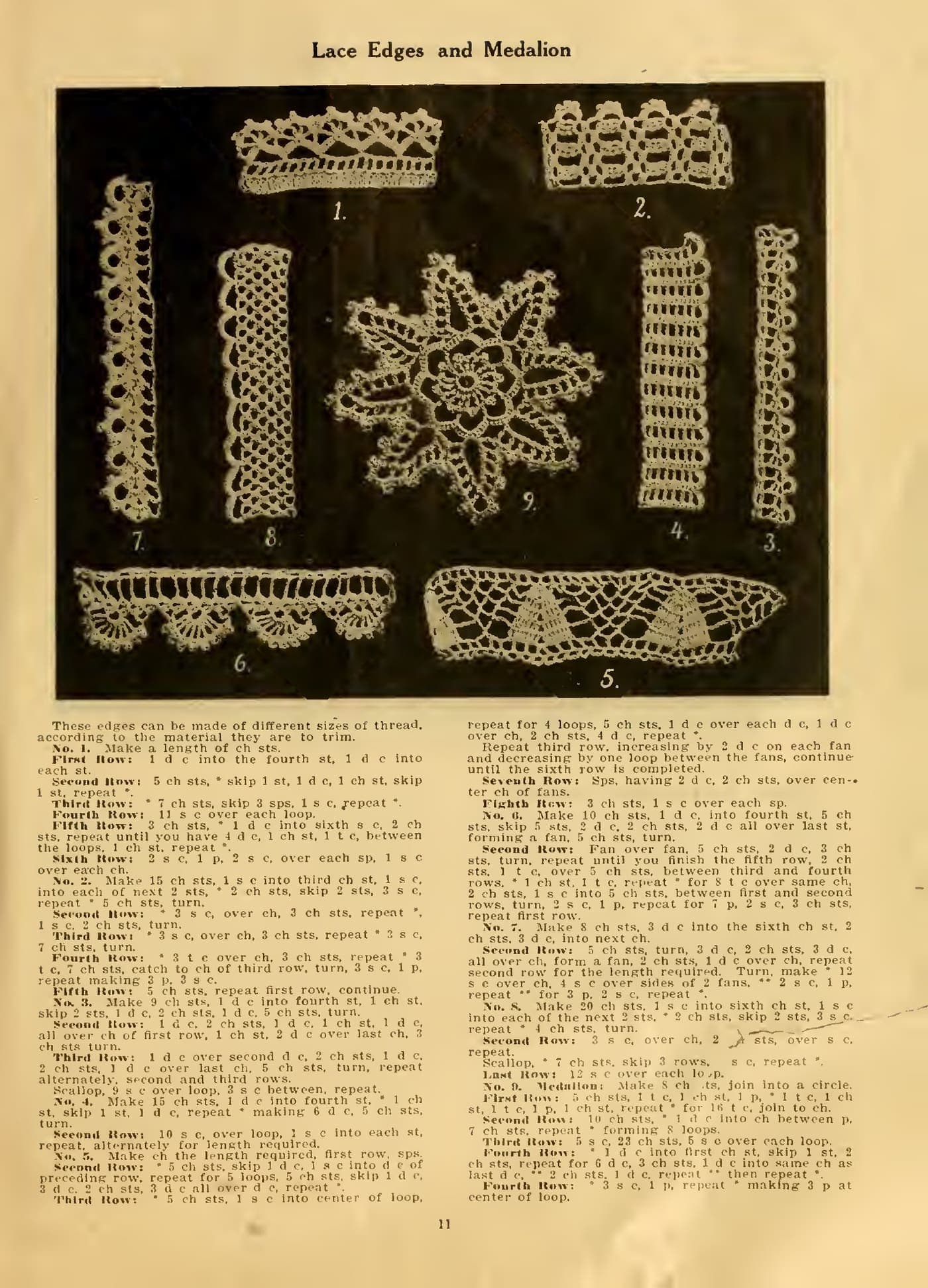
- Source: "Pine Needle Luncheon Set", The Elite Instruction Book, Pierre C. Brin, Chicago, Ill., 1916. Public domain in the USA.
- As printed — materials: Six balls of No. 5 hard twisted crochet cotton, for 36-inch luncheon cloth, 4 12-inch doilies and 4 9-inch doilies; 6 strand mercerized cotton for the embroidery, green for the needles and brown for the stems; Linen for the cloth and doilies. Gauge: Not given.
- Modernisation note: Stitches are converted from this book's own designs, not from a printed key and not from the date. The book prints NO abbreviation list anywhere: all sixteen printed pages are design pages, and none of them carries a key, a glossary or a stitch definition, so the ladder had to be read off the directions. The book names only three heights — s c, d c and t c — and nothing taller than t c appears in it. s c is the modern US single crochet. d c is the modern US double crochet: nine designs open a row “1 d c into the fourth st” (book pages 9, 10 and 11), the modern convention of a 3-chain turning chain worked into the 4th chain, and the filet foundation on book page 7 chains 42 for “1 d c into the 8th st, 11 sp”, three chains a mesh, which is the double-crochet filet formula. t c is the modern US treble, the next step up, and is written tr below; the book opens it with 5 chains rather than the modern 4, which is its own generosity and not a taller stitch — the Yoke for Corset Cover No. 2 joins its opening “8 ch sts” at the 5th chain, and the book has no fourth name to give the step above t c, while its graduated shell “1 s c, 1 d c, 6 t c, 1 d c, 1 s c” (book page 10, No. 5) climbs single to double to t c with no rung between. Note that Clark's 1923 book in this same collection abbreviates “D c” for a stitch that is the modern half double — the identical-looking abbreviation means a different stitch there, which is why this book's ladder was checked against its own pages rather than carried across.
- Modernisation note: The book's wording is written in modern US form: “ch sts” = ch; “s c” = sc; “d c” = dc; “t c” = tr; “sl st” = sl st; “sps” = spaces; “p” = picot; “gr” = group; “sk” = sk. “Break thread” is written fasten off, and “catch” is written join or work into according to what the row is doing. Ordinal row names (“First Row”, “Second Row”) are written Row 1, Row 2, and the book's “repeat *” is written rep from *.
- Modernisation note: The printed paragraphs are split into one row or step per line; stitch order and counts are unchanged. Section headings are added for navigation. The OCR of this scan is rough: it prints “d c” variously as “dc”, “de”, “d ec” and “d ¢”, sets “1 s c” as “1s c”, prints “No.” as “No,” and drops whole words at the column breaks. Those quirks are kept in the excerpts and not in the rows.
- Modernisation note: The book names a thread by maker's number only (for example “No. 30 mercerized crochet cotton”), with no brand. Those numbers are read as roughly equal to the modern crochet cotton sizes of the same number — approximate only.
- Modernisation note: No hook size is printed for this design. The only hook numbers anywhere in the book are the “No. 5 steel hook” and “No. 3 steel hook” given for the Cake and Sherbet Serving Set on book page 2, which is not among these patterns, so any metric hook suggested here is ours, read across from the thread size rather than from the page.
- Modernisation note: No gauge is printed for this design — the book prints no gauge, tension or stitch count per inch anywhere. Work a sample and change hook size until the piece lies flat.
- Modernisation note: No yardage is printed for this design. The book gives ball counts for a few pieces only, and where it does they are recorded above as printed; no length in yards or metres appears anywhere in the book.
- Modernisation note: Check: Row 1 is printed in full as “5 ch sts, sps for this row.” The book never defines its space, but it is consistent across the book: a space is ch 2, sk 2, 1 dc, and an opening ch 5 is the 3 chains of the first dc plus the 2 chains of its space (see the Bread Tray and the Jewel Box, which both chain and then say “sps for this row”). No count is printed because the number of spaces is set by the size of the linen round.
- Modernisation note: Check: the picot in the finishing row is printed only as “1 p”, with no chain count, so it is left unnumbered above rather than given a count we would have to invent.
- Modernisation note: Check: the tall stitch in Row 2 is the book's d c, which is the modern US double crochet by the key finding above.
- Modernisation note: The pressing line in the finishing is ours; the book prints no finishing beyond the edge row.
Row progress: 0 of 2 done (0%)
Preparation
0 of 2 done- Cut the linen round. Work sc close together over the hem into the linen all around the piece.Mark row complete
- The pine needles are embroidered, not crocheted: outline stitch is the stitch used, green for the needles and brown for the stems.Mark row complete
Working on:
Cut the linen round. Work sc close together over the hem into the linen all around the piece.
Continue this pattern
The rest of the Pine Needle Luncheon Set Edge (1916) pattern is in the Vintage Crochet Edgings & Trims
Still to come in the full pattern:
- Edge
- Finishing row
- Finishing
Included with 618 patterns for $9 — $0.01 per pattern.
Errata
No corrections have been published for this pattern. Found a mistake? Tell us and we will log the fix here with a date.
Your notes on this pattern
Keep track of the yarn, hook and changes you used. Saved in this browser only — nobody else can see it.
Frequently asked questions
Where is the Pine Needle Luncheon Set pattern from?
It was published as "Pine Needle Luncheon Set" in The Elite Instruction Book by Pierre C. Brin, Chicago, Ill. in 1916. The publication is in the public domain in the United States; this version is transcribed and modernised by crochetpatterns.io.
What yarn or thread do I need for the Pine Needle Luncheon Set?
Size 5 crochet cotton (approximate). Not printed — the book gives only the thread number.
What hook should I use?
Start with a 1.75 mm (US steel 4–5) hook — approximate, and ours: the book prints no hook size for this design. Change size until the work lies flat. Gauge: No gauge printed.