Free preview · full pattern in the Vintage Crochet Baby & Kids' Patterns
Carrying Coat in Shell Pattern (1911): vintage crochet pattern
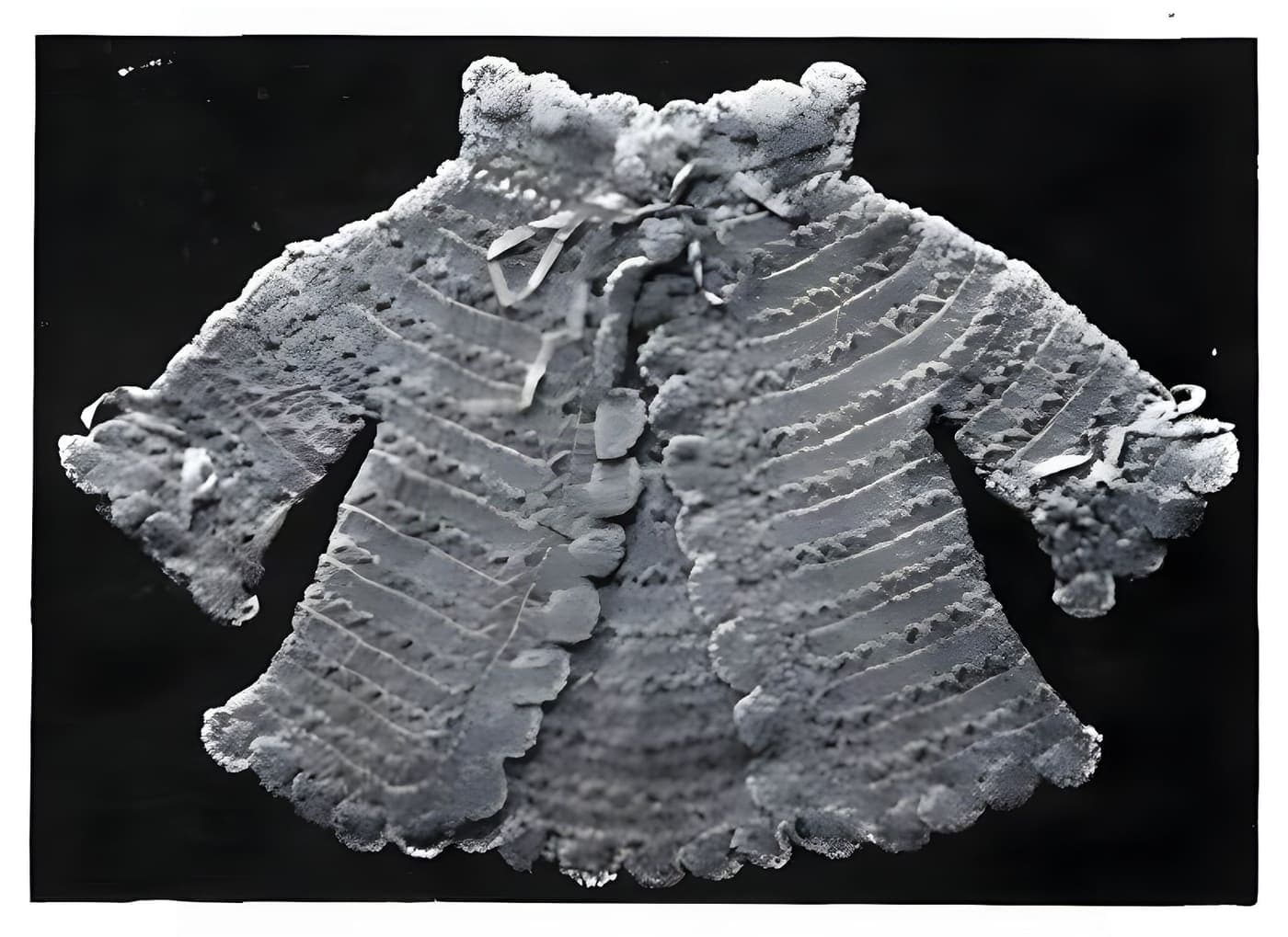
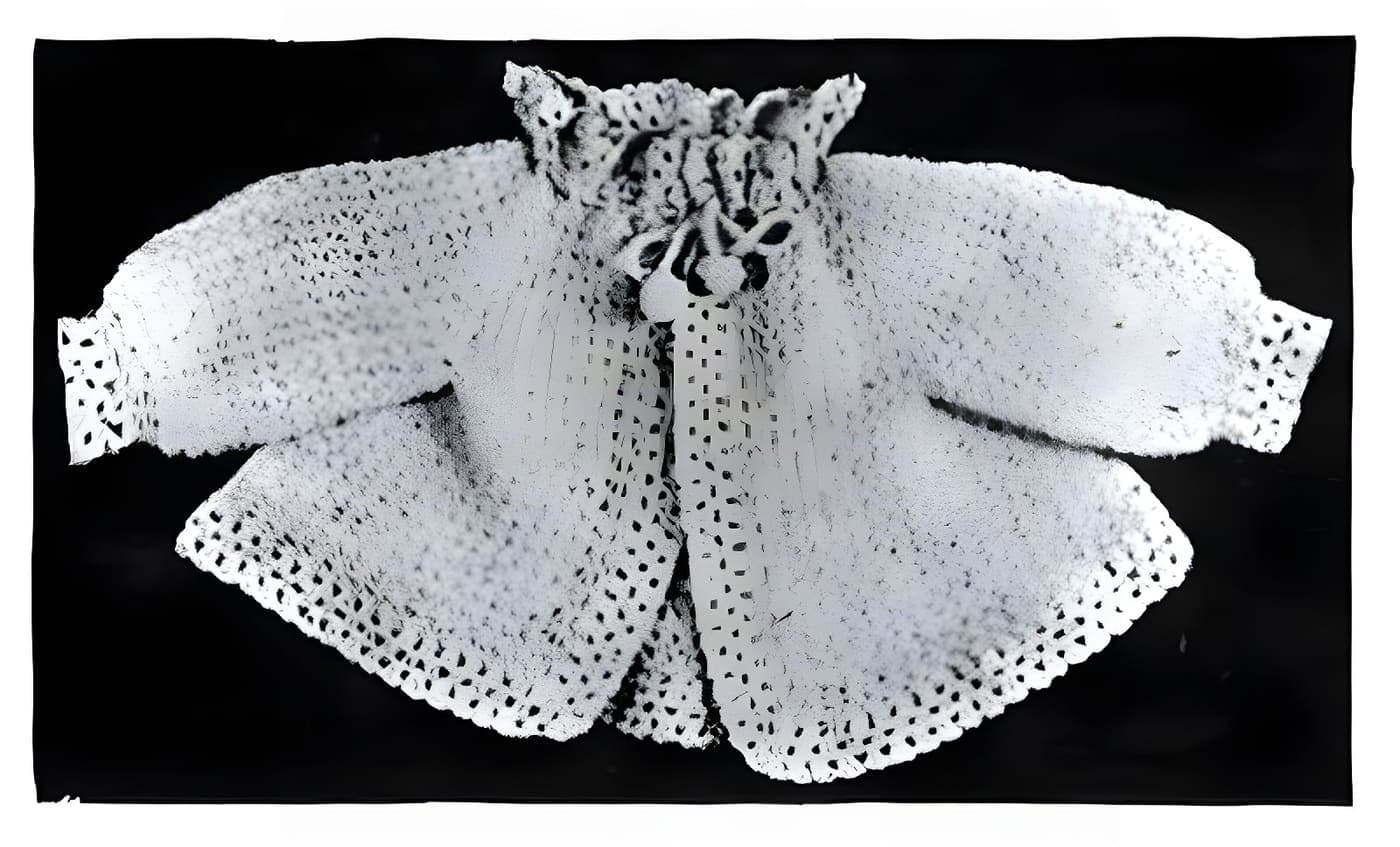
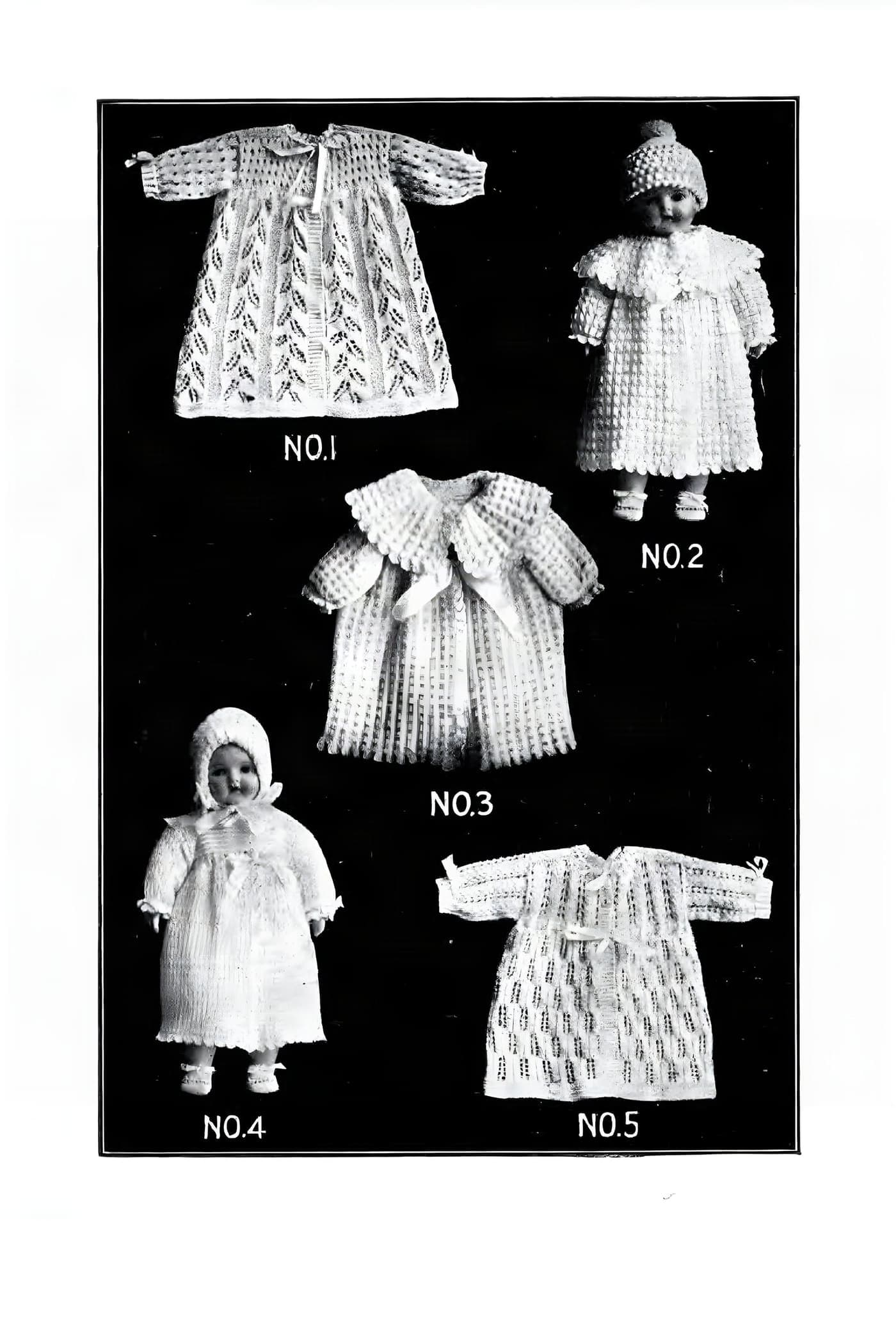
A long crocheted carrying coat: a ribbed single-crochet yoke with four increase lines that form the armholes, a skirt and sleeves of three-double-crochet shells joined by slip stitches, and a shaped shell collar that widens from three to five double crochets a group.
By the crochetpatterns.io editorial team · Updated · Editorial policy · pattern testing in progress
| Detail | Value |
|---|---|
| Skill level | Intermediate |
| Yarn weight | Super fine (#1) |
| Yardage | the book gives 4 oz of 2-ply fingering wool and 1 ball of silk; yardage is not stated. (as printed; yardage not given) |
| Hook | 3.25 mm |
| Gauge | No gauge or measurement printed. |
| Finished size | Not printed. The yoke starts with ch 72 (34 chain spaces) and is worked until it shows 12 raised ribs; the skirt is worked to the length desired, the sleeves 13 shells wide and 18 rows deep, and the collar 13 rows. |
| Time | about 7 hours |
Materials
- Super fine (CYC #1) fingering-weight wool — approximate; the original was 4 oz of 2-ply fingering wool
- Fine crochet silk or size 10 crochet cotton for the edging — the original was Carlson, Currier's crochet silk, shade 90
- Crochet hook (original: No. 10 Strathnoid) and a finer hook for the silk edging (original: No. 13)
- Tapestry needle
- Hook: Start with 3.25 mm (US D-3) for the wool and about 1.5 mm (US steel 7) for the silk edging — both approximate; no measurement or gauge is printed
Yarn Kit & Substitution Options
This pattern calls for 350 yards of weight #1 yarn. Select a suggested yarn to see required skeins and estimated cost:
Knit Picks Stroll Sock · 75% Superwash Merino, 25% Nylon
231 yds per skein · Durable stitch definition, machine washable
2 skeins required
approx. $$13.98 total
Abbreviations (US terms)
- chain
- slip stitch
- single crochet
- double crochet
- stitch
- stitches
- repeat
- skip
- chain space
- shell
- row
- back loop only
- fasten off
Notes before you start
- Source: "Carrying Coat (Crochet)" (No. 3), What to Make for Baby, Part One (Ella Allan), Mrs Ella Allan's Publications; printed by The Specialty Press Pty. Ltd., Melbourne. Public domain in the USA.
- As printed — materials: 4 oz. 2-ply fingering wool; Crochet hook, No. 10 (Strathnoid); Carlson, Currier's crochet silk, shade 90, and hook No. 13 (for the edging). Gauge: Not given.
- Modernisation note: Stitches converted by the book's own “Explanation of Crochet Stitches” page, not by name — the key is a British one, so every stitch is renamed here: chain = ch; “single crochet” (“put hook through work at stitch indicated; draw thread through work and through loop on needle at same time. This is sometimes called Slip Stitch.”) = modern slip stitch (sl st); “double crochet” (d c: insert the hook, thread over and draw through making 2 loops, thread over and draw through both) = modern single crochet (sc); “treble” (tr: thread over, insert, draw through making 3 loops, thread over through 2, thread over through the remaining 2) = modern double crochet (dc); “double treble” (thread over twice) = modern treble (tr); “long treble” (thread over three times) = modern double treble (dtr). The heights are confirmed by the book's own turning chains — it turns a d c row with 2 ch and a treble row with 3 ch — so nothing here rests on the names alone.
- Modernisation note: The book's abbreviations are written in modern US form: ch = ch, d c = sc, tr = dc, st(s) = st(s); “miss” = sk; “wool over” / “thread over” = yo; “needle” (used for the crochet hook as well as the knitting needle) = hook; “hole” (the space under a chain) = ch-sp or sp; “break off” / “fasten off” = FO; “repeat” = rep. Ordinal names (“1st Row”, “2nd Round”) are written Row 1, Rnd 1; where the book calls a circuit of a round piece a “row” its own word is kept. The book's words “shell”, “group”, “cluster”, “tuft”, “star”, “eye” and “picot” are kept as printed, each with the book's own definition given at first use.
- Modernisation note: Long printed paragraphs are split into one row, round or step per line; stitch order and counts are unchanged. Section headings added for navigation.
- Modernisation note: Hooks are printed only as Strathnoid numbers (No. 10, 12, 13, 14) — a proprietary sizing with no diameters printed — or as “fine hook”, “fine steel crochet hook” or “large hook”. No exact metric size can be read from the book, so the suggested modern hook is an approximate starting point chosen for the yarn and tied to any printed measurement.
- Modernisation note: No stitch gauge is printed anywhere in the book. Work a swatch and match any printed measurement (repeated in the modern gauge line) before starting.
- Modernisation note: The yarns are 1911 Australian trade names with no exact modern equivalent, and the book prints no yardage and no ball or skein weights. The CYC weights given are approximations only, to be matched by gauge or measurement rather than by weight: 2-ply fingering as super fine (CYC #1); 3-ply and 4-ply fingering, 4-ply “Lady Betty” and Andalusian wool as fine (CYC #2); “Ivorine” wool as a fine baby wool (CYC #2, approximate — the book gives no ply for it); crochet silk and “jumper silk” as a fine thread rather than a yarn. “Ivorine” and “Lady Betty” are brand names, not colours or fibre descriptions.
- Modernisation note: No finished measurements, ages or sizes are printed for this design; the figures given are the book's own stitch and row counts and any lengths it prints.
- Modernisation note: Check: no year is printed in the book. The title page gives only the title, “57 designs in knitting and crochet”, “Part One”, the author and the Melbourne printer; the cover instead says “55 designs in knitting or crochet”. The year 1911 is the date recorded for this scan, which notes that it is approximate.
- Modernisation note: The book's photographs are black and white and this design's colour is not printed, so the colour given is read from the photograph only.
- Modernisation note: The book's “shell” (3 dc in one place, separated by ch 1 and anchored with a sl st) is kept as printed.
- Modernisation note: The scan reads “these increases from armholes”; the sense is “form armholes”, and it is written so.
- Modernisation note: Check: the yoke row is to be repeated “23 times” and should then show 12 raised ribs; the two counts only agree if the repeats are counted as the book counts its ribs (one rib per two rows). Work to 12 ribs.
- Modernisation note: Check: the collar's first row is printed with 2 dc a group and the second with 3; the book gives no separate count of groups for the collar.
- Modernisation note: Metric conversions added.
- Modernisation note: Finishing line (weaving in ends) added.
Row progress: 0 of 7 done (0%)
Yoke
0 of 7 done- Ch 72, turn, and make 1 dc in the 6th ch from the hook, then ch 1, 1 dc in each alternate ch st — 34 ch-sps.Mark row complete
- Turn with ch 2, and make 1 sc in each dc and each ch-sp to end.Mark row complete
- Next row: Turn with ch 2, and make 1 sc in each sc of the previous row, taking up the back thread only, except in the 16th, 22nd, 48th and 54th sts, in which make 3 sc taken through both top threads; these increases form the armholes.Mark row complete
- Rep this row 23 times, making 3 sc in the centre of each 3 sc of the previous row. You will have 12 raised ribs.Mark row complete
- Next row: Work as usual to the centre of the 1st increase, where make 1 sc instead of 3, ch 4, pass over to the centre of the next increase, and work across the back, ch 4, pass over to the last increase, and work to end.Mark row complete
- Next row: Ch 5 to turn, then 1 dc, ch 1, in each alternate st to end.Mark row complete
- Next row: Turn with ch 2, and make 1 sc in each dc and each ch-sp to end.Mark row complete
Working on:
Ch 72, turn, and make 1 dc in the 6th ch from the hook, then ch 1, 1 dc in each alternate ch st — 34 ch-sps.
Continue this pattern
The rest of the Carrying Coat in Shell Pattern (1911) pattern is in the Vintage Crochet Baby & Kids' Patterns
Still to come in the full pattern:
- Skirt Pattern
- Sleeves
- Fronts and Neck
- Collar
- Silk Edging
- Finishing
Included with 133 patterns for $12 — $0.09 per pattern.
Errata
No corrections have been published for this pattern. Found a mistake? Tell us and we will log the fix here with a date.
Your notes on this pattern
Keep track of the yarn, hook and changes you used. Saved in this browser only — nobody else can see it.
Frequently asked questions
Where is the Carrying Coat (Crochet) pattern from?
It was published as "Carrying Coat (Crochet)" in What to Make for Baby, Part One (Ella Allan) by Mrs Ella Allan's Publications; printed by The Specialty Press Pty. Ltd., Melbourne. The publication is in the public domain in the United States; this version is transcribed and modernised by crochetpatterns.io.
What yarn or thread do I need for the Carrying Coat (Crochet)?
Size 10 crochet cotton or fine crochet silk for the edging — approximate; the book gives only a shade number. Not printed — the book gives 4 oz of 2-ply fingering wool and 1 ball of silk; yardage is not stated.
What hook should I use?
Start with 3.25 mm (US D-3) for the wool and about 1.5 mm (US steel 7) for the silk edging — both approximate; no measurement or gauge is printed Gauge: No gauge or measurement printed.