Free preview · full pattern in the Vintage Crochet Fashion
Ladies' Filet Tuxedo Sweater (1920): vintage crochet pattern
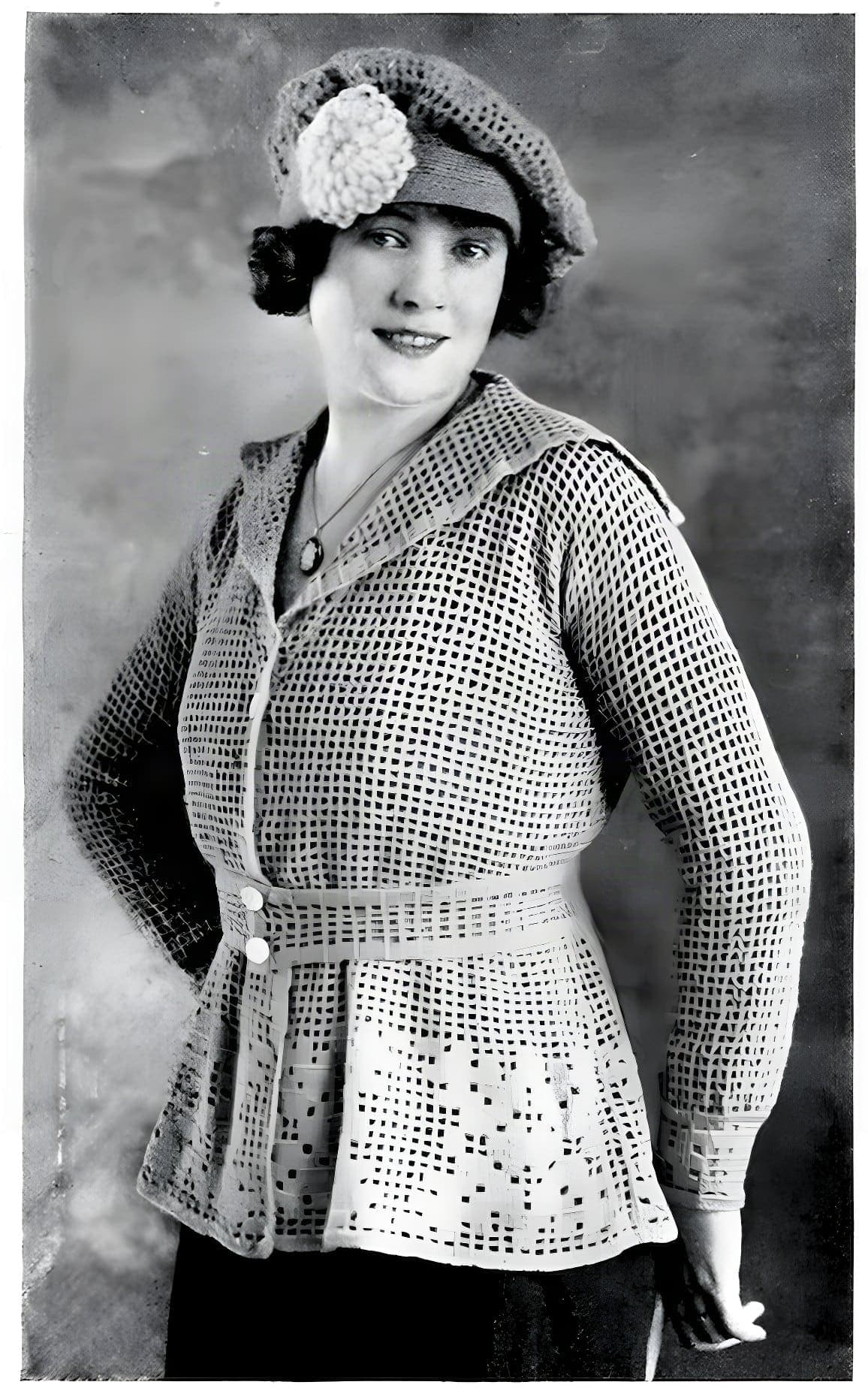
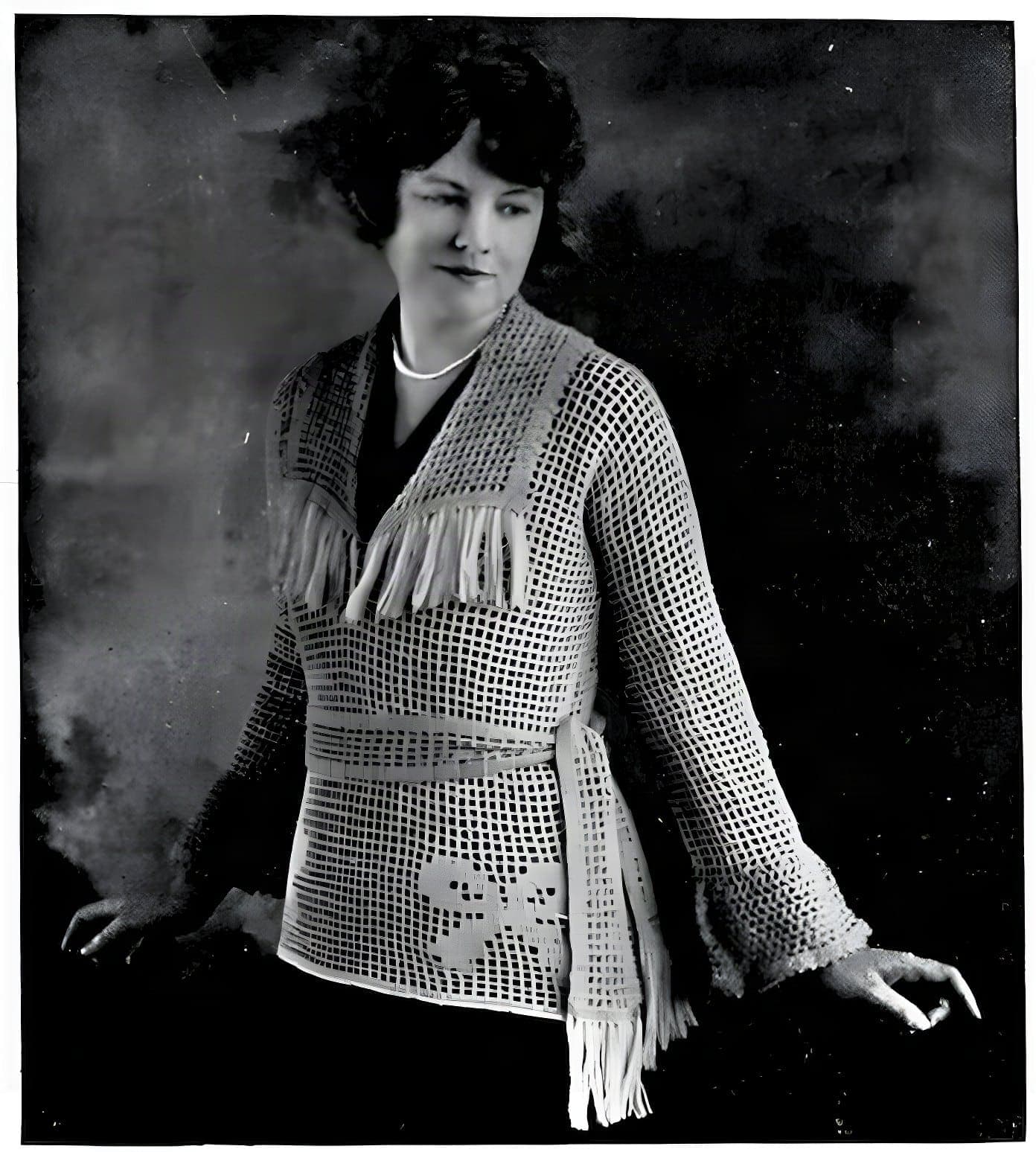
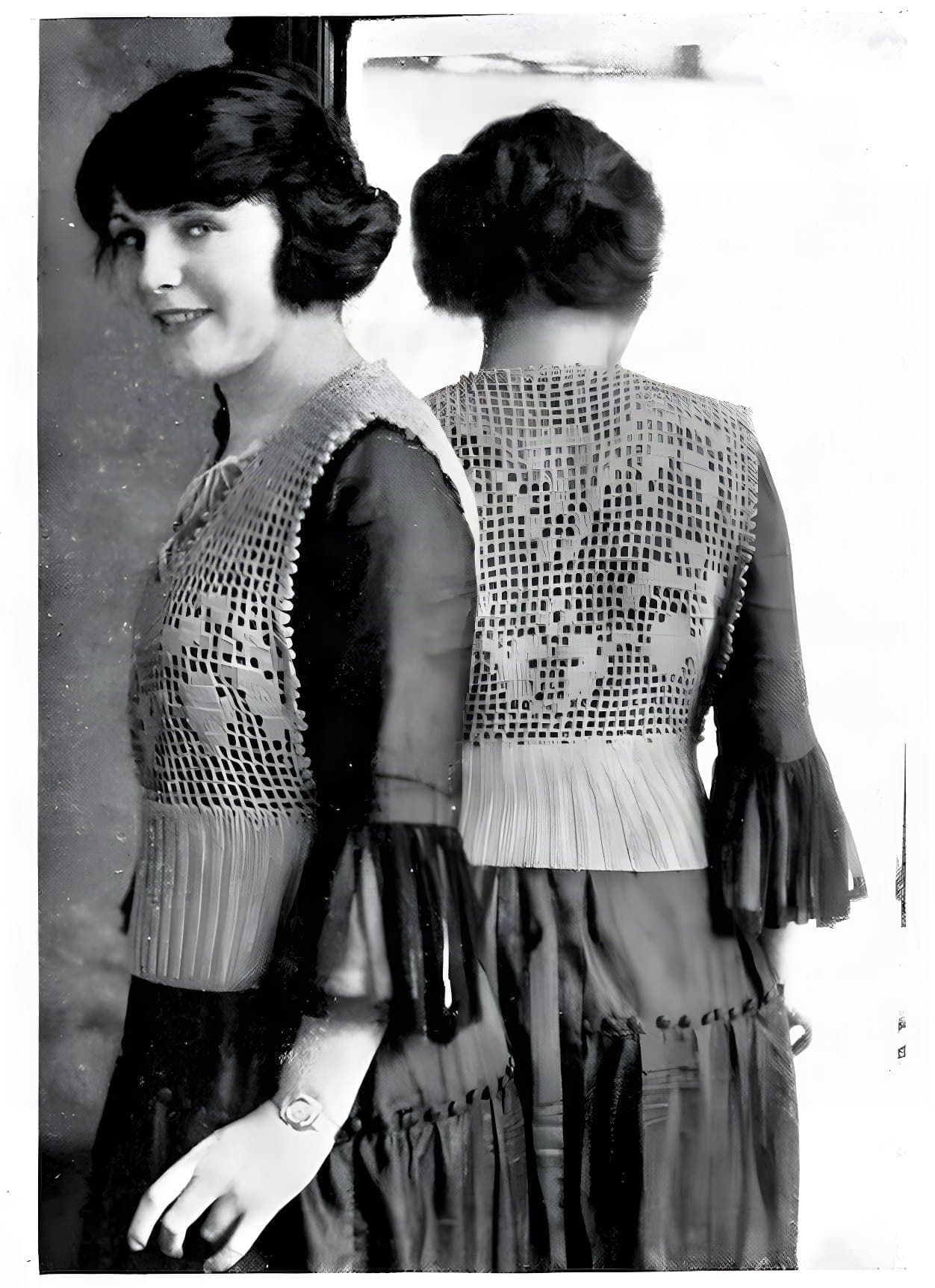
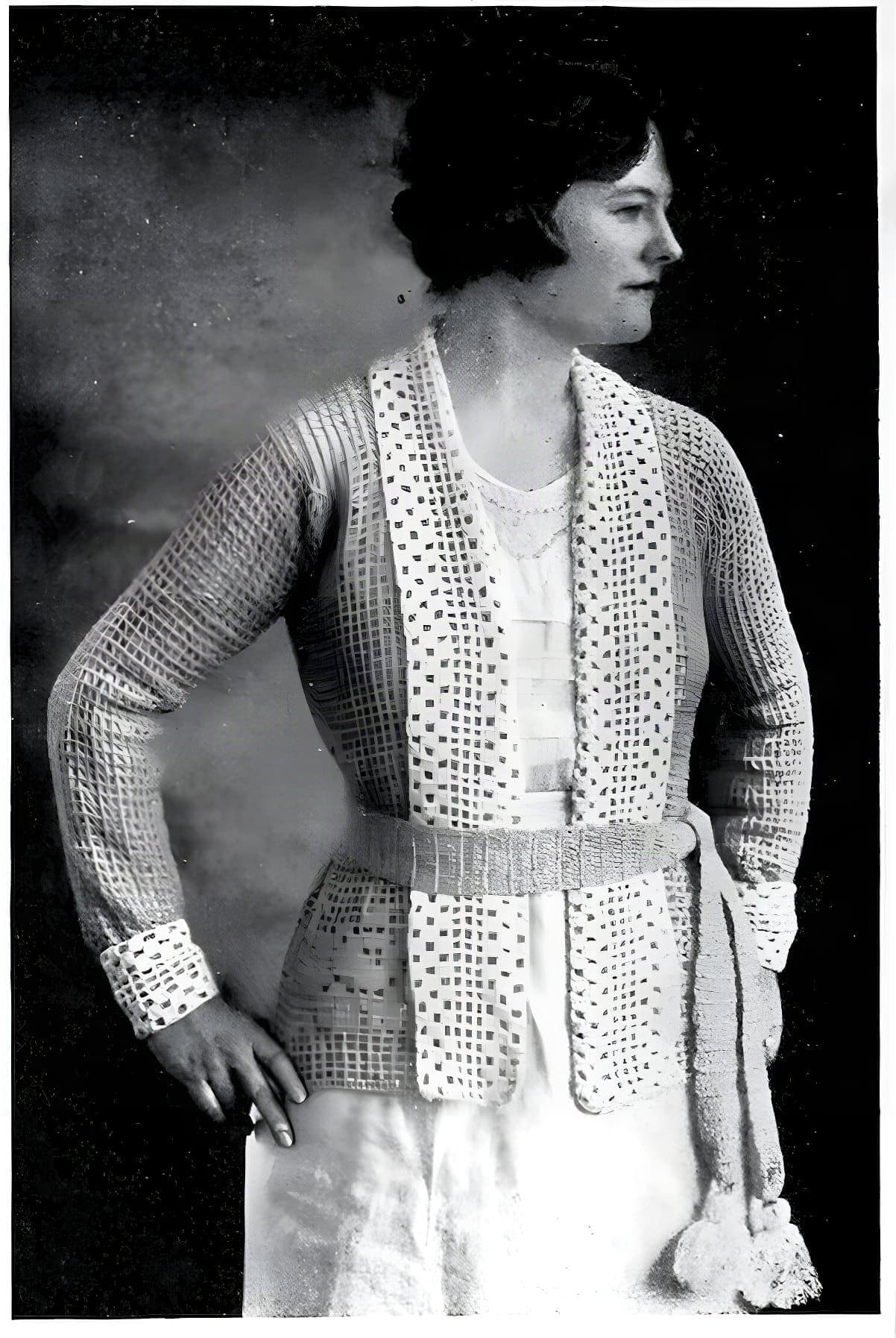
An open-front tuxedo jacket in Shetland floss filet crochet with a charted rose border (two Diagrams No. 112), kimono sleeves, block-bordered fronts, a separate block-and-mesh band, dc cuffs in a second color, and a dc sash with tassels. Originally published as "Ladies' Filet Tuxedo Sweater" in Lion Yarn Book: Describing Latest Creations in Worsted Work by The Lion.
By the crochetpatterns.io editorial team · Updated · Editorial policy · pattern testing in progress
| Detail | Value |
|---|---|
| Skill level | Intermediate |
| Yarn weight | Fine (#2) |
| Yardage | the book gives 10 skeins of Lion Brand Shetland Floss; skein weight and yardage are not stated. (as printed; yardage not given) |
| Hook | 3.5 mm |
| Gauge | No stitch gauge printed. Printed checks: back 19 in (48 cm) to the sleeves; sleeve 5 in (12.5 cm). |
| Finished size | Ladies' size (bust not printed). Printed lengths: back 19 in (48 cm) to the sleeves; sleeves 5 in (12.5 cm) deep on the back. |
| Time | about 6 hours |
Materials
- Fine (CYC #2) wool yarn — the original was Lion Brand Shetland Floss, 10 skeins; the cuffs use a "colored" floss and white
- Crochet hook (original: No. 2 or No. 3)
- Tapestry needle
- Hook: Start with 3.5 mm (US E-4) — approximate; change size so the back reaches 19 in (48 cm) to the sleeves at a width that fits (no stitch gauge is printed)
Yarn Kit & Substitution Options
This pattern calls for 350 yards of weight #2 yarn. Select a suggested yarn to see required skeins and estimated cost:
Lion Brand Coboo · 50% Cotton, 50% Bamboo
232 yds per skein · Silky breathable drape, lovely stitch shine
2 skeins required
approx. $$12.98 total
Abbreviations (US terms)
- chain
- single crochet
- double crochet
- stitch
- stitches
- space
- repeat
- row
Notes before you start
- Source: "Ladies' Filet Tuxedo Sweater" (Diagram No. 112), Lion Yarn Book: Describing Latest Creations in Worsted Work, The Lion Yarn Co., 1920. Public domain in the USA.
- As printed — materials: 10 Skeins LION BRAND Shetland Floss; 1 Crochet Hook, No. 2 or No. 3.. Gauge: Not given.
- Modernisation note: The book prints no crochet lesson and no definitions of its basic stitches; it defines only star stitch (with the Auto Scarf) and a picot edge (with the Filet and Knitted Sweater). Its s. c. and d. c. are read as American terms, which are the same as modern US sc and dc, for this reason: the filet designs build open meshes out of d. c. worked on a chain ("Ch. 94 sts. and work 92 d. c. on ch.", then "46M"). Only a tall stitch (modern US dc) forms filet meshes; a British-style "double crochet" (= US sc) could not. The book is an American (New York) publication. So no stitch changes height; s. c. = sc, d. c. = dc, ch. = ch, slip st. = sl st.
- Modernisation note: M (mesh) and B (block) are listed as abbreviations but not defined. The printed counts show that each mesh takes 2 stitches of the row below (92 dc give 46 meshes; 104 dc give 52; a 100-ch sleeve gives 48 meshes), so a mesh is read as dc, ch 1, sk 1 (a 1-chain filet mesh) and a block as the same width filled solid (dc in the ch-1 space instead of the chain). Check: this reading is inferred from the counts, not printed; if your filet is narrower than the printed measurements, go up a hook size rather than changing the counts.
- Modernisation note: Period abbreviations and wording modernised: s. c., d. c., ch., st./sts. written as sc, dc, ch, st/sts; M and B written as mesh and block; "skip" as sk; "yarn over" as yo; "fasten wool on" and "fasten yarn at" as join yarn; "fasten back in" as sl st in; "break off" as fasten off; "crochet needle" as hook; "repeat from star" as rep from *; "sts." after a chain count dropped ("Ch. 94 sts." written as "Ch 94"); ordinal row names ("Second Row") written as Row 2 (or Rnd 2 when worked in the round).
- Modernisation note: Long printed paragraphs split into one row, round or step per line; stitch order and counts unchanged. Section headings added for navigation.
- Modernisation note: The filet charts ("Diagram No. …") are printed as pictures and are not transcribed square by square here; rows that say "follow diagram" are kept as printed, and the chart image is listed with this pattern's images.
- Modernisation note: Hook numbers (No. 1–5, bone or amber) are 1920 makers' numbers; the book prints no diameters, so no exact metric size can be read from it. The suggested modern hook is an approximate starting point for the yarn weight, to be adjusted to the printed measurements.
- Modernisation note: No stitch gauge is printed anywhere in the book; work a swatch and match the printed measurements (given in the modern gauge line) before starting.
- Modernisation note: Lion Brand yarns of 1920 have no exact modern equivalent. The modern CYC weights are approximations only: Lion Brand Shetland Floss (a soft, lofty yarn) as fine (CYC #2); Lion Brand Knitting Yarn / Knitting Worsted as medium (CYC #4) — the book's own advertisement page lists Lion knitting worsted in "4 oz. hanks"; 3-fold (3-ply) Saxony as super fine (CYC #1); Pompadour Wool as fine (CYC #2); Lion Brand Crochet Wool (used doubled in the sacque) as fine (CYC #2), so the doubled strand works roughly as light (CYC #3). Yardage is never printed — the book gives skeins, hanks or balls only.
- Modernisation note: Size is given only as "Ladies'", "Misses'" or an age; vintage sizing and ease differ from today's — compare the printed lengths with a garment that fits before starting.
- Modernisation note: The "other front" step and the finishing step are added; the book does not state them.
- Modernisation note: Check: the front counts agree — 68 meshes = 48 sleeve meshes + 20 front meshes, and the front grows to "4B, 20M" (24) as printed.
- Modernisation note: Check: the materials list a single floss, but the cuffs call for "colored floss" and white. Left as printed.
- Modernisation note: Metric conversions added.
Row progress: 0 of 6 done (0%)
Back
0 of 6 done- Foundation: Ch 107, work 104 dc on the ch, turn.Mark row complete
- Row 2: 52 meshes on the dc.Mark row complete
- Rows 3–6: 4 more rows of 52 meshes.Mark row complete
- Then follow Diagram No. 112.Mark row complete
- Now work all rows of meshes until the back measures 19 in (48 cm).Mark row complete
- Add a ch of 100 at each end for sleeves; work 48 meshes on each ch, having 148 meshes in the row; work for 5 in (12.5 cm) more. This finishes the back.Mark row complete
Working on:
Foundation: Ch 107, work 104 dc on the ch, turn.
Continue this pattern
The rest of the Ladies' Filet Tuxedo Sweater (1920) pattern is in the Vintage Crochet Fashion
Still to come in the full pattern:
- Fronts
- Band
- Cuffs
- Sash
- Finishing
Included with 71 patterns for $15 — $0.21 per pattern.
Errata
No corrections have been published for this pattern. Found a mistake? Tell us and we will log the fix here with a date.
Your notes on this pattern
Keep track of the yarn, hook and changes you used. Saved in this browser only — nobody else can see it.
Frequently asked questions
Where is the Ladies' Filet Tuxedo Sweater pattern from?
It was published as "Ladies' Filet Tuxedo Sweater" in Lion Yarn Book: Describing Latest Creations in Worsted Work by The Lion Yarn Co. in 1920. The publication is in the public domain in the United States; this version is transcribed and modernised by crochetpatterns.io.
What yarn or thread do I need for the Ladies' Filet Tuxedo Sweater?
fine (#2) yarn. Not printed — the book gives 10 skeins of Lion Brand Shetland Floss; skein weight and yardage are not stated.
What hook should I use?
Start with 3.5 mm (US E-4) — approximate; change size so the back reaches 19 in (48 cm) to the sleeves at a width that fits (no stitch gauge is printed) Gauge: No stitch gauge printed. Printed checks: back 19 in (48 cm) to the sleeves; sleeve 5 in (12.5 cm).